Are you intelligent?
Everyone has theirdefinition of intelligence, but what do psychologists say? How do they measure intelligence? The answer isn’t so simple. Let’s touch on the basics of intelligence, how it’s been defined in recent years, and where the theories of intelligence are moving.
What Is Intelligence?Can Intelligence Be Measured? IQ Tests And IntelligenceFluid Vs. Crystallized IntelligencePractical Intelligence and the Triarchic TheoryGardener’s Nine Types of Intelligence
What Is Intelligence?
Can Intelligence Be Measured? IQ Tests And Intelligence
Fluid Vs. Crystallized Intelligence
Practical Intelligence and the Triarchic Theory
Gardener’s Nine Types of Intelligence
The two definitions of intelligence are the root of the controversies regarding measuring and identifying intelligence. The first definition is: “Intelligence is the ability to acquire and apply knowledge and skills.” The other definition is more complex: “Intelligence is the collection of information of military or political value.”
The second definition infers that intelligence is a measure of potential success throughout a community. This use of intelligence is what led psychologists to develop the IQ test.
In the early 1900s, French psychologist Alfred Binet helped to develop the first type of intelligence quotient tests, orIQ tests. The French government wanted the test to determine which children were more likely to succeed in school and which children needed more help.

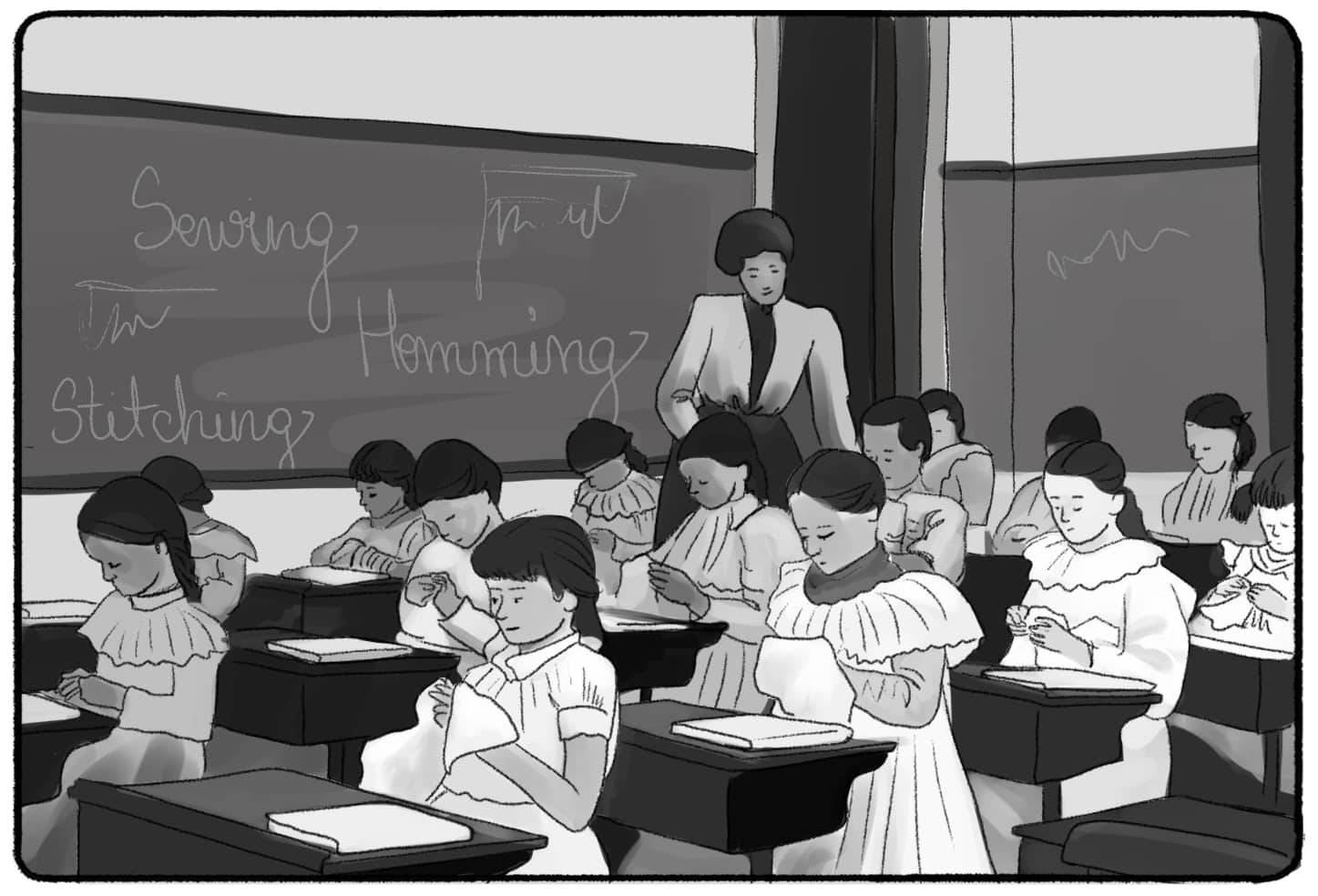
Binet’s original test measured children’s “mental age” based on the average age and skills of a group of students. He admitted that the test had limits and that a single number was insufficient to depict all of the factors that influence intelligence accurately.
Still, the test was adapted to American schools and is still used to measure intelligence today. High IQ is still associated with overall job performance and life “success.” IQ can change throughout a person’s lifetime. While decreasing a person’s IQ is very easy, science is still looking for ways to “increase” a person’s IQ points.
Controversy with IQ Tests: Intelligence and Speed
Unfortunately, even through many revisions of the standard IQ tests, there are still flaws in the test design. Let’s look at one for right now.
Intelligence has a lot to do with “speed.” If I give you a complex problem on an IQ test, you might need a few minutes or a month to solve it. In both cases, you have the ability to solve the problem, but the person who can solve the problem more quickly will end up with a higher IQ score.
But what if you have learned how to solve the test before? The IQ test considers your age, but other factors (including your education) aren’t necessarily considered. It’san important part of the “formula” that determines your final IQ score.Remember, in both cases, the person learned how to solve the problem eventually, and when asked to solve the problem again, they could probably increase their speed. Does the IQ test accurately show how often people have had to solve related problems before the IQ test was administered?
These questions have led people to explore differenttypesof intelligence. How can we recognize people who take a little longer to learn something but still have the ability to do so? How do we categorize people who just need to pull on past experiences to solve problems and repeat learned facts?
He theorized that there are two types of intelligence: fluid and crystallized.
Fluid intelligence is the ability to gather, store, and organize facts. Crystallized intelligence is factual knowledge. People can gain crystallized intelligence as they memorize new facts and are exposed to more knowledge. Fluid intelligence, on the other hand, is the ability to learn - and it decreases with age. Both types of intelligence, however, give you the ability to succeed.
Fun facts about animals or the ability to solve a logic puzzle may not help you when you’re trying to read a map or network, but these skillscanhelp you succeed in certain situations. That’s what the Triarchic Theory aims to recognize.
They separate intelligence into three categories.
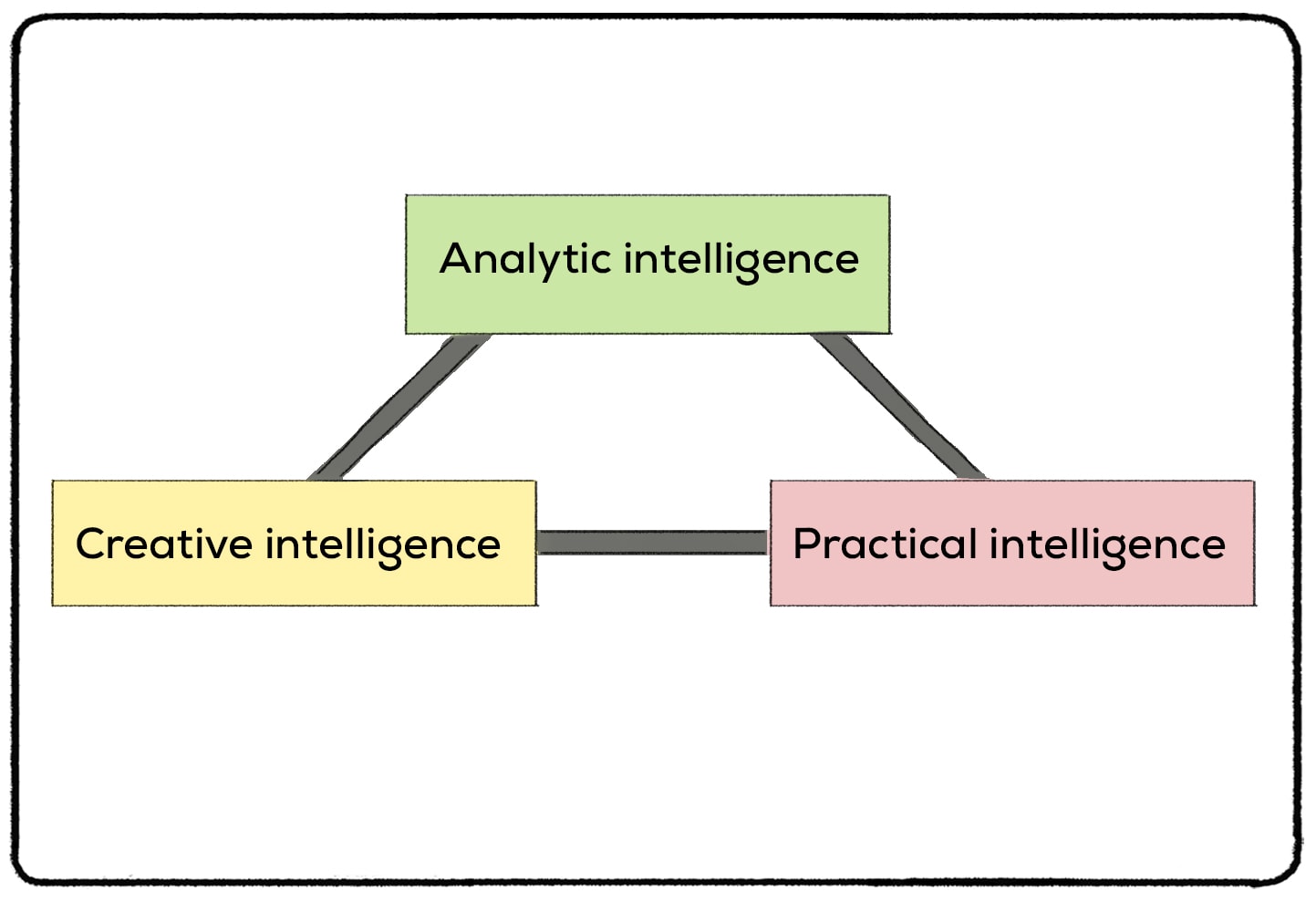
Analytical Intelligenceis the type of intelligence we have been discussing. It is the brain’s ability to interpret and use that information to solve problems. This type of knowledge is required to gain a high IQ score, but the Triarchic Theory argues that there is more to intelligence than just solving a math problem. A lot of people call this type of intelligence “book smarts.”
Practical Intelligenceis “an experience-based accumulation of skills and explicit knowledge as well as the ability to apply that knowledge to solve everyday problems.” This is the type of intelligence that you need to solve the problems of the world around you. To gain practical intelligence, you need to know the area, culture, history, the list goes on and on.
Math won’t help you solve a dispute between two neighbors or settle a debate on how to solve the city’s traffic problems. These are both great examples of practical intelligence.
This type of intelligence is highly present in great leaders. Robert Sternberg saidthe definition of practical intelligence is to find the best fit between your personality strengths and the environment.
Creative Intelligenceis the last type of intelligence in the Triarchic Theory. It describes the ability to adapt your knowledge and gather relevant knowledge to help you adapt to new situations. While practical intelligence is often called “street smarts,” I would argue that this type of intelligence is more suited to be called “street smarts.” If you are dropped in the middle of an unknown street in an unknown culture, you’ll need creative intelligence to get where you need to go and adapt to the new situation.
Does this cover all types of intelligence? Not according to the last theory we are going to cover. We’ll wrap this video up with information about the nine types of intelligence.
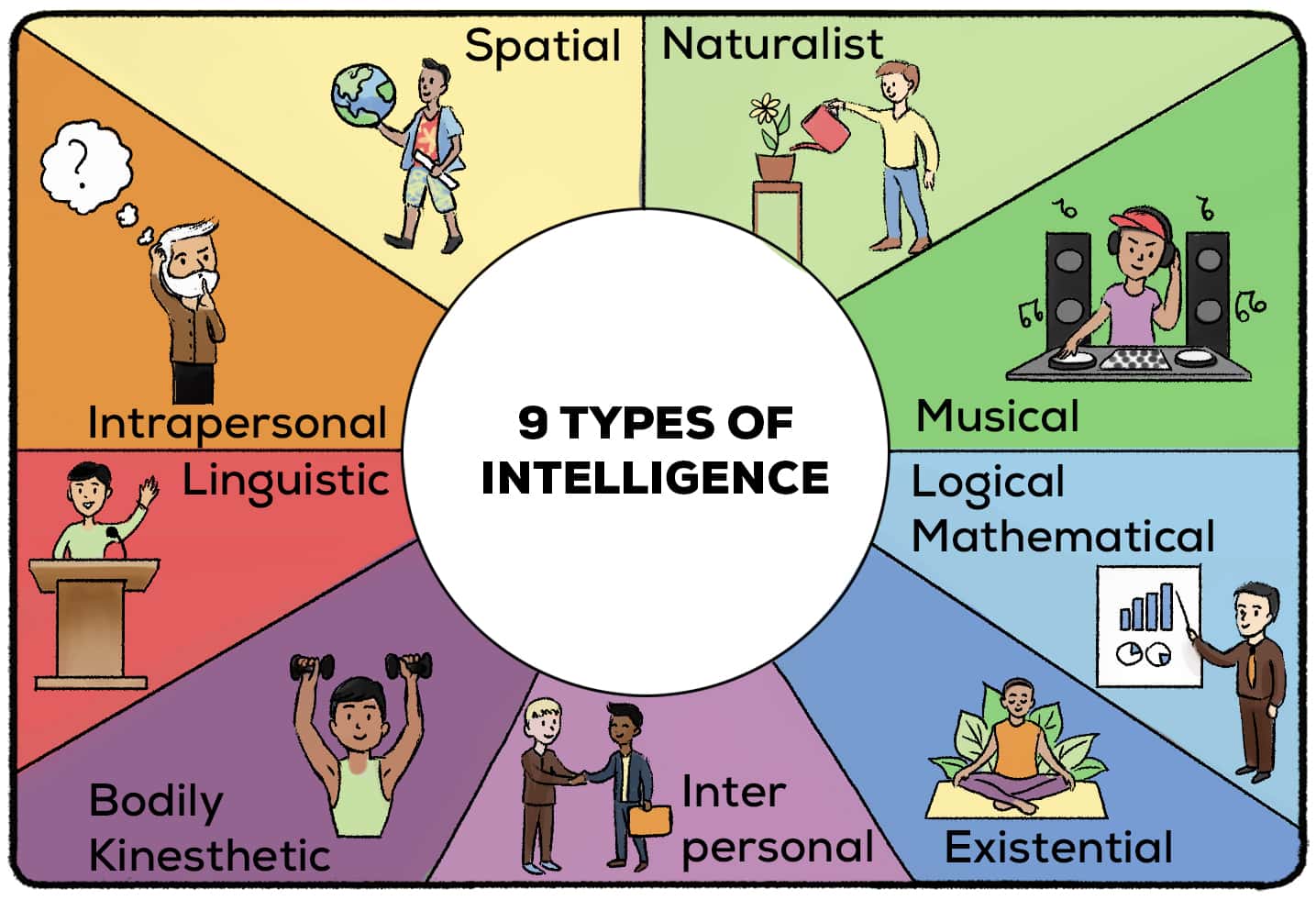
You probably thought this would be a video about the different types of intelligence: musical, kinesthetic, linguistic…right?
In his 1983 book, Frames of Mind: The Theory of Multiple Intelligences, he explained seven different types of intelligence.Over the years, he’s added two other types of intelligence. While this theory is entirely separate from Kolb’s theories about different learning styles, we can connect the two and explore how people with different types of intelligence learn.
Gardener’s nine types of intelligence include:
Controversy With the Nine Types of Intelligence
The nine types of intelligence rocked the world of educational psychology. In recent years, this theory has been disputed. Jordan Peterson, arguably one of the most famous psychologists in the world today, calls the nine types of intelligence theory “rubbish.” He argues that the the nine types of “intelligence” are just nine types of talents.
These critiques and arguments are still in development. It will be interesting to see where the world of educational psychology and measuring intelligence moves within the next few decades. Keep an eye out for new developments, and remember - even if you never scored high on an IQ test, there’s still a good chance that you hold some type of intelligence that will help you succeed.
Related posts:Free Online IQ Test (No Email + 5 Mins + Instant Results)Wisdom vs Intelligence (Differences + Similarities)Cerebral Aqueduct (Location and Function)Ventricles of the Brain (Functions)Howard Gardner’s 9 Types of Intelligence (Examples)
Related posts:
Reference this article:Practical Psychology. (2019, February).What is Intelligence? (9 Types Controversy + Examples).Retrieved from https://practicalpie.com/what-is-intelligence/.Practical Psychology. (2019, February). What is Intelligence? (9 Types Controversy + Examples). Retrieved from https://practicalpie.com/what-is-intelligence/.Copy
Reference this article:
Practical Psychology. (2019, February).What is Intelligence? (9 Types Controversy + Examples).Retrieved from https://practicalpie.com/what-is-intelligence/.Practical Psychology. (2019, February). What is Intelligence? (9 Types Controversy + Examples). Retrieved from https://practicalpie.com/what-is-intelligence/.Copy
Copy
