Please answer the questions to determine your personality type:
Start The Test
Have you ever heard someone describe themselves as a Type A personality? As you’ll soon see, classifying themselves as Type A is typical Type A behavior. But what does this mean, and how do personality “types” fit into personality psychology?
This article will describe the different personality types and how certain traits can affect behavior and even physical health. Learning your personality type may help you prepare for certain situations and lead you toward the success you want.
It’s important to remember that being categorized as a type A or Type B personality doesn’t doom you to a life of determinism… instead remember that this is just a classical way of organizing people into a dichotomy based on how they behave.
Research on personality types across genders has not found any significant differences. What does that mean? It means along gender lines, there is almost no difference in the handling of stress.
When studying personality types in relation to age groups, it was discovered that older generations tend to exhibit greater agreeableness compared to younger generations, which aligns with a Type B personality profile.
One thing to note is that personality is complex and ever-changing, just as all of your body and mind function throughout your life, so don’t let your personality type put you in a box!
Log In0%complete
Log In
0%complete
Type A PersonalityType A Personality TraitsExamples of Type A PersonalityType B PersonalityType B Personality TraitsExamples of Type B PersonalityPhysical Effects of Personality TypesAdvancements in Personality Type TheoryAm I Type A Or B?
Type A Personality
Type A Personality Traits
Examples of Type A Personality
Type B Personality
Type B Personality Traits
Examples of Type B Personality
Physical Effects of Personality Types
Advancements in Personality Type Theory
Am I Type A Or B?
 type a personalities
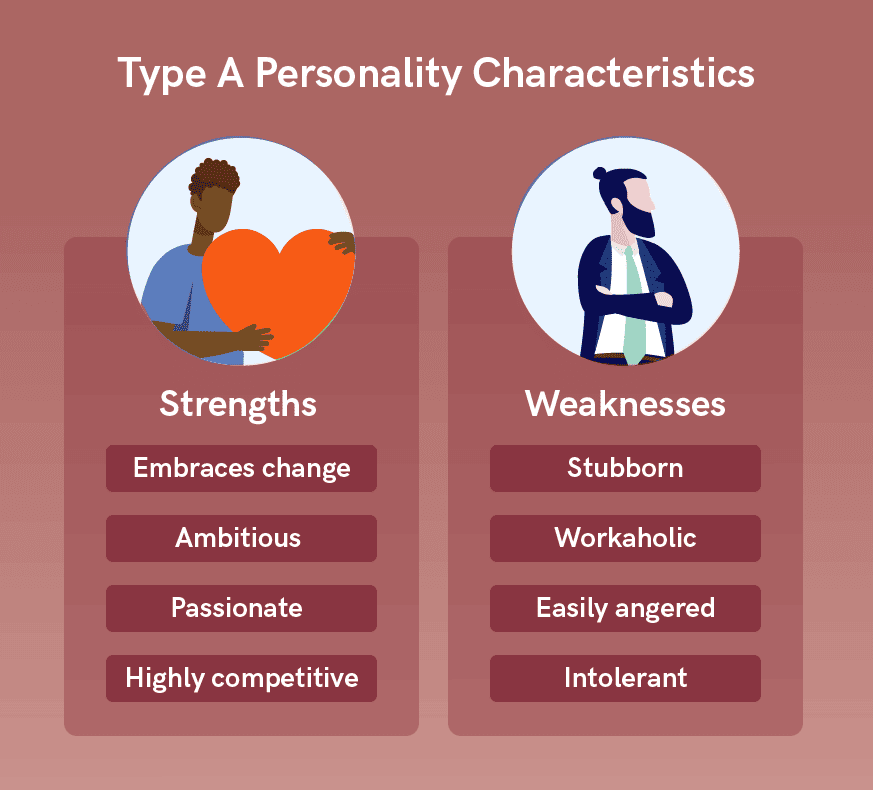
A Type A personality is easy to identify. People who have this type of personality want to be high achievers. They push themselves to be the best. Type A personalities tend to be competitive, even if competing against themselves. There’s usually quite an imbalance in their life regarding love, finances, or health.
When given a task, they are more likely to immediately make a thorough plan and follow it all the way through until they achieve their goal. If tasked with planning a trip, they will have every detail of the itinerary organized before boarding the plane.
Type A personalities experience the most stress when things don’t go according to plan. Things like delays in their workflows or obstacles that they didn’t foresee. They also tend to be harder on themselves for the work that they do, they are more overcritical of themselves than any of the other personality types.
Type A personalities are also highly organized and methodical with their time. These are the type of members you want in your group projects for school or work, they waste no time getting things done and are very structured, wanting things in a very particular way.
To sum it up, these are the characteristics of a Type A Personality:
Regarding the Big Five, people with a Type A tend to be more Disagreeable, but they also tend to be more Conscientious.
If you think you might be a Type A personality, here are some examples of other Type A personalities that you might recognize:
An example of Type A personality in action could go something like this, see if you can identify the person in this situation with this personality type:
“There are four students in a group working on a poster project for their high-school English class. Student 1 figures that there are three other people in the group and decides to take a nap during class time, thinking that someone else will get the project done. Student 2 wants to do well on the project but is not outspoken enough to get her ideas out there. Student 3 takes out a pencil and paper and decides to write down all her thoughts in an organized way and makes all her ideas known to the group. Student 4 is balancing a pencil on his nose.”
Could you tell in that little snippet of text who was the one that was most likely to be the Type A personality? If you guessed student 3, then you guessed correctly. Not only was she organized in her note-taking to ensure she got all her thoughts down, but she also told the group what her thoughts were and was not afraid to do it.
Just because you feel Type A describes you best, this shouldn’t make you feel categorized (or pigeonholed). Maybe in some situations, you’re the one who wants everything a certain way, but in other cases, you’d rather just relax and let someone else take the reign.
 Type b personalities
Type B is often called “non-Type A.” A person with a Type B personality is everything that a person with a Type A personality is not. Type B personalities are less concerned with being the best or finishing first. Rather than powering toward an end goal, people with a Type B personality may prefer to explore different possibilities and ways to achieve that goal. Life is about the journey rather than the destination.
Think that the Type B life sounds pretty stress-free? So do we. And that big difference made a huge impact on the initial research into Type A and Type B personalities. In fact, Type B personalities were actually likely to live longer.
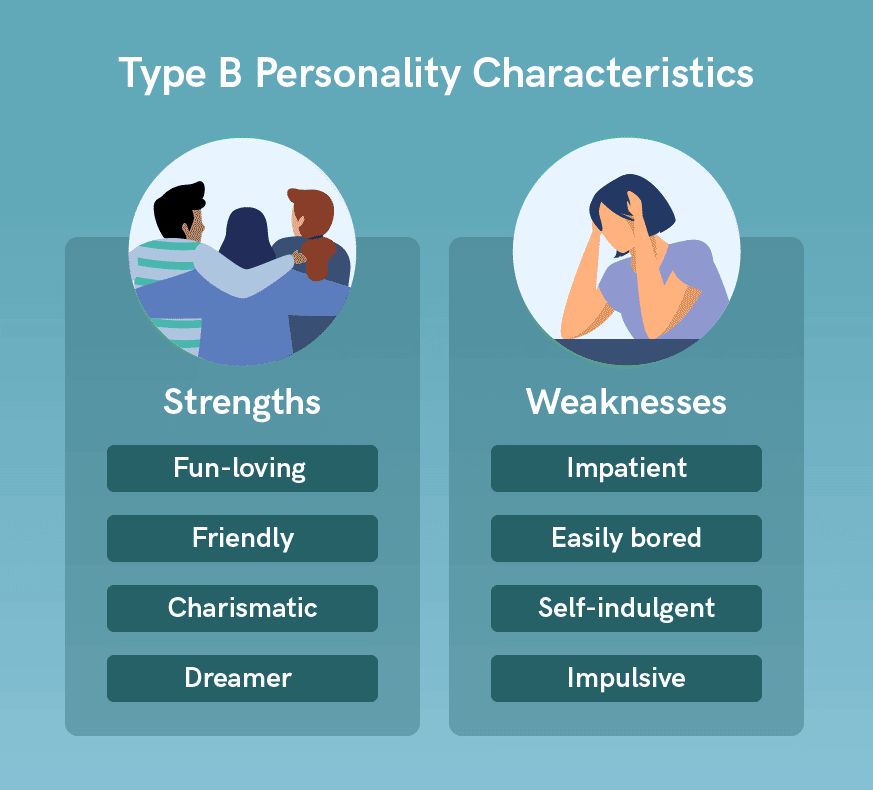
Type B personalities are more balanced in temper and more patient than Type A. This contributes to their stress levels not being as high as Type A. What also helps Type B personalities is their ability to adapt efficiently to change. Not only do they handle change well, they embrace it with no fear.
The difference between Type B and Type A personalities is like night and day. When we think of Type B personalities, these traits should come to mind:
The laid-back personality that Type B personalities have makes them very likable to their peers. With these personality tendencies, Type B tends to put things off until the last minute or just “wing it.” They don’t stress it because they are highly creative and can think up things on the spot.
If you find yourself waiting until the day before a big project is due to do the work for it, you might be a Type B personality. If you plan trips but don’t keep an itinerary, you might be Type B. And if your flight for that trip gets delayed and you don’t sweat it, you might be a Type B personality!
Let’s take that same example from above and use it to figure out the Type B personality:
Some famous examples of people with Type B personalities include:
Meyer Friedman and Ray Rosenman developed the theory of the two original personality types in the 1950s. Friedman and Rosenman weren’t renowned psychologists. They were cardiologists. And while Type A and Type B personalities have a role in modern personality psychology, Friedman and Rosenman weren’t interested in changing the world of psychology.
They were concerned with heart disease.
The two cardiologists also noted that most Type A participants didn’t like to sit in the waiting room as long as Type B participants would.
But Friedman and Rosenman’s research didn’t stop there. In their initial research about personality types, they claimed that Type A personalities were more likely to get a heart attack. Why? The stress of having a Type A personality, where everything has to be perfect and planned, can take a serious toll on your heart health.
It should also be noted that these cardiologists found participants who showed type A behavior also were more prone to stress-related illnesses and have their flight-or-fight response set off more often.
Friedman and Rosenman published their initial findings back in the 1950s. Personality psychology has come a long way since then. Two other personality types have been added to the roster of personalities that could potentially cause health problems.
Let’s discuss Type D and T personalities.
Type D Personality
Type D personality traits exist outside of Type A or Type B. Even if a person with a Type A personality faces a big task, they meticulously plan and organize themselves with the hopes and determination to complete it. People with a Type B personality live a less stressful, and therefore more easygoing, life. They face big tasks with a shrug and the assumption that everything will work out.
If faced with a big task, people with Type D are unlikely to think they can accomplish the task in the first place. The “D” stands for distress. People with Type D personalities are more likely to be pessimistic, talk negatively to themselves, and feel hopeless.
Negativity can cause stress and physical problems similar to the ones people with Type A personalities experience. Research shows that people with a Type D personality are more likely to experience coronary artery disease, a weak immune system, or chronic inflammation.
To review, these are the types of characteristics that you would find in someone with a type D personality:
The best word to describe type D personalities is introverts, not liking much attention. They are wallflowers, and they don’t mind it.
The “depressive” type personalities don’t entirely mean that you’re always down and out about life, it just means that these personality types tend to react to stress more negatively than the Type A or B personalities. They are not as adaptable to change.
But this also means that these personality types might report higher job satisfaction, not getting bored with their work because it makes them feel more secure.
Type T Personality
Type D personality traits may encourage someone to stay in and mope. Do people with a Type T personality mope? They’re probably too busy snowboarding or bungee jumping.
The last personality type that has gained popularity recently is the Type T personality. People with this type of personality are thrill-seekers. They seek out and chase experiences with high risks. These risks could be death (Type T personalities tend to climb mountains or skydive) or living without a steady income (artists, entrepreneurs, gamblers…they are likely to have a Type T personality.)
Like Type B personalities, people with Type T personalities are not at high risk for specific heart problems (at least, none that we know of yet.) But with thrill-seeking activities come high risks of their own.
However, the adrenaline pumping through the systems of these type T personalities may be causing them to have more heightened senses, as happens when adrenaline is higher. This is why some people chase these thrills, to feel that rush going over them.
A person with a Type T Personality will likely have these characteristics:
Little research has been done on Type T personalities, but we know that the type that most closely parallels these is the Type A personality. The characteristics of these two personality types make them popular and successful.
The only perceived negative effect of having this personality type is that you can get into some pretty stressful situations if you aren’t careful.
And not being able to stay in one spot for long may make it difficult to form deep bonds with other people. You may have to sacrifice relationships for the high-risk lifestyle or vice versa.
What does all of this mean for you? First, you’ll have to find out what personality type you are. While the answers tend to be pretty obvious, you can also take tests online to determine which type fits you and your lifestyle (like the one above!).
Put, you can ask yourself these questions and quickly determine what personality type you most likely fit:
If you are a Type A or a Type D personality, you may want to reach out to a professional to learn about ways to manage your risk of heart disease and other complications. Healthy habits, like positive self-talk or exercise, can help to reduce stress and stay heart-healthy.
It’s important to note that Type A and Type B personality traits are not mutually exclusive, and individuals can possess a mix of both traits. Additionally, it’s important to remember that personality is complex and multifaceted, and many other personality traits beyond just Type A and Type B contribute to our overall personality.
Related posts:Project Manager Interview Questions (14 Specific Questions + Answers)17+ Cardinal Traits (Definition + Examples)What is Personality Psychology?Myers Briggs Test (5 Mins) [MBTI Quiz Information]Personality Trait Theory
Related posts:
Reference this article:Practical Psychology. (2019, February).Type A and Type B Personality (Free 3-Min Test).Retrieved from https://practicalpie.com/type-a-and-type-b-personalities/.Practical Psychology. (2019, February). Type A and Type B Personality (Free 3-Min Test). Retrieved from https://practicalpie.com/type-a-and-type-b-personalities/.Copy
Reference this article:
Practical Psychology. (2019, February).Type A and Type B Personality (Free 3-Min Test).Retrieved from https://practicalpie.com/type-a-and-type-b-personalities/.Practical Psychology. (2019, February). Type A and Type B Personality (Free 3-Min Test). Retrieved from https://practicalpie.com/type-a-and-type-b-personalities/.Copy
Copy
