Some experts believe that we process information based on direct sensory input. In contrast, others subscribe to the theory of top-down processing.
In other words, top-down processing occurs when we predict what we will see or experience before actually seeing or experiencing it.
This cognitive process plays a major role in everyday life, including language comprehension and reading. For example, if you are given a sentence to read, such as “The dog ran around the corner,” you would use your prior knowledge to anticipate that there will be something else behind the corner (e.g., another dog). You already know that dogs chase each other, so your brain predicts what might happen next to help you understand the sentence fully.
Examples of Top Down ProcessingTop-Down vs. Bottom-Up ProcessingIs Top-Down Processing Automatic?Role of ContextResearch On Information ProcessingLearn More about Top Down Processing
Examples of Top Down Processing
Top-Down vs. Bottom-Up Processing
Is Top-Down Processing Automatic?
Role of Context
Research On Information Processing
Learn More about Top Down Processing
Have you ever seen the image of a vase and two faces? This image doesn’t change, but we are more likely to see one image or the other at first glance. Only after training our brain to see the other image, or someone tells us to see this image, does it appear.
Top Down Processing can help us make sense of a confusing situation or figure out hidden meanings within something. Examples of top-down processing include:
Consider the 1961 study involving an ambiguous image that can be perceived as either a rat or a man. When participants were primed with the context, their perception of the image shifted accordingly. If they were asked to identify themanin the image, most recognized the man’s face promptly.
 rat man picture example for top down processing
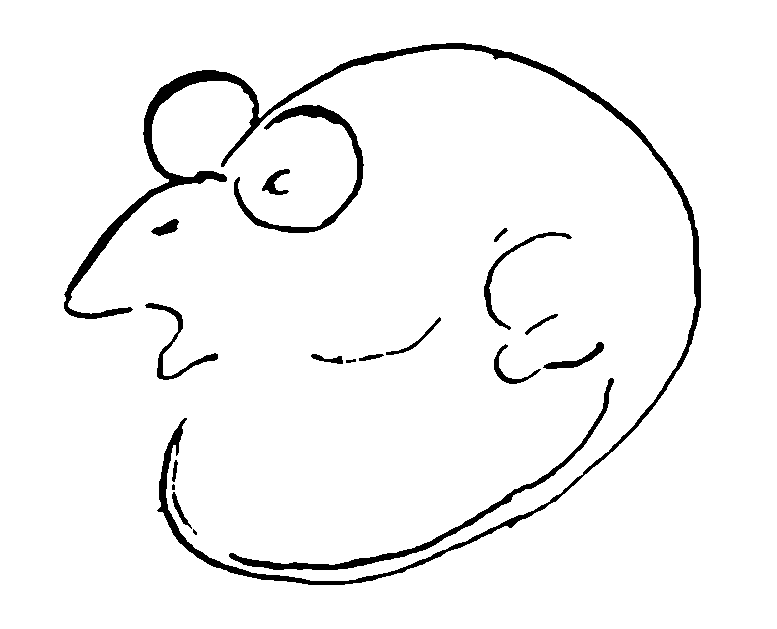
Conversely, if prompted to find therat, their perception shifted to discern the rat. This study demonstrates how our expectations and prior knowledge (the “top” in top-down processing) can influence and guide our perception of sensory information. It’s a classic example that supports the idea of top-down processing.
If you have done some research into these theories, you know that top-down processing is a theory that opposesbottom-up processing, which James J. Gibson proposed.
This approach to visual perception is more holistic because it considers the sensory inputs we receive and our prior knowledge, expectations, and context in which we perceive them. Instead of solely relying on the immediate visual data, top-down processing integrates broader cognitive factors to construct a more comprehensive understanding of what we see.
Gregory’s Theory
British psychologist Richard Gregory is the man responsible for developing this take on visual perception theory. Gregory did not coin “top-down processing” or create this idea from scratch. His theory was mainly realized as a response to Gibson, and he credits Hermann von Helmholtz as the father of this theory.
To “fill in the blanks,” the brain uses hypotheses based on what it expects and what it already knows about the world. Of course, hypotheses are not always true. We discover that our initial hypotheses aren’t true as we gather more details and focus more on different elements of what we see. Hence, we realize the rat isn’t just a rat, or the man isn’t just the man.
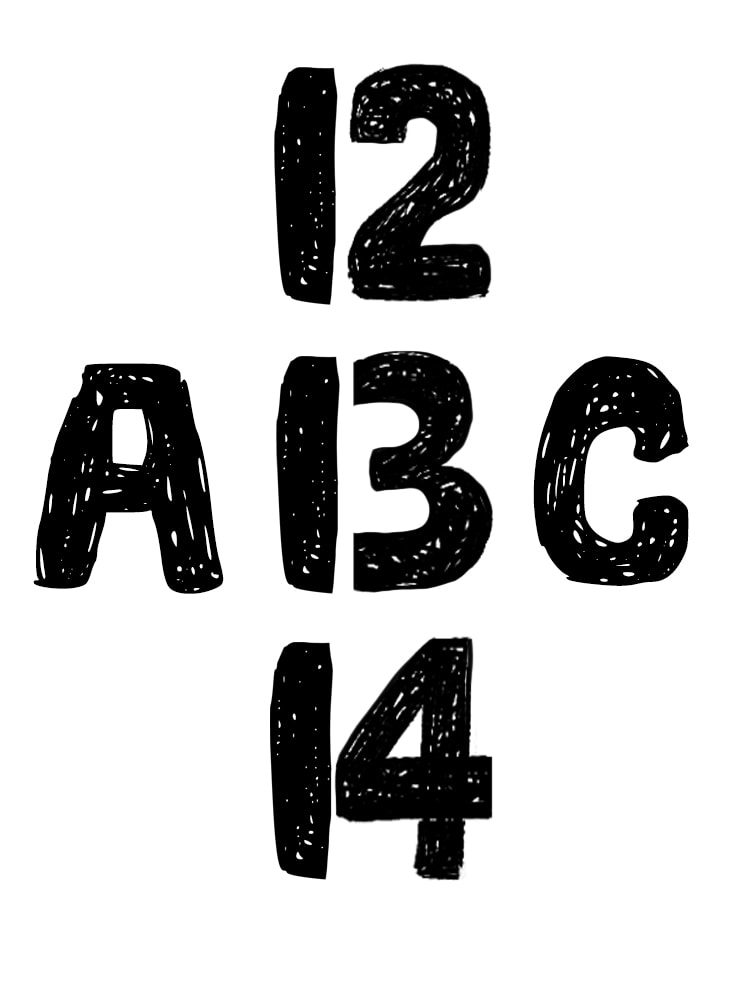
Let’s say you are reading a piece of paper. You see the number 11, the number 12, and then what appears to be the number 13. Or, at least, that’s what your brain says when you encounter it. After a closer look, you realize you are looking at a capital B, but your brain chose a number first due to the context of what you were seeing.
How is this significant? If you were using bottom-up processing, you probably wouldn’t have made the mistake of seeing the 13 first. You would have taken in the stimuli for what it was and then analyzed whether or not it was a B, a 13, another symbol, etc. With bottom-up processing, you are not making assumptions based on context, patterns, or past experiences. Bottom-up processing takes place in real-time, and we take in each stimulus as it is before we assign it a larger context.
Of course, this doesn’t happen all the time. Most of the time, we can look at a list that says “11 12 13 14” and assume what number comes next. So we use top-down processing to speed up how we assign meaning to what we’re seeing, hearing, or taking in through other senses.
More Examples of Top-Down Processing in Everyday Life
The following are only examples of top-down processing.
Have you ever seen a passage where every word is spelled incorrectly, but the first and last letters are correct? Most likely, you can read the whole passage without struggling. The individual words themselves make no sense, but reading the word as a whole and within the context of the larger sentence is a breeze.
While this passage was not written to support top-down processing, it could serve as evidence to prove that we can process words as a whole rather than letting the stimuli themselves lead the way in reading and understanding a piece of text.
There’s a picture that floats around social media or falls into your email inbox now and again. It shows a paragraph made of misspelled words. The letters are rearranged to correct the first and last letters, but everything else is out of place. Somehow, you can still read the entire paragraph!
This is top-down processing in action. If you were to see any of the words in the paragraph separately, you would probably have a harder time understanding what the word is saying. But when it’s strung together in a sentence, your brain understands the context and easily comprehends the word.
You might have heard about this little challenge before. Let’s say you see a list of colors: red, black, etc. Each word is written in a different color that doesn’t match the word. “Red” might be written in black, etc. People may have a hard time when asked to identify the colors of the words rather than the word itself. It’s easy for the brain to read the word.
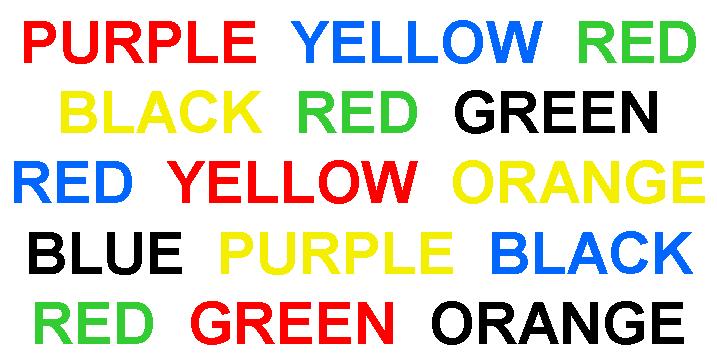
This is an example of top-down processing because we understand and process the concept of reading the words before us rather than identifying the color. We automatically process the word, causing the delay when trying to do a different task. You can learn more about theStroop Effect Here.
Top-down processing helps us “fill in the blanks” and gives our senses less. A majority of the things that we see and hear are “filled in.” Once we’ve grasped what we’reseeing, hearing, smelling, etc., the brain does the rest.
This causes an exciting phenomenon called phonemic restoration. When speech signals are replaced with certain sounds, our brains can fill in the blanks and “hear” what is being said. White noise, for example, could disrupt small pieces of speech signals and would go completely unnoticed. You can hear examples of phonemic restorationonline. As white or pink noise fills in the gaps between the person’s speech, it becomes more coherent.
Phonemic restoration is very useful for humans. Without it, we would have a hard time hearing everything and would require a quieter environment to chat.
Top-down processing doesn’t allow us to fill in the blanks when listening to people. We also fill in the blanks with our eyes. This means that knowledge of top-down processing can be used to manipulate an image or idea.
Let’s say you are arranging fruit at a grocery store. Only one side of the fruit has some bruises, but you need to sell the fruit. What side do you have facing the customers?
You could arrange the produce so that the good-looking side faces the customers. When the customers see the fruit, they “fill in the blanks.” They don’t need to see the back of the fruit - they know it’s there. In this case, unfortunately, they won’t know that the back of the fruit is covered in bruises. Only if they pick it up and inspect it will they know what’s on the other side.
While it appears that top-down and bottom-up processing are two different ways to view the world, many argue that we use a combination of both to see, hear, and understand what is happening around us. Top-down processing allows us to apply patterns and past knowledge to understand what is happening faster. But taking in smaller details allows us to refine what we see and possibly see things in new ways.
Psychologists who have studiedtop-down processinghave distinguished it from “voluntary” forms of perception. So this can be considered an automatic process!
That being said, sometimes it can lead us to make mistakes. If we see a “13,” that should be a B, we may have to go back and correct what we assumed. Taking “shortcuts” like this can also cause us to miss things right before us. Have you ever heard of change blindness? Our minds may miss changes in our environment because we have already assumed what we will see in front of us. When we make assumptions about what the world looks like, we can accept those assumptions without seeing what is in front of us.
Context plays an important role in top-down processing. Top-down processing is a cognitive strategy that uses prior knowledge and expectations to interpret stimuli. This means that, when presented with a stimulus, individuals will draw upon existing contextual factors to make sense of it. For instance, if an individual is presented with a word, they may consider context clues such as the surrounding words or sentences to determine its meaning.
In addition, contextual information can also be used to help resolve ambiguities within a given stimulus. Suppose a sentence contains two possible interpretations based on one particular word. In that case, an individual might consider their current context to decide which interpretation makes more sense given the situation.
The ability of individuals to successfully employ top-down processing largely depends on having access to appropriate contexts. Without sufficient contextual information, it becomes much more difficult for them to make accurate predictions about what kind of stimuli they will likely encounter next and, therefore, less able to utilize top-down strategies effectively.
Top-down information processing is a type of cognitive processing that relies on stored knowledge to interpret and analyze incoming sensory information. It involves using existing mental schemas, or frameworks, to process new data. This contrasts with bottom-up processing, which relies more heavily on the direct analysis of sensory data without relying on past experiences or prior expectations.
Studies have demonstrated that when given an ambiguous stimulus, people are more likely to interpret it based on their beliefs instead of objectively analyzing the raw data. As such, this form of information processing can be seen as an important component in problem-solving, decision-making processes, and general cognition.
Studies utilizing functional magnetic resonance imaging (fMRI) have also been conducted to investigate the neural mechanisms behind top-down effects during various tasks such as memory recall or perceptual identification experiments. This research has provided insight into how different brain regions interact during these processes and how they contribute to overall performance outcomes.
Want to dive deeper into this subject? Check out this TED Talk thatwe found on r/psychology! Enjoy learning more about optical illusions, top-down processing, and how we see the world.
Related posts:Bottom Up Processing (Definition + 23 Examples)The Psychology of Long Distance RelationshipsOperant Conditioning (Examples + Research)Beck’s Depression Inventory (BDI Test)Variable Interval Reinforcement Schedule (Examples)
Related posts:
Reference this article:Practical Psychology. (2019, September).Top Down Processing (Definition + 7 Examples).Retrieved from https://practicalpie.com/top-down-processing/.Practical Psychology. (2019, September). Top Down Processing (Definition + 7 Examples). Retrieved from https://practicalpie.com/top-down-processing/.Copy
Reference this article:
Practical Psychology. (2019, September).Top Down Processing (Definition + 7 Examples).Retrieved from https://practicalpie.com/top-down-processing/.Practical Psychology. (2019, September). Top Down Processing (Definition + 7 Examples). Retrieved from https://practicalpie.com/top-down-processing/.Copy
Copy
