In 1984, Russian computer engineer Alexey Pajitnov developed a simple game. It allowed players to rotate and drop four-block shapes into place to create orderly rows. Tetris was an instant success and is still one of the most addictive games ever created. However, the popular game has a surprising side effect in popular psychology. “The Tetris Effect” can affect more gamers than just Tetris players. If you enjoy video games, be aware of The Tetris Effect and how your game habits may affect your brain.
What Is the Tetris Effect?Tetris DreamsExamples of The Tetris EffectWhat Causes the Tetris Effect?Studies on the Tetris EffectGame Transfer PhenomenaDoes Playing Tetris Help Your Brain? The Benefits of the Tetris EffectHow To Stop the Tetris EffectHow Long Does the Tetris Effect Last?
What Is the Tetris Effect?
Tetris Dreams
Examples of The Tetris Effect
What Causes the Tetris Effect?
Studies on the Tetris Effect
Game Transfer Phenomena
Does Playing Tetris Help Your Brain? The Benefits of the Tetris Effect
How To Stop the Tetris Effect
How Long Does the Tetris Effect Last?
The Tetris effect, or Tetris syndrome, occurs when something we focus on for extended periods starts appearing in our thoughts, perceptions, and dreams. Journalist Jeffrey Goldsmith coined the term in his Wired magazine article “This Is Your Brain on Tetris” in 1994.
After focusing on Tetris for longer periods, many players experience a strange phenomenon. They start seeing forms that can be flipped and arranged, like in the game, in everyday objects such as cereal boxes or buildings. They keep thinking about ways different shapes around them could fit together. In a way, their minds continue playing even after they have finished the game.
 tetris effect meat example

And that’s not all.
For some players, the Tetris effect manifests itself in hypnagogic hallucinations, imagined yet realistic sensations that occur during the transition from wakefulness to sleep. The recognizable tetromino shapes and images of falling blocks often pervade Tetris players’ dreams.
This phenomenon is known as the Tetris effect.
A few years after the publication of Goldsmith’s article, Robert Stickgold, a psychiatry professor and sleep researcher at Harvard Medical School, experimented to explore how playing Tetris affects thoughts and dreams. He involved various participants: beginners, experienced players, and those with amnesia, particularly anterograde amnesia. In its most extreme form, this amnesia prevents individuals from learning or retaining new information.
The findings of this study were fascinating. Sixty-three percent of the participants, including two-thirds of the inexperienced players, reported visions of Tetris shapes as they fell asleep and even saw these shapes in their dreams. Moreover, the Tetris blocks continued to linger in their vision when awake.
Interestingly, those with anterograde amnesia experienced similar effects. Despite having no recollection of playing the game, their dreams were still filled with Tetris images. This suggests that the formation of these images is connected to procedural memory, a type of memory related to skills acquired through practice, like sports or music, which remains intact even in severe cases of amnesia.
Below is an example of the Tetris effect at work:
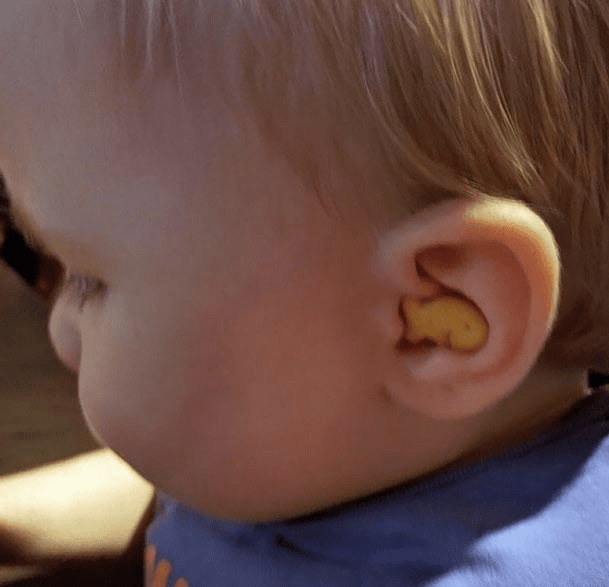
u/smoke_woods said:“I have this but for skyrim. I’ll dream about skyrim, see bushes and flowers and plants and be reminded of that stuff in skyrim, etc. it’s wild. My girlfriend has said I’ve said stuff about it multiple times in my sleep 😂 no joke
EDIT: I have it for THPS as of late too since I’ve been playing a ton of it on Switch. Still obsessed with Skyrim tho lol”
u/Banana_King123 said:“The Tetris Effect has happened to me 3 times in my life. Once with Tetris when I used to play Tricky Towers all the time, once with Bejeweled 3 when I used to play that a ton, and most recently THPS 1+2. Going for lvl 100 and doing those hard get there’s definitely lead to the Tetris effect for me. Didn’t go away until maybe a week after achieving platinum. I think it’s an interesting concept.”
u/Arkneryyn said:“I make music and if I stay up late working on a song I’ll dream that I’m still working on it lol. Also totally had this with THPS at certain point in my life same with a few other games, had a bunch of dreams where I’m building an empire in civilization lol.”
The floating pieces that Tetris players observe when not playing are prime examples of cognitive afterimages. A cognitive afterimage is a mental impression that lingers in our minds, similar to an optical illusion where an image persists in our vision after looking at an object. Just like the Tetris effect, there are other instances of cognitive afterimages.
For example, earworms, where a catchy tune replays in your mind long after you’ve stopped listening. Phantom phone vibrations are another, where you feel your phone buzzing even when it’s not. People who read extensively might continue to think in the style of the text they were reading, or chess enthusiasts may see chess boards and pieces in their mind’s eye.
These examples highlight how our brains can hold onto and replay experiences, illustrating the broader concept of cognitive afterimages and providing context to understand the Tetris effect fully.
When we play Tetris for hours, our brain starts creating new neural pathways that allow us to recognize patterns with less effort and improve at the activity. Our brain, as it were, helps us practice the game even when we are not playing.
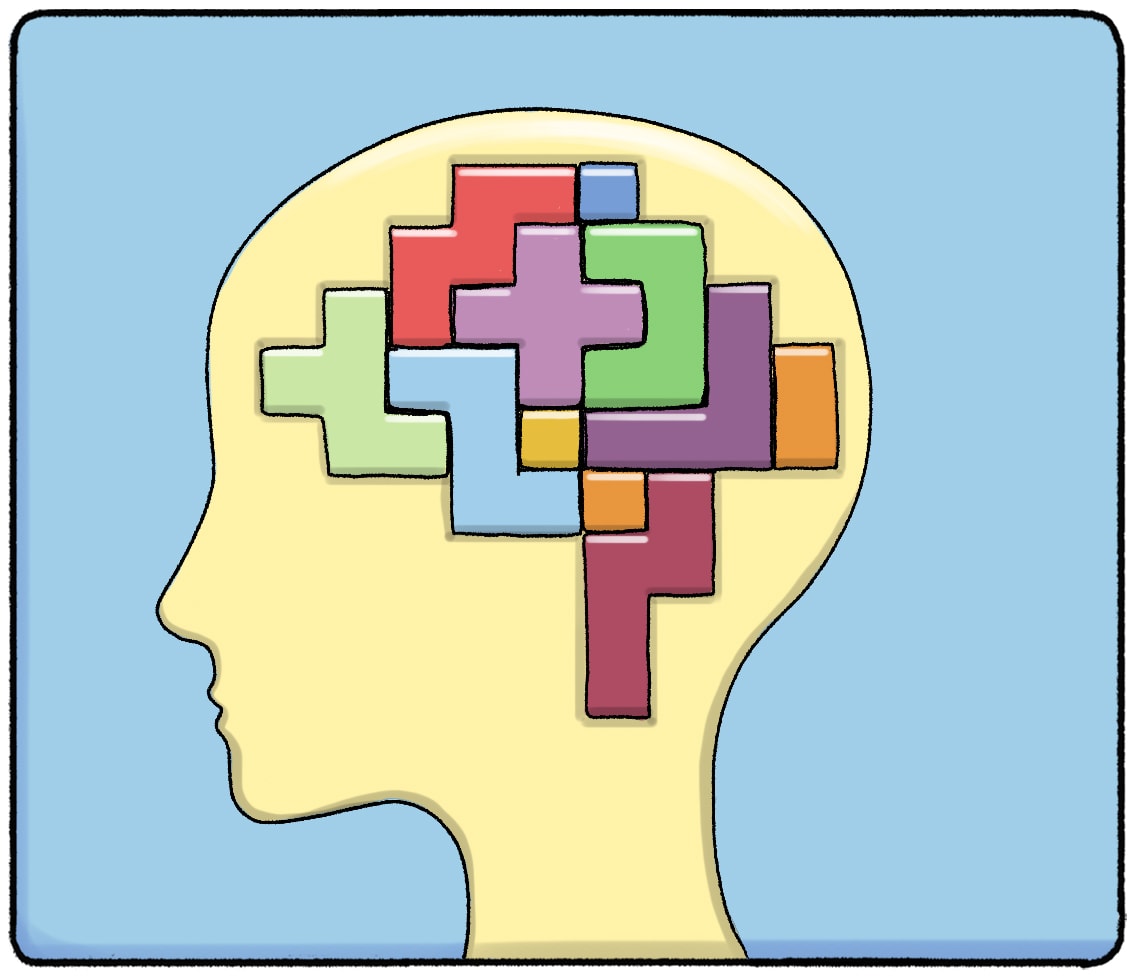
American psychologist Richard Haier at the University of California conducted one of the earliest studies on the Tetris effect in 1992. He discovered the brain consumes less energy as players’ game skills improve. Haier showed that regularly playing Tetris increases the cerebral cortex’s thickness, making the brain more efficient.
Haier also demonstrated that Tetris affects thebrain’s plasticity, that is, the ability to change and adapt due to experience. It turns out that this captivating game can promote cognitive development, enhance memory capacity, and generally contribute to keeping our brains healthy. There are benefits to playing video games! But there are drawbacks, too. The more you know about this effect, the easier it will be to look for signs that The Tetris Effect is improving your brainpower or having less-than-great effects.
The influence of repetitive actions on our perception of reality is typical of many other games besides Tetris. Speedcubing, solving a Rubik’s cube as fast as possible, or doing jigsaw puzzles can similarly affect our brains. These games can modify our visual impressions and the way we use logic. Professional gamers often find that the strategy and actions they take in a game affect their thought patterns in the real world.
Examples of Game Transfer Phenomena
Reddit users have also experienced general game transfer phenomena! The Casual Impact subreddit has funny examples of how it has affected their behaviors and decisions.
u/TwistedSystems said: “So shortly after the release of Inazuma I decided I’d speedrun the new quests. Now, I rarely play for more than an hour in one go so playing this game for hours was an exception for me. Suddenly, the delivery guy calls he’s gonna be here in a few mins, so I get ready to receive my package. (They can’t just drop it off on doorsteps here but we have to sign a document that we got it.) But I couldn’t find my door keys! So, naturally, I tried to use Elemental Sight because the key would surely glow white, right?”
u/4eyedfreak96 said:“I don’t know if this counts but right after playing any game for a while, talking to anyone in my house feels like I’m talking to an NPC and I kinda have this urge to “skip” dialogue. 😂”
You can read through the whole post and its comment sectionhere!
Improving sleep
Overcoming negativity bias
Dealing with trauma
The Tetris effect is increasingly being used as a tool in mental health research. Psychologists at Oxford University and the Karolinska Institute in Sweden have found that playing Tetris may interrupt processes that would otherwise embed traumatic events in the memory.
A dissociative state that the game creates blocks the formation of long-term memories that could lead to post-traumatic stress disorder. The parts of the brain that generally form these memories are filled with the spatial puzzle. Consequently, the person playing the game shortly after a distressing event would remember Tetris patterns instead of the traumatic experience.
The Tetris Effect and game transfer phenomena can make for some really funny stories, but getting too caught up in video games can eventually negatively affect your life. If you want to step outside the Tetris Effect, use these tips: Step away from the game. Choose a different activity that challenges other skills. Reading, writing, and coloring are all nice hobbies that don’t require a computer screen. Try a body scan meditation or another form of mindfulness that will distract your brain.
Notice how these changes take your mind off the game and give you something else to focus on. You may find yourself thinking about the characters of your book at night. That’s okay! As you explore other ways to wind down, you’ll find a balance that eliminates The Tetris Effect.
Within a few days of putting down your game, you’ll notice that the Tetris dreams go away and that you stop seeing everything as an opportunity for Tetris. The more you play the game, the more your brain will be focused on “playing the game,” even after you have logged off or stepped away from your gaming device.
Related posts:
Reference this article:Practical Psychology. (2020, April).The Tetris Effect (Definition + Examples).Retrieved from https://practicalpie.com/the-tetris-effect/.Practical Psychology. (2020, April). The Tetris Effect (Definition + Examples). Retrieved from https://practicalpie.com/the-tetris-effect/.Copy
Reference this article:
Practical Psychology. (2020, April).The Tetris Effect (Definition + Examples).Retrieved from https://practicalpie.com/the-tetris-effect/.Practical Psychology. (2020, April). The Tetris Effect (Definition + Examples). Retrieved from https://practicalpie.com/the-tetris-effect/.Copy
Copy
