In this article, you’ll learn a new way in which you can identify your emotions. It’s called the Emotion Wheel. This uses different dimensions to describe emotions that we feel at any given time. The Emotion Wheel, like other diagrams related to emotions, is not perfect. But it’s a great reference point as we explore and understand what we are feeling.
What Is the Emotion Wheel?List Of EmotionsEmotions and SurvivalEvolution and EmotionsHow to Identify Your EmotionsThe Importance of Emotional Intelligence
What Is the Emotion Wheel?
List Of Emotions
Emotions and Survival
Evolution and Emotions
How to Identify Your Emotions
The Importance of Emotional Intelligence
Free Printable Emotion Wheel PDF Download
 Main Emotion Wheel
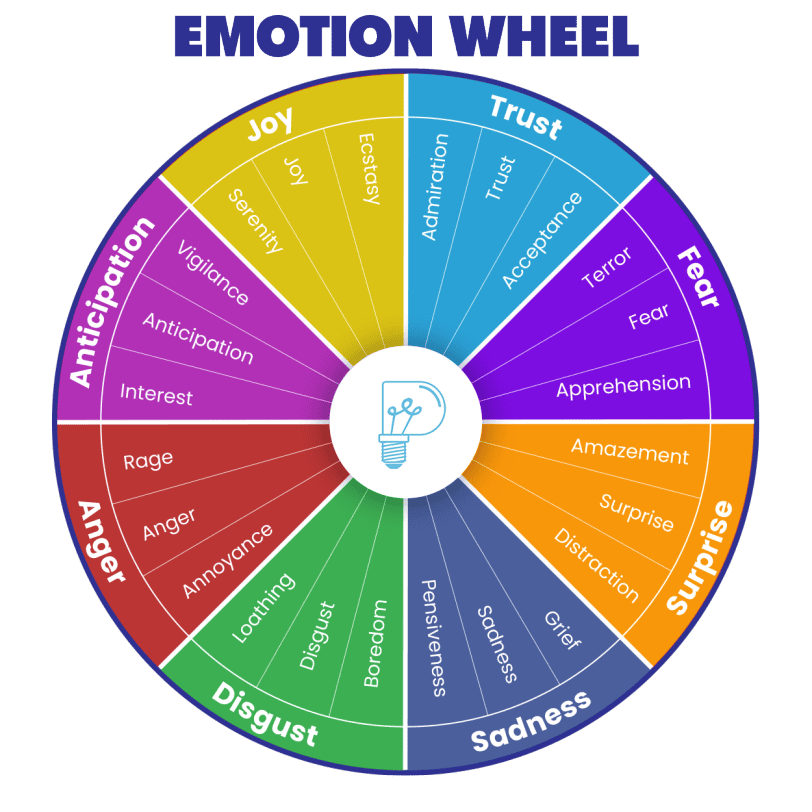
Robert Plutchik, an American psychologist, created the Emotion Wheel in 1980. His theory of emotion expanded on previous theories, some of which had labeled six primary emotions that all human beings feel. Plutchik believed that humans experience eight primary emotions, and each of these emotions has a polar opposite that is also included on the wheel:
Already, this wheel begins to resemble a color wheel. But there is more to the Emotion Wheel than just eight primary emotions.
Combinations
You have probably found yourself in between two emotions. You feel joy, but you also feel anticipation. Maybe you’re waiting for a check in the mail or are particularly excited about the year to come. Plutchik covered these emotions, too. In between each emotion is an emotion that combines two adjoining emotions:
But we’re not done quite yet.
Degrees
Saying that you feel “joy” doesn’t always feel like enough to cover the full spectrum of that one emotion. Some days, you’re jumping out of your set with joy! Other days, you are simply feeling calm and happy. On either side of the primary emotions, Plutchik listed “degrees” in which these emotions can be felt.
These spectrums look like this:
Plutchik has used both two-dimensional and three-dimensional models to show the relationship between primary emotions, the spectrum in which they sit, and the combination of emotions that we may experience at once.
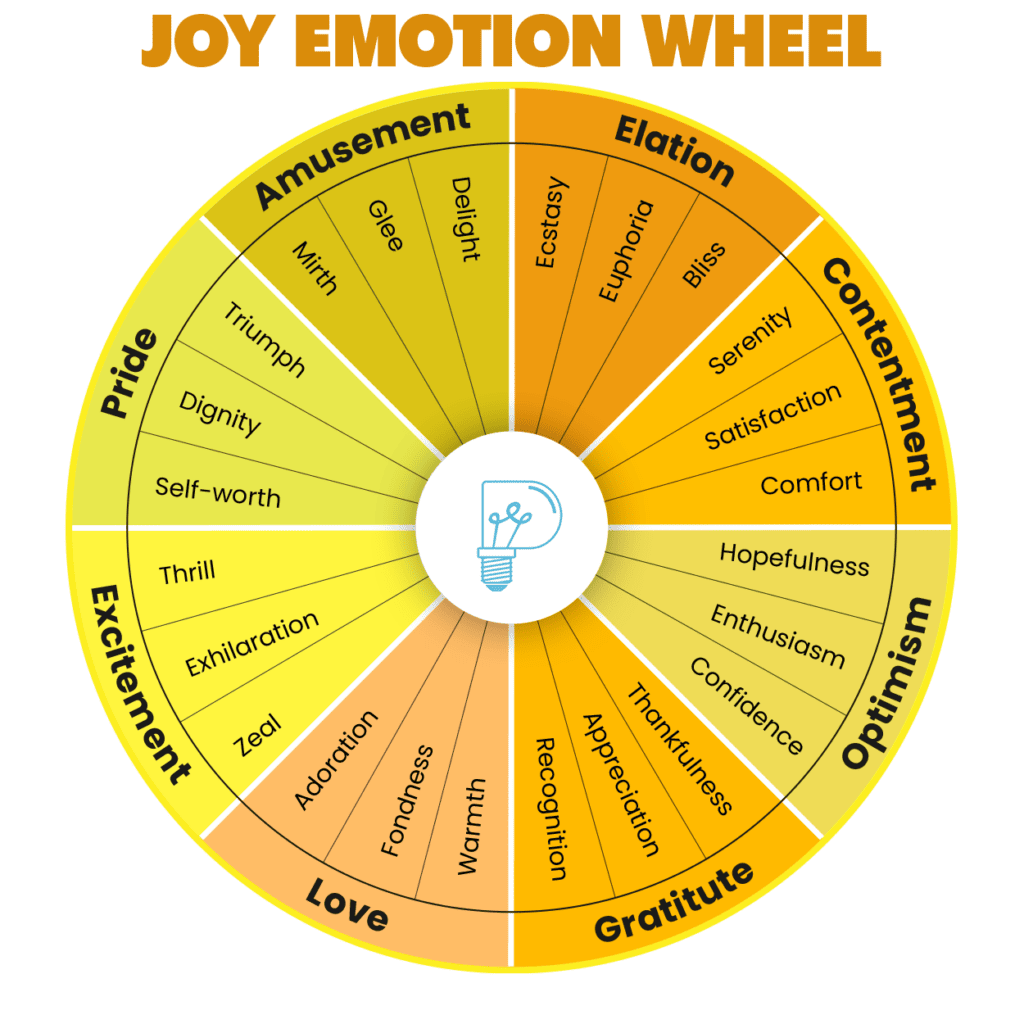
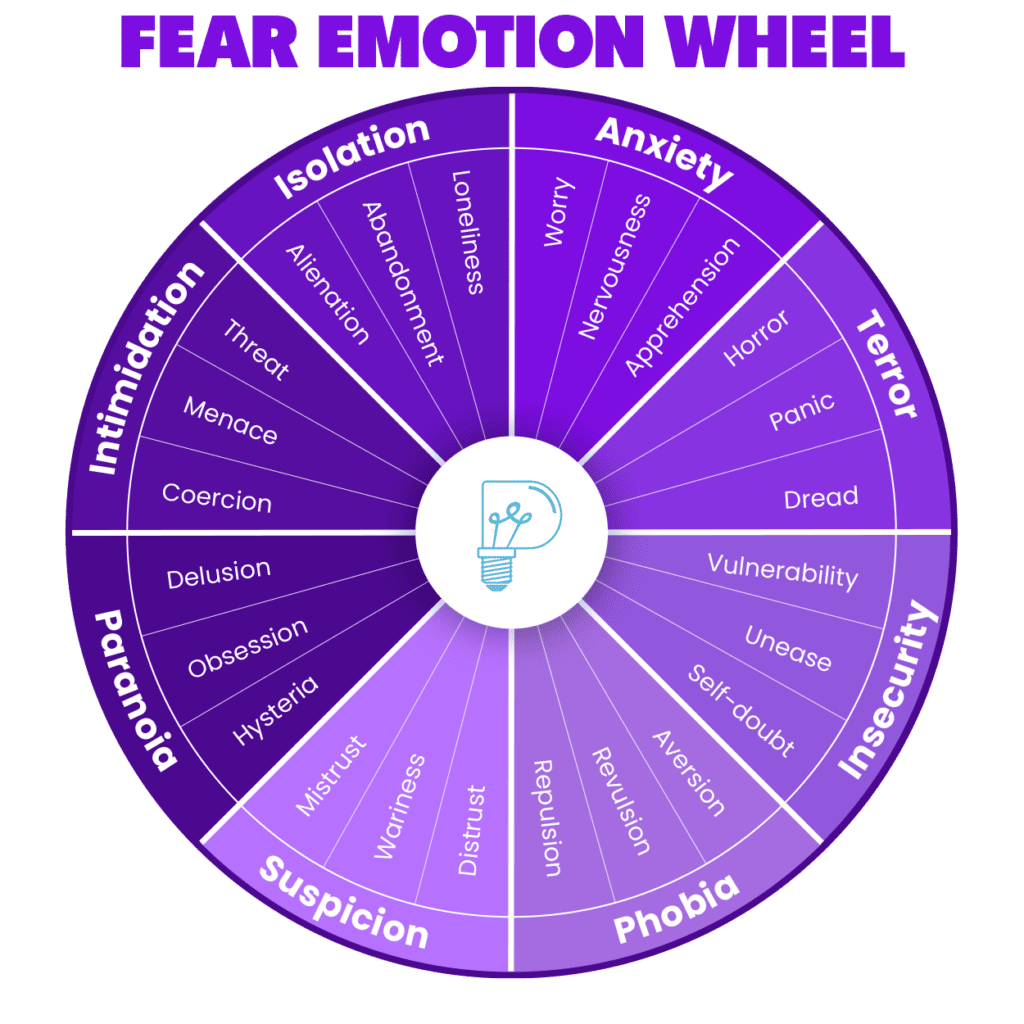
To help you better understand your emotions, let’s dive deep into each subcategory of the main categories. Along with naming each associated emotion, we’ll also describe it so you can identify them within yourself.
Joy
Sadness
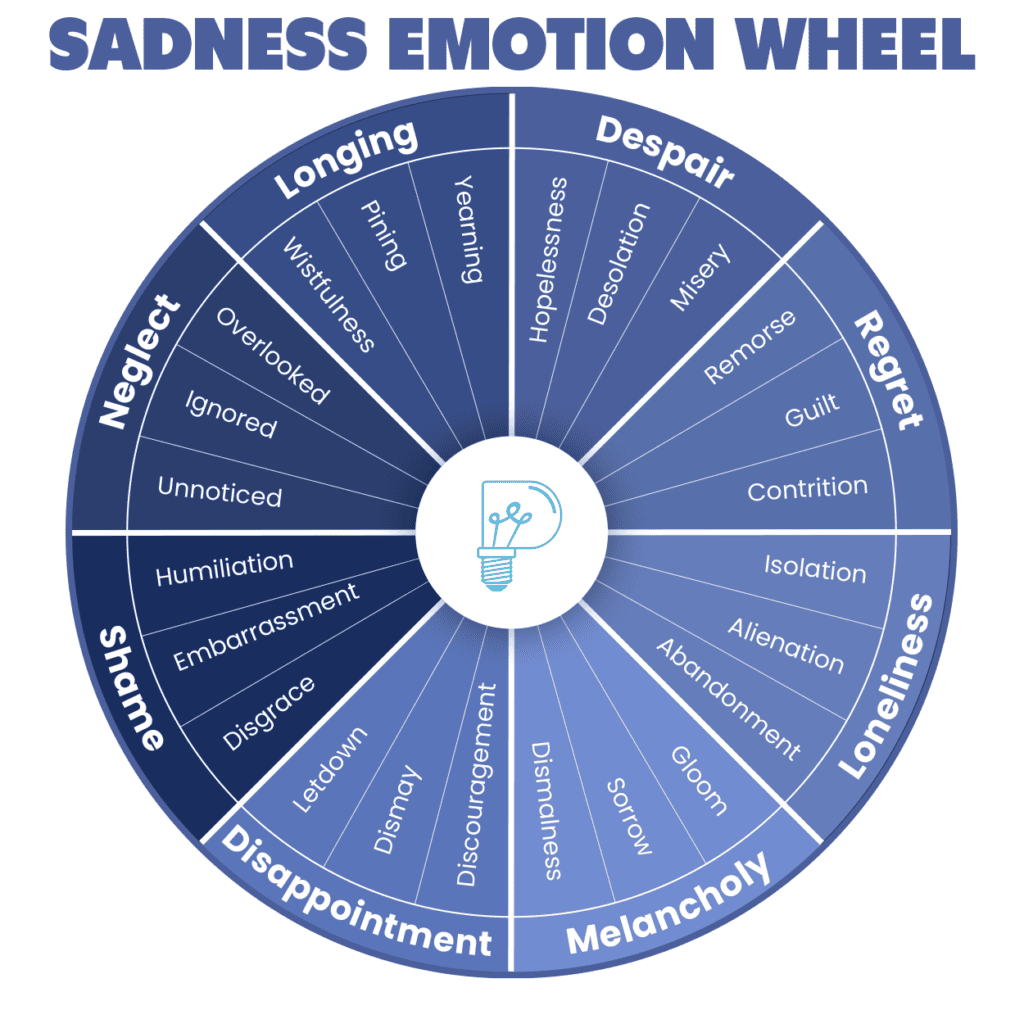
Sadness is a complex emotional state that stems from experiences of loss, disappointment, or frustration. It can manifest as feelings of sorrow, loneliness, despair, or grief, marking periods of difficulty but also potentially leading to personal growth and emotional depth.
Fear
Anger
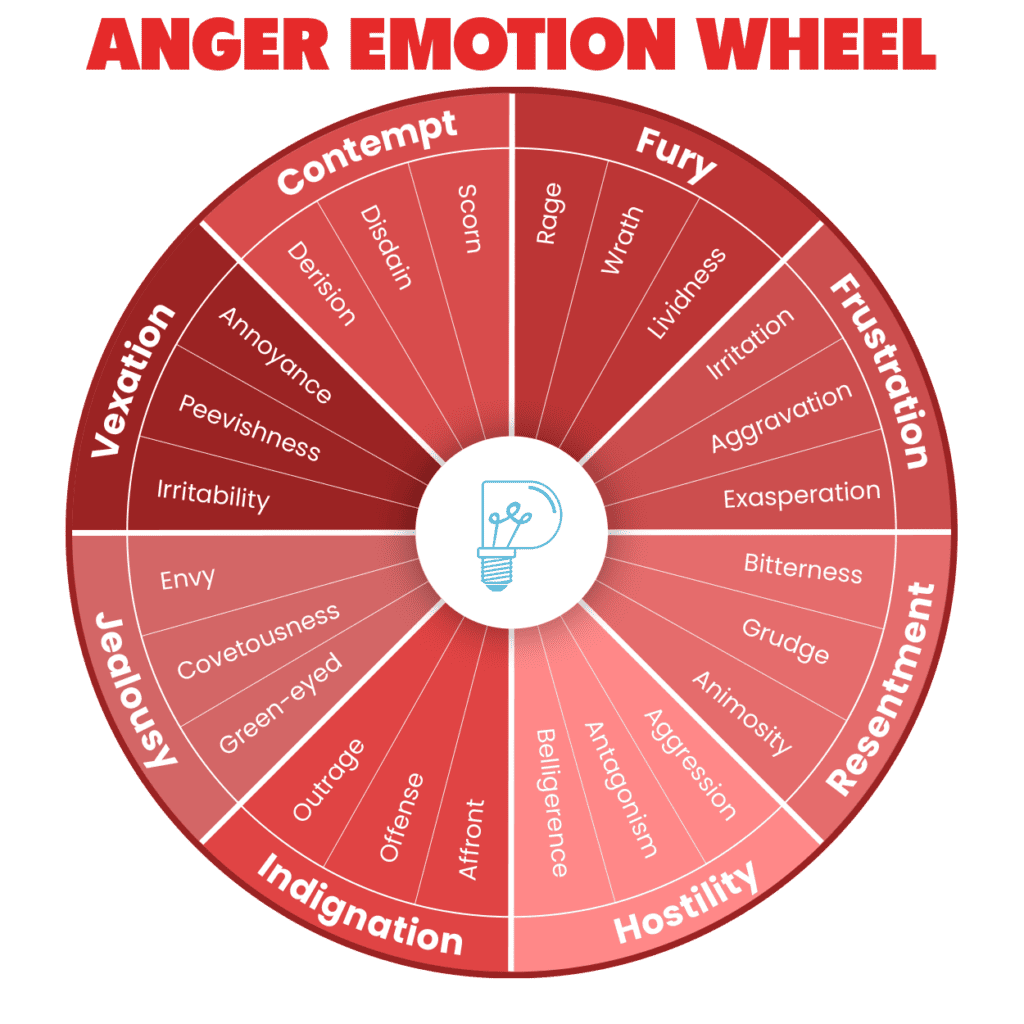
Anger is a strong emotion that arises in response to perceived wrongs or injustices. While it can range from mild irritation to intense fury or outrage, it serves as a signal that one’s boundaries have been crossed, potentially driving protective action or inciting change.
Anticipation
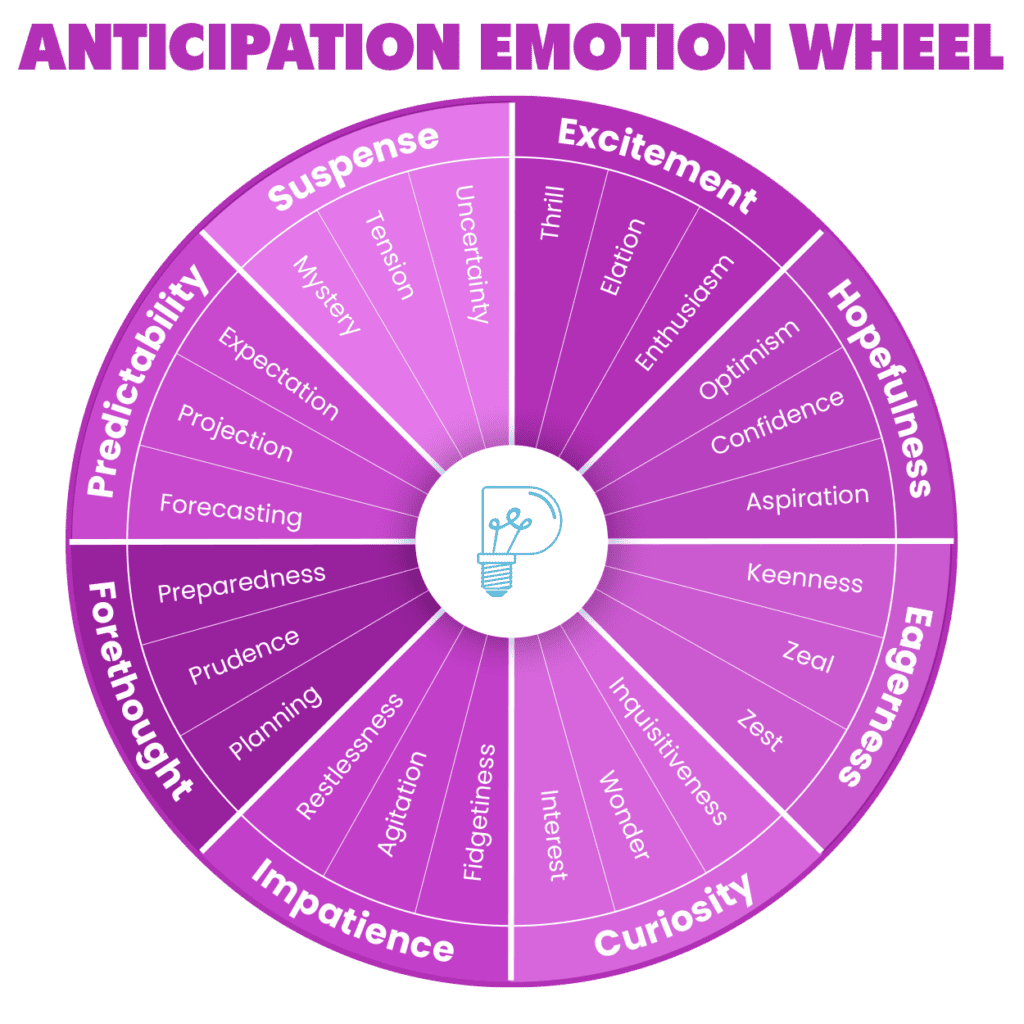
Anticipation is an emotional response to the expectation or foresight of future events. Whether filled with hope, excitement, or anxiety, anticipation helps us prepare for what lies ahead, adding a dimension of projection and planning to our emotional lives.
Surprise
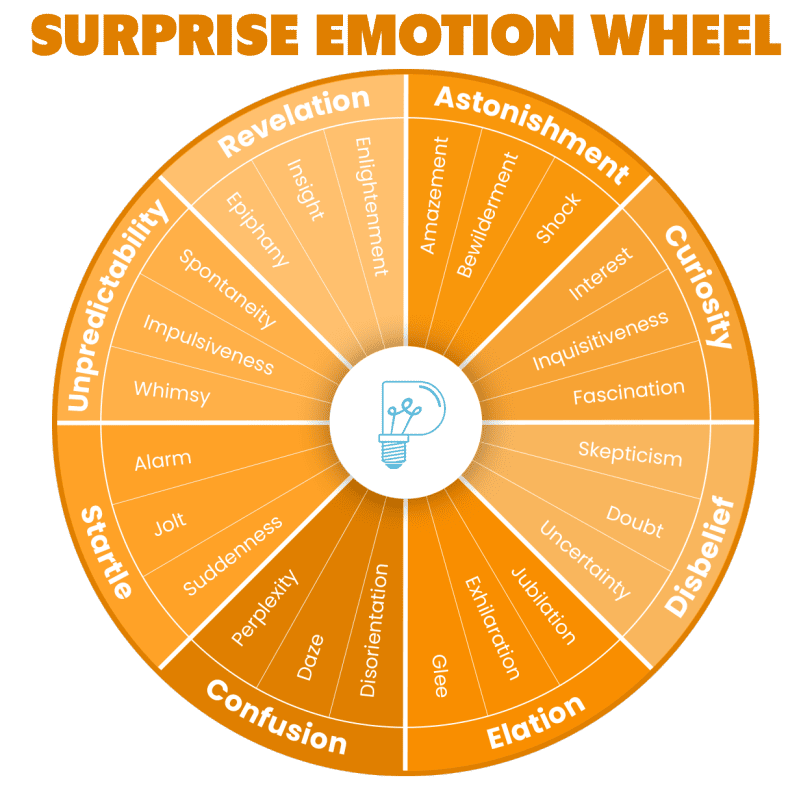
Surprise is an emotion that arises from unexpected or novel events, sparking reactions ranging from shock to delight. This emotional jolt can disrupt our assumptions or patterns, challenging us to adapt, reassess, and engage with the unpredictability of life.
Disgust
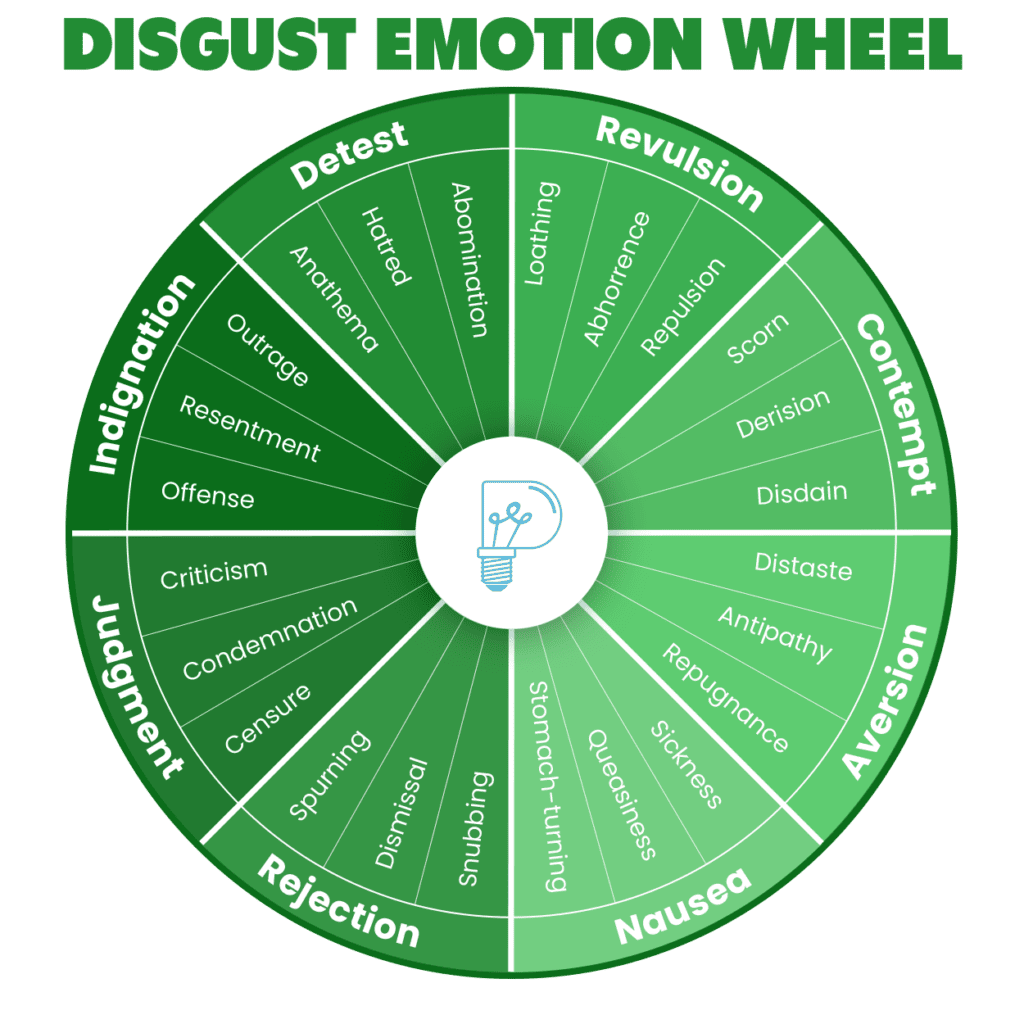
Disgust is a powerful emotional response that triggers rejection or avoidance of unpleasant, offensive, or harmful stimuli. Ranging from mild distaste to deep revulsion, disgust serves a protective role, steering us away from potentially harmful situations or substances.
Trust
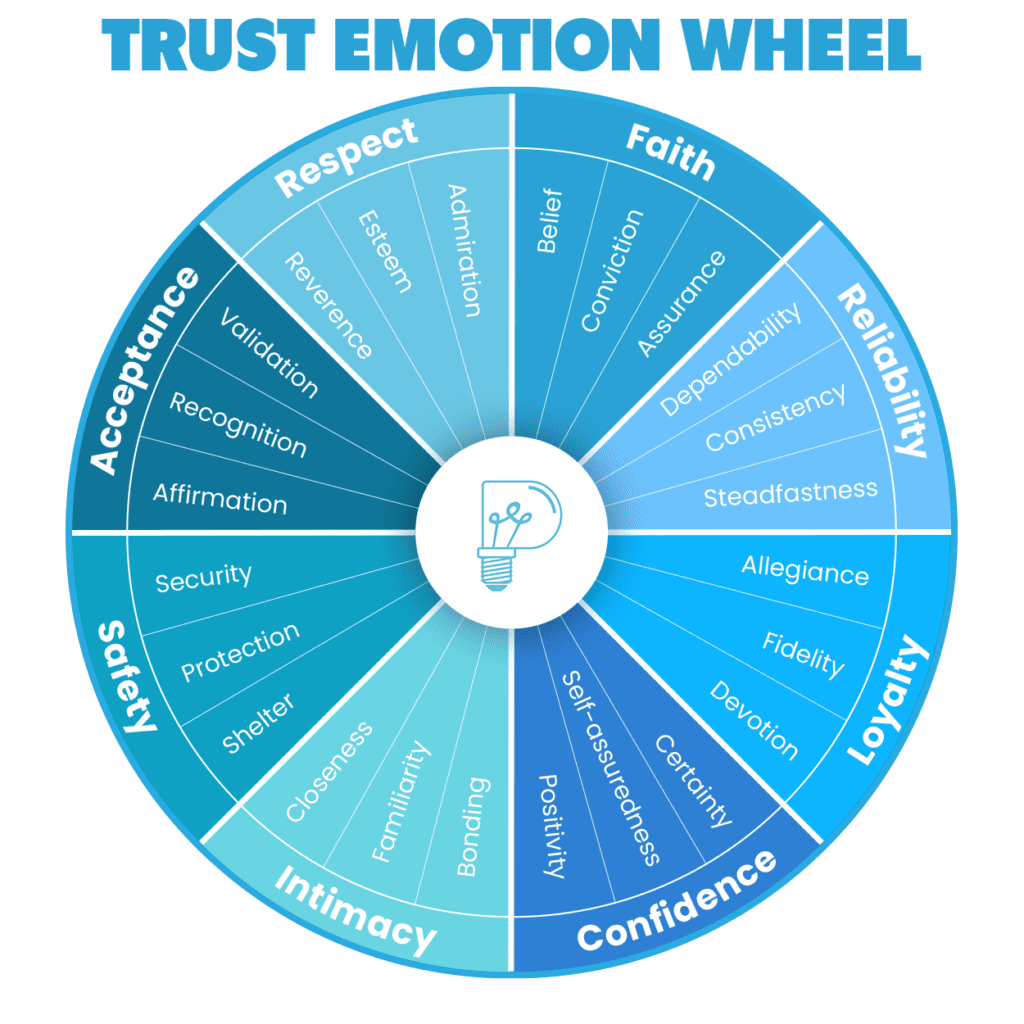
Trust is a positive emotional state that reflects reliance on the integrity and character of another person or concept. From the expectation of reliability to deep-seated confidence, trust is a vital component of functional relationships and societal structures, fostering cooperation and encouraging mutual support.
Plutchik did not just create the Emotion Wheel so we could explore and identify our emotions. He was interested in the ways that emotions allow us to engage and learn basic survival mechanisms. HisPsychoevolutionary Theory of Emotionsincluded The Sequential Model of Emotions and the Place of Cognitions, which showed how this process took place. Each survival mechanism, from fight or flight to mapping out new territory, is linked to one of the eight primary emotions.
When we encounter a threat, for example, we need to do something in order to escape that threat and survive. Plutchik called the encounter of a threat a “stimulus event.” The inferred cognition that occurs in response to this stimulus is “danger.” The emotion that we feel is fear, ranging from apprehension to terror. Fear engages our “fight or flight mode,” and we end up fighting off the threat or fleeing the situation.
That is our behavior, in response to our emotions. The desired effect of our behavior is some form of survival. In this case, it’s protection from the threat. This sequence of events helps to explain the purpose and use of “fight or flight,” one of our most well-known defense mechanisms.
Back in more primitive times, we neededfight or flightto help us address threats, like wild animals or an enemy tribe. Threats nowadays, like a D on a test or not getting a promotion, are not exactly as serious. Yet, our mind may still register them as threats, and the sequence engages our fight or flight response.
As we learn to identify our emotions, we can control them and prevent the use of inappropriate defense or survival mechanisms. Not all threats require us to fight or flight. By understanding where our emotional responses are coming from, we can better assess our behaviors and when it’s time to truly take action.

How are you feeling today?
Sometimes, you might find that this simple question has a simple answer. You are happy. Content. Sad. Excited. Other times, this simple question doesn’t have a simple answer. You are nervous, but you can’t tell if it’s a “good nervous” or a “bad nervous.” You are happy, but that happiness is mixed in with a twinge of guilt that prevents you from truly feeling happy.
Identifying emotions is not an easy process, but it is crucial to understanding the way that people think and behave. There are various cognitive theories about how emotion plays into our cognitive process and the decisions that we make. So it makes sense that psychologists want to get a good grip on how we identify emotions and how they play into our behaviors and attitudes.
With tools like The Emotion Wheel, we can put words to our feelings. Here are some other ways to identify your emotions and properly manage them more effectively:
With tools like The Emotion Wheel, we can put words to our feelings. Here are some other ways to identify your emotions and manage them more effectively:
Sit with yourself
Take a moment to sit in a silent place and observe your body and mind. (Guided meditations on apps like Insight Timer can help you do this, too.) Do you feel tension anywhere in your body? Are your thoughts positive, negative, hopeful, etc.? Be patient and honest with yourself. Take 5-10 minutes to go through this process.
Refer to The Emotion Wheel afterward. Do your thoughts reflect a feeling of anxiety? Contentment? Embarrassment? Start from the innermost circle and move outward if you have to.
Accept all emotions
Your emotions are valid. We often do not want to admit to experiencing feelings like shame, sadness, or disappointment. Know that these feelings are completely normal. We all experience certain feelings, even when we have not done anything to “deserve” them. The sooner you can admit your feelings, the sooner you can manage them.
Identifying your emotions, through the use of the Emotion Wheel or otherwise, builds EQ. EQ, or emotional intelligence, is the ability to identify and use emotions effectively.
Emotional intelligence looks like:
Example of Using the Emotion Wheel To Gain Emotional Intelligence
Darren doesn’t know how to explain his feelings. Left unchecked, his stress affects his sleep, ability to work out, and focus. It’s not until he sees an article about The Emotion Wheel that he decides to take stock of his emotions.
He listens to a meditation on YouTube about identifying his emotions. The meditation instructs him to notice different parts of his body and mind. Darren realizes his chest is tight. His thoughts are moving very quickly. After the meditation, he Googles his symptoms and realizes he is experiencing anxiety.
This is new to Darren, but he has the Emotion Wheel to help him. He looks at the area that says, “Anxious.” In the innermost circle, he sees “fearful” encompassing “anxious”. Darren would not usually be a person to say that he is afraid, but he has an open mind. What could he be afraid of? Maybe he’s afraid that his mother won’t recover from her illness, or that his wife will become ill because she is so stressed.
He looks at the outermost circles on the Emotion Wheel: overwhelmed and worried. While both of those emotions seem to fit his current feelings, the sheer number of worries in his lifeisoverwhelming him.
Darren decides to look up what to do when he’s overwhelmed, and talks to a friend and shares his overwhelm. Through this process, he realizes that he has too much time on his plate and has little time to devote to self-care and spending time with the people he loves. By focusing more of his energy on this, Darren finds that his symptoms of anxiety affect him far less often than before.
Emotional Intelligence and Behavior
Of course, emotional intelligence doesn’t end when you do something to resolve your feelings. Emotional intelligence can also help you if you find yourself acting out due to your emotions. Let’s say Darren’s boss tends to be critical of Darren whenever she is angry. She may not be angryatDarren, but her anger comes out through that behavior. Whenshelearns about the Emotion Wheel, she sees the tie between criticism and anger.
The next time she finds herself getting angry, she takes some time to pause. How can she bring herself into the present moment and look for solutions? What is the best way to communicate her thoughts with Darren while reassuring him that he’s doing a good job? As she navigates the answers to these questions, she starts to communicate more effectively with Darren and he finds that he becomes less anxious at work, too.
Related posts:Dream Interpreter & Dictionary (270+ Meanings)37+ Instructional Strategies (Examples + Quizzes)201+ Strengths Examples For SWOT Analysis (Huge List)197+ Weaknesses Examples for SWOT Analysis (List)Anger Issues Test (Signs + Guide)
Related posts:
Reference this article:Practical Psychology. (2020, September).The Emotion Wheel (9 Wheels + PDF + How To Use).Retrieved from https://practicalpie.com/the-emotion-wheel/.Practical Psychology. (2020, September). The Emotion Wheel (9 Wheels + PDF + How To Use). Retrieved from https://practicalpie.com/the-emotion-wheel/.Copy
Reference this article:
Practical Psychology. (2020, September).The Emotion Wheel (9 Wheels + PDF + How To Use).Retrieved from https://practicalpie.com/the-emotion-wheel/.Practical Psychology. (2020, September). The Emotion Wheel (9 Wheels + PDF + How To Use). Retrieved from https://practicalpie.com/the-emotion-wheel/.Copy
Copy
