Ever jumped because of a sudden loud noise? Or felt your mouth water when you smell your favorite food cooking? These reactions aren’t just random; they’re part of something called the “Stimulus Response Theory.” In simple terms, it’s the idea that we react in specific ways to certain things or events around us. Think of it like a cause and effect: something happens (the stimulus), and we respond in a certain way.
This theory helps explain why we do many of the things we do without even thinking about them. It’s like our body’s automatic reply to the world around us. Some of these reactions are natural, like flinching from a hot stove, while others can be learned over time, like feeling excited when you hear a specific song because it reminds you of a fun memory.
In this article, we’ll dive into the fascinating world of stimulus and response, exploring how and why we react to things the way we do. It’s a journey into understanding our automatic behaviors a bit better. Ready to discover more about yourself and the world around you? Let’s go!
What Is Thorndike’s Stimulus Response Theory of Learning?Law of EffectLaw of ExerciseLaw of ReadinessExamples Of Stimulus Response TheoryOther Stimulus Response TheoriesCognitive PsychologyCan You Train Yourself?
What Is Thorndike’s Stimulus Response Theory of Learning?
Law of Effect
Law of Exercise
Law of Readiness
Examples Of Stimulus Response Theory
Other Stimulus Response Theories
Cognitive Psychology
Can You Train Yourself?
 Stimulus Response Theory of Learning
If that relationship was strong, the response was likely to occur when the stimulus was presented. In order to elicit a specific response to a specific stimulus, you had to strengthen its relationship in one of a few ways. This is where Pavlov’s experiment comes in.
When you think of behaviorism, you may think of Pavlov’s dog. This experiment is one of the most famous experiments in the history of psychology. It is also some of the strongest evidence for theories that fall under the larger category of Stimulus Response (S-R) Theory. Stimulus Response Theories attempts to explain the ways that human beings behave. These theories, and behaviorism as a whole, are not the forefront of modern psychology. Still, they still serve as an important lesson about why we believe the things we believe about decision-making, behavior, and human nature.
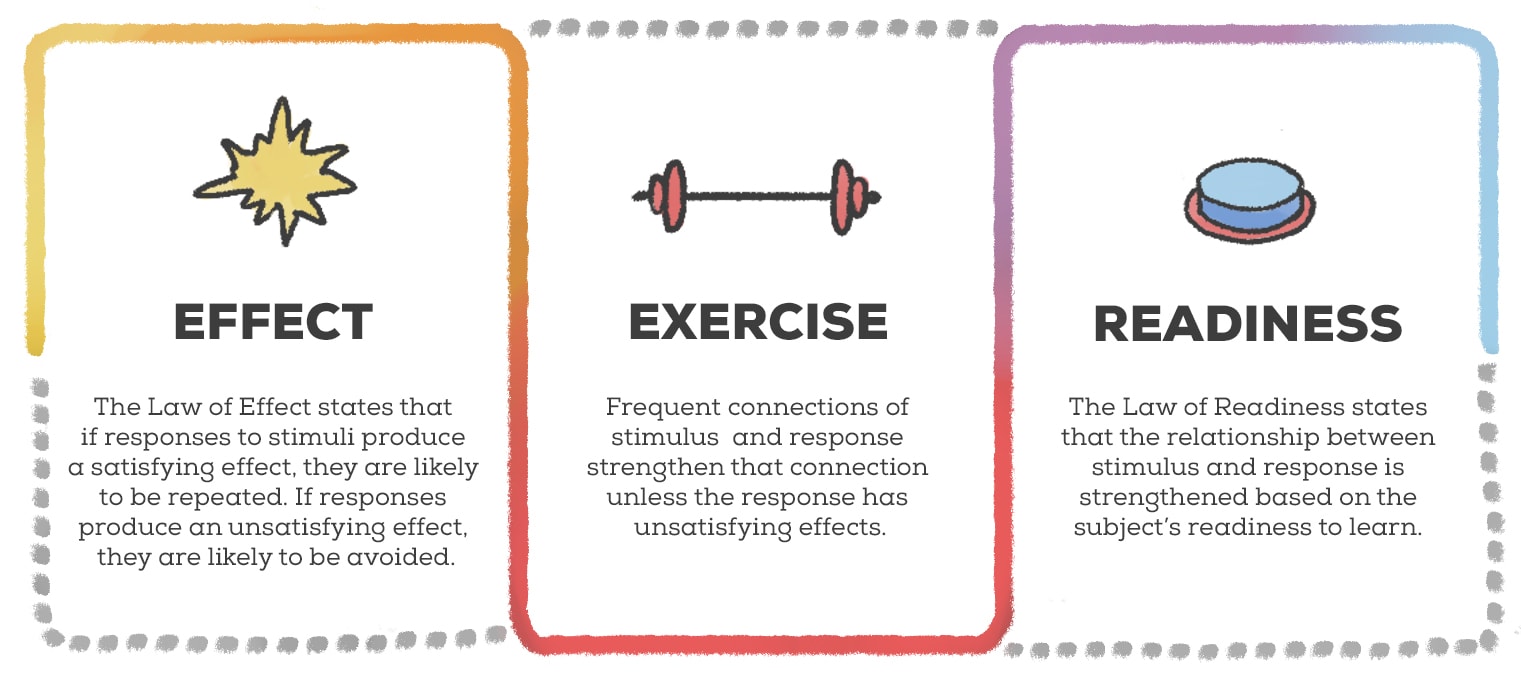
Let’s look at three concepts that Thorndike developed while explaining the Stimulus-Response Theory of Learning: Law of Effect, Law of Exercise, and Law of Readiness.
Before Pavlov worked with dogs, Thorndike worked with cats.
He would place them in a box. Outside the box was a scrap of fish. As the cats looked for ways to get to the fish, they would try to escape the box. Escaping was as easy as pulling a lever. When the cat pulled the lever, they were able to leave and enjoy the fish.
Thorndike observed the cats be placed in this box over and over again, under the same conditions. He saw that the time it took to pull the lever decreased as the cats associated the lever with the fish. This helped him develop the Law of Effect.
We seek responses with positive effects, strengthening the relationship between a stimulus and the response.
The Law of Exercise is an element within Thorndike’s work that he later modified. Initially, Thorndike believed that frequent connections of stimulus and response strengthened that connection. The more often a cat was given the opportunity to pull a lever and receive a fish, for example, the stronger that connection would be and the more likely they would pull the lever.
But, as Thorndike continued his work, he realized that this was not necessarily true. If the response leads to an unsatisfying effect or punishment, the connection between the stimulus and the response will not be strengthened. But Thorndike observed that the connection may not be weakened every time the subject gets “punished,” either.
Being subject to continuous trials of pulling levers and escaping boxes sounds exhausting. If a cat, human, or any other creature is too tired to try something out, they might just take a cat nap and leave the response hanging. This idea fits into Thorndike’s law of readiness.
The Law of Readiness states that the relationship between stimulus and response is strengthened based on the subject’s readiness to learn. If the subject, be it a cat or a person, is not interested or ready to learn, they will not connect stimulus and response as strongly as someone who is eager and excited.
Contiguity Theory
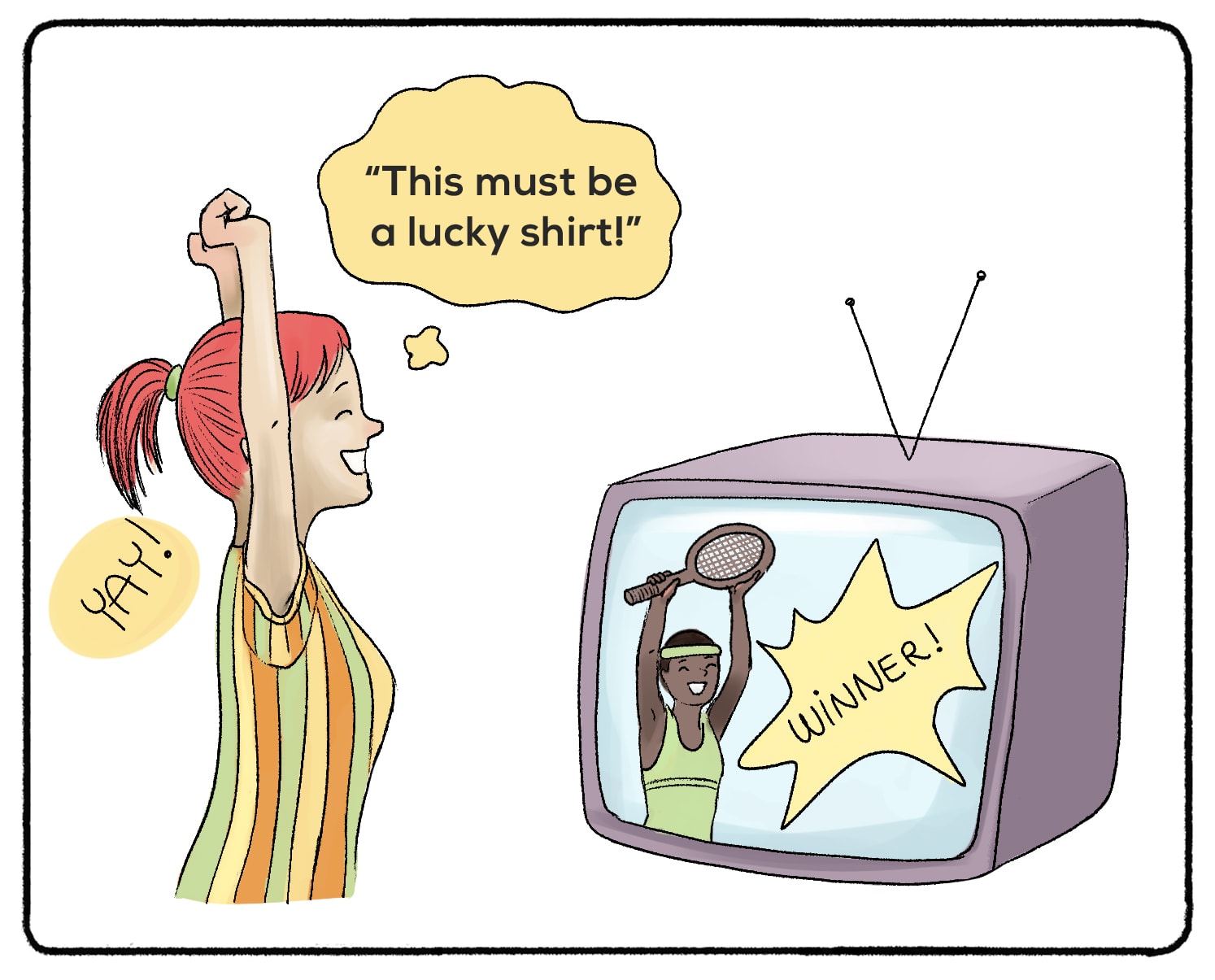
One such theory includes Edwin Guthrie’sContiguity Theory.Like other Behaviorists, Guthrie believed that learning occurred when connections were made between a stimulus and a response. But his ideas went beyond exercise and readiness. The Contiguity Theory included the law of contiguity, which suggested that time played a factor in the strength between a stimulus and a response.
If the response did not occur immediately after the stimulus, the subject would be less likely to associate the stimulus with the response. If you get a stomachache in the evening, you might associate your body’s response with what you ate in the morning, but you are much more likely to associate the response with what you ate for lunch or dinner. Time makes a difference.
Drive-Reduction Theory
Drive, Hull and Spence said, is a state that humans experience when they have a need to fulfill. If you are hungry, you are in a state of drive. If you are craving sex, comfort, or safety, you are in a state of drive. As humans, we want to reduce drive and return to a state of calm homeostasis.
What do you do when you are hungry? You eat food and feel full.Drive-Reduction Theorystates that when the effect of a response is a reduction in drive, a subject will more likely respond to that stimulus in the same way.
Classical Conditioning
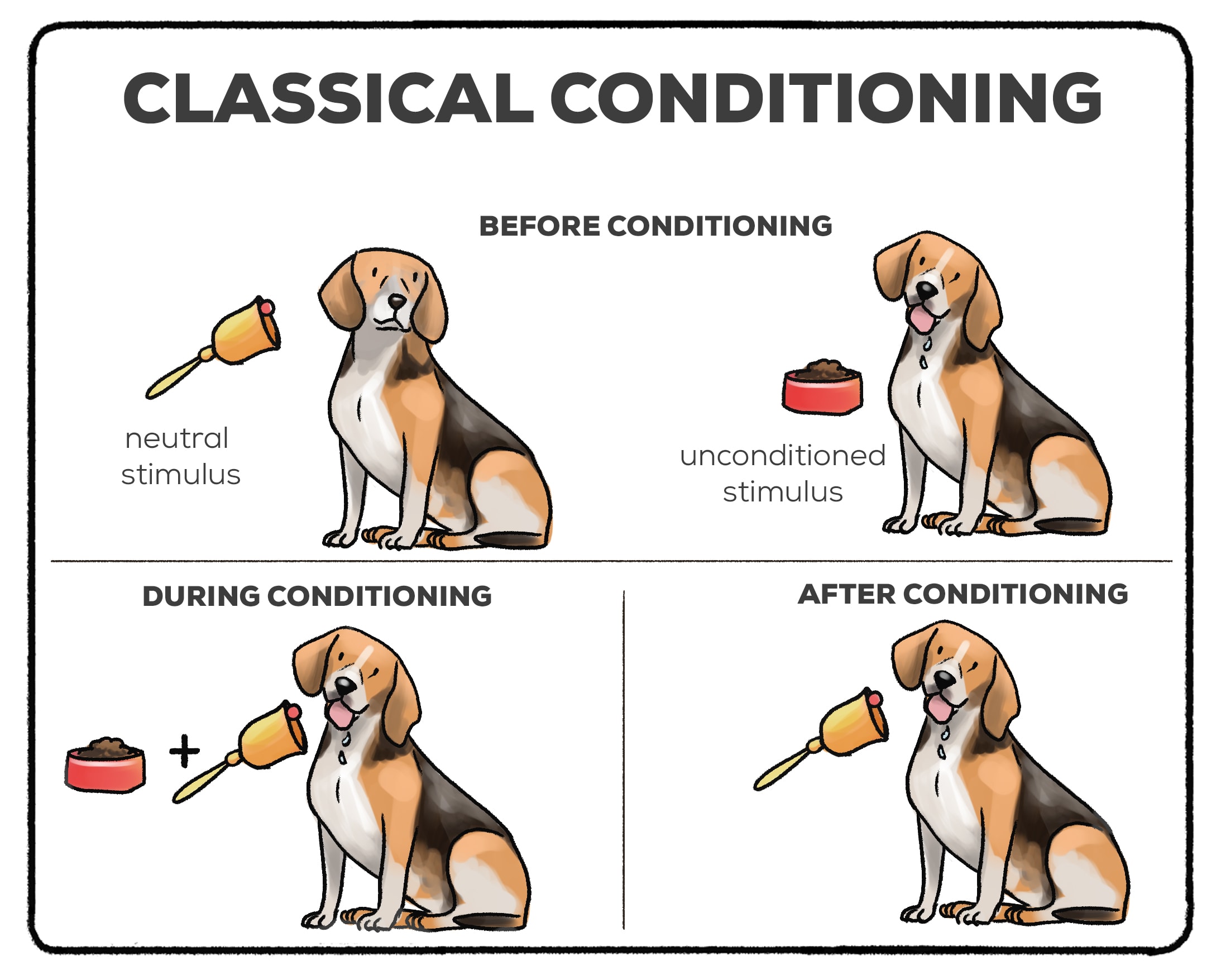
We could not wrap up these theories without talking about Pavlov’s dogs. Pavlov used stimulus-response theory to demonstrate how dogs (or humans) could learn throughclassical conditioning. This is a process in which a “neutral” stimulus becomes connected to a stimulus that already elicits a response. Once this connection is made, the previously neutral stimulus elicits a response.
Stimulus response theories, to be blunt, can be quite simple. They are alsodeterministicin nature. No one wants to believe that their decisions are the result of any sort of conditioning. Additional factors, like your thought process or the experiences that have shaped you as a person, may also influence the decisions you make. Making a decision or performing a behavior often seems more complicated than just responding to the stimulus in front of you.
As these questions were raised more and more frequently, schools of thought like humanism, positive psychology, and cognitive psychology were born.
These schools of thought are not immune to criticism, either. So completely replacing education on behaviorism with information on cognitive psychology is not necessarily the best approach. Although psychologists view behavior as more than just a stimulus and a response, we cannot forget the theories that built the foundation to what we know today.
Teachers are not solely relying on conditioning or behaviorism to teach their students. But, you can still use concepts from stimulus-response theory to teach yourself new behaviors. Want to make your bed every morning? Want to add 15 minutes of meditation into your routine? Maybe you want to replace having a cigarette with seltzer water or a piece of gum. Tap into the laws within the stimulus-response theory to “condition yourself” and bring new behaviors into your routine.
Readiness: Commit to Learning a New Behavior
Effect: Find a Suitable “Reward”
What satisfying effects can you gain from performing a behavior? For many, the Law of Effect encourages people to reward themselves. This is certainly what behaviorists had in mind when they put together schedules of reinforcement for conditioning.
Exercise: Keep Going!
The stimulus (running) and the response (a podcast) work well together. Now, you just have to keep going! The more you run and save your podcasts for that run, the more likely it will be that you integrate running into your routine permanently. Remind yourself that routines are not built in a day. Sometimes, you will slip up. All of this is okay. Every time you perform the desired behavior, you are contributing to this habit.
There are many approaches that you can use toform habits. Whether you want to build wealth, protect your health, or find happiness in the small moments, stimulus-response theory can help you build habits (or explain how you developed the ones you have!)
Related posts:Beck’s Depression Inventory (BDI Test)Operant Conditioning (Examples + Research)The Psychology of Long Distance RelationshipsVariable Interval Reinforcement Schedule (Examples)Discrimination Stimulus
Related posts:
Reference this article:Practical Psychology. (2020, November).Stimulus Response Theory (Thorndike’s Research + Examples).Retrieved from https://practicalpie.com/stimulus-response-theory/.Practical Psychology. (2020, November). Stimulus Response Theory (Thorndike’s Research + Examples). Retrieved from https://practicalpie.com/stimulus-response-theory/.Copy
Reference this article:
Practical Psychology. (2020, November).Stimulus Response Theory (Thorndike’s Research + Examples).Retrieved from https://practicalpie.com/stimulus-response-theory/.Practical Psychology. (2020, November). Stimulus Response Theory (Thorndike’s Research + Examples). Retrieved from https://practicalpie.com/stimulus-response-theory/.Copy
Copy
