 Sigmund Freud
Who Is Sigmund Freud?Sigmund Freud’s Family BackgroundEducational BackgroundFreud’s Theory of PsychoanalysisDefense MechanismsThe 5 Stages of Psychosexual DevelopmentDream Analysis and InterpretationCriticisms of PsychoanalysisSigmund Freud’s Books, Awards, and AccomplishmentsPersonal Life
Who Is Sigmund Freud?
Sigmund Freud’s Family Background
Educational Background
Freud’s Theory of Psychoanalysis
Defense Mechanisms
The 5 Stages of Psychosexual Development
Dream Analysis and Interpretation
Criticisms of Psychoanalysis
Sigmund Freud’s Books, Awards, and Accomplishments
Personal Life
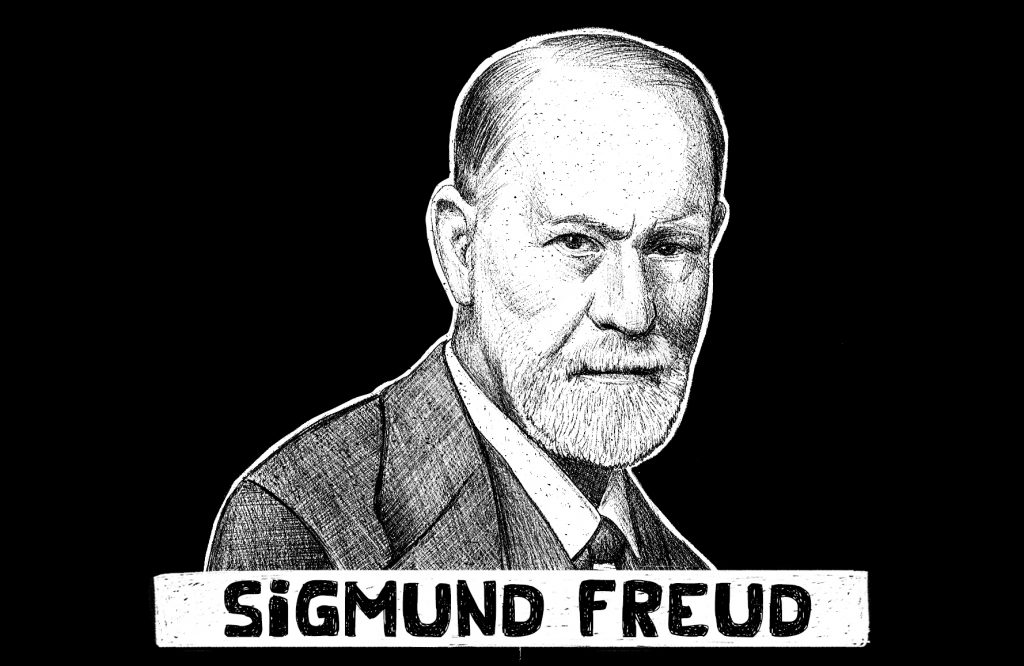
Sigmund Freud was an Austrian neurologist and the founding father of psychoanalysis. He believed that childhood experiences can impact adult life and help to shape our personality. Despite proposing a number of controversial theories throughout his career, Freud’s influence on the field of psychology is profound.
Sigmund (originally Sigismund) Freud was born on May 6, 1856, in the small Moravian town of Freiberg (now Pribor, Czech Republic). He was the eldest of eight children born to Jewish parents Jakob Freud and Amalia Nathansohn. Freud’s father worked as a wool merchant and had two adult sons from a previous marriage. At the time of Freud’s birth, the family was relatively poor and lived in a single rented room. Due to mounting financial struggles, they left Freiberg in 1859, and eventually settled in Vienna when Freud was four years old.
Childhood
Freud had a close, positive relationship with his mother and is said to have been her favorite child. He was given a bedroom for himself so he could focus on his studies, a privilege none of his other siblings received. His mother would often serve him his meals in his room.
Early Schooling
Freud’s first exposure to formal education came in 1865 when he entered a prominent high school at age nine—a year earlier than most of his peers. He was an excellent student and was constantly at the top of his class. He graduated with honors at age 17.
In 1873, Freud enrolled at the University of Vienna to study medicine. He completed his studies and earned his MD in 1881. Between 1882 and 1885, Freud worked in various departments at the Vienna General Hospital, including the Department of Psychiatry. He was appointed as aPrivatdozent(lecturer) at the University of Vienna in 1885. In that same year, he received a grant to study in Paris under neurologist Jean-Martin Charcot, who trained him in the use of hypnosis to treat the condition then known as hysteria.
Upon his return to Vienna, Freud began his private practice, specializing in nervous and brain disorders. During the 1890’s, he became dissatisfied with hypnosis as a treatment method for hysteria and began focusing more on an approach he learned previously from respected Viennese physician, Josef Breuer. While Freud was still in medical school, Breuer began treating a young woman pseudonymously called Anna O. for symptoms of hysteria. Breuer found that if he hypnotized the woman and asked her to recall events that occurred around the time a particular symptom first appeared, that symptom would disappear.
Free Association
In 1902, Freud and a small group of scholars formed the first organized group of psychoanalysts, which was called the Wednesday Psychological Society (later known as the Vienna Psychoanalytic Society). That same year, he was promoted to the rank of full professor at the University of Vienna, a position which he held until 1938.
Psychoanalysis is both a theory that attempts to explain human behavior and a form of talk therapy. Freud believed that childhood experiences help to shape one’s personality and can impact a person when he or she becomes an adult. The goal of psychoanalysis is to release repressed or pent up memories and emotions so that the individual in treatment can heal. This form of therapy involves bringing events that are in the unconscious or the subconscious to the conscious.
Freud developed psychoanalysis over the course of several years. As the theory evolved, it eventually covered a number of different concepts and mechanisms. To get a better understanding of what is involved in psychoanalysis and how the theory developed, it may be best to start with Freud’s view of the human mind.
One of Freud’s most significant contributions to psychology was his model of the human mind. He believed the mind was divided into three regions:
Freud later suggested that human personality was also divided into three major categories. These are:
Pleasure Principle
The ego develops from the id during the latter part of infancy and operates on the reality principle. It tries to satisfy the desires of the id in a socially appropriate way. This means the child will weigh the pros and cons of a particular behavior instead of acting impulsively. In this case, a hungry child who is stuck in class may think about pizza (primary process thinking) until he finally gets the opportunity to eat during his lunch break and satisfy his desire in a way that is socially acceptable.
The superego is the last part of personality to develop. Freud claimed that the superego begins to emerge when an individual is about five years old. The superego contains a person’s sense of right and wrong, and it holds all the ideals and moral standards that have been learned over time. It provides the guidelines for making decisions.
The goal of the superego is perfect behavior. As it wants the individual to behave in a civilized manner, it works to restrict the unacceptable desires of the id and tries to make the ego act on standards that are idealistic rather than realistic.
Freud believed that a good balance between id, ego, and superego results in a healthy personality. If someone has an id that is too dominant, he may develop into an adult that is impulsive or uncontrollable. As such a person wants all his desires to be satisfied right away, he may be more likely to engage in criminal activity than the average person. On the other hand, an individual with a dominant superego may be extremely moralistic and judgmental. As a result, this individual may hold himself or other people to standards that are unreachable.
Common types of defense mechanisms include:
Repression- the ego pushes disturbing thoughts out of consciousness and prevents them from coming back into the conscious mind. For example, a person who experienced sexual abuse as a child may have repressed memories of the abuse.
Denial- overwhelming external events are blocked from awareness so that the individual refuses to believe or is not aware of what is currently happening. For example, people who are addicted to alcohol may refuse to believe that they have a drinking problem.
Rationalization- the individual explains difficult feelings or unacceptable behavior in a rational or logical manner while avoiding the real reason for the feelings or behavior. For example, a student who fails a test may reason that the instructor did a poor job in teaching the topic.
Projection- the ego takes unacceptable thoughts or feelings and ascribes them to other people. For example, you may hate your teacher but you know these feelings are socially inappropriate. So you convince yourself that it is your teacher who hates you.
Regression- the individual moves backward in psychological development in order to cope with stress. For example, an adult who is stressed out at work may start throwing tantrums like a child.
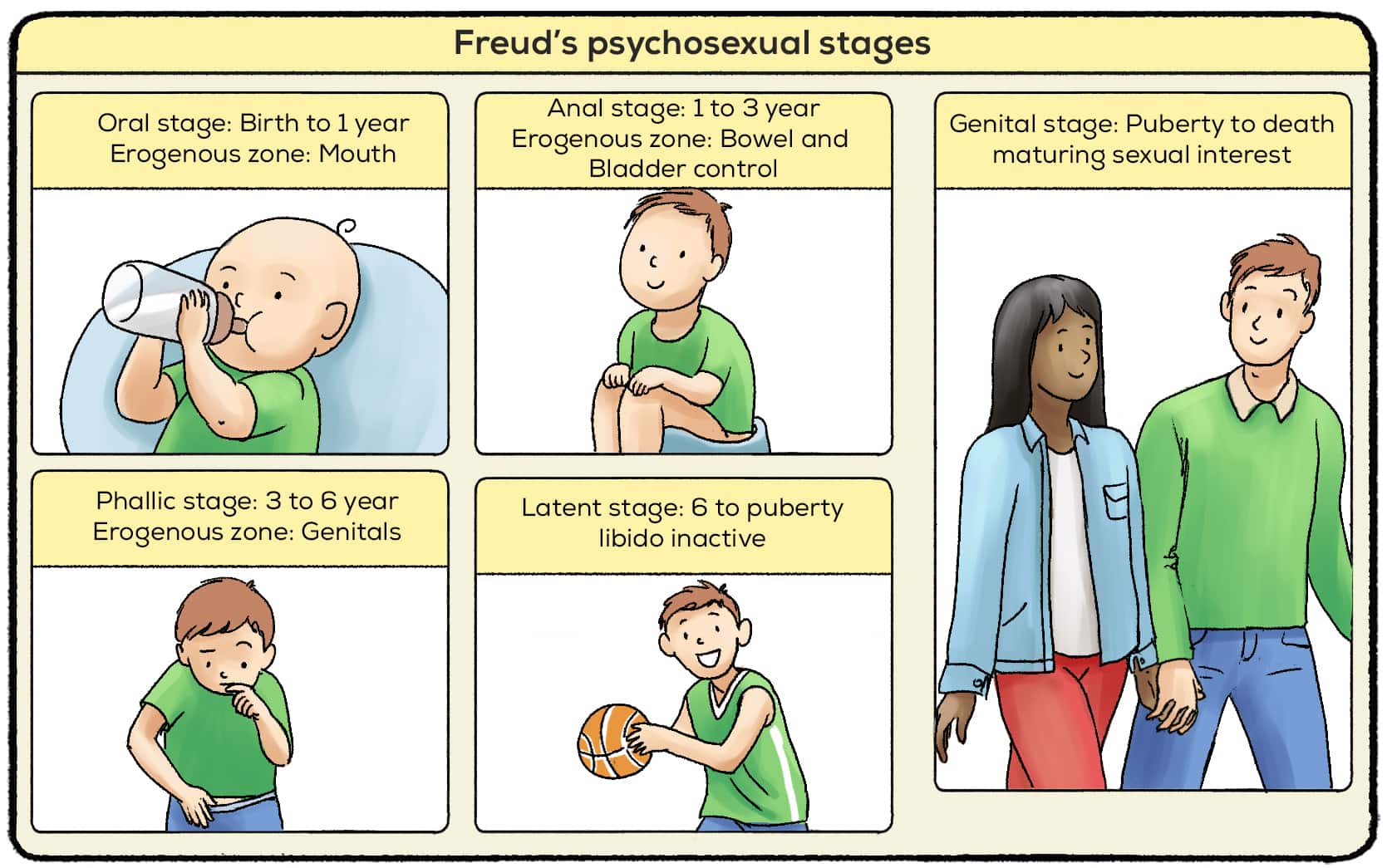
Freud suggested that children develop throughfive distinct stages of psychosexual development. He believed that children focus on a different body part as a source of pleasure in each stage. This is one of Freud’s most well-known and controversial theories. The five stages he proposed include:
Oedipal Complex
Freud also proposed that an Oedipal complex occurs during the phallic stage when children are roughly 3-6 years old. He claimed that children in this stage of development have an unconscious desire for their opposite-sex parent and feel jealous of their same-sex parent.
The Oedipal complex manifests as either an Oedipus complex in boys or an Electra complex in girls. According to Freud, a young boy will develop an Oedipus complex, become sexually attracted to his mother and view his father as a rival. As his mother shows affection for his father, the boy fantasizes about getting rid of his father and taking his place. However, the boy also develops a fear that his father will castrate him (castration anxiety) so he begins to identify with his father and adopt his attitudes, behaviors, roles, and values. This eventually results in the father becoming a role model for the boy as the boy develops his superego and learns his roles as a male in society.
Freud claimed that a young girl in the phallic stage will develop an Oedipal complex, become sexually attracted to her father, and treat her mother with hostility. The complex begins when the girl realizes that she does not have a penis and develops “penis envy.” She also blames her mother for her castration. However, fear of losing her mother’s love moves the girl to identify with her mother and adopt her attitudes, behaviors, roles, and values. This leads to the development of the girl’s superego as she learns her roles as a female in society.
Interestingly (and controversially), Freud suggested that the identification of a girl with her mother is less complete than the identification of a boy with his father. As a result, he claimed that the female superego is weaker and less developed than the male superego.
Freud believed that an individual must successfully complete each of the five psychosexual stages in order to develop into a healthy adult. If there is a conflict during any stage that remains unresolved, the individual may become stuck at that stage of development. For example, children who did not successfully complete the oral stage may demonstrate an excessive reliance on oral behaviors such as biting fingernails, eating, or smoking when they become adults.
Freud described dreams as “the royal road to the unconscious.” He believed that analyzing a person’s dreams could provide much insight into the thoughts, feelings, and memories that are buried deep within the mind. Freud viewed dreams as a way to see how the unconscious mind functions. He also used dreams to take a peek at what inappropriate thoughts lay outside of a person’s awareness.
Freud believed that the content in dreams could be separated into two categories calledmanifest contentandlatent content. Manifest content refers to all the images, sounds, and events the dreamer remembers once he awakens. Latent content refers to the symbolic meaning or underlying wish that is hidden in the dream.
Applications of Psychoanalysis
There are three main applications of psychoanalysis. It is used to:
Psychoanalysis helps people in treatment to better understand theunconscious forcesthat influence their current thoughts, feelings, and behaviors. This approach often involves eliciting emotional responses and helping individuals to overcome negative defense mechanisms. Psychoanalysis also teaches coping techniques so that people can address problems that arise in the future rather than fall back on unhealthy defenses. Individuals in therapy develop deep personal insight and learn how to deal with feelings that are difficult to process.
Although fewer therapists currently use psychoanalysis to explore human behavior or diagnose and treat mental health concerns, the approach is still well-known and hotly debated in the field of psychology. Freud’s work also influenced many younger psychologists who would help to develop the field, including Carl Jung, Erik Erikson, Alfred Adler, and Anna Freud.
One of the major criticisms of psychoanalysis is that the theory is highly unscientific. While Freud suggested explanations for human behavior, he was unable to predict behavior because his methods were not based on objective measurements. Freud developed the majority of his theories while working with a small sample of people. As a result, his theories may not be applicable to the wider population.
Some people who need mental health counseling may avoid psychoanalysis because it can be a very intense and personal treatment approach. Critics argue that the approach is too time-consuming (treatment may last for years), too costly, and is generally ineffective. Notable researchers such as Karl Popper and Noam Chomsky have repeatedly claimed that psychoanalysis is not based on empirical evidence. Some critics have suggested that Freud may have focused on information that supported his theories and ignored data that did not fit.
Sigmund Freud was a prolific writer and published a number of books on his theories. Some of his most important works include:
In 1886, Freud married Martha Bernays after a four-year engagement and the couple had six children—three boys and three girls. One of their daughters, Anna, later became a famous child psychoanalyst and was instrumental in leading the Freudian movement after her father’s death.
American Psychological Association. (2002).Eminent psychologists of the 20th century.Retrieved fromhttps://www.apa.org/monitor/julaug02/eminent
Hergenhahn, B. R. (2009).An introduction to the history of psychology(6th ed.). Belmont, CA: Wadsworth.
Rudnytsky, P. L. (2002). Freud, Sigmund. (1856-1939). In E. Erwin (Ed.),The Freud encyclopedia: Theory, therapy, and culture. New York: Routledge.
Sheehy, N. (2004).Fifty key thinkers in psychology. New York: Routledge.
Sigmund Freud (1856-1939). (n.d.). Retrieved fromhttps://www.bbc.co.uk/history/historic_figures/freud_sigmund.shtml
Related posts:Unconscious Mind (Definition + Purpose)Freud’s Psychosexual Stages of Development (Definition and Examples)Psychoanalytic Theory of Personality40+ Famous Psychologists (Images + Biographies)The Psychodynamic Approach
Related posts:
Reference this article:Practical Psychology. (2020, July).Sigmund Freud (Psychologist Biography).Retrieved from https://practicalpie.com/sigmund-freud/.Practical Psychology. (2020, July). Sigmund Freud (Psychologist Biography). Retrieved from https://practicalpie.com/sigmund-freud/.Copy
Reference this article:
Practical Psychology. (2020, July).Sigmund Freud (Psychologist Biography).Retrieved from https://practicalpie.com/sigmund-freud/.Practical Psychology. (2020, July). Sigmund Freud (Psychologist Biography). Retrieved from https://practicalpie.com/sigmund-freud/.Copy
Copy
