 Robert Hare
Who Is Robert Hare?Robert Hare’s Early LifeEducational BackgroundHare’s Research on PsychopathyHare’s Psychopathy ChecklistHare’s Psychopathy Checklist RevisedRobert Hare’s Books, Awards, and AccomplishmentsPersonal Life
Who Is Robert Hare?
Robert Hare’s Early Life
Educational Background
Hare’s Research on Psychopathy
Hare’s Psychopathy Checklist
Hare’s Psychopathy Checklist Revised
Robert Hare’s Books, Awards, and Accomplishments
Personal Life
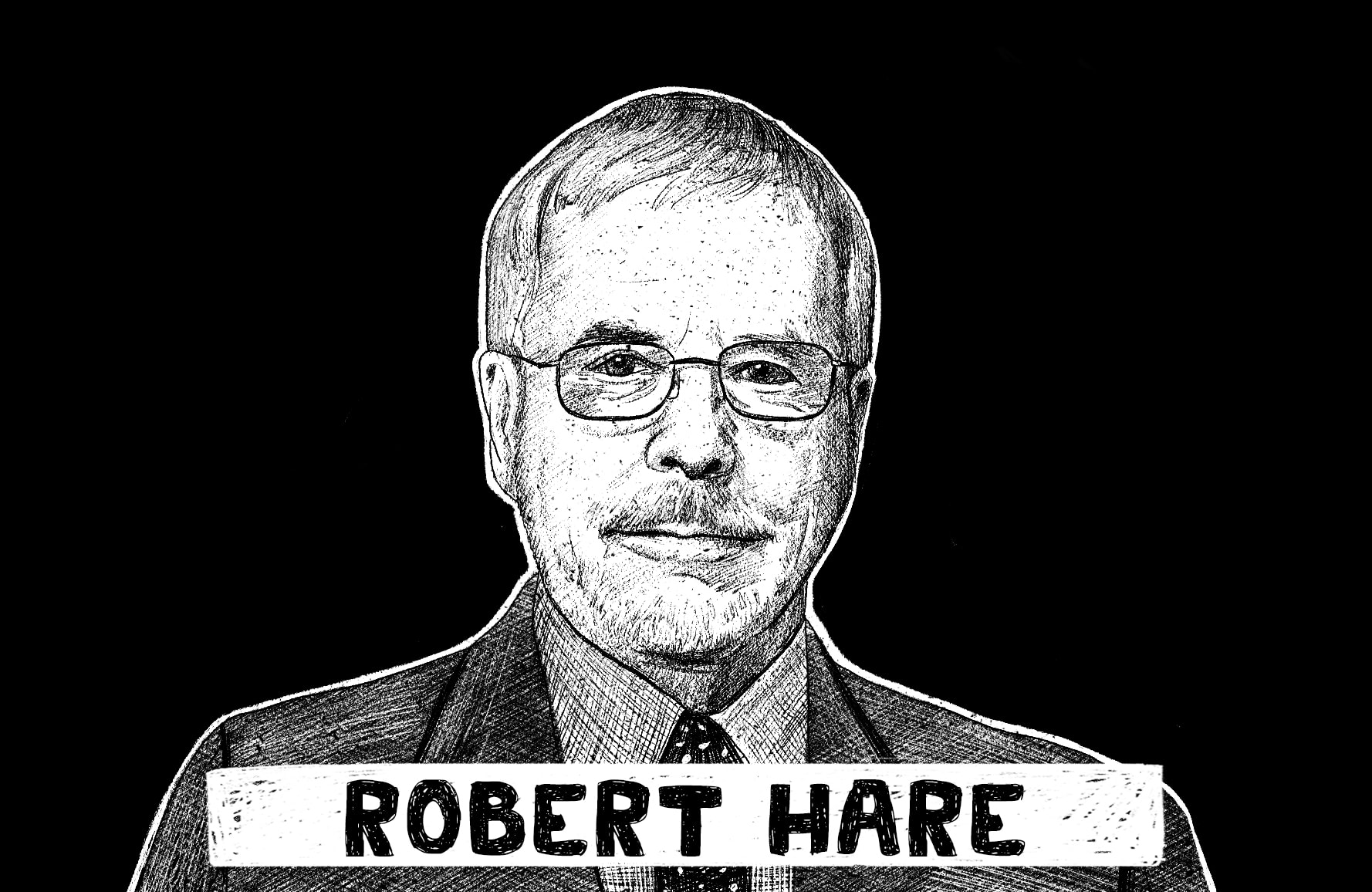
Robert Hare is a Canadian psychologist who made major contributions to the fields of criminal psychology and forensic psychology. He is best known for his research on psychopathy. Hare is the creator of the Psychopathy Checklist and the Psychopathy Checklist-Revised.
These tools help to assess a person’s psychopathic and antisocial tendencies as well as the potential risk he or she may pose to other people.
Robert D. Hare was born on January 1, 1934 in Calgary, Alberta. He was raised in a close-knit, working class family. Hare’s mother had French Canadian roots and her family dated back to Montreal in the 1600s. Hare’s father was a roofing contractor who spent much of his time during the great depression riding the rails and looking for work.
Hare enjoyed his time in school. He performed relatively well academically and often found his classes to be very easy. He claims that he coasted through high school and may gotten even better grades had he decided to apply himself. Besides his academic pursuits, Hare also played football and other sports. He recalls that during his youth he had no idea what he wanted to do with his life.
Hare enrolled at the University of Alberta in Edmonton after graduating from high school. During his first year, he did not have a clear view of what he wanted to study. His favorite subjects were science and math and he was interested in ancient history and archaeology. In the end, he took a mixture of courses that included an introduction to psychology.
Abnormal Psychology
After receiving his bachelor’s degree, Hare was eager to study human perception, emotion, and motivation. He was particularly curious about “what was going on from an experimental scientific perspective.” In 1959, Hare married an undergraduate student named Averil whom he had previously met in a class on abnormal psychology. He earned his masters degree in psychology from the University of Alberta in 1960.
One year after they were married, Hare and Averil had a daughter named Cheryl. The entire family moved to the United States so that Hare could enroll in the PhD program in psychophysiology at the University of Oregon. However, Cheryl soon developed medical issues. These issues prompted Hare and Averil to move back to Canada where treatment was less expensive.
Work at the British Columbia Penitentiary
Hare spent a total of eight months working at the prison. During that time, the smooth talking Ray persuaded Hare to recommend him for the best prison jobs, including working in the prison’s auto repair shop. When the time came for Hare to leave the prison and pursue his PhD, he took his car to the prison auto shop for a tune-up before traveling cross country with his family. As he and his family were driving downhill, the brakes on the car failed. An inspection at an auto service station revealed that someone had rigged the brake line on Hare’s car so that it leaked brake fluid slowly.
University of Western Ontario
After receiving his doctoral degree, Hare accepted a position in the psychology department at the University of British Columbia. His goal was to continue his study on how people respond to fear, punishment, rewards, and motivation. Unfortunately, Hare had no equipment or volunteers to work with. At the time, the University of British Columbia was a small regional school and the psychology department was located in several old army huts on the edge of campus.
Recognizing that he needed more resources, Hare decided to get creative. He recalled from his time at the British Columbia Penitentiary that some of the prisoners seemed immune to the threat of punishment. Hare received approval from Correctional Services Canada to carry out assessments on the inmate population. As he still had several colleagues at the BC Penitentiary, he was able to conduct his research at the prison.
Hare’s first experiment on psychopathy focused onphysiological arousal. Male volunteers were fitted with a sweat gland monitor and told that they would receive an electric shock eight seconds into a 12-second countdown. The study showed that the control subjects and most of the inmates experienced much physiological stress as they waited for the shock. However, inmates who were suspected of being psychopaths did not show significant distress.
One year later, Hare conducted a second experiment. This time, the subjects were asked to choose whether they preferred to be shocked immediately or wait ten seconds for the shock. While more than 80% of the control group and non-psychopathic inmates preferred to be shocked immediately, only 56% of psychopathic inmates chose that option. The results suggested that (1) most people prefer to get an unpleasant experience behind them as quickly as possible, and (2) psychopaths are indifferent about experiencing a negative event right away or waiting for it at a later time.
As Hare continued his studies in the mid 1970s, his greatest challenge was finding a valid psychometric tool that could be used to assess psychopathy. He realized that the concept of psychopathy had to become quantifiable in order for it to be thoroughly researched. Although self-report tests were available and the Diagnostic and Statistical Manual of Mental Disorders (DSM) provided broad guidelines on assessing antisocial personality disorder, psychopaths were able to outsmart these tools with ease. So Hare set about creating a valid assessment tool himself.
The first tool Hare devised was a checklist using the key traits Cleckley identified in his book. However, this checklist was not ideal as the traits were not specific for an assessment of psychopathy. Hare decided to work with two independent assessors to conduct more interviews with psychopathic prisoners and then analyzed the data. He shortened the list from 100 items to 22 and published a paper describing the Psychopathy Checklist in 1980.
The Psychopathy Checklist proved to be a useful tool among researchers in Canada, the United States, and the United Kingdom. According to Hare, “They might not have agreed with all the elements, but it allowed us to speak the same language and put all of us on the same diagnostic page.”
The clinician may score each item with 0 (no presence of trait), 1 (uncertain), or 2 (trait definitely present). The maximum score is 40. A person must score 30 points to be regarded as a psychopath. Non-psychopathic criminals typically score about 22 or 23 points on average. People without criminal backgrounds usually score 5 points or less.
As psychopaths tend to lie frequently, the information collected in the interview is checked against the files in the subject’s case history. The clinician also interviews family members, friends, workmates, or other associates to determine whether the subject was truthful.
Psychopathy and Brain Activity
Hare also conducted innovative experiments to examine if psychopaths have different brain activity from non-psychopaths. In one such experiment, Hare hooked up study participants to an electroencephalogram (EEG) and presented them with neutral words such as “table,” emotional words such as “torture,” and scrambled words. The results of the study showed that non-psychopaths were able to differentiate between neutral words and emotional words as emotional words produced increased brain activity. However, psychopaths showed no significant difference in brain activity when presented with neutral words and emotional words.
Hare concluded that psychopaths may view language as “purely a linguistic intellectual thing without the emotional underpinnings that color everything we do.” He reasoned that “the emotional components of language were somehow lost to the psychopath.” When the research paper was submitted for publication, the publishers doubted the accuracy and validity of the study. However, the results of the experiment were replicated years later during the world’s first brain imaging study of psychopathy.
Application of Hare’s Theories and Tools
Hare’s research has influenced modern day interview methods and crime scene analysis. His most popular tool—the PCL-R—is currently the standard tool for measuring psychopathic traits worldwide. The PCL-R is also the most popular psychometric tool for assessing the risk of violence. It is often used in post-sentencing and parole hearings that involve the most dangerous criminals.
Hare has also developed derivative tools such as the Psychopathy Checklist” Screening Version (PCL:SV), the Psychopathy Checklist: Youth Version (PCL:YV), the P-Scan, and the Antisocial Process Screening Device (APSD). The PCL-R and PCL:SV help to predict the likelihood that a criminal will reoffend, use violence, or respond well to therapy. The PCL:YV is used to assess children who show early signs of psychopathy. The P-Scan is used as a rough screen for psychopathic tendencies in a person of interest. The APSD is an instrument that detects antisocial tendencies in young children so that preventative measures can be put in place at an early age.
Criticisms of Hare’s Theories and Tools
Several researchers have criticized Hare’s theories and questioned the reliability and usefulness of the PCL-R. They argue that PCL-R scores are linked to conclusions on how treatable psychopaths are and these conclusions may be incorrect, harmful or unethical. Critics also claim that the PCL-R may be easily misused in psychiatric and legal settings.
In 2007, Hare threatened to file a defamation lawsuit against forensic psychologist Jennifer Skeem and psychologist David Cooke whose research paper was critical of the PCL-R. He also threatened legal action against the publisher of the peer-reviewed journalPsychological Assessment. As a result, the publication of Skeem and Cooke’s paper was delayed for three years. Hare received strong criticism from academia for using legal threats that impeded the progress of psychological science.
In their paper, Skeem and Cooke claim that many mental health professionals today have developed the incorrect view that the PCL-R provides a complete description of pathopathy. They argue that the PCL-R puts too much emphasis on criminality and does not include key traits of psychopathy such as low anxiety. Skeem and Cooke believe these factors may contribute to an “overdiagnosis of psychopathy.” Hare has also been criticized for sensationalizing his research findings in order to attract attention from the media.
Robert Hare wrote three groundbreaking books on psychopathy. They include:
Yes, Robert Hare even wrote about “corporate psychopaths.” He’show he described them:
”glibness and superficial charm; grandiose sense of self-worth; pathological lying; conning and manipulativeness; lack of remorse or guilt; shallow affect; callousness and lack of empathy; and the failure to accept responsibility for one’s own actions.”
Awards
Hare also received a number of prestigious awards throughout his career. Some of these awards are listed below:
Hare describes his family as close, devoted, and supportive. He claims that he and his wife, Averil, like the same things and he still views her as his best friend. Hare and Averil have toured Europe twice in a Volkswagen camper.
On October 11, 2003, Hare’s daughter Cheryl passed away after a 12 year struggle with multiple sclerosis. Hare believes the loss of his daughter has helped to define the type of people he and his wife are. Although Cheryl’s death is still very painful, Hare’s memories of her are filled with affection, happiness, and pride.
Is Robert Hare Still Alive?
Yes! As a way of commemorating his daughter’s life, Hare and Averil plan to take another trip across Europe together.
Cheryl Hare.(2003, October 15). Retrieved from https://www.legacy.com/obituaries/vancouversun/obituary.aspx?n=cheryl-hare&pid=157262078
Egan, D. (2016, May 2).Into the mind of a psychopath. Discover Magazine. Retrieved from https://www.discovermagazine.com/mind/into-the-mind-of-a-psychopath
Martens, W. H. (2008). The problem with Robert Hare’s psychopathy checklist: incorrect conclusions, high risk of misuse, and lack of reliability.Med Law, 27(2):449-62.
The Great Canadian Psychology Website. (n.d.).Biography: Dr. Robert Hare. Retrieved from https://www.psych.ualberta.ca/GCPWS/Hare/Biography/Hare_bio1.html
Welcome to “Without Conscience” Robert Hare’s Web Site Devoted to the Study of Psychopathy.(n.d.). Retrieved from http://www.hare.org/welcome/
Related posts:
Reference this article:Practical Psychology. (2021, March).Robert Hare Biography - Contributions To Psychology.Retrieved from https://practicalpie.com/robert-hare/.Practical Psychology. (2021, March). Robert Hare Biography - Contributions To Psychology. Retrieved from https://practicalpie.com/robert-hare/.Copy
Reference this article:
Practical Psychology. (2021, March).Robert Hare Biography - Contributions To Psychology.Retrieved from https://practicalpie.com/robert-hare/.Practical Psychology. (2021, March). Robert Hare Biography - Contributions To Psychology. Retrieved from https://practicalpie.com/robert-hare/.Copy
Copy
