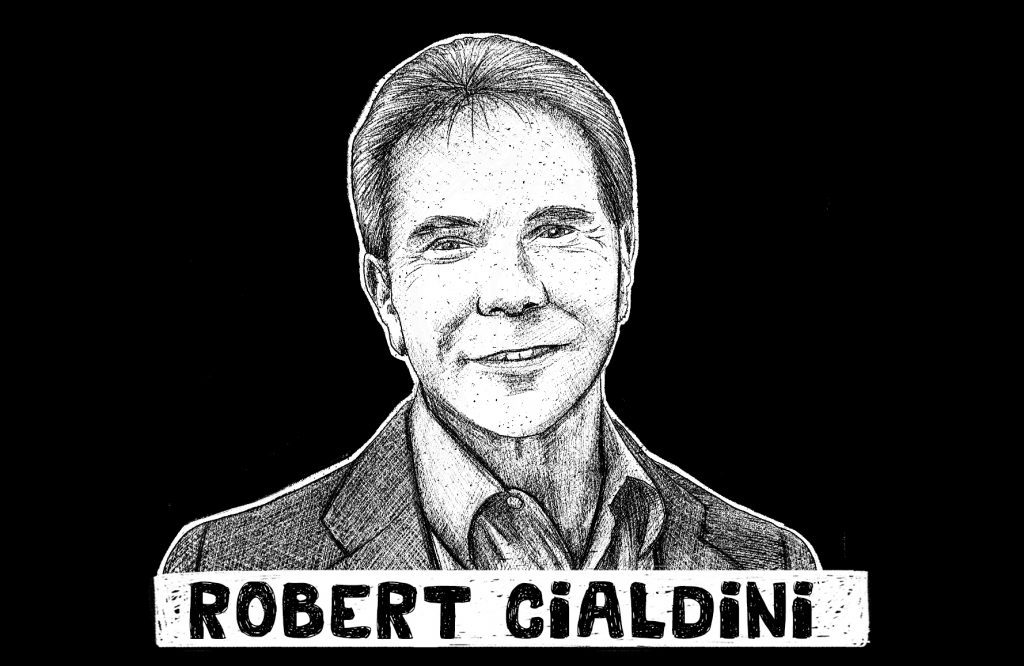
Robert Cialdini’s work has led to global praise and recognition and he is widely considered to be one of the world’s foremost experts in compliance, negotiation, andpersuasion. Want to learn more? Keep reading!

Who Is Robert Cialdini?Robert Cialdini’s Early YearsEducational BackgroundRobert Cialdini’s Six Principles of Persuasion and InfluenceApplications of Cialdini’s Principles of PersuasionRobert Cialdini’s Books, Awards, and AccomplishmentsPersonal Life
Who Is Robert Cialdini?
Robert Cialdini’s Early Years
Educational Background
Robert Cialdini’s Six Principles of Persuasion and Influence
Applications of Cialdini’s Principles of Persuasion
Robert Cialdini’s Books, Awards, and Accomplishments
Personal Life
Robert Cialdini is an American social psychologist who specializes in the science of influence. His research is focused on uncovering why people say “yes” to certain requests and how to apply these findings ethically in the business world. He is often referred to as the “godfather of influence.”
Robert Beno Cialdini was born on April 7, 1945 in Milwaukee, Wisconsin. He is of Italian descent and was raised in what he describes as an “entirely Italian family.” Interestingly, Cialdini’s Italian family lived in a neighborhood that was primarily Polish, which was located in Milwaukee—a city that was historically German.
Although not much has been documented about Cialdini’s early years, he has revealed that his childhood experiences ignited his interest insocial psychologyand behavioral science. From a young age he learned that different groups in his community had to be approached in a slightly different way if he wanted to gain their approval. Cialdini noticed that each group had its own code of conduct and characteristic tendencies. He recognized that if he wanted to maximize the chances that a member of a particular group would comply with a request, he needed to take into account the dominant social norms of that specific group.
Cialdini enrolled at the University of Wisconsin in 1963. Although he studied psychology in college, his focus at the time was animal behavior. Cialdini published his first research article on earthworm pheromones in the peer-review journalScience. He earned his bachelor’s degree in psychology in 1967.
Cialdini had every intention to continue his studies in animal behavior after receiving his first degree. His goal was to go to graduate school and become an ethologist. However, Cialdini “had a mad crush” on another student named Marilyn Repinski, so he decided to take the same social psychology course she did just so that he could get a seat next to her. By the end of the semester, Cialdini says he was more interested in social psychology than Miss Repinski.
After graduating from the University of North Carolina, Cialdini spent two years as a postdoctoral fellow at Columbia University, where he received advanced training in social psychology. In 1971, he accepted a position as an assistant professor in the Department of Psychology at Arizona State University (ASU) and remained in that role for four years. In 1975, Cialdini was promoted to associate professor before being appointed as a professor of psychology in 1979.
Cialdini was appointed as a Visiting Scholar at Ohio State University (1973-1974), the University of California at San Diego (1979), the University of California at Santa Cruz (1986), the Annenberg School of Communications at the University of Southern California (1987-1988), and the Graduate School of Business at Stanford University (1991-1994; 2001). Cialdini retired from Arizona State University in 2008 and is currently the Regents’ Professor Emeritus of Psychology and Marketing at ASU.
Social scientists have been investigating the underlying reasons people agree to the requests of others for decades. While there is still much to learn, what these researchers have discovered is that there is a science to persuasion, and many of the findings are quite surprising. For example, many people think that intelligent humans tend to consider all the facts before they make decisions. However, Cialdini’s research shows that the busier people get, the more they use shortcuts to guide their decision-making.
Cialdini identified six shortcuts or universal principles that people often use to guide their thinking and behavior. These principles are:
Cialdini believes that if you understand and apply these six universal principles, it is much easier for you to persuade someone else to agree to your request.
The Principle of Reciprocity
Cialdini’s first principle of persuasion is thePrinciple of Reciprocity. It states that people have a drive to reciprocate because they feel obligated to repay debts or return favors that they received first. This means men and women are much more likely to say “yes” to people they owe. For example, if your friend lends you some money when you are short on cash, you may feel obligated to repay the favor when your friend is low on funds.
To highlight the principle of reciprocity, Cialdini referred to a series of studies conducted in restaurants where researchers tracked the correlation between mints offered to customers to the size of the tip the waiter received after the customers finished their meal. While most people may think that a waiter leaving a mint has no influence on whether or not they will leave it tip, the research findings suggested otherwise.
The Principle of Scarcity
The second principle of persuasion is scarcity. This principle refers to the fact that people have a stronger desire for things that are in short supply or are harder to get. To highlight his point, Cialdini mentioned how sales increased overnight for British Airways in 2003 when they announced they would no longer be offering the twice daily London-New York Concorde flight. It is important to note that nothing changed about the cost or quality of the service. It had simply become a scarce resource so people wanted it more.
The more likely it is that a person will miss out on a good opportunity, service, or product, the more valuable it may seem to him or her. To maximize the effect of the Principle of Scarcity in your proposals, Cialdini recommends letting people know exactly what they stand to lose if they fail to consider your offer.
Cialdini’s third principle of persuasion is authority. This principle highlights the idea that people tend to listen to the advice and recommendations of experts or authority figures. Cialdini stated that physiotherapists are better able to influence their clients to exercise when they display their credentials on the walls of their office. People are also more likely to give change for a parking meter if the person requesting the money is wearing a uniform.
The Principle of Consistency
The next principle of persuasion is consistency. This principle plays on the fact that people like to be consistent with the things they previously said or did. For the most part, people feel obligated to honor their commitments.
The Principle of Liking
The fifth principle of persuasion claims that an individual is more likely to say “yes” if he or she likes the person who is making the request. In general, we like people who are attractive, who work with us toward shared goals, who have similar interests, and who give us compliments. This is the reason a salesman will try to pay you compliments and make you feel as if you are his friend before he tries to sell you anything. He wants you to make a purchasing decision based on the positive emotions you feel rather than focus on the merits of his service or product.
To highlight how effective the Principle of Liking can be, Cialdini shared a report on negotiation studies that were carried out at two business schools. One group of students was told to “get straight down to business” when negotiating with clients. The second group was instructed to exchange some personal information and identify common interests they had with the client before they began negotiating. The report indicated that 55% of students in the first group were able to come to an agreement with the client. However, 90% of students were able to come to a successful outcome in the second group. To use the Principle of Liking effectively, Cialdini recommends that you give genuine compliments and highlight things you have in common with the client before you begin discussing business.
The Principle of Consensus or Social Proof
Cialdini’s sixth principle of persuasion is consensus or social proof. It suggests that people will often observe and imitate the actions of others if they are not sure what to do in a particular situation. This principle is related to the common beliefs that there is wisdom in crowds and safety in numbers.
Cialdini’s principles of persuasion provide people with small adjustments they can make to greatly increase their ability to influence others. While it is true that these principles can be used in a negative way, Cialdini encourages ethical applications of his research. His work has been used in a wide variety of fields such as:
Robert Cialdini Criticism
Cialdini has received widespread praise for the simplicity, relevance, and effectiveness of his work. However, there are people who have criticized his research. They argue that while it is true that the small changes Cialdini suggests may have big effects in certain settings, these tweaks may not be applicable in other contexts. For example, if you tell potential customers that many people use your online store you may improve your online business; if you tell potential customers that many people use your local supermarket they may stay away because they think it will be too crowded for them to shop.
Another criticism of Cialdini’s work is that it may give people the impression that they have access to shortcuts that will quickly transform them into experts of persuasion. That assumption is simply not true. The reality is that persuasion can be extremely complicated and is often very difficult to do well.
Cialdini himself acknowledges that there are limits to the persuasion tactics he recommends. He notes that persuasion tactics are unlikely to be enough to turn around a failing company with a poor business strategy. Some critics also point to the fact that society is constantly evolving. This means these persuasion principles may only work until people get wise to them or sick of them. While it is clear that progress has been made in the scientific study of influence, some individuals believe much more testing is necessary before offering general principles of persuasion.
Robert Cialdini has authored or co-authored five books. His writings have had a major impact around the world. Cialdini is a Wall Street Journal, New York Times, and USA Today best-selling author. His books are listed below:
Cialdini’s books have sold more than five million copies worldwide and are available in 41 languages. His bookInfluencewas included inFortune Magazine’slist of “75 Smartest Business Books” andCEO Read’slist of “100 Best Business Books of All Time.” According to Wilhelmina Wosinska—one of Cialdini’s colleagues—his textbookInfluence: Science and Practice(originally published in 1984) has been taught in Poland for so many years that her students think Cialdini is dead.
Cialdini received honorary doctoral degrees from the following universities:
Robert Cialdini is married to Bobette Gorden. Close friends sometimes refer to the couple as “Bob and Bobette.” They have one son, Christopher Cialdini.
Is Robert Cialdini Still Alive?
Cialdini, Robert Beno. (2002). In N. Sheehy, A. J. Chapman, & W. A. Conroy (Eds.),Biographical dictionary of psychology. New York: Routledge.
Clayton, M. (2016).Robert Cialdini: Influence and pre-suasion. Retrieved fromhttps://www.pocketbook.co.uk/blog/2016/12/20/robert-cialdini-influence-and-pre-suasion/
D’Ardenne, K. (2018).ASU Department of Psychology leaps forward with gift from emeritus professor. Retrieved fromhttps://asunow.asu.edu/20180430-asu-department-psychology-leaps-forward-gift-emeritus-professor
Everett, H. (2018).The psychology of free: Does giving free samples increase sales?Retrieved formhttps://upserve.com/restaurant-insider/does-giving-free-samples-increase-sales/
Influence at Work. (2020). Retrieved frommhttps://www.influenceatwork.com/
Roux, C. (2013).Research heroes: Robert B. Cialdini. Retrieved fromhttps://indecisionblog.com/2013/05/20/research-heroes-robert-b-cialdini/
Society for Personality and Social Psychology. (n.d.).Robert B. Cialdini. Retrieved fromhttp://spsp.org/about/foundation/heritage-fund-initiative/cialdini
Related posts:40+ Famous Psychologists (Images + Biographies)The Psychology of Long Distance RelationshipsBeck’s Depression Inventory (BDI Test)Operant Conditioning (Examples + Research)Variable Interval Reinforcement Schedule (Examples)
Related posts:
Reference this article:Practical Psychology. (2020, July).Robert Cialdini (Psychologist Biography).Retrieved from https://practicalpie.com/robert-cialdini/.Practical Psychology. (2020, July). Robert Cialdini (Psychologist Biography). Retrieved from https://practicalpie.com/robert-cialdini/.Copy
Reference this article:
Practical Psychology. (2020, July).Robert Cialdini (Psychologist Biography).Retrieved from https://practicalpie.com/robert-cialdini/.Practical Psychology. (2020, July). Robert Cialdini (Psychologist Biography). Retrieved from https://practicalpie.com/robert-cialdini/.Copy
Copy
