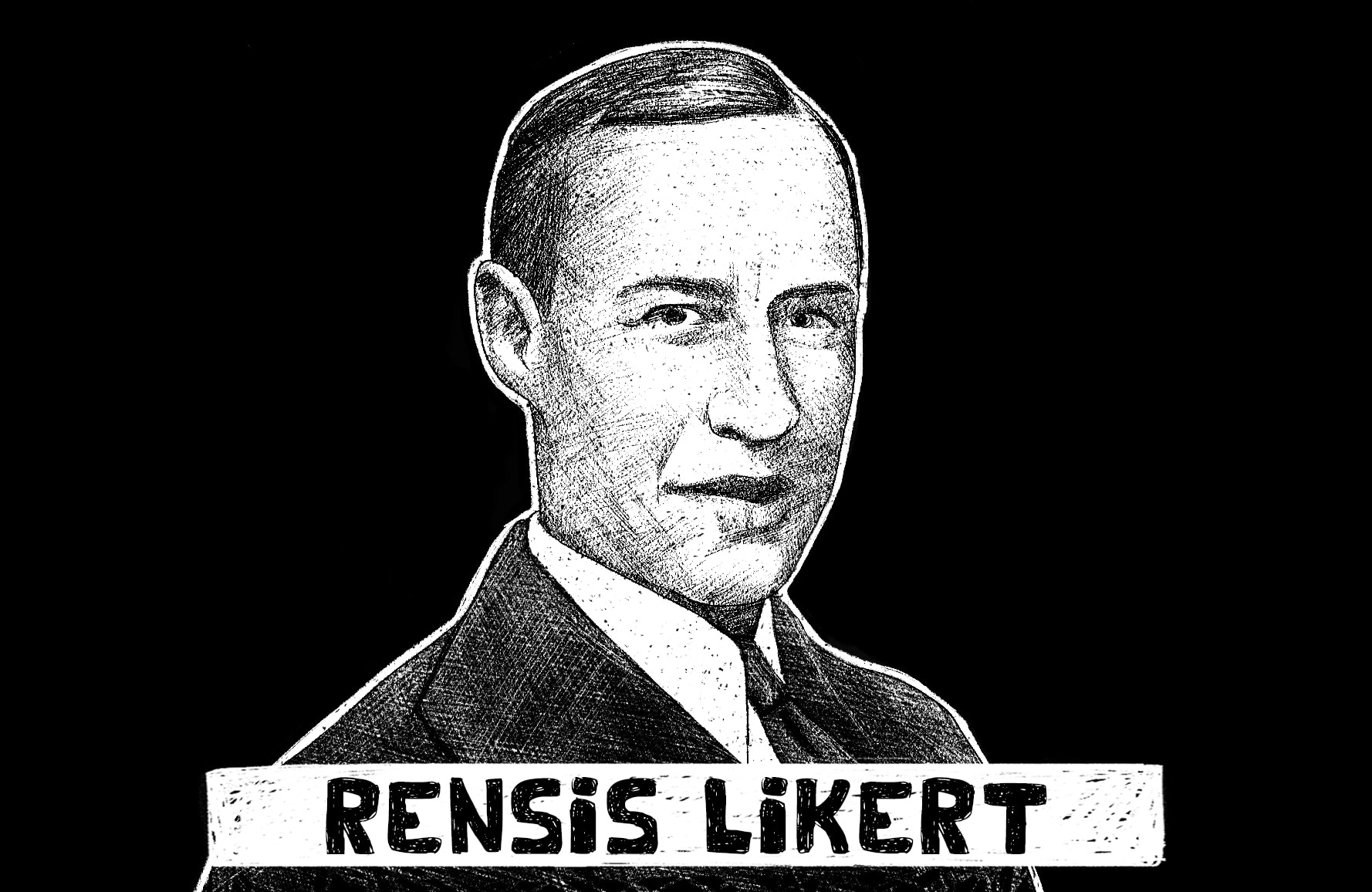
If you are studying organizational psychology, it’s likely you’ve run into the name Rensis Likert. Likert is well-known for his work on organizational behavior and management styles, particularly his theory of participative management. Over the course of his career, he held several prestigious positions and was the recipient of numerous professional awards.

Who Is Rensis Likert?Rensis Likert’s Early Life and Educational BackgroundEarly Psychology CareerThe Likert ScaleManagement Systems Model and Leadership StylesApplications of Likert’s TheoriesCriticisms Of Rensis LikertRensis Likert’s Contributions to Psychology: Books, Awards, and AccomplishmentsPersonal Life
Who Is Rensis Likert?
Rensis Likert’s Early Life and Educational Background
Early Psychology Career
The Likert Scale
Management Systems Model and Leadership Styles
Applications of Likert’s Theories
Criticisms Of Rensis Likert
Rensis Likert’s Contributions to Psychology: Books, Awards, and Accomplishments
Personal Life
Rensis Likert was born on August 5, 1903, in Cheyenne, Wyoming. He was the son of George Herbert Likert, an engineer who worked for Union Pacific Railroad, and Cornelia Adrianna Likert (nee Zonne), a former teacher. He had one sibling, a younger brother named after his father.
Study of Sociology
In his senior year, after taking a sociology course with Robert Angell, Likert’s interest in studying people intensified to the point where he changed his major to sociology and economics. Angell later recalled Likert as the brightest engineering student in that class. Likert graduated with a B.A. in sociology in 1926.
Likert was very active in undergraduate student activities on campus. In addition to being a member of several student organizations, he served as Vice-President of the Michigan Union and President of the cabinet of the Student Christian Association. After graduating from Michigan, he studied theology for one year at Union Theological Seminary and later earned his Ph.D. in psychology from Columbia University in 1932.
In 1930, Likert began lecturing in the psychology department at New York University. He also taught at Sarah Lawrence College and Columbia University. He left academia in 1936 to take up a position as director of research for the Life Insurance Agency Management Association in Hartford, Connecticut. While there, he embarked on a program of research on the effectiveness of different styles of supervision, an area of research to which he would return in the 1960s.
Work During World War II
After the end of World War II, government support for the DPS waned and its work was eventually suspended. Likert and his team decided to move together to a university where they could continue their research. They eventually accepted an offer from the University of Michigan to set up an interdisciplinary institute for research in the social sciences. They founded the Survey Research Center (later called the Institute for Social Research) in July 1946.
Survey Research Center
Likert served as director of the Survey Research Center from its inception until his retirement in 1970. Under his directorship, the center grew into the largest university based social science research organization in the nation. Likert and his associates studied a wide range of organizations ranging from schools and hospitals to businesses and voluntary groups. Among the topics they studied were consumer motivation and economic behavior, organizational change, political motivation, group behavior, industrial mental health, and community leadership. During his time at the University of Michigan, Likert also served as a professor of sociology and psychology. In 1967, he helped establish the Human Resource Institute (now known as the Institute for Corporate Productivity) at the University.
Likert’s interest in studying people’s attitudes led to the creation of theLikert Scalein 1932. The measurement tool was developed as part of his Ph.D. dissertation, entitledA Technique for the Measurement of Attitudes. In that paper, Likert used empirical evidence to show that his simple technique produced similar results to the more complicated Thurstone procedure in popular use at the time.
The Likert scale assesses people’s attitudes with a series of statements to which the respondent indicates his or her level of agreement. The values of the “classical” scale range from 1 to 5 (from strongly agree to strongly disagree), with the midpoint of the scale reflecting a neutral or undecided position. For example, the following items might appear on a scale designed to measure students’ attitude toward online learning.
Strongly Agree
1
Agree
2
Undecided
3
Disagree
4
Strongly Disagree
5
Responses to each statement or ‘item’ on the scale are combined to determine the individual’s overall attitude.
Interviewing Techniques
Likert also pioneered the use of open-ended survey questions which allow the respondent to answer in his or her own words. These are in contrast to forced-choice questions which offer the respondent a predetermined set of responses from which to choose. While forced-choice questions have their advantages, such as ease of coding, Likert recognized the need for a method of questioning that would facilitate greater depth when assessing people’s attitudes toward various issues. Open-ended questions accomplish this objective.
Soon after establishing the Institute for Social Research, Likert spearheaded a series of studies in over 200 governmental and business organizations. This led to his management system model in which he identified four management systems or leadership styles:
System 3: Consultative
System 4: Participative
In this management system, which Likert considered to be the ideal, there is an emphasis on teamwork, group decision-making, and supportive relationships. Managers willingly consult with subordinates and incorporate their suggestions and ideas when setting goals and making decisions. In addition to motivating employees through the use of rewards, managers also endeavor to enhance workers’ sense of worth and belongingness within the organization. A friendly, trusting relationship exists between managers and subordinates. Likert found that this management system engenders greater loyalty and cooperation among workers and results in higher levels of productivity than other systems.
Linking Pins
An important concept in participative management theory is what Likert called “linking pins.” These are individuals who are members of more than one group within an organization. The linking pin usually functions both as a superior in one group and as a subordinate in a higher group. He or she helps to keep the channels of communication open between different levels of the organization, transmitting upwards the needs, goals and feelings of subordinates to superiors, and communicating downwards organizational policies and objectives to subordinate staff. Linking pins create overlapping work groups that help to hold the organization together.
In spite of its popularity, the Likert scale has several limitations, some of which are noted below:
On a typical Likert scale, some items are wordedin favor ofthe issue or object in question, whereas others are wordedagainstthe issue or object. Some critics believe this lack of uniformity could confuse respondents.
Existing evidence suggests that respondents sometimes find the midpoint on a Likert scale confusing and may interpret it differently even when a label is assigned (e.g., Undecided or Neutral). This can introduce measurement error, adversely affecting the reliability and validity of the instrument.
It is generally assumed that the intervals between the values on the scale are equal but there is no sound basis for this belief. For example, the interval between agree and strongly agree may not necessarily be the same as the interval between agree and neutral. As such, the scale is said to be imprecise.
Equal scores on a Likert scale do not necessarily indicate an equal position in relation to the given issue or object. This is because the same overall score may be derived from different combinations of item values.
Respondents are often reluctant to choose extreme values (e.g., 1 and 5 on a five-point Likert scale), which could restrict the range of scores obtained.
Likert scales are fairly transparent and are therefore susceptible to response bias. Instead of answering honestly, respondents may answer in ways that they deem socially acceptable or in the manner they think the researcher wants them to respond.
Although Likert advocated participative management as the ideal management style, there are several drawbacks and criticisms associated with it as well. Firstly, allowing employees to participate in the decision-making process actually slows down the process as it is time-consuming to discuss multiple perspectives. In a situation where a decision needs to be made urgently, this style of leadership could actually be counterproductive. Poor or mediocre decisions may also be made when less experienced workers are allowed to have a major input in the decision-making process.
Another limitation of participative management is that it can generate conflict between employees. For example, some workers may take offense if they think that their ideas are being disregarded. Instead of building supportive relationships, constant use of participative management may therefore create rifts between employees. Other critics argue that Likert ignored the influence of situational factors which could cause the participative system to fail. These include the skill of the leader, the nature of subordinates, as well as theorganizational climate.
Over the course of his distinguished career, Likert authored and co-authored over 100 published articles, as well as several books, most of which were written on the subject of management. These include:
Likert was a member of several professional organizations, including the American Academy of Arts and Sciences, the American Management Association, the National Academy of Public Administration, and the American Statistical Association (ASA). He was vice president of the ASA from 1953 to 1955, and president in 1959. He was also a member of the Executive Council of the American Association of Public Opinion Research and was on the Board of Directors of the American Psychological Association.
Likert served on several research committees and received numerous awards for his research and writing. These include the Paul D. Converse Award from the University of Illinois in 1955, the James A. Hamilton Award in 1962, and the Society for Personnel Administration’s Stockberger Award in 1963. He also received awards from the Society for the Advancement of Management, the American Board of Examiners of Professional Psychologists, the American Association of Public Opinion Research, the Organization Development Council, the McKinsey Foundation, and the American Society for Training and Development.
Likert was awarded the Medal of Freedom in 1946 for his work on the effects of constant bombing on the morale of civilians in Germany and Japan. During his tenure at the University of Michigan, he was a recipient of the Distinguished Faculty Achievement Award and in 1967, he was awarded an honorary degree from Tilburg University in the Netherlands.
While studying at the University of Michigan, Likert met Jane Gibson and the two got married in 1928 during his time at Columbia. They had two daughters, Elizabeth Jane and Patricia Anne. Jane, who received undergraduate training in education, helped establish the University of Michigan’s Center for the Education of Women in 1964. Likert and Jane were more than just marriage partners, they were also professional colleagues, collaborating on several writing projects. They moved to Honolulu, Hawaii in 1969 following Likert’s retirement.
Likert had a warm, engaging personality and adopted an open-door policy, freely welcoming others into his home and office. He also practiced what he preached in his theory of participative leadership, ensuring that his feedback to others was always constructive and upbuilding.
How Did Rensis Likert Die?
Likert died from bladder cancer on September 3, 1981, in Ann Arbor, Michigan. He was buried at the Forest Hill Cemetery in Ann Arbor.
Kish, L. (1982).Rensis Likert: Creator of organizations. Retrieved from
Rensis Likert: Creator of Organizations
Likert, Rensis. (2005). In M. Witzel (Ed.),Encyclopedia of history of American management(pp. 329-332). England: Thoemmes Continuum.
Mehta, A. (2009).Organisation development: Principles, process and performance. New Delhi, India: Global India Publications Pvt Ltd.
Rensis Likert. (n.d.). Retrieved from
https://ancestors.familysearch.org/en/LKRF-5YW/rensis-likert-1903-1981
Shear, R. G., & Cooper, B. S. (2012).Screwed up school reform: Fixing America’s broken promise. United Kingdom: Rowman and Littlefield Education.
University of Michigan. (n.d.).Classroom profile: Rensis Likert. Retrieved from
http://faculty-history.dc.umich.edu/faculty/rensis-likert/classroom-profile
Related posts:The Likert Scale (Definition + Examples)40+ Famous Psychologists (Images + Biographies)Kurt Lewin Biography - Contributions To PsychologyDaniel Kahneman Biography - Contributions To PsychologyCarl Jung Biography
Related posts:
Reference this article:Practical Psychology. (2021, March).Rensis Likert Biography - Contributions To Psychology.Retrieved from https://practicalpie.com/rensis-likert/.Practical Psychology. (2021, March). Rensis Likert Biography - Contributions To Psychology. Retrieved from https://practicalpie.com/rensis-likert/.Copy
Reference this article:
Practical Psychology. (2021, March).Rensis Likert Biography - Contributions To Psychology.Retrieved from https://practicalpie.com/rensis-likert/.Practical Psychology. (2021, March). Rensis Likert Biography - Contributions To Psychology. Retrieved from https://practicalpie.com/rensis-likert/.Copy
Copy
