Looking for examples of the Primacy Effect in action? Look no further, in this article I’m going to dive deep into what it is, how it works, and the psychology behind the Primacy Effect (also known as the Primacy Bias.)
What Is the Primacy Effect?Primacy Effect Example and ExperimentAnchoring Bias vs. Primacy BiasHow to Use The Primacy EffectThe Recency EffectRelated posts:
What Is the Primacy Effect?
Primacy Effect Example and Experiment
Anchoring Bias vs. Primacy Bias
How to Use The Primacy Effect
The Recency Effect
Related posts:
Here’s the basic idea of the primacy effect: when presented with a list of information, you are most likely to recall items at the beginning of the list. These items are more likely to end up in your long-term memory than items at the middle or the end of the list.

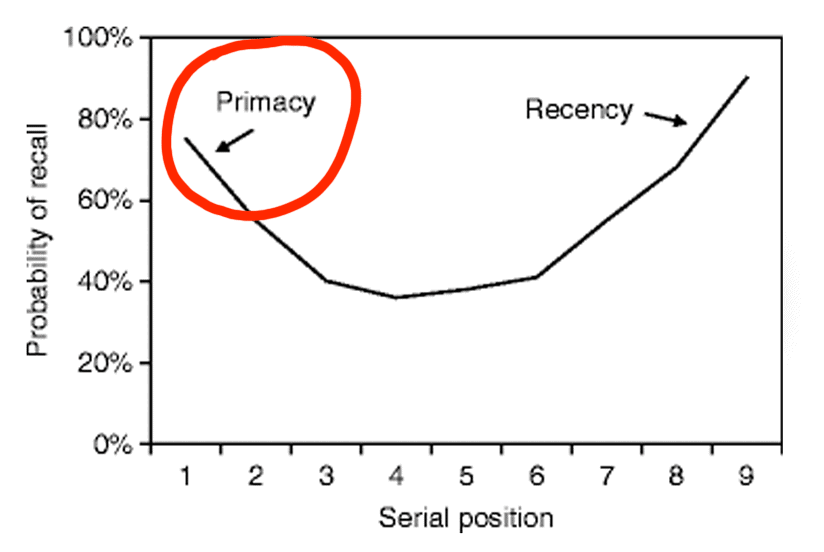
It’s a simple idea, but there are a lot of factors that play into the primacy effect:
You’ve got a choice between two dates.
The first date is envious, stubborn, critical, impulsive, industrious and intelligent.
The second date is intelligent, industrious, impulsive, critical, stubborn, and envious.
Who would you like to go on a date with?
Did you say the second person? You’re not alone. Did you notice that both people were described with the same words,just in a different order? Then you might have heard of this study before.
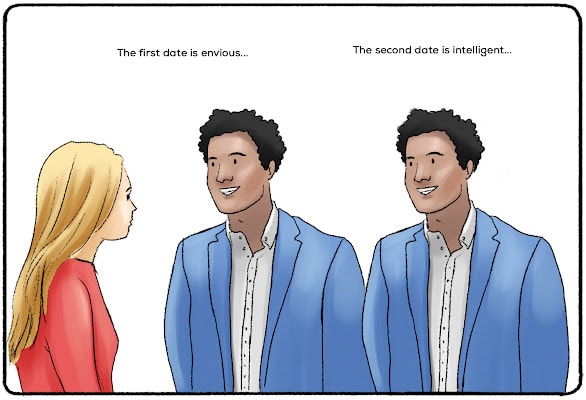
In 1946,Solomon Aschasked participants to rate people based on the collection of words that were used above. People rated the second person much higher than the first person. His results went on to support the Primacy Effect.
The Primacy Effect also ties into another concept in psychology concerning first impressions.
The same works with first impressions when meeting people. The first time someone meets you will stick in their mind a lot longer and be more memorable throughout time due to the primacy effect.
Miller and Campbell presented participants with two arguments: one for a plaintiff accused of a crime, and one against. In some trials, they switched the order in which the arguments were presented. In others, they delayed the time between hearing the two arguments and asking participants to make a decision.
When there was a delay between hearing the final judgement and making a decision, the participants were more likely to remember (and vote with) the first argument they heard. For example, if they heard the argument against the plaintiff, then immediately heard the argumentforthe plaintiff, and then made their decision a day or two later, they were more likely to vote against the plaintiff.
Once you come late or present a bad application, the hiring managers are likely to have written you off already. And as they circle back to your application as they make their decision, they are most likely to remember that you came late or made a bad first impression.
When you vote, it’s important to read over the list of candidates and learn about their policies. The order in which you learn the names of the candidates, however, could have an impact on how you vote.Multiple studiesfrom recent years show that the candidate listed first, who is likely to be listed first online and in other resources, was more likely to win than any of the other candidates. Politicians who open a debate with a strong argument are also more likely to have that message heard as opposed to the arguments they make in the middle of the debate.
The Primacy Effect can affect how we remember and view the world in many ways. The Primacy Effect is closely linked to the Anchoring Bias. Every time we “anchor” onto a piece of information, we let that first piece of information stick in our minds more than anything we learn after. If we first see that gas is $1.00, and then later see gas priced at $1.50, $1.10, and $.80, we are still most likely to remember that $1.00 and base our judgements off of that information.
Marketing and sales professionals use the idea of anchoring to get in the minds of their customers. They can also use it to position information in a way that benefits their business. You can use the primacy effect whether or not you work in sales.
Writing a speech?Make a list of what information you want to communicate to listeners. Put the most important information at the top of your list and use this list to write your speech.
Need to study?Switch up the lists of terms and concepts you need to memorize. If you stick to the same list, you’re likely to remember the top items - but the middle items might not be so easy to recall during test time.
Heading on a date?Don’t forget to make a good first impression. If you communicate (through body language or your tone) that you’re confident, this impression will continue to stick in your date’s mind throughout the evening.
What about items at the end of a list? Do your impressions matter less and less as you build relationships with others?
Both the Primacy and Recency Effect make up a theory on theSerial Position Effect, which shows through many studies that people are more likely to remember the first and last parts of a list than the middle.
Related posts:Serial Position Effect (Example + Definition)Anchoring Bias (Definition + Examples)The Mandela Effect (Definition + Examples)Recency Effect (Definition + Examples)The Framing Effect (Definition + Examples)
Reference this article:Practical Psychology. (2019, July).Primacy Effect (Definition + Examples).Retrieved from https://practicalpie.com/primacy-effect-examples/.Practical Psychology. (2019, July). Primacy Effect (Definition + Examples). Retrieved from https://practicalpie.com/primacy-effect-examples/.Copy
Reference this article:
Practical Psychology. (2019, July).Primacy Effect (Definition + Examples).Retrieved from https://practicalpie.com/primacy-effect-examples/.Practical Psychology. (2019, July). Primacy Effect (Definition + Examples). Retrieved from https://practicalpie.com/primacy-effect-examples/.Copy
Copy
