What’s harder to complete? Reading a nonfiction book or completing a 1,000-piece puzzle? Depending on your abilities and experience, you might have a different answer than the person next to you or your significant other. You use different skills to complete each task. And unfortunately, one set of skills is often valued higher than another when you’re taking tests for school or to get certain jobs.
People with high perceptual reasoning abilities, for example, may take a puzzle over a nonfiction book any day. And while their ability to complete a puzzle fast may not be the one skill that gets them into college, perceptual reasoning is crucial to solving many everyday problems.
What Is Perceptual Reasoning?Tasks and Problems That Require Perceptual Reasoning AbilitiesWhat Causes a Perceptual Reasoning Deficit?How To Improve Perceptual Reasoning SkillsDifferent Types of IntelligenceWAIS-IVPerceptual Reasoning vs. Other Forms of IntelligenceHow To Support Your Child With High Perceptual Reasoning Skills
What Is Perceptual Reasoning?
Tasks and Problems That Require Perceptual Reasoning Abilities
What Causes a Perceptual Reasoning Deficit?
How To Improve Perceptual Reasoning Skills
Different Types of Intelligence
WAIS-IV
Perceptual Reasoning vs. Other Forms of Intelligence
How To Support Your Child With High Perceptual Reasoning Skills
Perceptual reasoning is the ability to take in visual information and organize it, interpret it, and use it to solve problems. No verbal communication is required. If you’re solving a problem that requires you to visualize the solution in your head, you’re using perceptual reasoning.
Perceptual reasoning abilities can make life a lot easier. You could be looking at a map in a different language, but with high perceptual reasoning abilities, you may be able to get from Point A to Point B.
 tasks that require perceptual reasoning skills
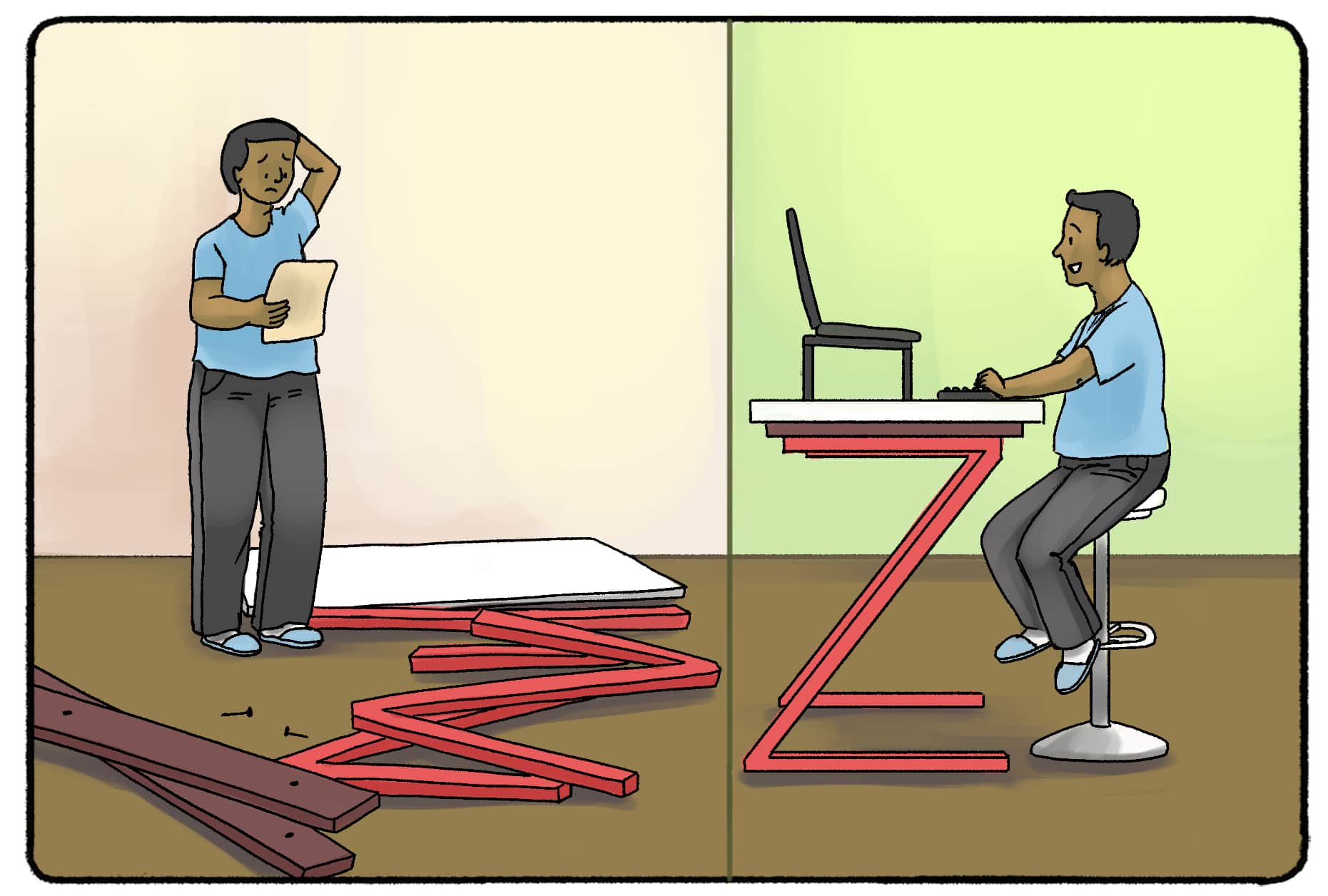
You might have high perceptual reasoning abilities if you can:
Perceptual reasoning consists of two processes: taking in visual information and applying that information. If you notice a perceptual reasoning deficit in your child, they might be experiencing developmental delays in the parietal lobe, occipital lobe, and their neuronal networks. They may also be experiencing visual impairment.Seven out of ten studentswho have a learning disability when it comes to reading have a visual impairment. Visual impairments simply aren’t uncommon, and their ability to interfere with perceptual reasoning and other skills aren’t uncommon, either. One in four children has visual impairments that hold them back if unmanaged.
Signs that your child has a perceptual reasoning deficit include:
For some students, a trip to the eye doctor will improve their perceptual reasoning skills quickly. Other parents may need to take their children to the pediatrician for a closer look into their developmental delays.
Children may also lack in perceptual reasoning skills simply because they haven’t practiced them enough. It is not uncommon for schools to prioritize activities like reading and math over logic and perceptual reasoning. Parents should consider adding activities to their child’s routine to observe their perceptual reasoning skills (and give them opportunity to practice.)
You may be considered intelligent if you can assemble furniture without minimal help. You may also be considered intelligent if you can read a book and put together a report on that book. And while educational standards may tell you that one of these skills is more important, they are still both valid types of intelligence.

A few different educational psychologists have created theories around the idea of multiple intelligences. In 1938,Louis Thurnstonewrote that intelligence did not just come from one general ability. He listed seven “primary mental abilities,” including verbal comprehension, perceptual speed, and spatial visualization. Howard Gardener has provided a more up-to-date theory onmultiple intelligences. Gardener listed a set of eight intelligences, including visual-spatial intelligence and verbal-linguistic intelligence.
The work of these psychologists and others has influenced the way that we measureintelligenceand qualify someone as advanced or deficient in some areas.
Curious to know where you fall when it comes to perceptual reasoning? Fortunately, there are tests that measure these skills in adults and children. Use the WAIS-IV to assess your skills or your child’s skills and see where you could support them in school and life.

The Perceptual Reasoning Index Scale is one of the four subtests of the current Wechsler Adult Intelligence Scale (WAIS.)WAISis an IQ test given to adults to measure their intelligence and cognitive abilities.
WAIS-IV, the current version of the test, is the first version that includes a “perceptual reasoning” scale. In earlier versions of the WAIS, “perceptual reasoning” was called “perceptual organization.”
To measure perceptual reasoning, participants are given three to five tasks:
Perceptual Reasoning tests, along with Working Memory, Verbal Comprehension, and Processing Speed tests, create a participant’s General Ability Index and Full Scale IQ scores.
Interpreting WAIS-IV Scores
Children who score low in all of these areas may be diagnosed with conditions likeADHDor Aspberger’s. Interestingly enough, children with high-functioning forms of these conditions often score very high on perceptual reasoning tests.
While you may be able to find blocks on anIQ test, you might not see them in the classroom past preschool. College admissions officers don’t require students to put together puzzles in order to be accepted.
Our current education system values verbal reasoning over perceptual reasoning. Tests ask you to read and write before they ask you to construct a photo or find the missing puzzle piece. But verbal-linguistic intelligence is just one form of intelligence, according to Howard Gardner. Verbal comprehension and word fluency are just two skills that contribute to overall intelligence, according to Louis Thurstone.
With today’s testing, a student with high verbal comprehension skills may be considered highly intelligent, even if they have little perceptual reasoning abilities. Conversely, a student with visual and spatial intelligence may not get the same praise or recognition if they suffer on verbal and linguistic tests.
So don’t let a standardized test based on one type of intelligence tell you that you aren’t intelligent. Don’t let a standardized test based on one type of intelligence tell you that you’re more intelligent than someone else. Everyone has different abilities and holds different types of intelligence. Use a test like WAIS-IV to get a bigger picture of your intelligence. As you discover where your strengths lie, you will be able to find the best ways to learn and solve problems in your unique way.
If a child’s strengths are not being validated at school, you should validate them at home. You may notice that your child struggles with math problems, but can build a skyscraper with minimal problems. They backseat drive, but they’re always right when it comes to directions! Maybe their grades don’t reflect how intelligent you know they are. Continue to support your child and nurture their skills. They will find, one day, that their strengths can help them establish a successful career!
Build your chore chart around organizational tasks:People with perceptual reasoning skills usually know how to make a space look nice. They have an eye for organization and even efficiency. When you create your child’s chore chart, play to those strengths. Can they help you put away the groceries? Tidy up the counters? Arrange the dolls and toy room? You might find that your child enjoys these tasks moreandis more motivated to get them done.
Reassure them of their intelligence: A child with high perceptual reasoning skills may not feel as “smart” as the other kids. Why? Their grades tell them they’re not. Talk to your child about the different forms of intelligence, and let them know there are other forms of intelligence outside of verbal.
Careers That Require High Perceptual Reasoning Skills
The world needs people who can map out what is in front of them and see what other people can’t. Perceptual reasoning is an important skill to have! Encourage your child and remember that not all tests of intelligence measure all types of intelligence.
Related posts:Free Online IQ Test (No Email + 5 Mins + Instant Results)Where is the Primary Visual Cortex Located?Inductive Reasoning (Definition + Examples)Perceptual Learning (Definition + Examples)Perceptual Adaptation (Definition + Examples)
Related posts:
Reference this article:Practical Psychology. (2020, May).Perceptual Reasoning (Definition + Examples).Retrieved from https://practicalpie.com/perceptual-reasoning/.Practical Psychology. (2020, May). Perceptual Reasoning (Definition + Examples). Retrieved from https://practicalpie.com/perceptual-reasoning/.Copy
Reference this article:
Practical Psychology. (2020, May).Perceptual Reasoning (Definition + Examples).Retrieved from https://practicalpie.com/perceptual-reasoning/.Practical Psychology. (2020, May). Perceptual Reasoning (Definition + Examples). Retrieved from https://practicalpie.com/perceptual-reasoning/.Copy
Copy
