If your friends were to describe you, what would they say? Would they say that you are open to new experiences? Would they say you are creative? Or would they say that you are more conservative, or set in your ways?
We’re going to zoom in on that one dimension: openness, or openness to experience. This is one out of five dimensions that make up the Big Five Personality Theory. Let’s talk about this theory, how openness fits into it, and whether or not you have a high level of openness to experience.
What is Openness to Experience?About the Big FiveExamples of Openness to ExperiencesAre These Personality Traits Fixed?How to Improve Openness to Experiences
What is Openness to Experience?
About the Big Five
Examples of Openness to Experiences
Are These Personality Traits Fixed?
How to Improve Openness to Experiences
To put it simply, it means the person is open-minded. They aren’t afraid to think outside the box or consider possibilities outside of what they already know. Abstract, new, or different ideas do not intimidate them. We often associate openness to experience with curiosity, creativity, or flexibility.
Of course, this is just one way that a person could describe you. Personality psychologists would say that this is just one dimension of a person’s personality.
 Five Factor Model
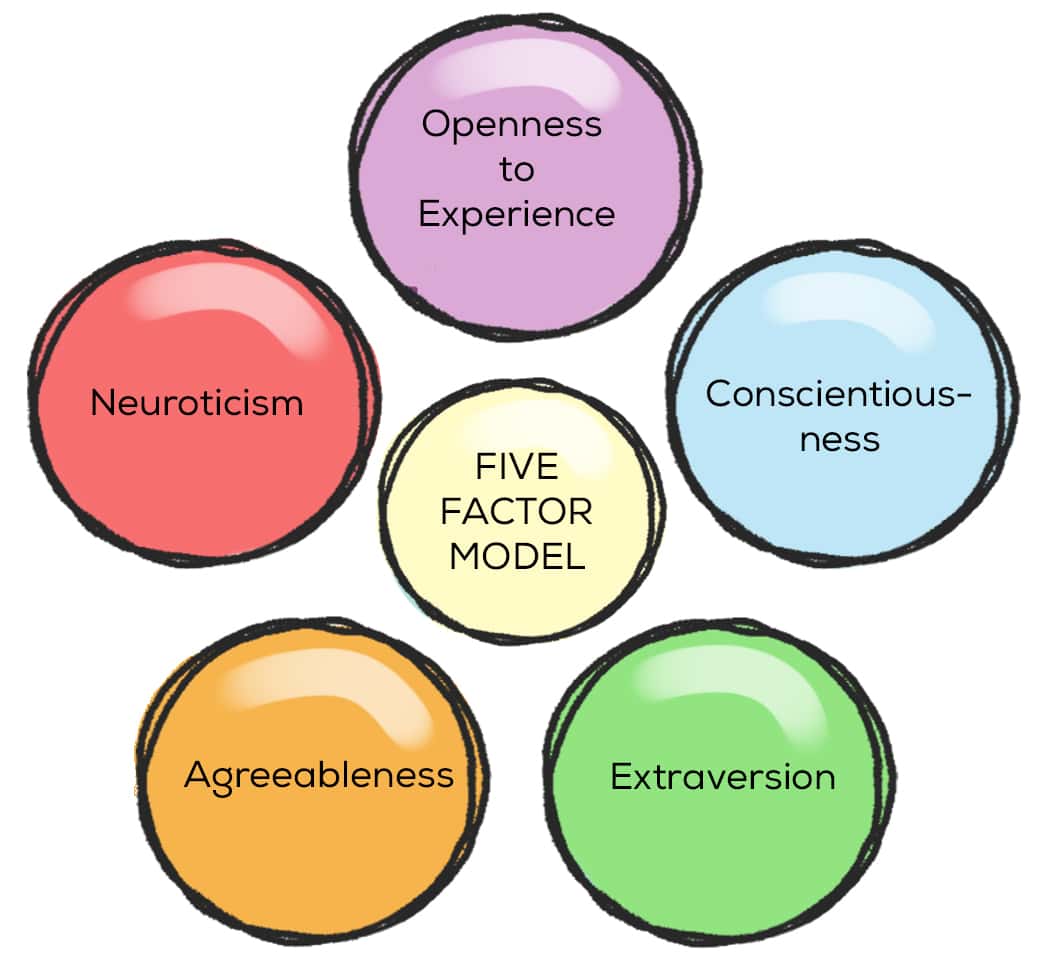
This theory identifies five traits that can be universally used to describe personality. Openness to experience is just one of these five traits. The other four are:
Now, you probably know someone who isn’t very extroverted or isn’t very open to experience. Don’t worry. That person still has a personality! These five traits exist on a spectrum - they are five dimensions of a person’s personality.Personality psychologistsbelieve that personality exists between one of two extremes. They might be very open to experience or they are incredibly close-minded. Or, a person may be somewhere in the middle.
High Openness to Experience
In general, progressive political agendas are favorable to people with a high openness of experience. Just because something is rooted in tradition does not mean it is necessarily the best idea for them as individuals, their family, town, or even country.
Outside of politics, a person with high openness to experience is likely to try new foods, activities, or creative endeavors. A spiritual retreat, a year-long backpacking trip across a new continent, or a bizarre art show all sound like great ideas to someone who is very open to new experiences. Sure, they might not always agree with the perspective of the artist or end up liking the experience, but they are willing to try everything once!
Low Openness to Experience
Not only do they dislike change, but a person with low openness to experience may actively resist it. When it comes to politics, a person with low openness to experience may grow up voting for the same party for their whole lives. They are happy to continue traditions. New forms of government or new political philosophies are not likely to get through to them or change the way they view certain issues or ways of doing things.
Is Openness to Experiences Good or Bad?
It’s important to note that it’s not good or bad to have a high or low openness to experience. These are two extremes. A person with a lower openness to experience may feel more comfortable in their comfort zone, but may not judge another person with a different perspective and lifestyle. Other personality traits, including conscientiousness and agreeableness, also influence how a person seeks out, processes, and acts on new information and experiences.
Based on the description of these two extremes, you may know where on the spectrum you fall. If you like to change up where you go on vacations or adventures every year, you’re likely to have a high openness to experience. If you prefer to go on the same trip and eat at the same restaurant, you’re likely to have low openness to experience. Take a look at the following phrases and see if you agree:
If you agree with at least half of these statements, then you are on the higher side of openness to experience.
If you are looking to become more open to new experiences, there is no better time to start than today! Be mindful of the choices that you make throughout the day. Are you watching a television show because it looks new and exciting, or because you’ve seen it before and feel comfortable with it? Are you watching a certain news channel because they agree with you or because you want to get a more well-rounded perspective on certain issues in politics or entertainment?
Starting Small
If you find yourself nervous about trying something new, start small. Order from a new restaurant. Read a book from an author you’ve never heard of. Attend a meetup or take a class with a bunch of strangers. Do not go into the new experience with any preconceived notions - they’ll only shape how you see the experience and how you feel when you walk away.
As you try something new, continue to question your judgment. Are you actively looking for flaws or excuses to not like the experience? Why might you see the experience differently than someone else? What previous experiences or perspectives may lead someone to see the experience in a more favorable light?
This work can be tiresome at first, so that’s why it’s good to start with small changes to yourroutine. Trying a new restaurant isn’t going to ruin your year or completely change your life. The worst that can happen is that you don’t love the experience and you can try something else. This is what openness is all about - letting the experiences shape themselves and continuing to try out something until you find what you like or learn something new.
Related posts:Beck’s Depression Inventory (BDI Test)The Psychology of Long Distance RelationshipsOperant Conditioning (Examples + Research)Big 5 Factor Model of Personality (Free Test + OCEAN)Variable Interval Reinforcement Schedule (Examples)
Related posts:
Reference this article:Practical Psychology. (2021, April).Openness to Experience (Meaning + Examples).Retrieved from https://practicalpie.com/openness-to-experience/.Practical Psychology. (2021, April). Openness to Experience (Meaning + Examples). Retrieved from https://practicalpie.com/openness-to-experience/.Copy
Reference this article:
Practical Psychology. (2021, April).Openness to Experience (Meaning + Examples).Retrieved from https://practicalpie.com/openness-to-experience/.Practical Psychology. (2021, April). Openness to Experience (Meaning + Examples). Retrieved from https://practicalpie.com/openness-to-experience/.Copy
Copy
