At first glance, “negative reinforcement” might sound uncomfortable or contradictory. Is there such a thing as negative reinforcement or positive punishment?
In the world of behaviorism, yes. Both of those terms exist. You might be surprised to learn that negative reinforcement actually encourages a behavior to happen again!
What is Negative Reinforcement?Operant ConditioningExamples of Negative Reinforcement in PsychologyContinuous vs. Partial Negative ReinforcementReinforcement SchedulesIs Negative Reinforcement Effective? Exploring Ethical and Long-Term Implications
What is Negative Reinforcement?
Operant Conditioning
Examples of Negative Reinforcement in Psychology
Continuous vs. Partial Negative Reinforcement
Reinforcement Schedules
Is Negative Reinforcement Effective? Exploring Ethical and Long-Term Implications
Negative Reinforcement is when a stimulus is removed to increase a certain behavior. For example, if a young adult gets up early in the morning to avoid being last in the bathroom, they have increased a certain behavior to avoid the stimulus of waiting in the bathroom.
Punishments and reinforcements could be broken down into positive or negative categories. This doesn’t signify the outcome of the reinforcement; rather, “positive” or “negative” refers to whether a stimulus was added or removed as a response to a behavior. In the case of negative reinforcement, a stimulus is removed. This stimulus was probably burdensome or cumbersome, so removing the stimulus often feels like a relief.
During the early 1900s, psychological experiments focused on understanding behavior, yielding notable works from psychologists Ivan Pavlov and B.F. Skinner, each establishing distinct theories – classical andoperant conditioning, respectively.
In the context of this experiment, there are additional underlying psychological principles beyond negative reinforcement, such as learned helplessness, which will be further discussed later in the article.
Here are some other examples of negative reinforcement that you may have observed or even experienced:
In each example, a stimulus is removed in response to a behavior. The next time the person (or animal) has the choice to do that behavior, they are more likely to do it because they know the negative stimulus may be removed again.
Expanding on the concept of continuous reinforcement, it’s essential to underscore why this method, despite its efficacy, might be impractical or unfeasible in various situations. Continuous reinforcement entails rewarding every time a desired behavior is executed. Although this approach can rapidly establish and solidify a behavior, it is often impractical due to time, resources, and logistics constraints.
Firstly, continuous reinforcement may be resource-intensive. Rewarding a behavior each time it occurs demands a significant supply of reinforcements, whether they be treats, praise, or other rewards. This could be impractical or economically unviable in real-world scenarios, particularly in contexts like classroom settings or large-scale animal training.
Secondly, administering continuous reinforcement can be incredibly time-consuming and attention-demanding for the one providing the reinforcement. In environments where one individual is managing the behaviors of many, such as a teacher with a large class or a trainer with multiple animals, maintaining a consistent and immediate reward schedule for every instance of a desired behavior can become a logistic challenge.
Moreover, once a behavior is established through continuous reinforcement, it may become notably susceptible to extinction if the reinforcement ceases. If the reward is suddenly no longer provided, the learned behavior might quickly diminish or disappear.
While continuous reinforcement has its challenges and limitations, psychologists like B.F. Skinner has examined alternativereinforcement schedules, notably partial or intermittent reinforcement schedules. These schedules, which include:
 reinforcement schedules
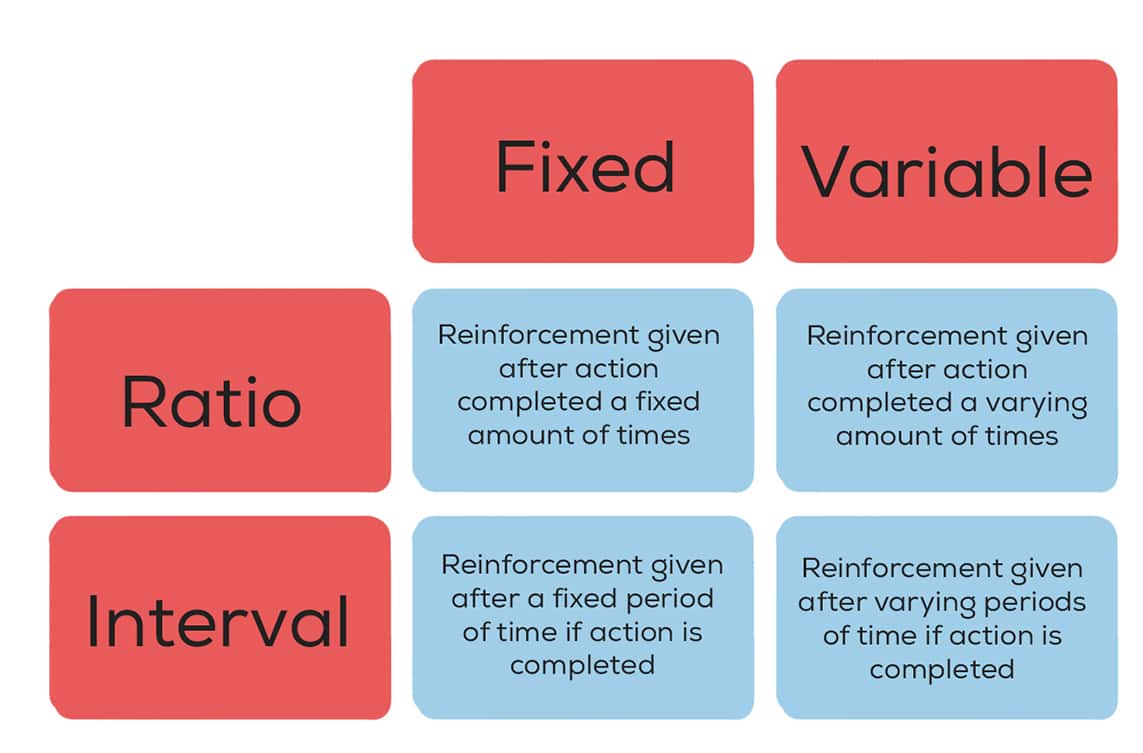
These schedules introduce an element of variability and unpredictability in reinforcement delivery, which can often be more manageable and similarly effective in maintaining established behaviors, and in some instances, even more resistant to extinction. Exploring these varied schedules allows researchers and practitioners to adapt reinforcement strategies to the practical and contextual demands of different learning and training environments.
However, educators must choose a realistic and achievable ratio to keep students motivated and ensure that the reinforcement is valuable and equitable to all students, considering their diverse needs and abilities. This method provides a clear, straightforward incentive for positive behavior while requiring the mindful application to maintain engagement and fairness in the learning environment.
A variable-ratio schedule removes the stimulus in response to an inconsistent number of behaviors. Maybe the assignments are removed after four assemblies of good behavior. Next time, the homework is removed after six assemblies of good behavior. Next time, the homework is removed after two assemblies of good behavior.
Another example of this is the example with the bath mentioned earlier. Every now and again, a parent may be so tired of their child screaming that they take away the stimulus of giving them a dreaded bath. In most cases, this reinforcement is doled out randomly. Yet, the child is still more likely to try at least screaming so that the negative stimulus may be removed. Although negative reinforcement can encourage positive outcomes, being unintentional about reinforcement can also encourage a person (or animal) to encourage negative outcomes.
Fixed-interval schedules remove the stimulus in response to a behavior after a fixed interval. The snooze button is a great example of this. You typically have nine minutes to perform a behavior (getting up and turning off your alarm.) If you can perform this behavior, the stimulus (the sound of the alarm) is removed. If you do not perform this behavior, the stimulus remains.
Fixed-interval schedules can be effective, but they often encourage people to just perform the behavior right before the interval. Let’s say children are encouraged to help other students - if they are observed doing so, their homework will be removed on Friday. Every Friday, the teacher goes down the list of students and removes the stimulus from the students who performed the behavior. While some students will be encouraged to perform the behavior early in the week, many will “cram” that behavior into Thursday or Friday. If you are a procrastinator, this isn’t the best schedule for training yourself.
The final reinforcement schedule is a variable-interval schedule. Instead of taking away homework every Friday for students who helped others throughout the week, the “schedule” is more sporadic. One week, the teacher may take away homework on Friday afternoon. The following week, they may not take it away at all. Next week, they may take it away on Tuesday for students who were observed helping a classmate in the past week.
This is another reinforcement schedule that keeps people on their toes. If they are motivated enough to have the stimulus removed, they are likely to complete the behavior more often. However, this type of conditioning takes time, as the person does not always know when they “should” be performing the behavior.
In some instances, the failure to appropriately implement negative reinforcement at initial stages might result in miscomprehensions about the possibility to “escaping” a negative stimulus, leading to variations in its effectiveness.
Long-Term Impacts: Unveiling “Learned Helplessness”
Reflecting on the dog experiment exposes negative reinforcement’s potential perils, such as inducing learned helplessness. Dogs unable to escape the shock collar in early trials, irrespective of their actions, became disinclined to attempt desired behaviors due to this learned helplessness. Contrastingly, those who comprehended their ability to control the situation (and thus the removal of the negative stimulus) were more likely to engage in the desired behavior.
Alternatives to Negative Reinforcement: A Multifaceted Approach
Amidst efforts to navigate behavioral training, whether teaching a dog to sit or encouraging children to consume vegetables, a keen awareness of the stimuli being manipulated in response to behaviors is paramount. It’s beneficial to explore diverse forms of operant conditioning, encompassing positive reinforcement and both positive and negative punishment, always ensuring ethical considerations are paramount.
Reddit user shoebox asked theDogTraining subreddit, “If negative reinforcement isn’t the right strategy, how do you get your dog to stop behaviors?” The comment section contains ways to reinforce, punish, and prevent behaviors! The ensuing dialogue unveiled many methods to reinforce, punish, and preempt behaviors, underscoring the wealth of alternatives available beyond negative reinforcement.
In summary, negative reinforcement can be potent yet warrants judicious and ethical application, always with an eye toward minimizing any potential negative emotional or psychological impact, particularly in vulnerable populations or in scenarios where the establishment of trust and positive relationship dynamics are crucial.
Related posts:Schedules of Reinforcement (Examples)Operant Conditioning (Examples + Research)Positive Reinforcement (Definition + Examples)Variable Interval Reinforcement Schedule (Examples)Fixed Ratio Reinforcement Schedule (Examples)
Related posts:
Reference this article:Practical Psychology. (2021, April).Negative Reinforcement (Definition + Examples).Retrieved from https://practicalpie.com/negative-reinforcement/.Practical Psychology. (2021, April). Negative Reinforcement (Definition + Examples). Retrieved from https://practicalpie.com/negative-reinforcement/.Copy
Reference this article:
Practical Psychology. (2021, April).Negative Reinforcement (Definition + Examples).Retrieved from https://practicalpie.com/negative-reinforcement/.Practical Psychology. (2021, April). Negative Reinforcement (Definition + Examples). Retrieved from https://practicalpie.com/negative-reinforcement/.Copy
Copy
