The Myers Briggs Type Indicator (MBTI) Test has been used for a long time to help students, patients, and researchers help understand a person better. This short Myers Briggs test can be used to help find a suitable career, a significant other, and even hobbies.
Are you an ENTJ? An INFP? Even if you have never used any Myers-Briggs tools to discover your personality type, you probably have seen these acronyms before. This is the most popular personality test in the country - over two millions adults use online tools to determine their personality type. A shocking 89 of theFortune100 companies use it for hiring and development purposes. In this video, I’ll tell the history of the Myers-Briggs Type Indicator and how it has became one of the most famous ways to look at different personalities.
Want to learn more about the Myers Briggs Personality test and what the results mean for you without reading about it? Check out this video I created:
Enjoy the video!
History of the Myers Briggs TestWhat Do The Results Mean?Who is Myers Briggs?Is the Myers Briggs reliable? (Is it scientific?)Why was the Myers Briggs Test Created?What can the Myers Briggs be used for?What Are The 16 Personalities?Myers Briggs and CompatibilityOther Personality Tests, Insights, and Variations of the Myers Briggs Test
History of the Myers Briggs Test
What Do The Results Mean?
Who is Myers Briggs?
Is the Myers Briggs reliable? (Is it scientific?)
Why was the Myers Briggs Test Created?
What can the Myers Briggs be used for?
What Are The 16 Personalities?
Myers Briggs and Compatibility
Other Personality Tests, Insights, and Variations of the Myers Briggs Test
Jung believed that humans experienced the world using four different functions. These functions were the dichotomies that we associate with the test today: Extraversion vs. Introversion; Sensing vs. Intuition; Thinking vs. Feeling; and Judging vs. Perception.
At the time that Briggs and her daughter were researching Jung’s theories, America was involved in World War Two. Women were looking for work at unprecedented rates, many for the first time. Briggs and Briggs Myers believed that if women could understand Jung’s theories and assess their personality, they would be able to look for jobs that would best suit their interests and personalities.
So they took all of the dichotomies and created a test that would show which “side” we stood on. Their assessment determined whether a person was more introverted than extroverted, more likely to think versus feel, etc. The combinations of these four “sides” creates a personality type: an ENTJ, for example, is more extraverted, uses intuition, is more likely to think than feel, and judges before perceiving. There are sixteen of these personality types and each one is more likely to have certain talents or skills in the workplace or in relationships.
Their first version of the assessment, TheBriggs Myers Type Indicator Handbook,was published in 1944, and it was a test that could be printed out. For the next fifty years, the assessment would be tweaked and threeMBTI Manuelswould be published. It contains over 80 questions in the European version and over 90 in the American version. Certified professionals are the only people allowed to administer and deliver the results of the MBTI. People can access many similar versions of the MBTI online, but unless a licensed professional is involved, they will only receive a close guess of their results.
If you’re looking for a myers-briggs personality test that is free, or one that is online, or even one that is printable, you probably won’t find one. Due to the company that owns the Myers Briggs Type Indicator assessment tool, you’ll have to visit a trained professional and pay an average of $49.95 to get your true results. If you want to become an MBTI test-giver, the fee to become accredited is up to $3850.
It should also be noted that there are many misspellings of the Myers Briggs Type Indicator tests, some of which include: Meyers Briggs, Meijer Briggs, and Myers Brigs. If any test is spelled this way, it is not the official personality assessment.
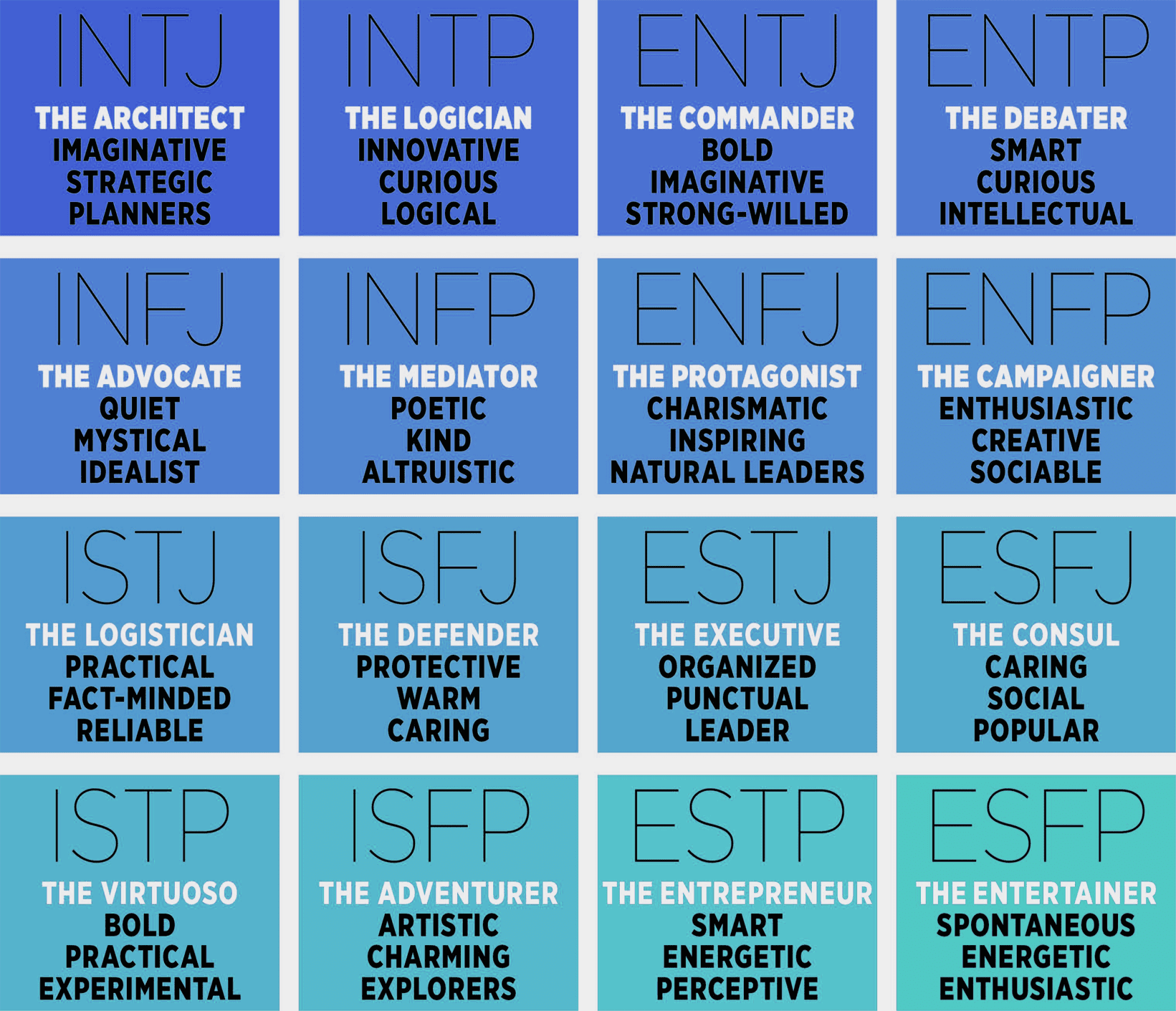 Printable Myers Briggs Matrix
So you took the official Myers Briggs test from an official test-giver and you’re an ENTJ. But what does that mean?
In order to look at the results for the MBTI, we’ll have to look back at how Carl Jung believed that humans interacted with their world and how Briggs interpreted his work.
Jung’s theories and Brigg’s work answer crucial questions about how we seek out and take in experiences. They answer these questions with four dichotomies, those dichotomies being the results that make up personality types. Let’s explore these questions and what they tell about your personality.
Question #1: Where do you get your energy?
Extraverts vs. introverts
The first question pairs with the first dichotomy: extraverts vs. introverts. These are a hot topic in the discussion of personality psychology. It seems like every personality test has results that will label you as an extravert or introvert. But there are many misconceptions about these two labels. Extraverts (E) don’t always want to get wild and party all of the time; they just get energy from stimuli within the outside world. Introverts (I) aren’t shy and secluded; they just get energy from self-reflection and staying within their “own” world. You can still be a social person and be an introvert.
Question #2: How do you take in information?
Sensing vs. Intuition
When you walk into a room, how do you assess what is going on? Do you prefer to get hard facts and direct answers? You probably ranked high for Sensing (S.) If you prefer to rely on your intuition (N,) you may walk into a room and get a “feeling” for what is happening. You may look at patterns, body language, or feel the energy in the room.
Question #3: How do you make decisions?
Thinking vs. Feeling
Once you have to act, how do you decide what to do? You might be the type to create a pros and cons list and rely on logical thought to make your decision. If you are, you probably scored high for Thinking (T.) Maybe you frequently go with your gut feeling and rely on emotions to make your decision. Then you might have ranked a bit higher for Feeling (F.)
Question #4: How do you organize your world?
Judgement vs. Perception
When you are planning a trip, do you plan or leave things open to change? If you tend to be a planner, you might find yourself planning most areas of your life. You use your judgement (J) to predict what you will do next and how the next few years are going to look for you. If you tend to be more flexible, you may be relying more on your perception (P) of the world. When you perceive things to be a signal for change, you make the change.
This dichotomy is an addition to Jung’s original theories. Remember, Briggs did not use Jung’s theories word for word; she simplybasedher personality assessment off of his work.
Again, most online versions of this test are not guaranteed to be accurate, but many are a great indicator about what personality type you have and how you interact with others. If you haven’t taken a MBTI yet, I highly recommend giving it a try, even if you just use your results to share with others and have some fun.
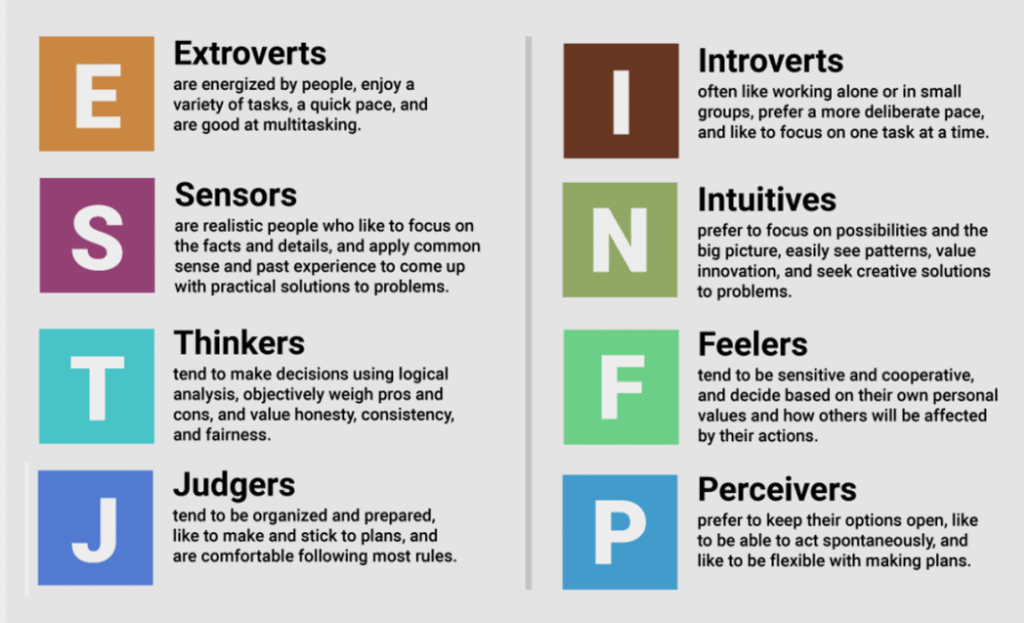 Quick MBTI Reference Guide
Yes, for most people, the Myers Briggs profile assigned to them is quite accurate. However, you must remember that the goal of the free test is to put people into similar categories so we can study the differences.
There are currently 16 different combinations you could receive from the quiz, and in general, those who score the same results behave and think in similar manners. The issue is that we can’t measure someone’s behavior directly with this test, but that we can only measure how they answer. For example, someone may be very kind, yet humble, so they’d answer “Disagree” on “I am more kind than the average person”; or very mean, yet answer “Agree”.
It’s important to note that there have not yet been any correlations between a MBTI type and intelligence.
The short answer is yes. Your Myers Briggs personality profile can change over time, just as any facet of your personality can change. There are 3 main things that cause your results to differ throughout time.
Time. Throughout time, the experiences you are exposed to will alter your personality slightly, and over time, those small changes may add up to large differences. For example, we are all different at the age of 20 and 40 years old.
Trauma. If you’ve experienced any major changes in your life, your personality can drastically change in a short period of time. For example, a car accident, the death of a loved one, or file for bankruptcy can greatly change how you view the world and the ways that you behave.
Drugs. There are many medicines and illegal drugs that alter the chemistry of the brain and cause an immediate change of a users' personality. In most cases, the change is for the worst, however some drugs can increase cognitive function or attention, which can alter your Myers Briggs personality results throughout time.
Myers Briggs is not the name of one person, but the name of a very accomplished mother-daughter duo! Mother Katharine Briggs and daughter Isabel Briggs Myers were the women behind the Myers Briggs Type Indicator.They were not famous for their work when they died, but their legacy lives on.
The mother-daughter team behind the MBTI were not psychologists and did not put their matrix to the test. Even the psychologist they based their work on, Carl Jung, was not one to take his hypotheses to the lab. The Myers Briggs, along with most personality tests, is generally considered pseudoscience.
This doesn’t negate how popular this test has become around the world. Even the more “accurate” personality assessments based on The Big Five Personality Traits are not perfect.
Katharine Briggs was brilliant, but she was not given many opportunities to showcase her brilliance because of her gender. Despite performing better than her husband in college, she was required to stay at home and care for her children and home. When her daughter Isabel was old enough to go to school, Katharine became depressed and looked for ways that she could fulfill her potential. This is how the Myers Briggs test came to be.
While her children studied and her husband worked, Katharine read Jung’s work on personality types. She began a correspondence with him and decided to put his work to the test at home. Briggs developed and distributed surveys that parents could take regarding their child’s personality. With the results, she developed the 16 personality types, based on four elements.
Although the Myers Briggs test is not scientifically sound, it is still used in the workplace and in team-building activities. Great teams communicate with each other. Communication requires empathy because not everyone communicates in the same way. By sharing your Myers Briggs type, teams can open up about their personalities and empathize with each other. Introverts and extroverts, for example, communicate in different ways. Using the results from the Myers Briggs test kick off the conversation about introversion vs. extroversion and what each personality type needs to succeed.
Remember that there is no hard science that proves these couples are completely compatible. Consider these pairings to be an opportunity to discuss how you and your partner, friends, or colleagues see the world in different or similar ways.
The Myers Briggs test is one of the most popular personality tests, but it’s far from the only personality tests. Other tests and methods for assessing personality and compatibility are used in the workplace, among friends, and in popular culture!
Type A vs. Type B
Want to keep things simple?Take this testto see whether you are more “Type A” (organized, neurotic, ambitious) or “Type B” (spontaneous, go-with-the-flow, calm.) You might even know the answer already!
Big Five
TheBig Five testis one of the most studied personality tests in psychology. It is the result of many psychologists trying to determine how many “traits” define a person’s personality. The “Big Five” stand for Openness, Conscientiousness, Extraversion, Agreeableness, and Neuroticism. Like the Myers Briggs test, each trait has an “opposite” trait. A person may display high agreeableness, for example, and low extraversion. These traits are also used to describe entire cultures and communities.
DiSC Assessment
The DiSC Assessment was actually in the works years before the Myers-Briggs Personality Assessment, but hasn’t seen as much popularity outside of the workplace. Many leaders use this assessment to discover how they and their team members work together. Test results put you in one of four categories: D (dominance,) i (influence,) S (steadiness,) or C (conscientiousness.)
Enneagram
Astrology
No need to take a test - just know the time, date, and place of your birth! Forms of astrology have been around for almost 2,500 years. It may not be based in Western science, but it has certainly stood the test of time. By knowing your birth chart, you can learn a lot about how you approach relationships, work, and yourself! A full birth chart doesn’t just show you your star or moon sign either. You will see what sign you are for each of the planets, offering deeper information about yourself and what might be in store for you over the period of days, months, or even years.
Dark Triad
Not all personality tests reveal the positive traits of your personality. TheDark Triad testreveals how much three negative traits may impact your relationships. These traits are Narcissism, Psychopathy, and Machiavellianism. Yeah, not exactly a score you want. The results of this test show how you compare to the rest of the population. Everyone has some good and some bad in them!
I hope you’ve enjoyed this Myers Briggs test and detail page. Feel free to leave a comment below of any questions you have!
Related posts:Carl Jung BiographyKeirsey Temperament SorterFree 3-in-1 Personality Test (5 Mins Quiz)ISTJ: Logistician (Description + Functions + Examples)Jungian Archetype Test (Free Jung Brand Quiz)
Related posts:
Reference this article:Practical Psychology. (2019, February).Myers Briggs Test (5 Mins) [MBTI Quiz Information].Retrieved from https://practicalpie.com/myers-briggs-type-indicator/.Practical Psychology. (2019, February). Myers Briggs Test (5 Mins) [MBTI Quiz Information]. Retrieved from https://practicalpie.com/myers-briggs-type-indicator/.Copy
Reference this article:
Practical Psychology. (2019, February).Myers Briggs Test (5 Mins) [MBTI Quiz Information].Retrieved from https://practicalpie.com/myers-briggs-type-indicator/.Practical Psychology. (2019, February). Myers Briggs Test (5 Mins) [MBTI Quiz Information]. Retrieved from https://practicalpie.com/myers-briggs-type-indicator/.Copy
Copy
