In cognitive psychology, the study of memory is quite important for many applications. When we experience events, we take the information our senses gathered and store it in various forms of memories so we can learn and grow as people.
Memory is the structure and processes involved in the encoding, storage, and retrieval of information, including both procedural and declarative information.
Cognitive psychologists quickly realized how fallible our memories are, and although there are some people who can display amazing feats of recall, we know that false memories can be created pretty easily. Nevertheless, we still aren’t completely sure how they are stored or retrieved.
In most contemporary models, there are 3 processes of memory: encoding, storage, retrieval.
EncodingStorageRetrievalSensory MemoryShort Term MemoryLong Term memoryAtkinson Shiffrin ModelLevels of Processing ModelSerial Position EffectFalse MemoriesPhotographic MemoriesHow to Memorize Quicker and Study Better
Encoding
Storage
Retrieval
Sensory Memory
Short Term Memory
Long Term memory
Atkinson Shiffrin Model
Levels of Processing Model
Serial Position Effect
False Memories
Photographic Memories
How to Memorize Quicker and Study Better
Encoding: The process of converting raw perception data from our sensory organs into information that can be easily stored in our brain.
Encoding can happen in one of three ways: Visual, Acoustic, or Semantic. Semantic seems to be the best for storing long term information.
Visual encoding is when you can close your eyes and see your notes from class.
Acoustic encoding is as simple as repeating something to yourself over and over again.
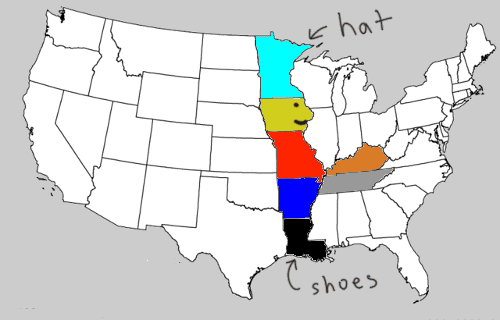
Semantic encoding is giving meaning to something you wish to remember. For example, if you are studying to memorize the name of the states for a free recall test, you can remember a chef named MIMAL (an acronym for Minnesota, Iowa, Missouri, Arkansas, Louisiana) cooking some Kentucky fried chicken to put meaning to otherwise random information:
 mimal encoding example
Storage: The process of taking encoded information and storing it in your memory for future use.
We will talk about the many types of storage in a bit. Remembering that there are 3 main processes of memory is a great example of the function of storage.
Retrieval: The process of pulling information from our memory
One of the most important parts of memory, is remembering something. It should be noted that errors in memory can happen both in storage and retrieval. One of the easiest ways to help the process of retrieval is to organize information, such as lecture notes. Even better, there’s an image below that organizes the different types of memory.
Psychologists have also categorized memory to further study the function and processes of each.
Here’s a quick rundown of the types of memory that your brain holds (If you’re coming from my email… don’t worry, I’m hiring a graphic artist to make this more visually pleasing):
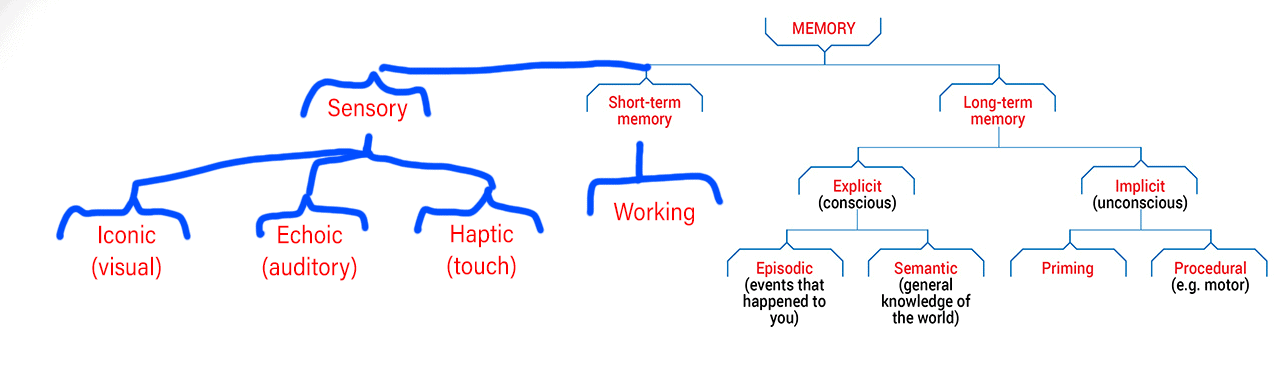
There are 3 main types of sensory memory: Iconic, Echoic, and Haptic. Sensory memory holds a quick flash of information from our sensory organs, so fast and short-lived that most of it doesn’t make it to our conscious awareness unless we focus our attention on it.
Iconic Memoryis the trace of visual information that lasts less than 4 seconds. When you use a sparkler to draw your name, and then hide the sparkler to still see your name written, your brain is using iconic memory to see the leftovers.
Echoic Memoryis auditory information that stays in your memory for less than 2 seconds.
Haptic Memorylasts less than 1 second and consists of information from touching things.
Working Memory
For example, I could ask you to multiply 5 times 7 in your head. You would very quickly come up with 35.
It should be noted that working memory has been link to higherintelligence.
Without going into detail, there are 3 main parts of working memory: the Visuospatial Sketchpad, the Phonological Loop, and the Episodic buffer.
TheVisuospatial Sketchpadis the part of your mind that you can create images with. When you think of a three-dimensional object and rotate it, or when you think of the way to get to your friends house, you are using this sketchpad.
ThePhonological Loopis the part of your brain that can repeat audible sounds. Repetition of a word or phrase in the loop causes it to stick longer in your memory. Note that the loop lasts only 2 seconds, that means the more syllables you can fit in those 2 seconds, the more information you can hold.
TheEpisodic Bufferis still a bit of a mystery, but it seems to tie the Visuosptial Sketchpad and the Phonological Loop together, and make a more realistic memory. When we use our imagination to daydream, we are putting the buffer to use.
There are two main types oflong term memory, explicit and implicit. For all we know, this form of storage is semi-permanent and can last forever. Think of long term memory like a hard drive you can access for any information you’ve deemed important in the past.
Explicit memory, also known asdeclarative memory, hold facts and information that we can directly understand.
One type of explicit memory isEpisodic Memory. Episodic memory is the type of memory that stores events or experiences in order that they happened. For example, you might remember that on your 10th birthday, you had cake first, then you opened gifts, and then you played with your new toys.
One type of explicit memory isSemantic Memory. Semantic memory is the type of memory that stores the meaning of words and events. For example, remembering what date your birthday is shows a perfect example of semantic memory. Another example of semantic memory is understanding what the meaning of a ‘birthday’ is.
Implicit memory, also known as non-declarative memory, holds information that we don’t know we know. This might sound confusing, but a quick example is riding a bike. You can explain to your friend how to ride a bike with words, but they still won’t have a good understanding of the process until they ride the bike themselves.
One type of implicit memory isProcedural Memory. Riding a bicycle is a perfect example of this, as is the knowledge or memory of any skill. Procedural memory consists of the skill-based actions you learn and commit to memory. You can drive a car with a manual transmission, and then 20 years later, still ‘remember’ how to drive the same car.
Another type of implicit memory is the concept ofpriming. Since I have been talking about riding bikes and driving cars, if I were to ask you to fill in the blanks of the word below, I could ‘prime’ you to think of a certain word.
T i _ _
You could think of tied, tips, tick, time, tint, or tide. However, you probably thought oftire. Priming is when the exposure to one stimulus (the car and bike) influences the response to another stimulus (fill in the blank).
Aflashbulb memoryis a form of a long-term memory that holds a significant piece of our history with us. Usually emotions are involved, and we feel very confident in these memories, even if we misremember very important parts.
The Atkinson-Shiffrin Model of Memory seems to be one of the best representations of memory that we have to date. Even though there are many studies that seem to prove some functions of the model, there are still weaknesses in the theory.
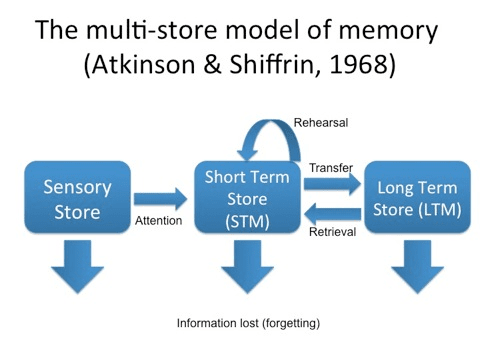
Richard Atkinson and Richard Shiffrin developed the theory in 1968 and theorized that information is processed in the sensory organs first, then moves through a short term memory process, until it is finally stored in long term memory.
It does not, however, explain decay theory, or why we forget things as time goes on.
The other main theory of memory psychologists seem to side with is called the Levels of Processing.
The less we pay attention to information, and the less we think about it, the less it is encoded.
The more we manipulate the information, or attach an emotional meaning to it, we encode it more.
When you take a piece of information and tie it with another piece of information, like remembering your friend’s name is Jake because he looks like the ‘Jake from State Farm’ character, you are also encoding that memory deeper.
Here is an example of 3 different levels, each with a deeper version of processing, which represents a more encoded and stable memory.
There is evidence to support this theory, as when you ask participants to remember a word, and then give them these questions, those who answered the questions that facilitated the deepest encoding (questions about the meaning of the word) were more likely to remember the word after a distraction task.
Here’s a great video that explains more studies on the Levels of Processing model:
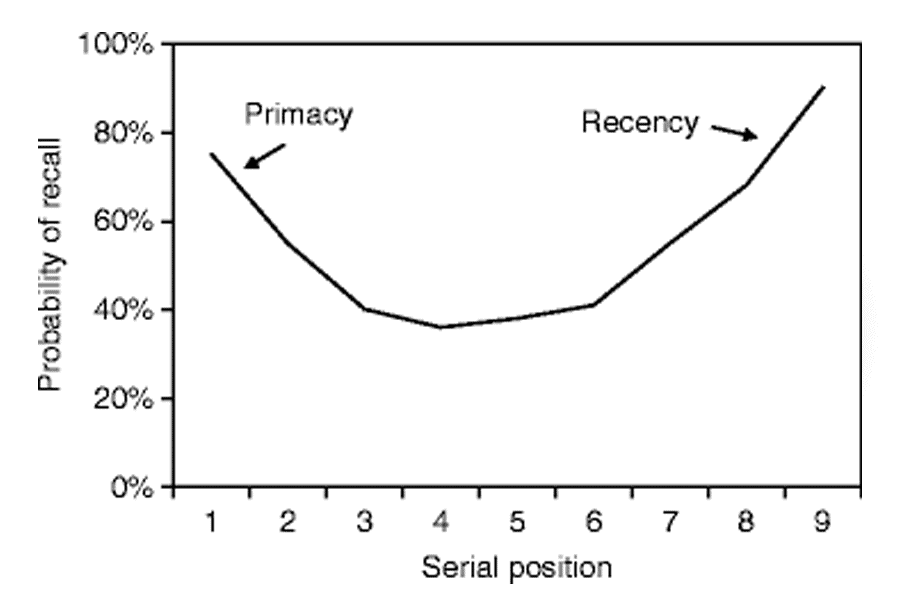
Hermann Ebbinghaus was a German cognitive psychologist who studied memory. He is credited for finding theSerial Position Effect, in which he theorizes that people are more likely to remember information depending on it’s position in a list.
The Primacy Effect
The Primacy Effectis a psychological phenomenon that occurs when participants are more likely to remember the beginning item of a list more than items in the middle.
The primacy effect becomes quite important for first impressions and anchoring, as the memory you leave in someone’s mind first sets the precedence for future interactions.
The Recency Effect
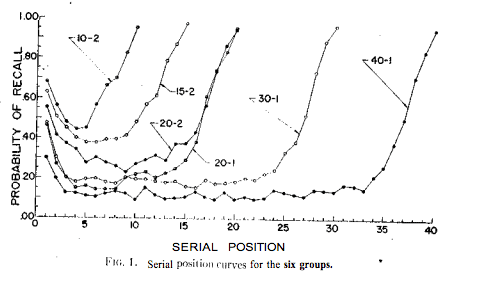
As you can see above,The Recency Effectis more powerful than the primacy effect, especially when there are more items in the list.
There’s a famous study on memory called the Murdock Study (the results are shown above).
Bennet Murdock gave a list of words to participants in 1962. He then asked them to recall as many words as they could without a cue, a form of free recall. The first words in the list they were given were likely to be remembered about 50% of the time, compared to an average of 16% of ‘middle words’. The last words in the list though, were 80% likely to be remembered, showing the power of the recency effect.
If there’s one thing cognitive psychologists can be sure of, it’s that memory is very fallible. That is, we often remember things wrong, or completely create a false memory.
Proactive Interferenceis when older information makes it much more difficult to learn something new. An example of this would be calling your new significant other your old significant other’s name.
On the other hand,Retroactive Interferenceis when new information prevents you from recalling old memories. One example of this would be learning your sister’s new phone number, as learning the updated string of digits might make you forget the old string of digits.
Check out thisfull guide to memory errorsif you’re curious about more.
We should also probably talk about amnesia and how it relates to memory.
Retrograde amnesiais when the ability to recall information that happened before the onset of their amnesia. If you’ve ever seen a scene in a movie where a football player gets hit really hard, and then doesn’t remember who he is, who’s president, or what day it is, they were affected with retrograde amnesia. Most retrograde amnesiacs are affected either through an injury to the brain or an illness like Alzheimer’s disease.
Anterograde amnesiais when the ability to store new information in long-term memory has been corrupted. A common example to show anterograde amnesia is Dory from Finding Nemo, as the character can’t remember events after a few seconds has passed. Lucy from the movie Fifty First Dates also had a form of anterograde amnesia.
It may be confusing to try to distinguish the different types of amnesia, but noting the differences allows us to study different function in memory, namely encoding and recall. If you get confused, just remember that “R"etrograde amnesia affects “R"ecall.
On another page, I explain in depth that there have beenno real documented cases of photographic memory. Nobody in history has ever been able to free recall 100% everything that has happened to them. However, there has been cases of a variation called Eidetic Memory.
Eidetic Memoryis the ability to recall images a few seconds after visual exposure with a high accuracy of details, and without using a memory device. Eidetic memory is pretty common (up to 10%) in children under the age of 10.
Cognitive psychologists theorized that this helped him remember better, due to an extreme amount of encoding that happened in the brain. S. could listen to a 10 minute speech and repeat the speech back word for word. He could also memorize very complex math formulas and poems in other languages.
One quirky phenomenon that also seems to tie in your experiences with memory isstate-dependent memory. This is when the retrieval of a memory is much more likely to happen when you are in the same state that you created it. For example, if someone were high on drugs, they would be more likely to remember what they learned once they became high again.
Acronym: An abbreviation for a phrase or sentence.
The acronym “ROY G. BIV” is a famous acronym to help memorize the order of colors in a rainbow.
Acrostics: A sentence or poem that is constructed with the letters in an acronym.
A great example of an acrostic is the “My Very Educated Mother Just Served Us Nine Pizzas” to remember the order of the planets from the sun.
Mind Palace: An imaginary location in your mind where each room stores information on a certain subject.
Sherlock Holmes is one of the most famous characters to utilize and popularize theMind Palace Technique. This Mnemonic requires practice, but can seemingly store a large amount of data very quickly and for long periods of time.
Chunking: When you break up information into smaller pieces.
When you remember a phone number and break it up into groups of 3 or 4 digits, you are breaking the information into digits.
Rote Memorization: The process of repeating information so often the likelihood of it being stored in long-term memory is higher.
Studying with flash cards for 10 minutes at a time throughout the day is a perfect way to learn using rote memorization.
Related posts:Semantic Encoding (Definition + Examples)Clive Wearing (Amnesia Patient)Long Term MemorySensory Memory (Definition + Examples)Semantic Memory (Definition + Examples + Pics)
Related posts:
Reference this article:Practical Psychology. (2019, August).Memory (Types + Models + Overview).Retrieved from https://practicalpie.com/memory-psychology/.Practical Psychology. (2019, August). Memory (Types + Models + Overview). Retrieved from https://practicalpie.com/memory-psychology/.Copy
Reference this article:
Practical Psychology. (2019, August).Memory (Types + Models + Overview).Retrieved from https://practicalpie.com/memory-psychology/.Practical Psychology. (2019, August). Memory (Types + Models + Overview). Retrieved from https://practicalpie.com/memory-psychology/.Copy
Copy
