Everyone wants to improve their memory capacity and duration. Being able to hold onto information for a long period of time comes in handy quite often! There are certainly ways to improve your overall ability to remember information, likegetting more sleeportaking B-12 vitamins. But on this page, you are not going to learn aboutthosetricks. This page is all about memory tricks, from mnemonics to chunking and more!
 Memory Tricks
What are Mnemonics?Famous Mnemonists
What are Mnemonics?
Famous Mnemonists
Mnemonics are memory tricks that can help you remember long strings of information, often in a particular order.You have been using mnemonic devices since…well, before you can remember!
Mnemonic devices have helped people achieve phenomenal feats in the world of memory. Get to know these tricks and devices. You can use them to help you remember phone numbers, create a more secure password, and maybe, one day, break a world record.
Chunking
Let’s start with “chunking.” If you have watched my video explainingshort-term memory, you have already heard a bit about this mnemonic device.
Short-term memory storage can only hold 5-9 items of information at a time. But they can store up to fourchunksof information. Chunking is an effective way to learn and recall more pieces of information.
The process of “chunking” information is explained in the name. If you are given multiple pieces of information to memorize, chunk it into groups. The groups could be based on the position in which you learn the information, similarities between the pieces of information that you need to memorize, or anything that helps you remember the information.
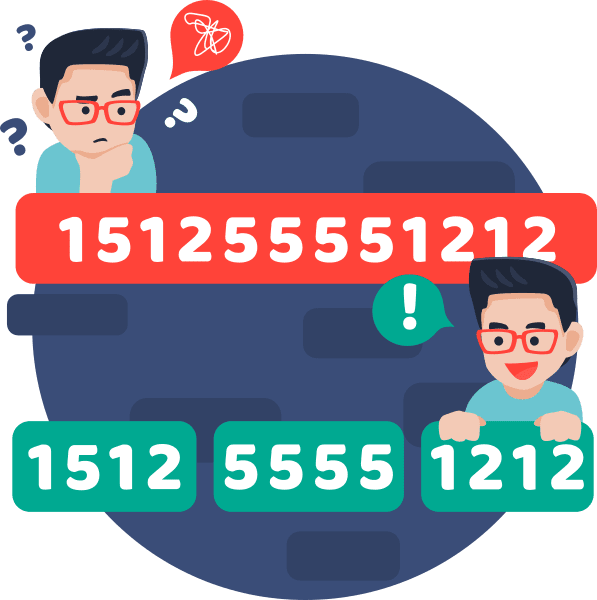
One example of “chunking” is the way that we memorize phone numbers. We split the ten numbers into three “chunks:”
Even if you can’t normally remember ten numbers in sequential order, you are likely to remember three “chunks” of information.
Acronym
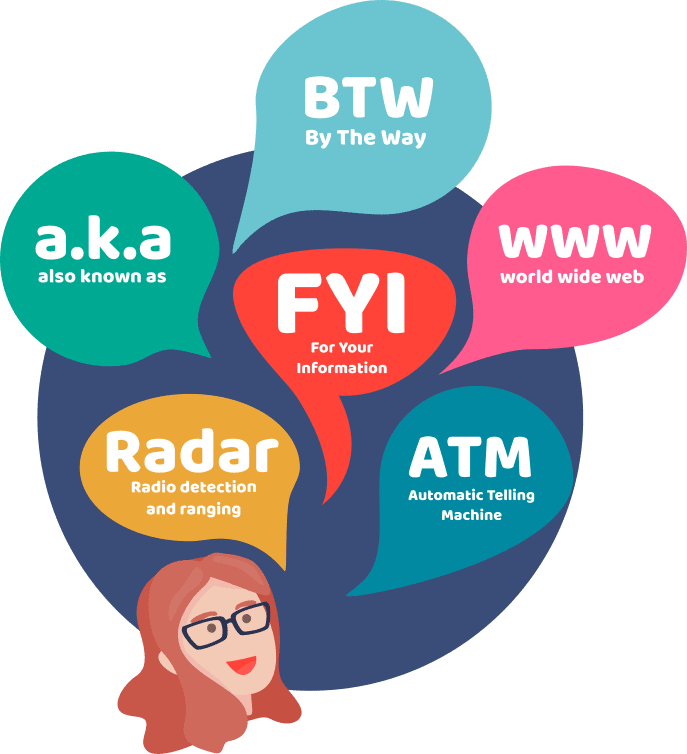
An acronym is a simple abbreviation for a phrase that makes the phrase ordering easier to remember.
Think back to your grade school days. Can you recall what PEMDAS means? Go back even further to preschool - what does ROY G BIV stand for?
These are all examples of acronyms.
It’s not easy to remember “Parentheses Exponents Multiplication Division Addition Subtraction”in orderon a math test. But PEMDAS is just one word. Ten years after your last math class, PEMDAS is likely to stick.
That’s the beauty of an acronym. It’s a single word, or maybe a phrase or title, that reveals a lot of information that you otherwise would not be able to remember in the correct order.
Other examples of acronyms include:
Not all acronyms will be perfect, but they don’t have to line up exactly with the phrase or list of items. As long as the acronym helps you remember the information, it works!
Acrostic
But some people don’t remember PEMDAS as PEMDAS. They remember it as “Please Excuse My Dear Aunt Sally.” If you were taughtthistrick to remember how to solve math problems, you weren’t using an acronym. You were using an acrostic poem to help you remember information in an important order.
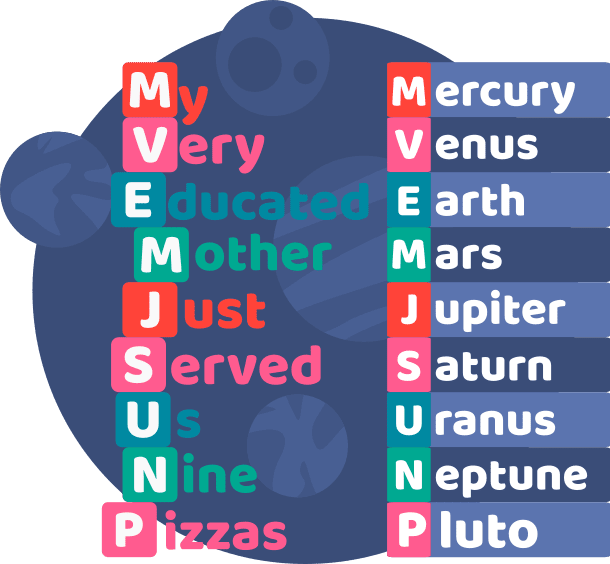
An acrostic is when you turn an acronym into a sentence to increase the likelihood of recalling it.
Take a moment to think of some other examples of acrostic poems.
“Every Good Boy Does Fine” is probably familiar to people who took an elementary school music class.
“My Very Educated Mother Just Served Us Nine Pizzas” is a great way to remember the order of the planets in our solar system.
The sillier they are, the easier they are to remember!
This is a great method for creating a secure password. Think of an obscure quote from a movie or a phrase that you can easily recall. For example, think of the famous line “May the Force Be With You” from Star Wars. That sentence is too long to be a password, but “MtfBwU” is a pretty strong password that is easy foryouto remember, but hard for hackers to guess. Add some numbers and the strength increases.
A grocery list of 15+ items can be hard to memorize. Inevitably, something is going to get lost unless you have a memory device to help you out. For lists of over seven or so items, chunking might be your best bet.
There are plenty of rhymes that we use to learn basic history or math information. How about this:
“Thirty days hath September….” You probably already know how to finish the sentence. “April, June, and November!” Other variations of this rhyme add even more information about the months that have 31 or 28 days.
Here’s another one. Do you remember when Amerigo Vespucci set sail from Portugal? Probably not. But you probably remember when Columbus embarked on his big journey. Why? “In 1492, Columbus sailed the ocean blue!”
And who could forget the rhyme used to help us with spelling?
“I before e except after c, or when sounding like a, like ‘neighbor’ and ‘weigh.'” How many times have you repeated that to yourself while writing words like “piece” or “neighbor?”
Breaking down hard-to-spell words into phrases could help you spell them correctly. Here are two examples that I use when I get stuck with spelling.
The first phrase I use is Wednesday: “Wed Nes Day.” Sure, this one doesn’t flow so well, but it can help to break down the different parts of spelling “Wednesday.” You won’t forget the hidden E between the N and the S!
Here’s another one. If you’ve ever seenBruce Almighty,you have probably heard this one before. Throughout the film, Jim Carrey’s character sarcastically says, “B-E-A-Utiful.” People who previously had a hard time spelling the wordbeautifulprobably found that film to be very helpful!
Acronyms are all around us. You might not remember the term “Subscriber Identity Module,” but you do know what a “SIM” card is. It’s a mouthful to mention that a member of the Special Weapons And Tactics team was present at work, so most people just say “SWAT” team.
Medical terms are much more approachable when they are cut down into an easy-to-understand acronym. It’s quicker to tell someone that they have HIV rather than “Human Immunodeficiency Virus.” Telling a child that they have “Attention Deficit Hyperactivity Disorder” can sound quite scary - ADHD is much easier to communicate. If you are studying for medical school, you may find that acronyms and memory tricks become your best friend. Some students use the acronym BAT, or the image of a bat, to remember that barbiturates, alcohol, and tranquilizers are all depressants (rather than stimulants.)
Terms like radar, CAPTCHA, and TED (as in TED talk) all come from acronyms. These easy-to-remember words and terms have become so integrated into our lives that you probably don’t even know all of them actually stand for longer phrases!
Other Types of Mnemonic Devices
These aren’t the only memory tricks in the book. The following techniques also fall under the broad category of “mnemonic devices."
Not everyone thinks solely in words or language. Visualizations can also form memory tricks. Let’s say you want to pick up a few things at the grocery store. You can create a map in your mind of the grocery store or the kitchen to navigate this list. Rather than trying to alphabetize them, you can just see them in your mind’s eye.
Memory champs may recognize this strategy as using a “Memory Palace” or “The Method of Loci.” It may not be effective for everyone, but it is one of the most well-known tricks for visual learners.
Similar to rhyming mnemonics, musical learners can put the information they need to remember in a song and sing that melody when they need to recall it. Replacing the tune of the ABCs or a hit pop song with the people you need to call that day may be the trick to remembering that information.
Based on your specific learning style or intelligence type, some memory tricks may work better for you.

If you are interested in learning more about mnemonics, I recommend that you look to the experts. Yes, you can be a famous mnemonist. These professionals are known for their extraordinary memories. These memories aren’t the result of a strange gene or disorder: they are just skilled in the art of mnemonics.
One of the most famous mnemonists of all time was simply called “S” for decades. He is described in the book “The Mind of a Mnemonist” from 1968. While the book is slightly fabricated and dramatized, it tells the fascinating story of a man who, it seemed, could remember just about anything. Further reporting and research revealed that S, whose full name was Solomon Shereshevsky, was not a man with aphotographic memory. He was just a skilled mnemonist.
Many mnemonists have followed in his footsteps. In the 1980s, two mnemonists made TheGuinness Book of World Recordsfor reciting over 30,000 digits of pi from memory. The current record holder was able to recite the first 40,000 digits of pi from memory.
The World Memory Championships have taken place every single year since 1993. One of the most memorable winners is Alex Mullen. Mullen was the first American to win the World Memory Championships, and he achieved the highest score in the history of the competition.
Want to be the next Alex Mullen? It’s going to take a lot of work. But acrostics, acronyms, and other memory tricks can help you get there!
Related posts:Beck’s Depression Inventory (BDI Test)The Psychology of Long Distance RelationshipsOperant Conditioning (Examples + Research)Variable Interval Reinforcement Schedule (Examples)Concrete Operational Stage (3rd Cognitive Development)
Related posts:
Reference this article:Practical Psychology. (2019, July).Memory Tricks and Mnemonics (Examples).Retrieved from https://practicalpie.com/memory-tricks-mnemonics-chunking-acronyms/.Practical Psychology. (2019, July). Memory Tricks and Mnemonics (Examples). Retrieved from https://practicalpie.com/memory-tricks-mnemonics-chunking-acronyms/.Copy
Reference this article:
Practical Psychology. (2019, July).Memory Tricks and Mnemonics (Examples).Retrieved from https://practicalpie.com/memory-tricks-mnemonics-chunking-acronyms/.Practical Psychology. (2019, July). Memory Tricks and Mnemonics (Examples). Retrieved from https://practicalpie.com/memory-tricks-mnemonics-chunking-acronyms/.Copy
Copy
