Maslow is most known for his Hierarchy of Needs. This is a diagram shaped like a pyramid, with “basic needs” at the bottom and “self-actualization” needs at the top. Maslow believed that when the needs at the bottom of the pyramid have not been yet, our motivation goes toward these basic needs. Once those needs are fulfilled, we focus on the needs at the top of the pyramid.
Maslow was one of the first psychologists to contribute to Humanistic psychology, a “third wave” of psychology afterpsychoanalysisandbehaviorism. Humanism takes a more positive approach to mental health than the first two. Rather than believing that we want to grow because we lack something, humanists believe that we want to grow because we are already fulfilled.
What Is the Hierarchy of Needs?What motivates you to take action?Deficiency Needs vs. Growth NeedsMaslow’s Hierarchy of Needs Are Flexible But Important to Remember
What Is the Hierarchy of Needs?
What motivates you to take action?
Deficiency Needs vs. Growth Needs
Maslow’s Hierarchy of Needs Are Flexible But Important to Remember
Let’s review these needs, starting at the bottom of the pyramid. Maslow’s Hierarchy of Needs is a psychological model that we use to understand the needs of humans. At the bottom are biological needs like food and water, while purpose and fulfillment are at the top.
 Maslow’s Hierarchy of Needs
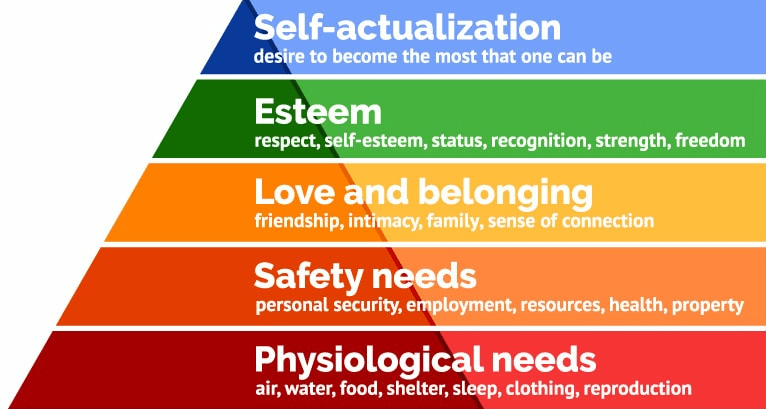
Physiological Needs
These are the needs that help us physically survive. It’s hard to focus on anything else when you are starving or dehydrated, like in the example I mentioned at the beginning of this video. That’s why these needs come first.
Physiological needs include things like:
Safety and Security
Above these physical needs are other basic needs: safety and security. Back in more primitive days, this is why we formed tribes and small groups. Being part of these groups meant we were protected from predators, warring tribes, and shortages of physiological needs. This is where the “us vs. them” mentality started.
These two sets of needs (physiological needs and safety) are considered our “basic needs.” Without them, we are likely anxious and concerned with nothing more than those needs. If you don’t feel safe in your home, you are probably not too bothered with your place in society or greater purpose in the universe. You just want to feel safe in your home.
Love/Belonging
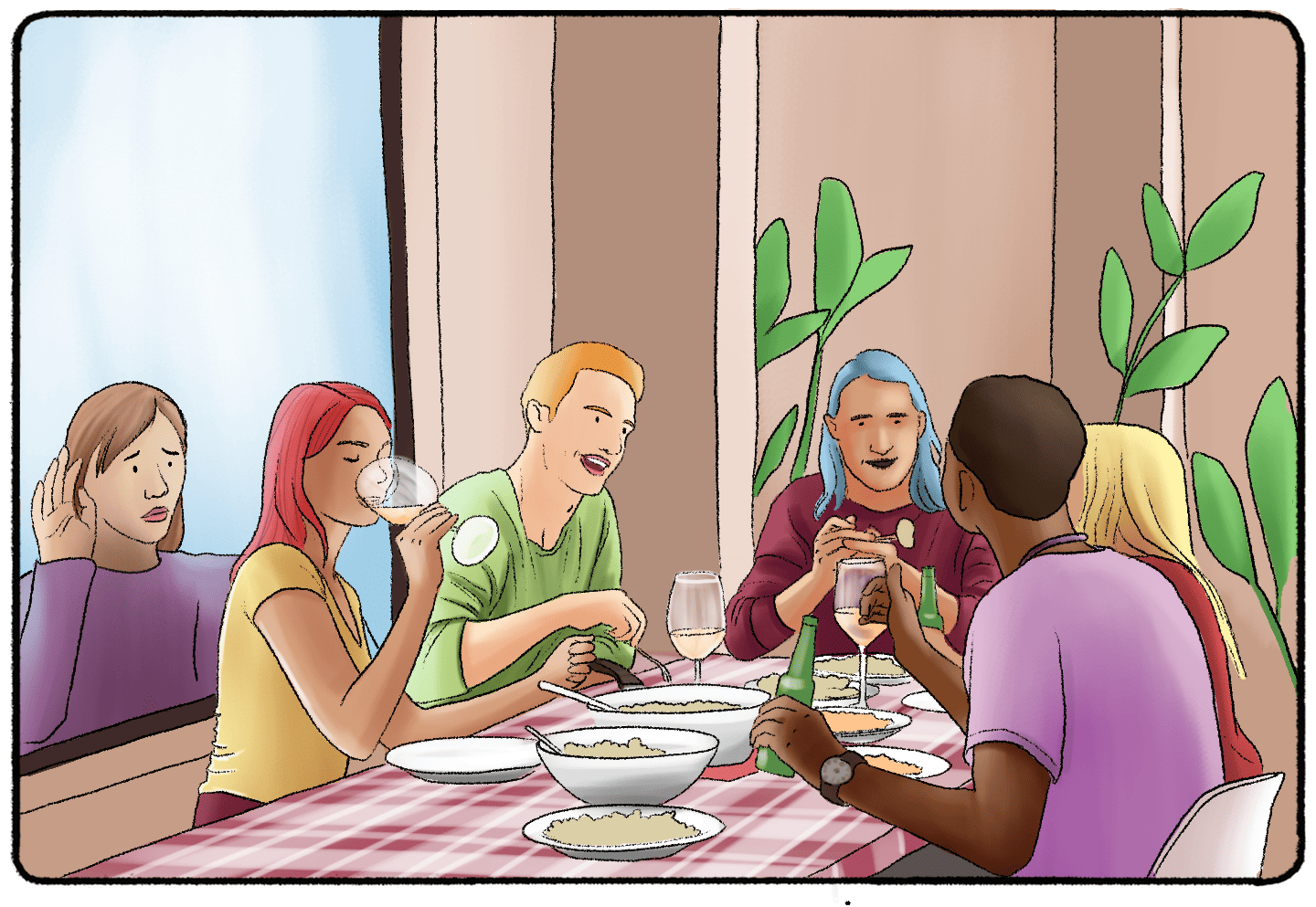
Let’s go back to the idea of a tribe. First and foremost, belonging to a tribe or a collection of people brought you things like food, shelter, and safety. But we still form groups today. We still have an “us vs. them” mentality today. Why?
Belonging to a group doesn’t always fulfill our basic needs anymore, but it does fulfill our basic psychological needs. Love and belonging are the third section of Maslow’s hierarchy of needs and are the bottom level of psychological needs.
We want to feel loved and love other people. We want to feel like we belong to a group. Without these feelings of love and belonging, we become isolated. Social isolation isn’t just a problem because it prevents us from fulfilling “higher” needs. Research shows that social isolation and loneliness can seriously affect physical and mental health. Who knew that joyous Thanksgiving dinners and lazy nights on the couch with your friends could be healthy?
Esteem
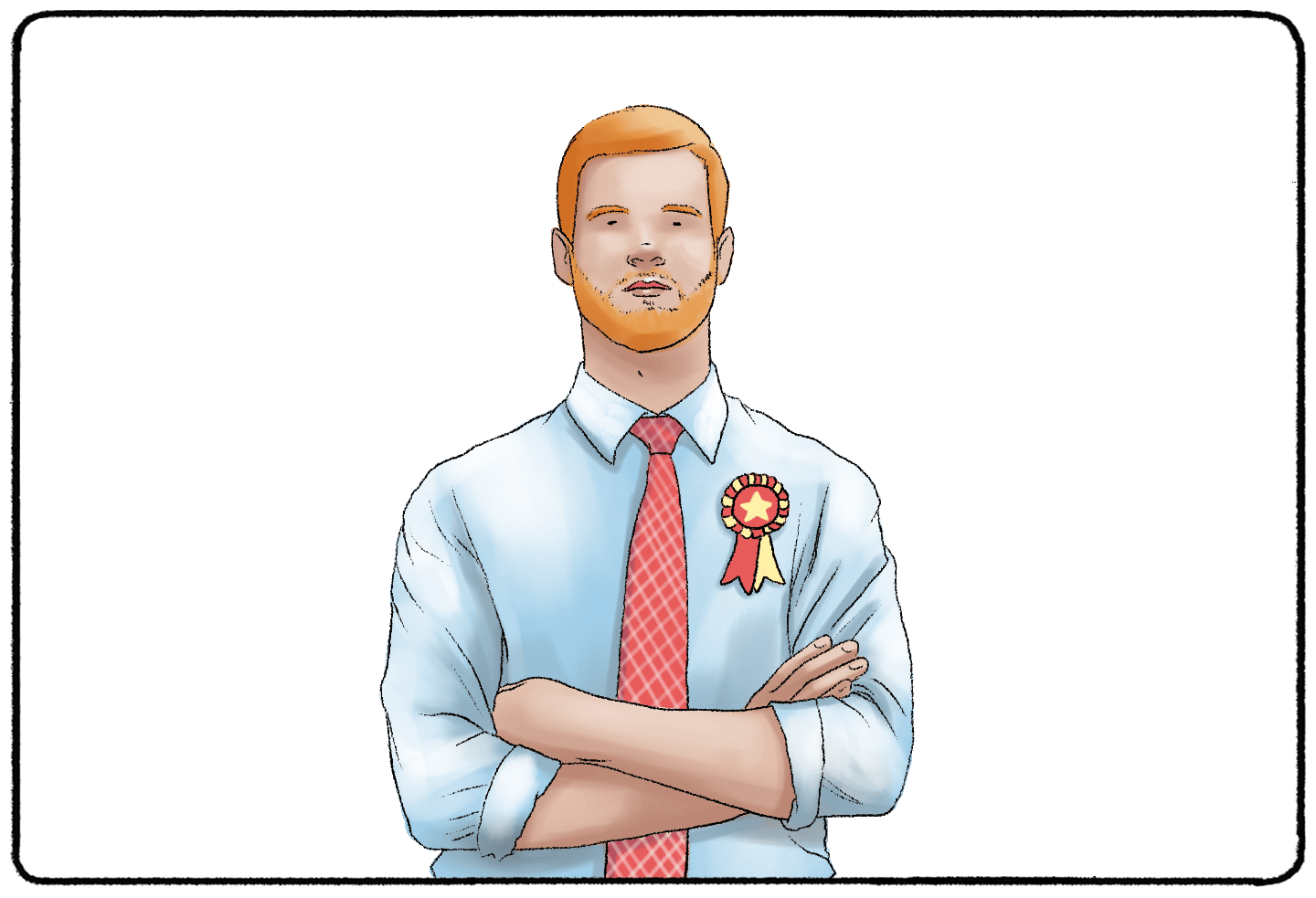
Being a part of a group, whether it’s your family, a community organization, or a country, satisfies our inherent need for belonging and connection. Yet, within these affiliations, there’s a deeper desire to be acknowledged and valued for our individual contributions and capabilities. This yearning is encapsulated in the fourth level of Maslow’s Hierarchy of Needs: esteem.
Esteem needs are intricately tied to our self-worth and the manner in which others regard us. It goes beyond merely being a group member; it touches upon the recognition and appreciation we receive for our unique contributions. Within community settings, satisfying esteem needs can manifest in various ways:
By recognizing and fulfilling these esteem needs, groups and communities foster individual growth and cultivate a more engaged, productive, and cohesive collective.
Self-Actualization
Historical Context and Impact of Humanistic Psychology
While psychoanalysis often delves into the recesses of the unconscious mind and past traumas, and behaviorism focuses on external behaviors and responses, Humanistic psychology presents a more holistic approach. It emphasized the inherent goodness of humans, the importance of self-actualization, and the free will to make choices. Its focus was not on the ‘dysfunction’ but on potential, highlighting the significance of personal growth and self-understanding.
Abraham Maslow and Carl Rogers were pivotal figures in this movement. Their work shifted the spotlight to the individual’s subjective experience, providing a fresh lens through which human behavior, thoughts, and feelings could be understood. The emphasis on the individual’s journey toward self-actualization, the apex of Maslow’s pyramid, underscored the innate human drive towards self-fulfillment, creativity, and personal growth.
This paradigm shift in understanding human behavior and motivation emphasized humans' intrinsic potential and resilience. As Maslow’s Hierarchy of Needs illustrates, there is a profound human urge to achieve fulfillment and purpose beyond mere survival. This humanistic approach paved the way for various therapeutic practices and interventions integral to modern psychology.
You already know that the answer varies daily, moment to moment. Let’s say you’re on a road trip to see your family for a reunion. You’re excited to get to your destination but become very hungry along the way. Suddenly, you are all concerned with finding the nearest fast-food place, even if it means going out of your way.
Once you’ve had dinner, it’s back to business as usual.
Why did your motivation change? Because you were hungry. We’ve all experienced something like this: your hunger, thirst, need to use the bathroom, or need to nap takes over everything else you had planned to do. Once these are fulfilled, you can focus on fulfilling larger needs.
A psychologist named Abraham Maslow took notice of this idea. In the 1940s, his ideas on motivation and mental health were revolutionary. He looked at how people could fulfill their needs to reach higher goals.
Humanism helped many psychologists and therapists discover new ways of understanding people’s motivations and helping them reach their overall goals. Its impact began with concepts like the Hierarchy of Needs.
Maslow’s Hierarchy of Needs operates on the fundamental distinction between two types of needs: deficiency needs and growth needs. His model suggests that an individual’s development depends on satisfying these needs in sequence.
Deficiency Needs
These needs arise from a lack of a deficit and revolve around physiological, safety, belonging, and esteem categories. Maslow theorized that when these needs are unmet, an individual experiences tension, discomfort, or anxiety.
Fulfilling these deficiency needs is essential not just because they are basic prerequisites for survival but because their satisfaction creates a foundation upon which individuals can strive for higher, more abstract aspirations.
Growth Needs
Once deficiency needs are adequately met, individuals transition to growth needs, focusing on personal growth, self-fulfillment, and achieving their highest potential.
Thus, in Maslow’s perspective, before individuals can fully engage in acts of creativity, altruism, or self-improvement (aspects of self-actualization), they must first ensure that their basic, deficiency-driven needs are securely met. This progression underscores the interconnectedness and the hierarchical nature of human needs in his model.
Studies on Deficiency vs. Growth Needs
Data backs this up. For example, astudyfrom 2012 looked at children’s deficiency needs and compared it to their performance in school. They concluded they were less likely to excel if a child had failed to fulfill their deficiency needs.
What needs had the biggest impact? Health and dental care. If a child cannot satisfy the basic physiological needs in Maslow’s Hierarchy of Needs, they may not be in the right headspace to learn and grow. Many argue that this is why children from lower-income households may fall short at school. It’s not because they’re not smart. It’s because their needs are not being met at home. Others argue that this is why school lunches should be free. By investing in children both in and out of school, we could help our children succeed and set all of us up for a better future.
While Maslow’s Hierarchy of Needs is a theoretical framework, it offers invaluable insights into understanding human motivations and behaviors. Throughout history, countless examples have demonstrated the resilience of the human spirit, showing that individuals can indeed strive for growth even when confronted with unmet basic needs. Nevertheless, having an awareness of this hierarchy can be beneficial in various facets of life:
Related posts:Abraham Maslow (Biography + Accomplishments)Humanistic Perspective of PersonalityWhat is Wet Brain?40+ Famous Psychologists (Images + Biographies)Emotional Intelligence
Related posts:
Reference this article:Practical Psychology. (2020, March).Maslow’s Hierarchy of Needs.Retrieved from https://practicalpie.com/maslows-hierarchy-of-needs/.Practical Psychology. (2020, March). Maslow’s Hierarchy of Needs. Retrieved from https://practicalpie.com/maslows-hierarchy-of-needs/.Copy
Reference this article:
Practical Psychology. (2020, March).Maslow’s Hierarchy of Needs.Retrieved from https://practicalpie.com/maslows-hierarchy-of-needs/.Practical Psychology. (2020, March). Maslow’s Hierarchy of Needs. Retrieved from https://practicalpie.com/maslows-hierarchy-of-needs/.Copy
Copy
