In 2002, theReview of General Psychologyranked Leon Festinger as the 5th most eminent psychologist of the 20th century.

Who Is Leon Festinger?Leon Festinger’s Birth and ParentsEarly Educational BackgroundFestinger’s Cognitive Dissonance Theory:Social Comparison TheoryThe Proximity EffectLeon Festinger’s Books, Awards, and AccomplishmentsPersonal Life
Who Is Leon Festinger?
Leon Festinger’s Birth and Parents
Early Educational Background
Festinger’s Cognitive Dissonance Theory:
Social Comparison Theory
The Proximity Effect
Leon Festinger’s Books, Awards, and Accomplishments
Personal Life
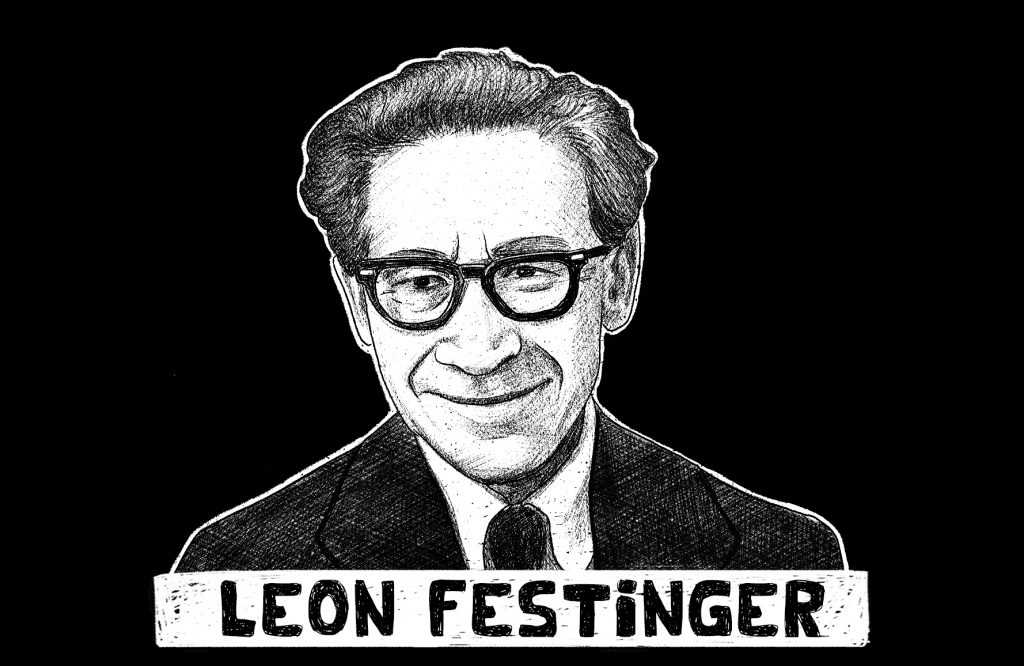
Leon Festinger was a renowned American psychologist, researcher, and author. He is best known for developing cognitive dissonance theory and social comparison theory. In addition to challenging the dominance of behaviorism, Festinger spearheaded the use of scientific experimentation in social psychology.
Leon Festinger was born on May 8, 1919 in Brooklyn, New York. His father and mother were Jewish-Russian immigrants named Alex Festinger and Sara Solomon Festinger. Festinger’s parents departed Russia for the United States just before the outbreak of World War I in 1914.
When Alex Festinger left Russia, he was known to be an atheist and a radical. He would maintain these ideals for the rest of his life. Alex Festinger worked as an embroidery manufacturer. He and his wife Sara were self-educated.
From an early age, Leon Festinger showed a deep love for science. He attended Boys’ High School in Brooklyn and was a very good student. Although he was extremely intelligent, some of Festinger’s childhood friends described him as “an aggressive, sometimes scathing critic.” During his teenage years, he read psychologist Clark Hull’s book entitledHypnosis and Suggestibilityand discovered a scientific field that “still had questions to be answered.”
After leaving Boys’ High School, Festinger enrolled at the City College of New York. He earned his bachelor’s degree in psychology in 1939 under the guidance of Max Hertzman. Festinger then pursued graduate studies under Kurt Lewin at the University of Iowa. Festinger was interested in Lewin’s efforts to establish psychology as a field with “dynamic processes involving perception, motivation, and cognition.” However, when Festinger arrived at the university, Lewin’s interests had shifted to “group dynamics” orsocial psychology.
At that time, Festinger was not interested in social psychology at all. He believed the field lacked scientific rigor, hard data, and clarity. As a result, he did not take a single social psychology course and chose instead to focus on Lewin’s earlier work. Festinger earned his master’s degree in child behavior in 1940 and his PhD in child behavior in 1942.
Embracing Social Psychology
Festinger continued his research at the University of Iowa until 1943. He then moved to the University of Rochester to work as a senior statistician for the National Research Council’s Committee on the Selection and Training of Aircraft Pilots during World War II. In 1945, Festinger moved to the Massachusetts Institute of Technology (MIT) to joinKurt Lewin’s Research Center for Group Dynamics as an assistant professor. It was during his time at MIT that Festinger eventually began to investigate and embrace social psychology.
Festinger continued his work at the University of Michigan in 1948 and the University of Minnesota in 1951. He published his paper on social comparison theory in 1954. In 1955, Festinger moved to Stanford University and published his theory of cognitive dissonance in 1957. In 1968, he left Stanford for The New School in New York City, where he conducted research on the visual system and perception.
What is Cognitive Dissonance?
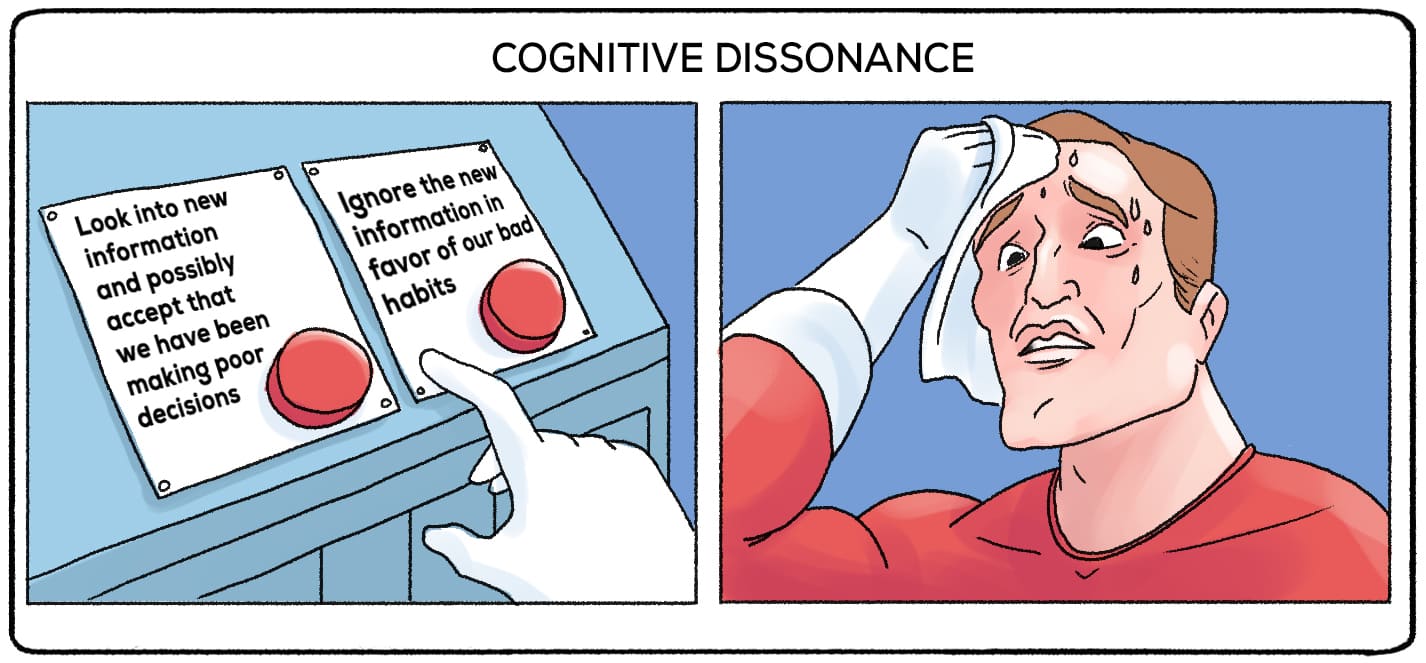
Cognitive dissonanceis the psychological tension people experience when they become aware of discrepancies between two of their cognitions (e.g., thoughts, beliefs, attitudes, plans, and knowledge about their behavior). According to Festinger, humans have a strong desire for consistency among cognitive elements. When they become aware of inconsistencies, it triggers an unpleasant psychological state of arousal, which then motivates them to reduce the inconsistency. Cognitive elements that conflict with each other are said to be dissonant, while those that are consistent with each other are termed consonant.
All of us have experienced cognitive dissonance at some point in our lives.
We may think fast food is bad for our health, but can’t resist stopping at Mcdonald’s on our way home from work. We may consider ourselves to be honest, but try to cheat on an online exam. In such situations, the conflict between what we think and what we do results in mental discomfort.
How was the Theory Developed?
At first, Festinger was puzzled as to why people would create and believe such rumors when there was hardly any evidence to support them. He later concluded that the rumors helped to justify the intense fear residents of these neighboring villages felt after the earthquake. According to Festinger, the villagers naturally became anxious and terrified after learning of the extreme devastation in neighboring areas. But given that they had sustained no damage, they also recognized that they had much less to be anxious about. Festinger believed this inconsistency between what the villagers felt and what they knew resulted in psychological tension. In order to reduce it, the villagers altered one of their beliefs, convincing themselves that they did in fact have something to fear—a more severe disaster was supposedly on the horizon.
Leon Festinger’s Study with Cults
Cognitive Dissonance and Cults, Religions, etc.
What Determines the Level of Cognitive Dissonance?
According to Festinger, two main factors influence the level of dissonance we experience in a given situation:
How Can Cognitive Dissonance be Reduced?
Festinger specified three primary ways in which dissonance may be reduced:
Social comparisons may result in a change in one’s opinion or ability. This change is usually in the direction of greater uniformity. Achieving similarity with others (i.e., fitting in) makes us more confident about our own opinions and abilities. The extent to which a person changes, however, depends on several factors, namely the importance and relevance of the comparison group, and how attracted the individual is to that group.
In composing his theory, Festinger noted a major distinction between comparisons of abilities and opinions. He suggested that in the case of abilities, humans possess a “unidirectional drive upward” which does not apply to opinions. This upward drive is a motivation to keep performing better and better, and it leads to ability comparisons with similar individuals who are slightly more capable than we are. When we notice that another individual is better than we are in a particular area of ability, we attempt to improve our performance level.
The upward drive promotes competition and may interfere with the emergence of social uniformity. However, Festinger acknowledged that this drive might apply only to Western cultures which promote individual achievement and competition.
Back in 1950, Festinger, Stanley Schachter, and Kurt Back undertook a study to determine how friendships were formed among residents of a students’ housing complex at the Massachusetts Institute of Technology (MIT). The researchers found that the formation of friendships was closely linked to physical proximity. This became known as theprinciple of propinquity- a fancy way of saying that the closer we are to someone physically, the more likely we are to be attracted to them.
This was demonstrated in Festinger’s study as residents tended to befriend people who lived in the same building and on the same floor as they did. They also socialized more with residents who lived closer to them on the same floor (e.g., those living next door), than with those who lived further away.
to form friendships with those living upstairs.
Applications of Festinger’s Theory
The technique described here is called hypocrisy induction. When individuals become aware of a glaring inconsistency between their attitudes and actions—that is, their own hypocrisy—the resulting discomfort acts as a powerful motivator for behavior change. The same principle has been used to reduce littering, speeding and prejudiced responses, and to promote water conservation, recycling, and charitable donations.
Social Comparison Examples
Social comparison theory has also been applied in several ways, a few of which are mentioned below:
Cognitive dissonance theoryremains one of the most popular theories in social psychology, but it is not without its critics. Some of the arguments that have been raised against it are:
Insocial comparison theory, Festinger suggested that people compare themselves to similar others but he did not state the basis of that similarity. In addition, some critics argue that people often engage in comparisons with individuals who differ from them in important ways and that such comparisons also supply valuable self-knowledge. Festinger further suggested that social comparison is a deliberate process but subsequent research has shown that comparisons can also be involuntary and automatic.
Another criticism of Festinger’s social comparison theory is that it does not specify the range and boundaries of social comparison. Some scholars consider this important since they doubt that people compare all of their abilities and opinions to those of others. Critics have also debated whether social comparison is primarily about self-evaluation, as Festinger suggests, or is more a matter of self-validation.
Festinger wrote several books on his landmark research. His most popular works are listed below:
Awards and accomplishments:
Leon Festinger married pianist Mary Oliver Ballou in 1943. The couple had three children—Catherine, Richard, and Kurt. Leon and Mary divorced years later. In 1968, Festinger married New York University professor Trudy Bradley.
Festinger closed his lab in 1979. Four years later, he expressed disappointment at what the field of psychology and he himself had accomplished. Festinger then became interested in archaeology as he wanted to see what else he could learn about human nature. His final academic pursuit was investigating why new technology tends to be adopted faster in the West than the East.
American Psychological Association. (2002). Eminent psychologists of the 20th century.Monitor on Psychology, 33(7). Retrieved fromhttps://www.apa.org/monitor/julaug02/eminent
Drakopoulos, S. A. (2016).Comparisons in economic thought: Economic interdependency reconsidered. New York: Routledge.Fehr, B. (1996).Friendship processes.Thousand Oaks, CA: Sage Publications.
Fogg, B. J. (2003).Persuasive technology: Using computers to change what we think and do. San Francisco, CA: Morgan Kaufmann Publishers.
Gazzaniga, M. S. (2006). Leon Festinger: Lunch with Leon.Perspectives on Psychological Science, 1(1), 88-94. Retrieved from https://journals.sagepub.com/doi/abs/10.1111/j.1745-6924.2006.t01-3-.x?journalCode=ppsa
Morvan, C., & O’Connor, A. J. (2017).An analysis of Leon Festinger’s a theory of cognitive dissonance. London: Macat International Ltd.
Miles, J. A. (2012). Management and organization theory: A Jossey-Bass Reader. San Francisco, CA: John Wiley and Sons.
Nail, P.R., & Boniecki, K. A. (2011). Inconsistency in cognition: Cognitive dissonance. In D. Chadee (Ed.),Theories in social psychology(pp. 44-71). Oxford: Wiley-Blackwell.
Sanderson, C. A. (2010).Social psychology. Hoboken, NJ: John Wiley & Sons.
Schachter, S. (1994). Leon Festinger.Biographical Memoirs, 64, 98-110. Retrieved from https://www.nap.edu/read/4547/chapter/5
Suls, J. (n.d.). Leon Festinger. InEncyclopedia Britannica. Retrieved from https://www.britannica.com/biography/Leon-Festinger
The New York Times. (1989, February 12).Leon Festinger, 69, new school professor.Retrieved from https://www.nytimes.com/1989/02/12/obituaries/leon-festinger-69-new-school-professor.html
Related posts:40+ Famous Psychologists (Images + Biographies)Cognitive Dissonance (Definition + Examples)Social Comparison Theory - Leon Festinger (Definition + Examples)Albert Bandura (Biography + Experiments)Kurt Lewin Biography - Contributions To Psychology
Related posts:
Reference this article:Practical Psychology. (2020, April).Leon Festinger (Psychologist Biography).Retrieved from https://practicalpie.com/leon-festinger/.Practical Psychology. (2020, April). Leon Festinger (Psychologist Biography). Retrieved from https://practicalpie.com/leon-festinger/.Copy
Reference this article:
Practical Psychology. (2020, April).Leon Festinger (Psychologist Biography).Retrieved from https://practicalpie.com/leon-festinger/.Practical Psychology. (2020, April). Leon Festinger (Psychologist Biography). Retrieved from https://practicalpie.com/leon-festinger/.Copy
Copy
