The Lake Wobegon Effect is one of those phenomena in psychology that you can immediately apply tomanypeople in your life. But what is it? Let’s find out!
What is the Lake Wobegon Effect?Is Lake Wobegon A Real Place? History of the Lake Wobegon EffectWhat Abilities or Skills Are Overinflated By the Lake Wobegon Effect?Lake Wobegon Effect and Social Comparison TheoryLake Wobegon Effect and Dunning-Kruger EffectOther Social Psychology TheoriesRemember The Lake Wobegon Effect
What is the Lake Wobegon Effect?
Is Lake Wobegon A Real Place? History of the Lake Wobegon Effect
What Abilities or Skills Are Overinflated By the Lake Wobegon Effect?
Lake Wobegon Effect and Social Comparison Theory
Lake Wobegon Effect and Dunning-Kruger Effect
Other Social Psychology Theories
Remember The Lake Wobegon Effect
The Lake Wobegon Effect, often called the Lake Wobegon Fallacy, is the tendency to overestimate one’s abilities. This is more likely to show up when we compare ourselves to others, which social psychologists say is a natural way to gauge our process and skills.

In 1987, a physicist named John Jacob Cannell published a report that was equal parts comical and concerning. The report looked at how each state in the country fared when it came to elementary school performance. The actual rankings of the states don’t matter for the purpose of this page. What does matter? Each state reported that the performance of their elementary schools was above-average.
Every single one believed this to be true.
Obviously, that is impossible.
Sure, some of the states were above average. But for every state that is above average, there is going to be a state that is below average. That’s kinda the point of finding an average number.
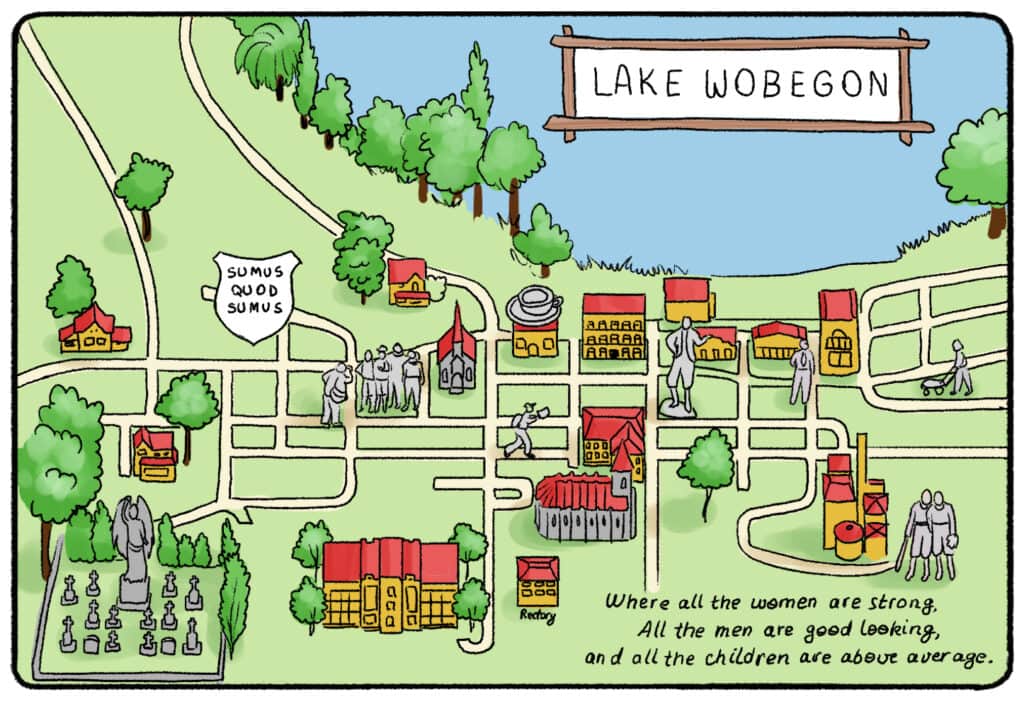
At the same time, a radio show called Prairie Home Companion was broadcast live every week. The setting of the show was a fictional city called Lake Wobegon. Garrison Keiller, the host of the show, would say that Lake Wobegon was a place where “all women are strong, all men are good-looking and all children are above-average.”
Thus, the Lake Wobegon Effect was born.
It turns out, we think we’re above-average at a lot of things.Studieson the Lake Wobegon Effect have focused on skills like leadership, popularity, and investing ability. A majority of participants believed that they were above average at these skills. The Lake Wobegon Effect even appears when people are assessing their luck or beating the odds when facing a terminal illness.
The one skill that comes up again and again when we talk about the Lake Wobegon Effect is driving. In 1981, psychologists asked participants how they would rank themselves when it came to their driving ability. 80% of the participants put themselves in the top 30% of drivers. And while this obviously does not reflect reality, it may have some very real consequences.
Similar theories insocial psychologyemphasize how much time we spend looking to others to assess ourselves. Social psychology also attempts to explain why we don’t always have
Festinger proposed that we compare ourselves to people as a way to judge our own performance. Let’s say you go to a rock climbing gym for the first time. The bouldering routes are ranked in difficulty from v0 to v8. After taking a lesson and exploring some different routes, all you can complete are v0 routes. What does this mean?
Types of Social Comparison
We don’t just compare ourselves to others when learning new skills. Festinger suggested that social comparison was an innate drive that continuously affects our thinking and judgment. There are also different forms of social comparison that we may use to assess where we are at:
Of course, both forms of social comparison can also be unproductive. Unfortunately, we are inundated with so much content from other peopleonline that we areconstantlycomparing ourselves to others. Be aware of this as you scroll through social media or compare yourself to the lives of other people online. We have an innate drive to make this comparison, but we can correct it in our minds and be appreciative of who we are and what we can do.
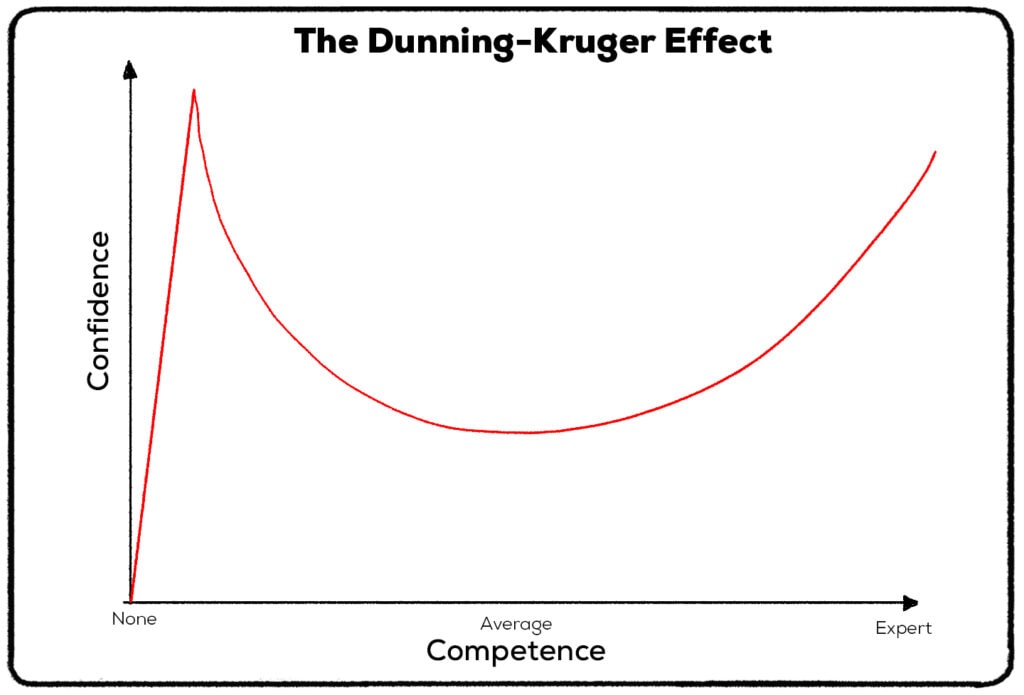
The Lake Wobegon Effect is not the only concept that suggests we are hyping ourselves up too much.The Dunning-Kruger Effectexplains a similar tendency, although there are slight differences between the two ideas.
The Dunning-Kruger Effect essentially says “you don’t know what you don’t know.” If you don’t know a lot about a subject, you are not likely to know how far behind you are compared to others. This can create a real sense of overinflated, and cringe-worthy, confidence.
Let’s say, for example, that a guy wants to take up coding. Having no coding experience or knowledge, he may think, “How hard can it be?” He has experience with HTML, so he’s already on his way to being a great programmer, right?
Anyone with a little more experience in coding may be shaking their heads. The guy’s lack of experience has shielded him from all of the other coding languages out there: CSS, JavaScript, Python, C++, SQL, you name it. Only until the aspiring programmer gets into coding will he realize that his abilities aren’t so ahead of the game.
The Dunning-Kruger Effect is especially concerning. It suggests that people with the least amount of knowledge on a subject are still (if not more) likely to rank themselves much higher than they actually are.
The identification of other cognitive biases and phenomena in social psychology helps us understand why we make the decisions we do. Psychologists have made a lot of progress in the world of social psychology!
Social facilitation theory suggests that people perform better when they’re in the presence of others. The experiments that led to the development of this theory are some of the earliest in social psychology. They date back to the 1800s! Researchers in the experiment asked children to wind up some fishing line. They compared the performance of the children when they were alone versus when they were in the presence of others. Children wound up the fishing line much faster when other people were watching!
When we look at people, we see how they perform. We also see the decisions people make. If you see someone steal a bike or help an old lady across the street, what do you think about that person? Attribution theory attempts to answer this question. It explores how we attribute certain behaviors to a person’s character or environment.
If you’ve ever made a false assumption about someone, you know that we aren’t always perfect in how we attribute behavior. This is due to a few cognitive biases, including the actor-observor bias.
Social comparison is one ofthreedifferent processes identified in the Social Identity Theory. The other two processes are social categorization and social identification. All of these processes are meant to help us see ourselves in our communities and the larger wold. Who are we? What do we mean to other people? Understanding our identity can help us make tough decisions.
I’ve got some news for you. Yes, you. You’re not immune to the Lake Wobegon Effect. You are especially not immune to it if you’re just hearing about it for the first time.
We’ve briefly looked at some of the effects of the Lake Wobegon Effect:
This can also cause tension between someone who believes they are above-average at some skills and people who are above-average. Take the aspiring programmer. His attitude and false confidence may be laughable (or annoying) to people who have amassed above-average coding skills. People who believe they are more persuasive or charismatic than they really are may turn people off before they can reach any goals. If you believe that you have more skills than you actually have, you may not be able to see the real barriers that are getting in your way.
How to Correct the Effects of the Lake Wobegon Effect
Related posts:Social Comparison Theory - Leon Festinger (Definition + Examples)Leon Festinger (Psychologist Biography)The Von Restorff Effect (Definition + Examples)The Tetris Effect (Definition + Examples)David Dunning (Psychologist Biography)
Related posts:
Reference this article:Practical Psychology. (2020, April).Lake Wobegon Effect (Definition + Examples).Retrieved from https://practicalpie.com/lake-wobegon-effect/.Practical Psychology. (2020, April). Lake Wobegon Effect (Definition + Examples). Retrieved from https://practicalpie.com/lake-wobegon-effect/.Copy
Reference this article:
Practical Psychology. (2020, April).Lake Wobegon Effect (Definition + Examples).Retrieved from https://practicalpie.com/lake-wobegon-effect/.Practical Psychology. (2020, April). Lake Wobegon Effect (Definition + Examples). Retrieved from https://practicalpie.com/lake-wobegon-effect/.Copy
Copy
