Kurt Lewin is widely considered to be the father of modern social psychology and one of the most influential psychologists in history.

Who Is Kurt Lewin?Kurt Lewin’s ChildhoodEducational Background and Early CareerLewin’s Field TheoryGroup DynamicsKurt Lewin’s Change TheoryHow to Apply Kurt Lewin’s Change Model and Other TheoriesKurt Lewin’s Books, Awards, and AccomplishmentsPersonal Life
Who Is Kurt Lewin?
Kurt Lewin’s Childhood
Educational Background and Early Career
Lewin’s Field Theory
Group Dynamics
Kurt Lewin’s Change Theory
How to Apply Kurt Lewin’s Change Model and Other Theories
Kurt Lewin’s Books, Awards, and Accomplishments
Personal Life
Kurt Lewin was a German-born American psychologist who made massive contributions to the fields of social, applied, and organizational psychology. He pioneered the use of scientific methods in the study of behavior. Lewin developed a number of key concepts during his career, including field theory, action research, and group dynamics.
Kurt Zadek Lewin was born on September 9, 1890, in the small town of Mogilno, Germany (now part of Poland). He was the second of four children born to middle-class Jewish parents, Leopold and Recha Lewin. He had three siblings—an older sister, Hertha, and two younger brothers, Egon and Fritz. The Lewins enjoyed close, affectionate relationships with one another and Kurt had a happy childhood.
Lewin’s parents owned and operated a small general store located on the ground floor of the family home, as well as a small farm on the outskirts of Mogilno. For a while, Leopold also served as president of the local synagogue. As a boy, Lewin enjoyed spending time on the family farm, where he got to explore the surrounding forests and fields. He developed a love of nature and even had a garden of his own.
In 1905, when Kurt was 15 years of age, the Lewins moved to Berlin in search of better educational opportunities for their children. Kurt obtained a place at the Kaiserin Augusta Gymnasium, a prestigious high school in Berlin. His performance was initially unremarkable but in his last two years he began to study Greek philosophy and excelled in the subject. He maintained his passion for philosophy throughout the rest of his life.
After graduating from the Gymnasium in 1909, Lewin immediately enrolled at the University of Freiburg with the intention of studying medicine. He did not enjoy the anatomy courses, however, and after only one semester, he transferred to the University of Munich to study biology. Lewin’s time at Munich was also short-lived and after completing just one semester, he transferred again—this time, to the University of Berlin where he remained until he earned his PhD.
At Berlin, Lewin took courses in philosophy and was particularly interested in the philosophy of science. One of his lecturers also directed him to the University’s Psychological Institute and suggested that he might find the budding field of psychology interesting. Lewin was attracted to the Institute due to a novel approach to behavior that was emerging there, an approach that later became known as Gestalt psychology. When the time came for him to undertake his dissertation, he requested Carl Stumpf, the director of the Institute and a pioneer in the experimental method in psychology, to be his supervisor. Lewin completed the requirements for his PhD in 1914 but the degree was not conferred until 1916.
During Lewin’s time at the University of Berlin, antisemitism was increasing in Germany and he was drawn to the socialist movement. While pursuing graduate studies, Lewin and a group of fellow students met regularly to discuss how to remedy various social problems, such as how to improve women’s position in society and how Germany could become a more democratic country. He also helped organize education programs for working class adults in subjects such as reading and arithmetic.
Time in the German Army
After completing his dissertation in 1914, Lewin enlisted in the German army and served throughout much of World War I. He published his first journal article while recovering from an injury he received in combat in 1917. He retired from the army in 1918 with an Iron Cross for bravery.
Lewin actively encouraged his students to question existing theories and to create their own ideas. For example, it was his custom to host lively, stimulating discussions with his students on a Saturday where psychological theories were explored, debated, and generated. This custom of holding informal meetings with his students is one he would repeat in the future after receiving teaching appointments at other institutions.
Kurt Lewin and Gestalt Psychology
Lewin’s work first began to receive attention in the United States in 1929, when an American student who had studied with him in Berlin published an English-language paper on his ideas and research. That same year, Lewin was invited to give a lecture to the International Congress of Psychology at Yale University. The following year, he was invited to spend six-months at Stanford University as a visiting professor.
When Hitler became chancellor of Germany in January 1933, Lewin recognized that he and his family were at risk because of their Jewish heritage. He resigned from his position at the University of Berlin and emigrated with his family to the United States in August 1933. He obtained a two-year position as acting professor of education in the School of Home Economics at Cornell University.
University of Iowa
During World War II, Lewin served as a consultant to the American government on a wide variety of issues related to the war effort. For example, he served as an advisor to the Office of Strategic Services (OSS) on the subject of psychological warfare.The Office of Naval Research (ONR) also invited Lewin and his team at the University of Iowa to provide feedback on ONR policy.
Time at MIT
By 1944, Lewin had developed a strong interest in group dynamics and action research but was not convinced that Iowa was the ideal place for him to carry out some of the studies he had in mind. He began to seek out another university where he could set up a research institute and eventually received government funding to do so at the Massachusetts Institute of Technology in 1945. The institute was called the Research Center for Group Dynamics and was the first research institute to be set up for the specific purpose of examining group behavior.
Lewin incorporated Gestalt principles, physics, and mathematics in his development offield theory.He believed that in order to get a clear understanding of human psychology, a human being should be studied as a whole individual rather than a collection of parts. Lewin also suggested that human behavior was the result of interactions between the individual’s perception of self and his perception of his environment.
Lewin is also known for developing the concept of “life space.” Life space refers to a combination of all of the forces that are acting on an individual at a particular moment in time to influence his behavior. Therefore, behavior can be expressed as a function of life space. This additional formula for behavior isB=f(LS).
AsB=f(P,E)andB=f(LS)
It is clear that(P,E) = (LS)
This expression shows that the interaction of the person with his environment produces his life space.
Lewin claimed that psychic forces operate within the life space and are comparable to the forces of physics. These forces come from both the inner personal environment as well as the outer environment. For example, an individual may have a drive to avoid threats and overcome barriers to reach his goals. According to Lewin, each object within an individual’s life space exists in relation to the other objects, with boundaries and areas of tension between them. Therefore, a person’s behavior or path of action is seen as the end result of all his psychic tensions at that moment in time.
Force Field Analysis
Lewin developed force field analysis as a way to examine the factors that influence a particular situation. Some forces may encourage movement toward a specific goal while other forces may hinder movement towards that goal. People typically use force field analysis when they have tough decisions to make as it improves the quality of their choices and increases their chances of success. A few of the benefits of force field analysis are listed below:
Lewin’s Leadership Styles
Lewin also had an interest in leadership. He argued that there are three main styles of leadership. They include:
These types of leaders make decisions without getting input from their team. This leadership style is useful when a quick decision needs to be made and the success of an endeavour does not depend on team agreement. However, organizations that use this leadership style tend to have high levels of absenteeism and staff turnover as staff members may feel demoralized and unmotivated.
These types of leaders get input from team members before making the final decision themselves. Team members are encouraged to be creative and they usually feel engaged as they do their work. Organizations that use a democratic leadership style tend to have staff members who are highly productive, motivated, and satisfied. However, this leadership style may not be effective if a quick, firm decision is needed.
These types of leaders give team members a lot of freedom to do their work. Laissez-faire leaders provide advice and resources if they are needed, however, team members are free to do their work in the manner they see fit and they also set their own deadlines. Organizations that use this leadership style tend to have high levels of job satisfaction. However, this leadership style may be detrimental if team members are unmotivated or unable to manage their time effectively.
Action Research
Lewin coined the term “action research” in the mid 1940s. The approach involves using research to improve the quality of a practice. Action research involves action, evaluation, and critical reflection. Based on the results of the research, changes in the practice are implemented. The cycle then continues with the next round of action, evaluation, critical reflection, implementation of changes, and so on. Over time, the overall quality of the practice is increased.
A few advantages of action research are listed below:
In Lewin’s day, many researchers believed that groups could not be studied scientifically. They also argued that groups merely reflected the wishes and actions of their individual members. However, Lewin believed that a group should be viewed as a unified whole that is more than just the sum of its parts (or members). He also believed that groups could be studied scientifically and applied his formulaB=f(P,E)to group settings.
In 1947, Lewin coined the term “group dynamics.” Group dynamics refers to how groups and individual people act and react to changes in their circumstances. Lewin founded the Research Center on Group Dynamics at MIT to better understand the issues listed below:
Productivity:Why do groups tend to be ineffective at getting things done?
Communication:How is influence spread within a group?
Social perception:How does a group affect the way a member perceives social events?
Intergroup relations:How do groups interact with each other?
Training leaders:How can you improve the functioning of groups?
Lewin’s group dynamic studies were conducted in real life situations and were geared towards eliminating prejudice. His concepts quickly gained support among social scientists who understood the significance of his work. Lewin’s theories on group dynamics and group communication are used extensively in a number of professions today.
Lewin is often credited with developing a “change management model” which is useful for making changes in organizations. The change management model involves three steps:
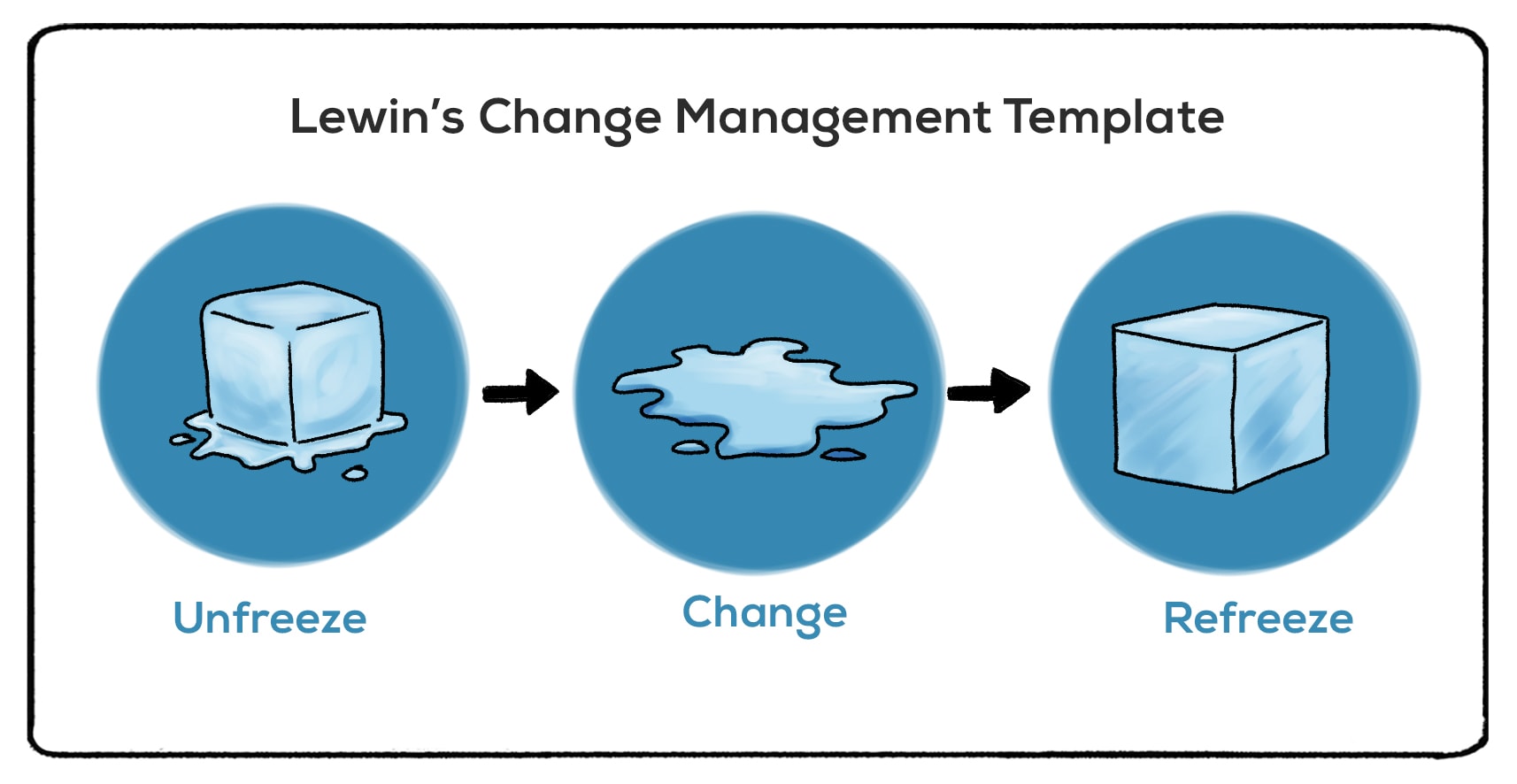
Although Lewin did briefly mention “unfreezing-changing-freezing” in his 1947 articleFrontiers in Group Dynamics, the concept was never elaborated upon. Later research suggests that the change management model actually developed after Lewin had already passed away.
Lewin has had a profound impact on the science of psychology as well as a number of other fields. A few applications of his theories are mentioned below:
Social scientists today have adopted Lewin’s approach to study human social behavior using methods that are scientific and systematic.
Lewin’s work on leadership styles has highlighted how different types of leadership may be beneficial in different settings.
Lewin’s concept of action research has helped numerous industries to improve their services. For example, the healthcare industry has conducted systematic investigations on its own practices. This has led to better health services and an improved working environment for medical professionals and patients over time.
Some critics have claimed that Lewin’s incorporation of mathematics and physics into his theories is “off-putting.” Other researchers have criticized Lewin for his focus on how current circumstances affect behavior and his seeming dismissal of historical explanations. American psychologist Gardner Murphy claimed that Lewin was not persuasive in explaining his reasons for taking a holistic approach to studying human behavior rather than a reductionist approach. Other critics have claimed that Lewin was more interested in his social agenda and viewed him as more of a propagandist than a social scientist.
Lewin authored eight books and more than eighty articles on his psychological theories and research. Some of his works are listed below:
Society for the Psychological Study of Social Issues
Lewin co-founded the Society for the Psychological Study of Social Issues in 1936. However, the American Psychological Association never asked him to serve on any committees nor was he offered a prestigious position at any of the top universities in the United States.
Nevertheless, Lewin is regarded as one of the most influential psychologists to ever live and is often given the same level of respect as B.F. Skinner and Sigmund Freud. In recognition of his contributions to psychology, the American Psychological Association offers the annual Kurt Lewin Award to individuals who make outstanding contributions to the development and integration of psychological research and social action. The European Association of Social Psychology offers the Kurt Lewin Medal to full members who have made an outstanding scientific contribution.
In 1917, just before his unit was sent to war, Lewin married Maria Landsberg, a schoolteacher and close friend of his best friend’s wife. They had two children together. Their first child, a daughter named Agnes, was born in 1919 while Lewin was still enlisted. Their son, Fritz, was born in 1922.
Two years later, Lewin married Gertrud Weiss, with whom he had two additional children—Miriam, born in 1931, and Daniel, born in 1933. Daniel was born shortly before Lewin emigrated to the United States. Lewin became a naturalized American citizen in 1940 and strongly identified with the American way of life. Despite his best efforts, he was unable to rescue his mother from Nazi Germany and in the early 1940’s he learned that she had died either in or near a concentration camp.
Lewin had a warm personality and a good sense of humor. He was passionate about his work and maintained a very busy schedule. He ignored the urging of his friends to slow down and suffered a fatal heart attack on February 11, 1947 in Newtonville, Massachusetts. He was 56 years of age.
Adelman, C. (1993). Kurt Lewin and the origins of action research.Educational Action Research, 1(1), 7-24.
A study guide for psychologists and their theories for students: Kurt Lewin. (2015). Farmington Hills, MI: Gale.
Cummings, S., Bridgman, T., & Brown, K. G. (2016). Unfreezing change as three steps: Rethinking Kurt Lewin’s legacy for change management.Human Relations, 69(1), 33-60. Retrieved from https://journals.sagepub.com/doi/pdf/10.1177/0018726715577707
Field theory. (n.d.). InEncyclopedia Britannica. Retrieved from https://www.britannica.com/science/field-theory-psychology
Kurt Lewin. (n.d.). InEncyclopedia Britannica. Retrieved from https://www.britannica.com/biography/Kurt-Lewin
Lewin, K. (1947). Frontiers in group dynamics: Concept, method and reality in social science; social equilibria and social change.Human Relations, 1(5), 5-41. Retrieved from http://lchc.ucsd.edu/MCA/Mail/xmcamail.2013_07.dir/pdfeF83xvxgaM.pdf
Rodgers, B. (2011).Lewin’s field theory and the life space. Retrieved from http://www.drbrianrodgers.com/research/life-space-mapping/lewin
Schramm, W. (1997).The beginnings of communications study in America: A personal memoir.Thousand Oaks, CA: Sage Publications.
Smith, T. E., & Leeming, C. S. (2011). Kurt Lewin: Another Kurt for experiential educators to know. In T. E. Smith & C. E. Knapp (Eds.),Sourcebook of experiential education: Key thinkers and their contributions(173-179). New York: Routledge.
Ullman, D. (2000).Kurt Lewin: His impact on American psychology, or bridging the gorge between theory and reality. Retrieved from http://www.psicopolis.com/kurt/bio1gb.htm
Witzel, M. (2005). Lewin, Kurt (1890-1947). In M. Witzel (Ed.),The encyclopedia of the history of American management(pp. 328-329). England: Thoemmes Continuum.
Related posts:Lewin’s Field Theory (Social Development)Lewin’s Change Theory (Definition + Examples)45+ Transformational Leaders (Examples + Quiz)40+ Famous Psychologists (Images + Biographies)Leon Festinger (Psychologist Biography)
Related posts:
Reference this article:Practical Psychology. (2021, March).Kurt Lewin Biography - Contributions To Psychology.Retrieved from https://practicalpie.com/kurt-lewin/.Practical Psychology. (2021, March). Kurt Lewin Biography - Contributions To Psychology. Retrieved from https://practicalpie.com/kurt-lewin/.Copy
Reference this article:
Practical Psychology. (2021, March).Kurt Lewin Biography - Contributions To Psychology.Retrieved from https://practicalpie.com/kurt-lewin/.Practical Psychology. (2021, March). Kurt Lewin Biography - Contributions To Psychology. Retrieved from https://practicalpie.com/kurt-lewin/.Copy
Copy
