
Who is Konrad Lorenz?Early LifeEducational BackgroundLorenz’s Theory of ImprintingApplications of Lorenz’s TheoriesKonrad Lorenz’s Books, Awards, and AccomplishmentsPersonal LifeIs Konrad Lorenz Still Alive?
Who is Konrad Lorenz?
Early Life
Educational Background
Lorenz’s Theory of Imprinting
Applications of Lorenz’s Theories
Konrad Lorenz’s Books, Awards, and Accomplishments
Personal Life
Is Konrad Lorenz Still Alive?
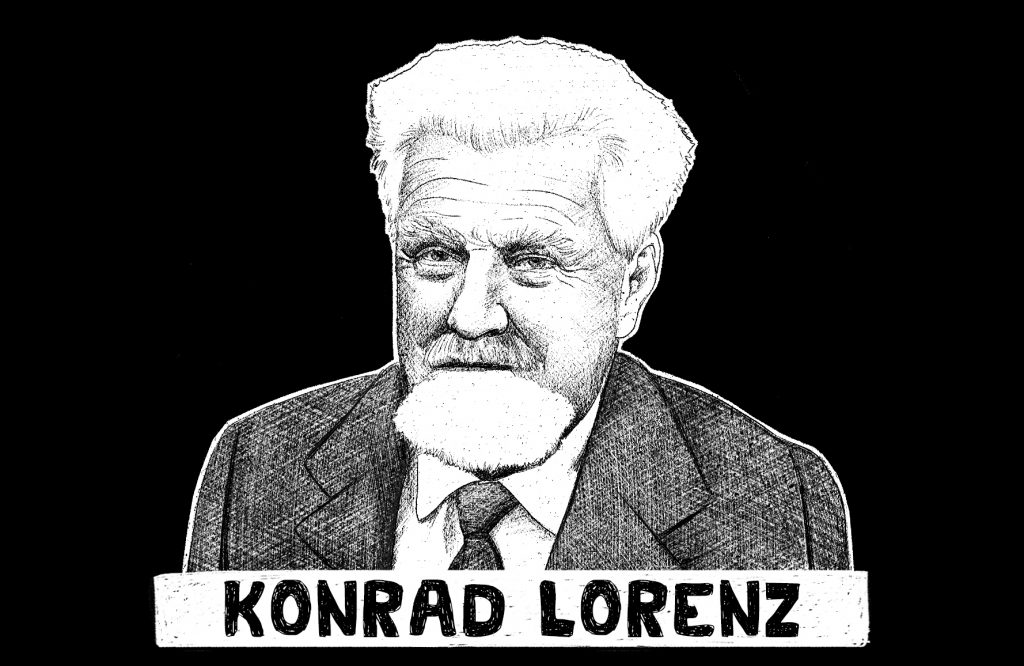
Konrad Lorenz was an Austrian zoologist and animal psychologist. He made major contributions to the study of animal behavior. Lorenz’s contributions to the fields of zoology, ornithology, and animal psychology led to him sharing the Nobel Prize in physiology or medicine in 1973.
Konrad Zacharias Lorenz was born in Altenberg, Vienna on November 7,1903. He was the second of two children born to Emma and Adolf Lorenz, both of whom were physicians. His brother, Albert, was 18 years his senior.
The Lorenz family was very wealthy and enjoyed a high social and cultural standing. Adolf Lorenz was a distinguished orthopedic surgeon who became world-renowned for his innovative treatment of a congenital hip disorder. He was a self-made man who traveled extensively, had numerous publications, and frequently associated with aristocrats and dignitaries. He had high ambitions for the younger Lorenz.
Early Interest in Animals
Lorenz developed a keen interest in animals from a very young age. He attributed this interest in part to his nanny, Resi Fuhringer, who had a special gift for raising animals. So obsessed was Lorenz with animals that for a time he wanted tobecomeone. His first desire was to become an owl but after learning that they could not swim, he changed his mind.
Lorenz acquired a day-old duck from a farmer in his neighborhood and his friend Margarethe Gebhardt (who would later become his wife) got one the day after. They spent many hours together pretending to be “mother ducks,” learning and responding to the sounds and movements of their animal friends. Lorenz eventually became fixated on water fowl and claimed to have been an expert on their behavior even as a child.
Lorenz eventually acquired a large collection of animals, transforming his extensive home garden into a mini zoo of sorts. He had a variety of birds, dogs, cats, rabbits, monkeys, fish, crustaceans, reptiles, and amphibians. Many of these he caught himself while roaming the countryside around his home. According to Lorenz, his parents were “supremely tolerant of [his] inordinate love for animals.”
Lorenz received his elementary and secondary education at private schools in Vienna. He was an excellent student and developed an obsession with the theory of evolution as a child. His first exposure to the theory came at age ten when he saw a picture ofArchaeopteryxin a book he was reading. His interest intensified later when he was formally taught Darwin’s theory in school. Lorenz enrolled at the elite high school known as the Schottengymnasium at around age eleven or twelve and graduated at age 19.
Even as a full time medical student, Lorenz continued to raise animals, both at the family home in Altenberg and at the family apartment in Vienna. In 1926, he purchased a young jackdaw and kept a diary in which he documented his observations of its behavior. In 1927, his report on the bird’s behavior was published in an ornithology journal, essentially launching his career in the study of animal behavior.
University of Vienna
Early Professional Life and Military Career
Back in Austria, Lorenz served as head of the Institute of Comparative Ethology at Altenberg from 1949 to 1951. In 1951, he accepted an offer to lead a small behavior research unit in the Max Planck Institute of Buldern, Westphalia. In 1958, he transferred to the Max Planck Institute for Behavioral Physiology in Seewiesen, Bavaria, where he served as co-director, before becoming the sole director in 1961. He remained in that position until his retirement in 1973.
In 1973, Lorenz was appointed as director of the department of animal sociology at the Institute for Comparative Ethology of the Austrian Academy of Sciences. The Institute was based at Lorenz’s family home in Altenberg.
Work With Geese
Imprinting was first demonstrated in 1935 when Lorenz was working with newly hatched greylag geese. He collected a number of goose eggs and when they were close to hatching, he placed half of them under a mother goose and put the other half in an incubator. Lorenz ensured that he was the first large moving object the goslings from the incubator saw after they emerged from their shells. The goslings that hatched with the mother goose followed her wherever she went. However, the goslings that hatched in the incubator followed and called to Lorenz as they would their real mother. Lorenz later found that newly hatched goslings would accept any moving object as their foster mother if it was the first thing they saw after hatching.
Lorenz then took his experiment a bit further. He marked the goslings so he could identify which had hatched naturally and which had been incubated. Then he covered all the goslings with a box to combine both groups. When the box was removed, the goslings again separated into two groups on their own; the group of naturally-hatched goslings walked toward the mother goose and the group of incubator-hatched goslings walked toward Lorenz.
Work With Ducks
In addition to greylag geese, Lorenz also conducted imprinting experiments on young mallard ducks. For the young ducklings to accept him as their foster mother, Lorenz discovered that he had to squat so that he was closer to their height and he had to quack like a duck. Once the ducklings received the visual and auditory stimuli they needed, they were successfully imprinted. As Lorenz continued his work he realized that imprinting took place only during a very short time span, which he referred to as thesensitive period. He also believed that once imprinting occurred, the young animals were not able to imprint on anything else.
Another important fact that Lorenz discovered is that imprinting may impact the sexual behavior of some animals when they become adults. He noticed that sexually mature animals that had foster parents from a different species tended to approach members of the same species as their foster parents rather than their own. The imprinted animals would mate with other members of their own species if they were placed together, but if given a choice, they preferred to approach an animal that was similar to their foster parents. He also noted that sexual imprinting does not occur in all species.
Why Imprinting is Important for Surival
Lorenz recognized that imprinting affected both the short-term survival and the long-term survival of some species. He claimed that some young animals need to develop an attachment to a parent who can provide food and protection (short-term survival) and older animals need to find a suitable mate to produce viable offspring and pass on their genes (long-term survival). Although imprinting is a form of learning, Lorenz suggested that it differs from other types of acquired behavior in three primary ways:
Lorenz’s research also led him to put forward an innate releasing mechanism theory. He claimed that an animal may have an innate behavior pattern (also called an innate releasing mechanism) that will stay dormant until a stimulating event (or releaser) activates it.
Lorenz’s work helped researchers to better understand how some behavioral patterns arise and develop during the life of an animal. He challenged the main principles of behavioral animal psychology, which claimed that all behavior is learned. His research provided evidence that attachment is innate and may have a genetic basis for the survival of the species. Lorenz’s insistence on studying animals in their natural environment and his humane investigative methods inspired younger researchers to conduct animal experiments without cruelty.
Criticism of Lorenz’s Theories and Approach
Perhaps the biggest criticisms of Lorenz’s work are that his observations were based on personal accounts and he collected his data outside of rigorous laboratory settings. Lorenz also believed that animals experience emotions that are similar to humans and his method involved trying to imagine the mental state of the animals he was studying. While Lorenz argued that it is necessary to observe animals in their natural context to investigate the full range of their behaviors, some critics claimed his methods were neither objective nor scientific.
Lorenz was a prolific writer and authored a number of books over the course of his long professional career. His most popular books include:
Lorenz received an honorary doctoral degree from the University of Salzburg in 1983. However, the degree was revoked in 2015 due to Lorenz’s involvement with the Nazi party during World War II. Some of Lorenz’s other awards include:
Lorenz deeply regretted his association with the Nazi party during World War II. After the war ended, he denied having been a party member until documents confirming his membership were made public. He explained that during his time in the German army, he was unaware of the many atrocities that were taking place across Europe.
Konrad Lorenz died from kidney failure on February 8, 1989, at his home in Altenberg, Austria. He was buried at the St. Andra-Wordern cemetery near Altenberg.
American Psychological Association. (2002).Eminent psychologists of the 20th century.Retrieved fromhttps://www.apa.org/monitor/julaug02/eminent
Burkhardt, R. W. (2005).Patterns of behavior: Konrad Lorenz, Niko Tinbergen, and the founding of ethology. Chicago, IL: The University of Chicago Press.
Hess, E. H. (n.d.).Konrad Lorenz. Retrieved fromhttps://www.britannica.com/biography/Konrad-Lorenz
Hinde, R. A. (). Konrad Lorenz (1903-89) and Nikolaas Tinbergen (1907-88). In R. Fuller (Ed.),Seven pioneers of psychology: Behavior and mind(pp. 75-108). New York: Routledge.
Innis, N. K. (1998). History of comparative psychology in biographical sketches. In G. Greenberg & M. M. Haraway (Eds.),Comparative psychology: A handbook(pp. 3-24). New York: Garland Publishing.
Lorenz, K. (1985). My family and other animals. In D. A. Dewsbury (Ed.),Leaders in the study of animal behavior: Autobiographical perspectives(pp. 258-287). Lewisburg, PA: Bucknell University Press.
Lorenz, K. (1973).Konrad Lorenz biographical. Retrieved fromhttps://www.nobelprize.org/prizes/medicine/1973/lorenz/biographical/
Timberlake, W. (2002). Lorenz, Konrad, Z. In N. Sheehy, A. J. Chapman, & W. Conroy (Eds.),Biographical dictionary of psychology. New York: Routledge
Related posts:Are Humans Animals?John B. Watson (Psychologist Biography)Ivan Pavlov (Biography + Experiments)Edward Thorndike (Psychologist Biography)Martin Seligman Biography - Contributions To Psychology
Related posts:
Reference this article:Practical Psychology. (2020, July).Konrad Lorenz (Biography).Retrieved from https://practicalpie.com/konrad-lorenz/.Practical Psychology. (2020, July). Konrad Lorenz (Biography). Retrieved from https://practicalpie.com/konrad-lorenz/.Copy
Reference this article:
Practical Psychology. (2020, July).Konrad Lorenz (Biography).Retrieved from https://practicalpie.com/konrad-lorenz/.Practical Psychology. (2020, July). Konrad Lorenz (Biography). Retrieved from https://practicalpie.com/konrad-lorenz/.Copy
Copy
