Have you ever wondered why little kids think sharing toys is a rule because “it’s nice,” while older students might believe it’s right because “it’s fair”? As we grow up, how we think about right and wrong changes greatly. This isn’t just random; there’s a pattern to it. A smart guy named Lawrence Kohlberg devised a way to explain this change, calling it the “Stages of Moral Development.”
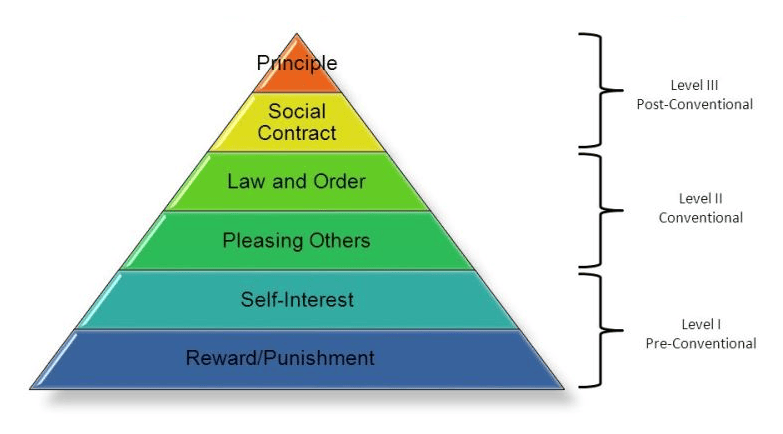
Imagine climbing a set of stairs. At the bottom, we might do things to avoid getting in trouble or to get a reward. As we go higher, we start to think about what others expect from us and what’s generally accepted as right in society. And for some, at the very top, they might start to question and think deeply about these rules themselves.
This article will dive into these stages, helping you understand how our thinking evolves at different ages. It’s like a roadmap to ourmoral growth, showing us how and why our views on right and wrong shift as we age. Let’s take a journey together and explore these stages!
What Are Kohlberg’s Stages of Moral Development?Stages of Moral Development and AgesStage 1) Obedience and punishmentStage 2) Self-interestStage 3) ConformityStage 4) Law and orderStage 5) Social ContractStage 6) Universal Ethical PrinciplesKohlberg’s Stages of Moral Development’s Heinz DilemmaIs Kohlberg’s Stages of Moral Development Theory Still Relevant Today?
What Are Kohlberg’s Stages of Moral Development?
Stages of Moral Development and Ages
Stage 1) Obedience and punishment
Stage 2) Self-interest
Stage 3) Conformity
Stage 4) Law and order
Stage 5) Social Contract
Stage 6) Universal Ethical Principles
Kohlberg’s Stages of Moral Development’s Heinz Dilemma
Is Kohlberg’s Stages of Moral Development Theory Still Relevant Today?
 Kohlbergs Morgal Development Stages
Lawrence Kohlbergexpanded on and revised the ideas of cognitive theoristJean Piaget. Piaget’s work suggested that children’s morality changes over time as they move through stages of mental development.
In his interviews, Kohlberg employed Piaget’s method of questioning participants about moral dilemmas. He would tell stories with conflicting ideas representing two moral values and ask children whether these were right or wrong. Kohlberg was less interested in the answers themselves than in understanding the thinking process behind them.
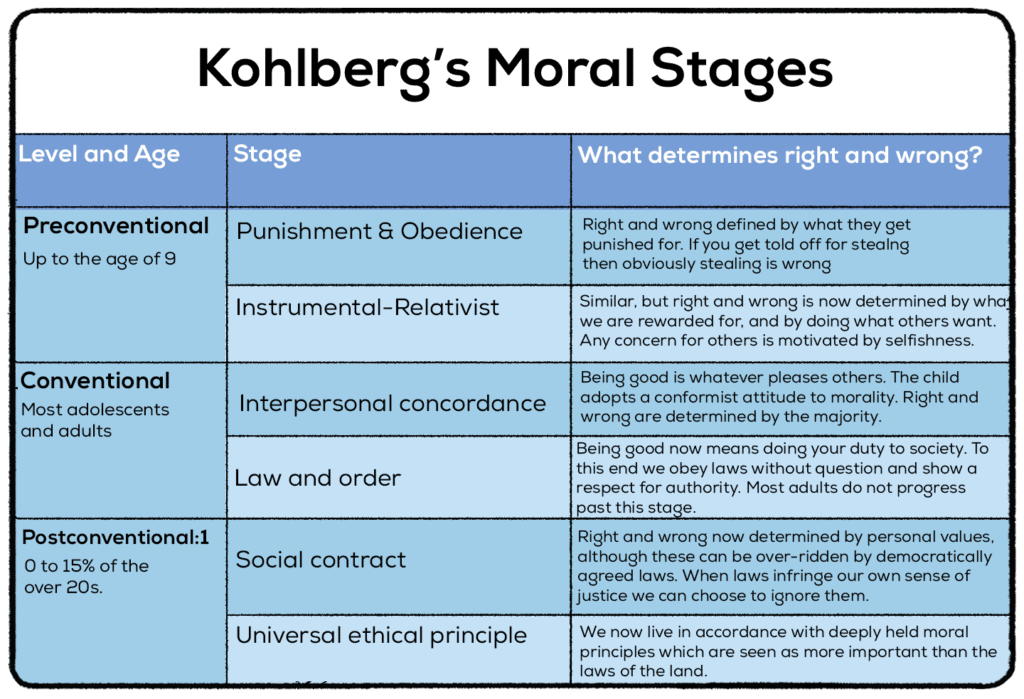
Based on the children’s responses, Kohlberg classified their moral reasoning into three levels: pre-conventional, conventional, and post-conventional. He further divided each level into two distinct stages.
LikePiaget’s theory of moral development, Kohlberg believes that moral development occurs in stages, but he argues that it is a continuous process throughout a person’s life.
Let’s look at the characteristics of each of Kohlberg’s stages.
Pre-conventional Level
Heinz’s dilemma is often used in the study of moral development, particularly in Kohlberg’s theory of moral development. The dilemma goes something like this:
At this level, a child faced with Heinz’s dilemma would say that the man shouldn’t steal the drug because stealing is wrong, and he will end up in prison.
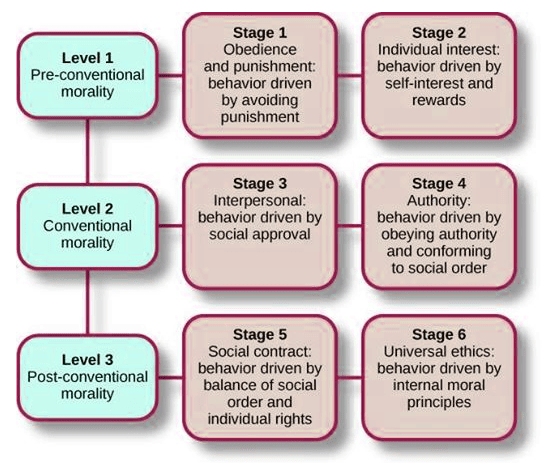
At this stage, individuals make moral decisions based on avoiding punishment or seeking reward. They follow rules to avoid physical punishment or loss of privileges but don’t understand that rules are based on social norms or the need for social order.
Individuals at this stage may also have a limited perspective, unable to see things from another’s point of view, and they may not consider the intentions or circumstances behind someone’s actions. For example, a child at this stage might think that stealing a toy from a store is always wrong, regardless of the reason why the person did it or the consequences that might follow.
To identify Stage 1, look for individuals mainly focused on avoiding punishment or seeking rewards who may not yet fully understand the concept of social norms or the importance of considering other people’s perspectives. They may also display a rigid and inflexible approach to moral decision-making.
As children mature, their motivation for displaying certain behaviors shifts from seeking external rewards to considering what they personally believe is in their best interest. This stage of moral reasoning is self-centered and shows little or no consideration of the needs of others. Children start realizing that rules are not absolute. People can have different perspectives, and there is more than one correct point of view.
At this stage, individuals make moral decisions based on their own self-interest and the exchange of favors. They begin to understand that others have their needs and wants and may be willing to negotiate to meet them.
Individuals at this stage may also display a more flexible approach to moral decision-making, recognizing that there are different perspectives and that the rules can be changed if they benefit everyone. For example, a child at this stage might think it’s okay to take someone else’s toy if they offer something else in exchange or convince the other person that it’s a fair trade.
To identify Stage 2, look for individuals who are mainly focused on their own self-interest but also aware of others' needs and wants. They may display a more flexible approach to rules and be willing to negotiate to achieve their goals. They may also be more aware of the social exchange of favors and obligations.
Conventional Level
The conventional level of morality is typical of adolescents and adults who internalize moral standards. An individual’s sense of morality is increasingly based on interpersonal relationships. At this level, children continue to conform to the rules of authority figures. But although they understand that there are conventions dictating how they should behave, following the rules is not necessarily related to the prospective punishment. Above all, they wish to ensure good relationships with others.
When presented with Heinz’s dilemma, some older children at the conventional level of moral development might argue that while stealing the drug can be justified to save his wife’s life, Heinz should still face the consequences and go to prison for his actions.
At this stage, individuals make moral decisions based on the expectations and approval of others, particularly those who are important to them. They begin to understand that good behavior is seen as what pleases others, and they want to be seen as a good person in the eyes of those who are important to them.
Individuals at this stage are also more likely to take into account the feelings and perspectives of others and may seek to maintain positive relationships. For example, a child at this stage might think it’s important to share toys with others so they will like them and want to play with them.
To identify Stage 3, look for individuals mainly focused on pleasing others and maintaining positive relationships. They may be more aware of social norms and expectations and may be more likely to take the perspective of others into account. They may also seek approval from authority figures and conform to social norms to gain approval.
At this stage, individuals make moral decisions based on a sense of duty to uphold social order and respect for authority. They begin to understand that social order depends on the rule of law and that laws must be respected to maintain social order.
Individuals at this stage are also more likely to consider the broader social context and the greater good rather than just their own personal relationships or interests. For example, a person at this stage might think it’s important to follow traffic laws, not just to avoid a ticket or to please others, but because it’s necessary for public safety and the greater good.
To identify Stage 4, look for individuals mainly focused on upholding social order and respect for authority. They may have a strong sense of duty and obligation to follow the rules and maintain social order. They may also be more likely to consider the broader social context and the greater good when making moral decisions.
Kohlberg believes that most individuals don’t develop their reasoning beyond this stage of moral development, in which morality is still predominantly dictated from the outside.
Postconventional Level
According to Kohlberg, only 10-15% of the population can achieve the post-conventional level of moral development because abstract principles and values define the sense of morality.
Those individuals who attain the highest level of moral development question whether what they see around them is good. There is an increasing sense of individuals being separate entities from society. Morality on this level comes from self-defined principles. Laws that are seen as unjust should be removed or changed. Disobeying rules is not necessarily wrong when they are incompatible with personal principles.
Participants in Kohlberg’s experiment who have reached the post-conventional level would believe that stealing the drug from the chemist’s office was not wrong. For them, saving a life is more important than the law itself.
Individuals at this stage of moral development understand that society is full of contrasting opinions and values that should be respected. Laws are regarded as flexible social contracts. Laws that don’t serve the greater common good should be changed to better align with the collective interests of society. In this context, morality and individual rights take precedence over established laws.
At this stage, individuals make moral decisions based on justice, democracy, and individual rights. They begin to understand that laws and social norms are not set in stone and can be changed if they do not promote the greater good or protect individual rights.
Individuals at this stage are also more likely to consider different groups' perspectives and recognize the need for compromise and negotiation. For example, a person at this stage might think it’s important to advocate for policies promoting equality and individual rights, even if it means challenging existing laws or social norms.
To identify Stage 5, look for individuals mainly focused on justice and rights. They may be more likely to challenge authority and advocate for change if they see laws or social norms as unjust or unfair. They may also be more aware of the perspectives of different groups and the need for compromise and negotiation to achieve the greater good.
At this stage, individuals believe that laws should align with these universal principles. If laws are perceived as unjust based on these principles, they feel such laws can and should be challenged or disobeyed. However, Kohlberg believed that very few people consistently operate at this advanced stage.
Individuals at this stage are also more likely to take a principled, ethical approach to decision-making and may see themselves as part of a larger moral community. For example, a person at this stage might think it’s important to fight against social injustices such as discrimination or environmental destruction, even if it means going against established laws or social norms.
Consider the following moral dilemma. A man named Heinz has a wife dying of a rare cancer. Heinz learns that a local chemist has invented a new drug that might save his wife’s life. But he can’t afford the drug. Although he tries to borrow money from his friends and family, the amount is still insufficient. The chemist is not ready to lower the price either. After trying everything he could think of without success, Heinz breaks into the chemist’s office and steals the drug. Was this the right thing to do?
Here is an example of how an individual may behave at each stage in Kohlberg’s Stages:
Obedience and Punishment Stage 1: An individual may say that Heinz should not steal the drug because stealing is wrong, and he could get arrested.
Self-InterestStage 2: An individual may say that Heinz should steal the drug to save his wife because he is important to him, and he would want others to do the same for him if he were in a similar situation.
Law and Order Stage 4: An individual may say that Heinz should not steal the drug because it’s against the law, and breaking the law would undermine social order and respect for authority.
Social Contract Stage 5: An individual may say that Heinz should steal the drug because the right to life and the principle of fairness outweigh the property rights of the pharmacist who owns the drug.
Universal Ethical Principles Stage 6: An individual may say that Heinz should steal the drug because it’s the right thing to do, even if it means breaking the law and risking punishment. They may also argue that the ethical principle of valuing human life is more important than any legal or social norm.
Today, people reference Kohlberg’s moral development stages when discussing communication, debate, and relating to others. But it’s not always accepted in these discussions.
Take this one Reddit user’s take on theJordan Peterson subreddit:
“This is one psychologist’s take on morality. It uses mortality, ethics and justice interchangeably, and hence lacks cohesion. Which is to be expected as morality is a deeply philosophical topic. It makes sense that a psychologist would have this sort of approach (which everyone acknowledges is just a reformatting of Jean Piaget’s stages of childhood development).
I think Maslow’s heiarchy of needs would have been a better map, looking at the general requirements in becoming moral, rather than treating morality as an ultimate ontological fact.
Either way, systematizing morality may not be the smartest idea. Better to pursue ethics.”
With its detailed delineation of children’s moral development, Kohlberg’s theory has significantly impacted psychology and education. However, like many pioneering theories, aspects of Kohlberg’s framework have been critiqued. Notably,Carol Gilligan, an ethicist and once Kohlberg’s research assistant, presented a key critique. She argued that Kohlberg’s stages of moral development were male-centric and might not adequately represent moral reasoning in women.
Criticisms of Kohlberg’s Theory of Moral Development
What’s more, Kohlberg’s theory does not consider the role cultural differences might play in the development of moral reasoning. For example, Western cultures may have different moral philosophies than societies that give more importance to the community than personal rights.
Some researchers have had doubts about Kohlberg’s general conclusions after he questioned whether older children and adolescents could attain the latest stages of moral reasoning. Somerecent studieshave shown that children as young as six can already understand vague concepts of universal ethical principles.
Kohlberg did not always tailor his experiments to present dilemmas relevant to the participant’s experiences. The Heinz story might not be relatable to individuals who have never been married. As a result, Kohlberg’s findings might have been different if the situations the participants were asked to analyze were more age-appropriate.
Lastly, Kohlberg’s theory suggests that certain types of moral reasoning are superior to others. Kohlberg supposes that justice is the most fundamental moral principle. He has been reproached for emphasizing justice while overlooking other values, such as compassion and care for others.
Related posts:Lawrence Kohlberg (Psychologist Biography)Piaget’s Theory of Moral Development (4 Stages + Examples)Erikson’s Stages of Psychosocial Development40+ Famous Psychologists (Images + Biographies)53+ Deviance Examples in Sociology (Definition + Theories)
Related posts:
Reference this article:Practical Psychology. (2020, April).Kohlberg’s Stages of Moral Development (6 Stages + Examples).Retrieved from https://practicalpie.com/kohlbergs-stages-of-moral-development/.Practical Psychology. (2020, April). Kohlberg’s Stages of Moral Development (6 Stages + Examples). Retrieved from https://practicalpie.com/kohlbergs-stages-of-moral-development/.Copy
Reference this article:
Practical Psychology. (2020, April).Kohlberg’s Stages of Moral Development (6 Stages + Examples).Retrieved from https://practicalpie.com/kohlbergs-stages-of-moral-development/.Practical Psychology. (2020, April). Kohlberg’s Stages of Moral Development (6 Stages + Examples). Retrieved from https://practicalpie.com/kohlbergs-stages-of-moral-development/.Copy
Copy
