Nowadays, many people know and share their personality types. If you are an INFP, or you want to get to know someone in your life who is an INFP, keep reading. Not sure if you’re an ESFP? Learn more about theMyers Briggs Testto find out!
What Does INFP Stand For?Functions of INFPReal-Life Examples of INFPsStrengths and Weaknesses of INFPsWorking and Living with an INFPBasic Stats About INFPsINFP-A vs. INFP-T
What Does INFP Stand For?
Functions of INFP
Real-Life Examples of INFPs
Strengths and Weaknesses of INFPs
Working and Living with an INFP
Basic Stats About INFPs
INFP-A vs. INFP-T
What makes INFP different from ENTJ? The answers lie in these four letters. I vs. E, N vs. S, T vs. F, and P vs. J represent four sets of ways that people take in the world around them. By breaking down INFP, we can see what makes INFPs unique.
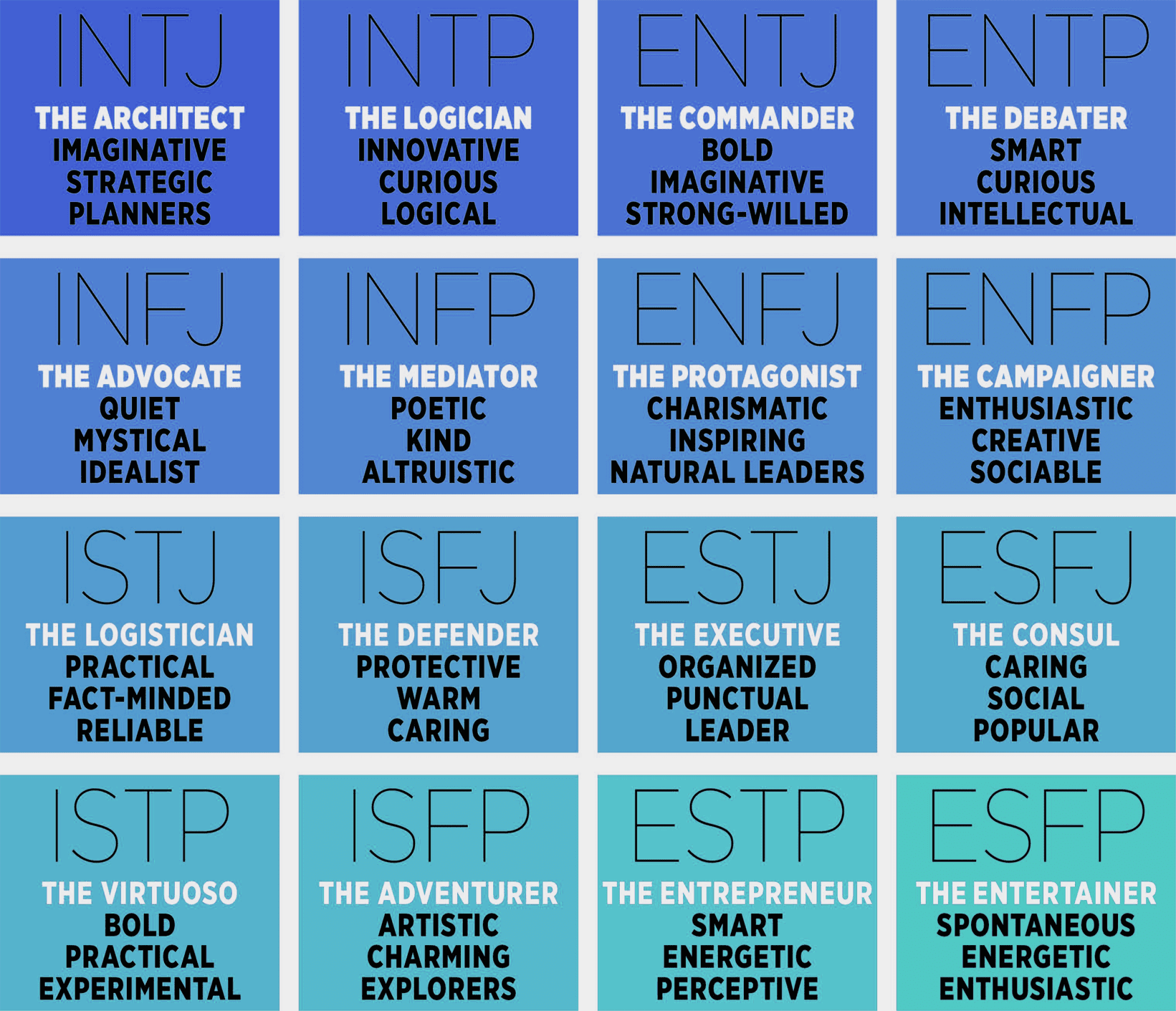
 Printable Myers Briggs Matrix
Introversion
Intuition
N stands for intuition (as opposed to sensing.) This indicates that a person makes judgments based on their intuition instead of the sensory information that is presented in front of them. They are more likely to rely on the impression they get from something than more “literal” data. Think of it as preferring the abstract to the concrete.
Feeling
F stands for feeling (as opposed to thinking.) Of course, people with both “feeling” and “thinking” in their personality type can do the other. INFPs do think, but they tend to rely more on how they, and more importantly others, feel. If they want to make a decision, they are more likely to ask around for opinions instead of doing research in textbooks. This often means they feel the weight of the world. Stats may not sway them as much as a story.
Perception
Finally, P is for perception (as opposed to judgment.) Although “judgers” tend to enjoy structure, people with perception in their personality type are likely to keep their options open. They logically see all of the possibilities in front of them and know that there is always more to learn about a situation. This is one of the reasons why an INFP tries to keep an open mind when meditating. They know, logically, when another person may have a different perspective or that there is always another way to look at a problem.
And there you have it! In addition to these four letters, all personality types are identified as a different role in society, from the commander to the debater to the mediator. Altogether, an INFP’s method for taking in and processing information makes them a perfect ‘Mediator.” They are good at this skill and usually have a desire to find common ground, unity, or peace between multiple parties. When two people are in a conflict, they should turn to an INFP for some perspective and compromise.
In addition to influencing the personality types themselves, Carl Jung spoke frequently about different cognitive functions. These functions describe how people act in the world. Out of the eight functions, each personality type corresponds with four.
The dominant function of INFP types is introverted feeling (Fi.) As their dominant function, INFPs are likely to use introverted thinking consistently to evaluate their personal emotions and gut instinct. However, they also use their inner understanding to derive meaning from the outside world and are often considerate of others’ feelings.
Right behind Introverted Feeling, the auxiliary function of INFP types is extroverted intuition (Ne.) INFPs use their extraverted intuition to process information from the world around them, often locating various patterns and connections in a broad view. This also means that they are engaged with outside sources, and open to exploring new possibilities.
The tertiary function of INFP types is introverted sensing (Si.) INFPs will rely on their introverted sensing around real-world situations, allowing them to interpret the sense of what is wrong and what is right. Essentially, this function gives them the ability to ground their feelings about this world in a more detailed and structured way.
Finally, the inferior function of INFP types is extroverted thinking (Te.) INFPs will only use their extroverted thinking as a last resort in order to solve a problem. Extroverted thinking functions use logic and critique, which INFPs find exhausting and unaligned with their emotional approach to living life.
Wouldn’t you like to hear the conversations being had at a dinner table with all of these meditators?
People love INFPs because they stick to their word while still considering the thoughts and feelings of others. Everyone needs a mediator in their friend group, family, or at work! INFPs have a long list of admirable strengths, including:
There are upsides to being the mediator of the group…and there are downsides. Aside from maybe Andy Warhol or Bob Marley, you don’t see too many INFPs being the life of the party. Their inward focus and loyalty to their values creates room for some common weaknesses among INFPs, including:
The conflict between the dedication to their own values and their tendency to be a “people-pleaser” can often cause conflict in an INFP.
As I said before, you probably know someone who acts as the mediator between more fiery personalities. It’s nice to have an INFP in your life! Whether you work with an INFP, are friends with them, or date them, knowing them on a deeper level is key to effective communication. Understanding their strengths, weaknesses, and tendencies is the best way to form a strong bond.
Working with INFPs
INFPs are known as “the meditator,” but that is not all they do at work. They bring a lot to the table! An INFP does everything they can to feel that they are making a difference at work (or at home, among friends, etc.) If they feel as though they are fulfilling a purpose, they will be a stellar colleague or employee.
Knowing this, be sure to reassure the INFPs on your team that theyarebringing something to the table. INFPs respond well to praise. They come from a place of empathy and expect others to do the same. Strict workplace hierarchies, drama, and rigidity hold them back and make them feel trapped. To allow the INFPs on your team to thrive, give them freedom within deadlines, and communicate to the whole team that working together is a high priority.
Friendship with INFPs
In their personal life, INFPs are very supportive of others and seek to nurture their relationship. They are laid-back and try to avoid conflict as much as possible. However, this means that they will often sacrifice their own needs to make others happy.
The best friendship with an INFP is one where both parties mutually agree to lift each other up. Do you know what the INFPs in your life want to achieve? As a friend, can you help them? These conversations will help you create a deeper bondandgive your INFP friend an opportunity to helpyou.Being friends with an INFP is a huge win-win, as long as you are willing to put in the same amount of work and effort that they do!
Romantic Relationships with INFPs (INFP Compatibility)
As for romantic relationships, INFPs are in search of the perfect person, and their high expectations make it difficult for them to commit to someone. They are hopeless romantics, but once they find someone who meets their soul-mate level standards, they will do anything to keep the relationship strong.
When looking for a partner, INFPs will look beyond the shallow stuff. Will their partner work hard on the relationship? Are they committed to a life of growing together? When conflicts arise, will their partner take the time to be empathetic and work to solve the conflict? If the answer to these questions is “yes,” the INFP will do what it takes to support their partner. INFPs certainly have what it takes to build a deep, beautiful connection that lasts for the rest of their lives!
All personality types that perform the Extroverted Feeling (Fe) function are the most compatible with INFPs. Those personality types include:
How many mediators are out there? They’re not the rarest personality type, but they’re far from the most frequent. INFPs make up 4% of the general population. 5% of women are INFPs, and 4% of men are INFPs. That’s a pretty good balance!
You are unlikely to call the INFPs in your life “assertive” or even “turbulent.” But these are two traits that have recently been added to the Meyers-Briggs vocabulary. In addition to introversion vs. extroversion, intuition vs. sensing, thinking vs. feeling, and perceiving vs. judgement, there is a fifth set of traits that experts have observed in people: assertive vs. turbulent. The INFPs in your life are either an INFP-A or an INFP-T.
Turbulent Mediators (INFP-T) are more likely to experience negative emotions, but it allows them to have more empathy towards others. When in pursuit of their idealistic goals, turbulent INFPs will take the time to self-assess and recognize when they need to put forth a stronger effort.
Related posts:Beck’s Depression Inventory (BDI Test)The Psychology of Long Distance RelationshipsOperant Conditioning (Examples + Research)Variable Interval Reinforcement Schedule (Examples)Concrete Operational Stage (3rd Cognitive Development)
Related posts:
Reference this article:Practical Psychology. (2021, April).INFP – Mediator (Description + Functions + Examples).Retrieved from https://practicalpie.com/infp/.Practical Psychology. (2021, April). INFP – Mediator (Description + Functions + Examples). Retrieved from https://practicalpie.com/infp/.Copy
Reference this article:
Practical Psychology. (2021, April).INFP – Mediator (Description + Functions + Examples).Retrieved from https://practicalpie.com/infp/.Practical Psychology. (2021, April). INFP – Mediator (Description + Functions + Examples). Retrieved from https://practicalpie.com/infp/.Copy
Copy
