Have you ever heard the term “identity crisis?” Maybe you’ve observed a friend go through an identity crisis after getting fired from a job or dropping out of school. Looking back on your teenage years, you might feel as though you went through an identity crisis yourself. This term might seem dramatic or have a negative connotation, but some psychologists believe that this is just a normal part of social development.
Let’s learn about the people who coined the term “identity crisis” and the stage of life when most people go through an identity crisis.
What is Identity vs. Confusion?Erikson and the Identity CrisisWhat Happens During the Identity vs. Confusion StageJames Marcia and the Identity CrisisHow to Resolve Identity vs. Role ConfusionParenting Styles and Identity FormationIdentity Crises Can Happen Past Adolescence
What is Identity vs. Confusion?
Erikson and the Identity Crisis
What Happens During the Identity vs. Confusion Stage
James Marcia and the Identity Crisis
How to Resolve Identity vs. Role Confusion
Parenting Styles and Identity Formation
Identity Crises Can Happen Past Adolescence
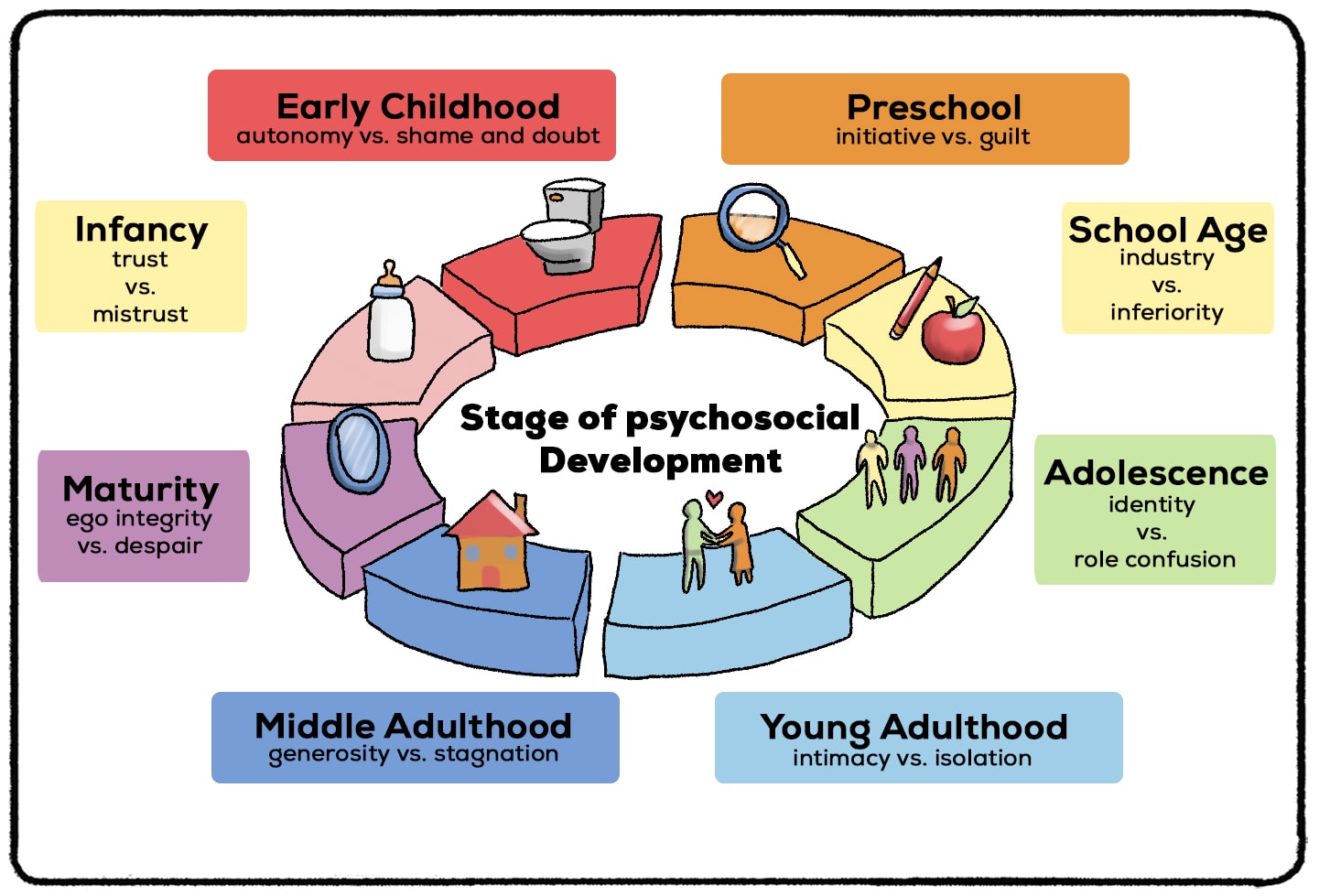
 stages of psychosocial development
Erik Erikson, the influential German-American psychologist, is most widely known for coining the term “identity crisis.” However, his interest in identity and its formation can be traced back to his early life experiences, which were rife with questions of belonging and identity.
These personal experiences profoundly influenced his later work. Erikson identified with the feelings of not fully belonging to one particular group and constantly trying to navigate between conflicting identities. When he began studying Native American children in the 1930s and 40s, he saw echoes of his own identity struggles. Observing these children grappling with the expectations and norms of their indigenous heritage and Western culture, he recognized similar identity formation, acceptance, and conflict patterns.
This stage ofpsychosocial developmentfollows the industry vs. inferiority stage. At this age, children have begun to compare themselves to other children. They know that there are consequences that come with good performance and bad performance. Between the ages of 12-18, adolescents begin to grasp that they will have to perform on a much larger scale than they are used to in school. Parents, teachers, and the society they live in have placed expectations on children beyond school. These expectations influence the teen’s overall identity.
Does the teenager think they can live up to these expectations? Do they want to? What do they even want to do? Who do they want to be?
These are big questions - no wonder an identity crisis may occur during this stage! As the adolescent continues to explore their identity, they may find that everything is cohesive and there are no struggles against society, a parent’s expectations, or their own questioning mind. If there is cohesion, the teen will complete the stage with the basic virtue of fidelity. (Fidelity is faithfulness to a relationship and an identity, set of values, or cause.)
What is Role Confusion?
However, many teens find themselves struggling during this period. Their parents want them to be one thing, but they want to be another. Society expects them to be one thing, but adolescents don’t think they can meet those expectations. The teen may feel confused or even rebel when this struggle sets in. Holding onto any identity, even one that is negative, might seem like the best solution.
Erikson is not the only psychologist to study what happens during an identity crisis, although he is one of the first. His work inspired James Marcia to develop four identity statuses based on a teen’s exploration of and commitment to their identity during this crisis. Their status greatly impacts whether or not the teenager completes the stage successfully.
Examples of Role Confusion
What does it look like when an adolescent is going through a crisis of identity vs. role confusion?
Drawing upon Erikson’s “Identity vs. Role Confusion” stage, a male teenager raised in a societal framework that predominantly values heterosexual relationships may experience an intensified identity crisis. While Erikson identified the teenage years as the primary period for exploring and establishing a coherent identity, this teenager’s challenge to navigate his homosexual orientation amidst societal expectations exemplifies Marcia’s notion of “identity moratorium” - actively questioning and exploring but not yet committed to an identity.
As adolescents journey through Erikson’s fifth stage of development, they typically seek groups or communities that align with their emerging sense of self. For instance, a teenager’s decision to exclusively mingle with the cheerleading squad can be interpreted as an exploration of “identity achievement” as per Marcia’s expansions on Erikson - where they have explored and committed to a particular identity.
Conversely, a teen distancing themselves from friends involved in drug use showcases a conflict between societal expectations (from Erikson’s perspective) and personal identity exploration, potentially leading to an “identity moratorium” phase where they’re actively exploring what aligns with their true self.
A Reddit user on the NewZealand subreddit shared apostsaying, “Hi, currently going through an identity crisis and I feel like I don’t have much hobbies?” The post says that people are searching for a purpose in life. A person going through an identity crisis or role confusion may not know what to do with their day. A writer writes. A gardener goes out in the garden. The head of a family finds ways to provide for their partner, children, and family members. There are many ways to fulfill your identity, but having that identity gives you a little direction on where to go and what to do.
Impact of Previous Stages
Incorporating Erikson’s cumulative nature of stages, if prior stages like “Trust vs. Mistrust” or “Initiative vs. Guilt” were unresolved, this could manifest as an intensified identity struggle during adolescence. A teen might lack foundational trust in their decisions or carry residual shame and guilt, further complicating their identity exploration. Erikson emphasized that the success of navigating the identity crisis is built upon the foundations laid in earlier stages, underscoring the interconnectedness of developmental challenges across the lifespan.
The only person who can determine your identity isyou.Parents, teachers, mentors, and others may try to determine who you are, but you have the final say. If you are experiencing outside pressure, take some time to reflect inward. Grab a journal. Put on some nice music. Shut the door and just write about your feelings. The following prompts may help you get started:
Journal without putting expectations on yourself or thinking that something is “too outlandish” or “silly.”
Erikson may have formally written about identity vs. role confusion, but people recognized this phenomenon before he studied it. Anyone over 12-18 can probably remember going through confusing times in their teenage years. Other teenagers are going through hard times, too. If you’re having an identity crisis, you’re not alone. And the people around you should recognize that you are exploring who you are and your place in this world.
Take a moment to reflect on the people in your life. Would they judge you if you explored new hobbies? Do they affirm your identity? Do they listen without judgment when you talk to them about your feelings? The answer to these questions isn’t always yes. If you find that the people around you are not supportive of who you are, seek out people that are.
If these larger questions of identity and purpose are getting overwhelming, you might want to consider reaching out for help. A therapist may be able to talk you through your questions and assess whether your identity crisis is actually a symptom of depression or anxiety. Mental health can have a serious effect on the way that we view ourselves (and vice versa.)
Parents' styles and approaches play a pivotal role in adolescents' identity formation.Diana Baumrind’stypology of parenting styles — authoritative, authoritarian, permissive, and neglectful — can profoundly influence a teen’s navigation through Erikson’s “Identity vs. Role Confusion” stage.
In the context of Erikson’s “Identity vs. Role Confusion” stage, the parenting style experienced can either aid or hinder the adolescent’s quest for self-understanding. An open, supportive environment fosters exploration and commitment to an identity. In contrast, a restrictive or indifferent environment can lead to role confusion, premature commitment without exploration, or even apathy toward self-definition.
Understanding the profound impact of parenting styles on identity formation underscores the significance of nurturing and guided environments in which adolescents can safely explore, question, and affirm their sense of self. It’s not just about an adolescent’s internal struggles but also about the external factors — primarily parenting — that can shape this critical period of identity development.
Don’t put off asking for help or admitting that you are confused just because an identity crisis is associated with adolescence. Psychologists have observed that people go through other types of identity crises throughout their lives: midlife, quarter-life, etc. Divorce, loss of a job, or loss of a close family member may also lead someone to question who they are and how they live their life.
In fact, every stage of Erikson’s Stages of Psychosocial Development is based on a crisis. During stage 4, that crisis is Identity vs. Role Confusion. But the next stages also contain a crisis. Click to learn more aboutStage 6 of Psychosocial Development: Intimacy vs. Isolation.
Related posts:Erik Erikson’s Biography (Psychologist)Identity Crisis (Definition + Examples)Generativity vs Stagnation: Psychosocial Stage 7Identity Achievement (in Psychology)Integrity vs Despair (Psychosocial Stage 8)
Related posts:
Reference this article:Practical Psychology. (2020, March).Identity vs Confusion: Psychosocial Stage 5.Retrieved from https://practicalpie.com/identity-vs-confusion-psychosocial/.Practical Psychology. (2020, March). Identity vs Confusion: Psychosocial Stage 5. Retrieved from https://practicalpie.com/identity-vs-confusion-psychosocial/.Copy
Reference this article:
Practical Psychology. (2020, March).Identity vs Confusion: Psychosocial Stage 5.Retrieved from https://practicalpie.com/identity-vs-confusion-psychosocial/.Practical Psychology. (2020, March). Identity vs Confusion: Psychosocial Stage 5. Retrieved from https://practicalpie.com/identity-vs-confusion-psychosocial/.Copy
Copy
