What separates us from animals? Our opposable thumbs? Our complex language? The fact that we farm our food? In early personality psychology, not much separates us from animals. Early psychologistsconducted most research and experiments using animals as subjects. Many psychologists found this process to be demeaning and ultimately pessimistic. Are we just trained monkeys in a zoo? Are we Pavlov’s dogs? Do we have any control over our personality and who we become?
Enter Abraham Maslow, the father of the humanistic perspective on personality. His theory separates humans from animals and offers hope that humans can exercise control over personality traits and behaviors that they want to change.
What is the Humanistic Theory of Personality?Origins of Humanistic Perspective of PersonalityAbraham Maslow’s Humanistic Perspective of PersonalityCarl Rogers and HumanismHumanistic StudiesHow Humanism Affects Us TodayDiscovering Your Personality Through the Humanistic Perspective
What is the Humanistic Theory of Personality?
Origins of Humanistic Perspective of Personality
Abraham Maslow’s Humanistic Perspective of Personality
Carl Rogers and Humanism
Humanistic Studies
How Humanism Affects Us Today
Discovering Your Personality Through the Humanistic Perspective
In the 1930s through the 1950s, psychologists like Abraham Maslow and Carl Rogers pioneered humanist theories of personality. Their work offered a new perspective on how humans see themselves, behave, and make decisions. Humanistic theories are a more positive and holistic alternative to Behaviorism and Psychoanalysis.
In the 1920s and 1930s, prominent psychologists uplifted the ideas of Behaviorism and Psychoanalysis. Psychoanalysis suggests that the unconscious mind and childhood traumas highly influence our personalities. Behaviorism suggests that our behaviors are learned, and through reinforcement and punishment, these behaviors can change.
Not all psychologists agree with these ideas. They found them to be pessimistic and hard to prove with scientific studies. Humanistic psychologists didn’t necessarily create their perspective tocompletelyreplace the ideas of behaviorism and psychoanalysisbut to offer a more holistic look at how humans make choices and perform various behaviors.
If you have heard Maslow’s name before, you’re one step closer to understanding the humanistic perspective. Maslow created theHierarchy of Needs. This theory shows the evolution of a human’s needs from the most basic (food, shelter, water) to the more complex (safety, self-esteem, love, and belonging.) As we satisfy our most basic needs, we are motivated to seek out the more complex needs at the top of the pyramid.

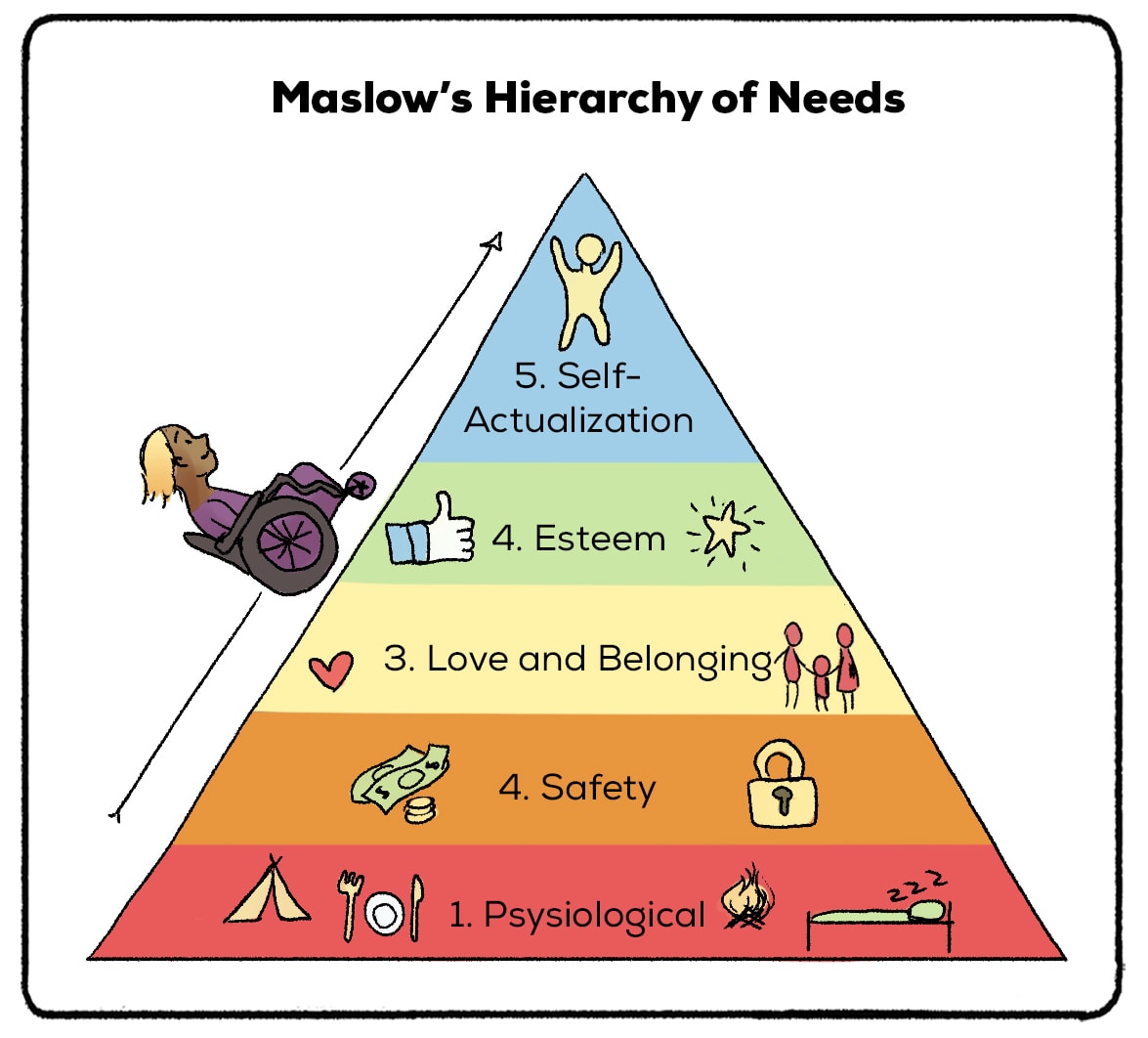
Physiological:basic human needs like food, shelter, and water. It’s hard to focus on the more abstract goals when you’re hungry or looking for a place to sleep at night!
Safety:physical and emotional safety is considered more “basic” human needs. This may also mean the safety to express oneself, grow, or be the person they want to be!
Esteem:This need encompasses feelings of self-respect, self-esteem, accomplishment, and respect from others. It’s not an easy need, so it’s toward the top!
How does this tie into personality? Maslow started to develop these theories in response to the more pessimistic views on personality at the time. Many behaviorists believe that humans have little control over their personalities and can be subjected to conditioning, just like any other animal species. Maslow disagreed. He believed that humanscouldtake control of their personalities as they attempted to achieve self-actualization.
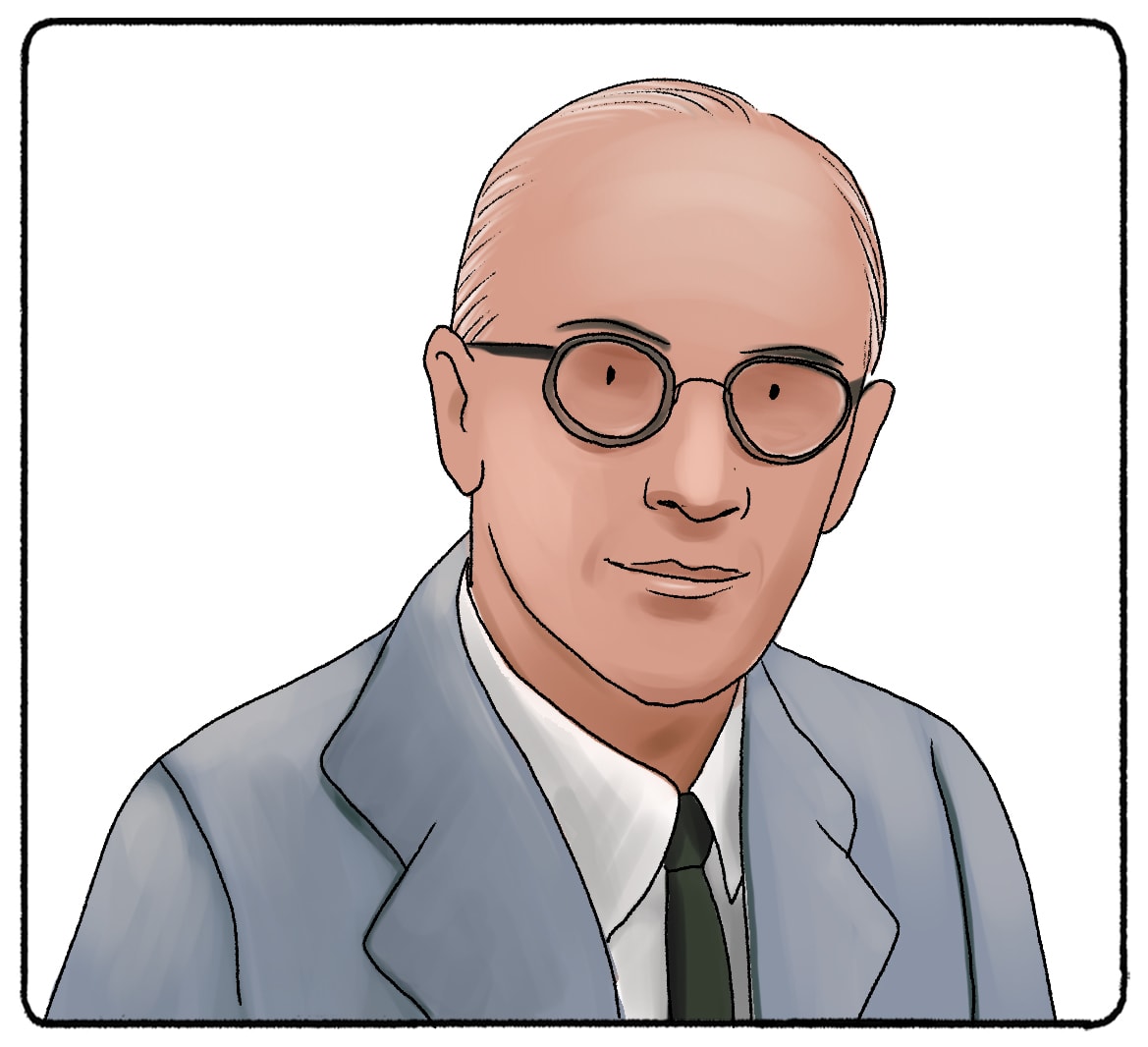
To work toward self-actualization, humans must reflect on who they are and what they need to change or do to move forward.Carl Rogerswas a humanist psychologist who focused on this process. He agreed with Maslow’s theories but continued to studyhowpeople try to satisfy these complex needs.
When people think about their personality, they may tell themselves they are honest, generous, and agreeable. These traits are all subjective and may not be how other people see the person’s deeds or personality. This disconnect, or incongruence, can prevent people from reaching self-actualization and can cause anxiety.
How does this happen? Our brains can be picky about what they see, process, and remember. A person who onlybelievesthey are agreeable may unconsciously choose to remember positive, agreeable interactions or misinterpret situations in which they were not actually displaying agreeable behavior.
Where does incongruence come from? How can we develop a more objective sense of ourselves and reach self-actualization?
Client-Centered Therapy
One of Carl Rogers’ most notable works is the development ofclient-centered therapy, also known as person-centered therapy. Client-centered therapy added a new perspective on how to conduct therapy, much like how humanism added a new perspective to the current schools of thought.
Client-centered therapy operates differently. The therapist asks the client to lead the conversation. Therapists offer support and guidance throughout the conversation but do not open up the situation with an agenda or list of questions. Moreover, the therapist does not place judgments or scold the client in any way. The therapist’s office should be an environment ofunconditional positive regard. (This is another concept that Carl Rogers created.)
For the answers to these questions, MaslowandRogers studied people they believed reached some form of self-actualization. These people were successful and spent their lives working to elevate humanity.
This approach to studying healthy, successful people was a big change in the world of personality psychology. Behaviorists and other personality psychologists at the time turned to studying people who had made poor decisions in their lives or had poor mental health. Humanists took a more optimistic approach to their subjects.
So what do people need to become self-actualized and positive members of society? Rogers concluded that people need to live in an environment with the following qualities:
If someone grew up in this environment, they are more likely to holdcongruentviews of themselves that match how the rest of the world sees them. Conversely, if someone grew up in a more hostile or negative environment, they are more likely only to see what they want.
Rogers uses the example of parents showing conditional vs. unconditional love. When children grow up in a household with unconditional love, they are more likely to hold congruent views of themselves and be on a path toward self-actualization. The children who received conditional love were likelier to block out times they were unloved. This pattern is likely to continue as an adult; only seeing parts of a situation or misconstruing a situation is likely to continue unless they are put in a more positive environment.
Remember, the humanistic approach to personality is very positive. Humanists believe that with openness, empathy, and a genuinely positive environment, anyone can develop congruent views of themselves and move toward self-actualization.

Humanistic psychology has had a very positive impact on the world of psychology. People can visit a therapist that uses a humanist approach to their practice. This is also calledGestalt therapy.Gestalt therapists use an approach that views patients and therapists as equals. The therapist empathizes with the patient rather than being an authority figure who looks down upon the patient. They use humanist ideas to create a positive environment that focuses on the present rather than incidents from the past.
How can you use these theories to discover your personality? First things first, acknowledge that you have the ability to make these discoveries and take charge of your destiny! Then, try out the following exercises and contemplate how you, as an individual, move through the world.
Write down the things you like about yourself
Humanist theories were created with the belief that people were inherentlygood.Do you see yourself the same way? If you’re not sure, take some time to complete this exercise. Simply write down five things that you believe are good about yourself. Maybe it’s your patience, your dedication to volunteering, or the empathy you display when listening to viewpoints that aren’t yours. As you write down these things, you may find that they reveal elements of your personality and traits that define who you are and strive to be!
Think about your goals
From the humanistic perspective, humans aren’t just inherently good - they’re inherentlygrowing. People have the ability to take on a growth mindset and improve themselves and their place in life. As they progress on this journey, they can reach self-actualization.
What does your journey look like? How does it relate to Maslow’s Hierarchy of Needs? Talk to yourself through the perspective of unconditional positive regard as you answer these questions. You have the ability to have your needs met. You areworthyof love and belonging, high esteem, and self-actualization. You are likely doing quite a lot to reach your goals already! If not, writing them out and looking at behaviors that prevent you from getting there will help you grow.
Reach out to a client-centered therapist
You may be able to ask yourself questions about your personality and goals but need assistance discovering the answers. That’s where support groups, community, and professional help come in! Look for a therapist specializing in client-centered, gestalt, or person-centered therapy. Not sure what your therapist specializes in? Schedule a free consultation to ask!
Discovering that your view of yourself may be incongruent with the world isn’t always easy. Supportive friends, groups, or therapists can help you understand where you fit. Think about how you see yourself and how you behave when friends or family try to offer opposing perspectives. How does this behavior contribute to your overall personality? How can you create and put yourself in an environment that encourages an open, genuine look at yourself through the eyes of the world?
Related posts:Carl Rogers Biography - Contributions To PsychologyAbraham Maslow (Biography + Accomplishments)Client Centered Therapy (Benefits + Explanation)Therapy Question List (190+ Examples and 10 Types)Maslow’s Hierarchy of Needs
Related posts:
Reference this article:Practical Psychology. (2019, January).Humanistic Perspective of Personality.Retrieved from https://practicalpie.com/humanistic-perspective-of-personality/.Practical Psychology. (2019, January). Humanistic Perspective of Personality. Retrieved from https://practicalpie.com/humanistic-perspective-of-personality/.Copy
Reference this article:
Practical Psychology. (2019, January).Humanistic Perspective of Personality.Retrieved from https://practicalpie.com/humanistic-perspective-of-personality/.Practical Psychology. (2019, January). Humanistic Perspective of Personality. Retrieved from https://practicalpie.com/humanistic-perspective-of-personality/.Copy
Copy
