What are the most important tasks in your life right now? I’m not talking about little things like brushing your teeth or paying a bill. I’m talking about the biggest goals in your overall development. According to the Havighurst’s Developmental Task Theory, your age plays a big role in this answer.
Who Was Robert J. Havighurst?What Is Developmental Task Theory?What Are the Stages in Havighurst’s Developmental Task Theory?Examples of Developmental Tasks
Who Was Robert J. Havighurst?
What Is Developmental Task Theory?
What Are the Stages in Havighurst’s Developmental Task Theory?
Examples of Developmental Tasks
Havighurst was an American psychologist who developed his theory on Developmental Tasks between 1948 and 1953. His work came after the work of Sigmund Freud and Jean Piaget, but before Erik Erikson. He is also known for popularizing the phrase “teachable moments” in his 1952 book Human Development and Education.
In his book, he writes:
“A developmental task is a task which is learned at a specific point and which makes achievement of succeeding tasks possible. When the timing is right, the ability to learn a particular task will be possible. This is referred to as a ‘teachable moment.’ It is important to keep in mind that unless the time is right, learning will not occur. Hence, it is important to repeat important points whenever possible so that when a student’s teachable moment occurs, s/he can benefit from the knowledge."
Havighurst’s Theory defined developmental stages and tasks pertaining to each stage. This mirrors the work of Piaget and Erikson, who also identified “stages” of development and what each child achieved at different ages. Within each stage is a list of tasks that the individual feels that they must complete.
 stages of Havighurst’s Developmental Task Theory
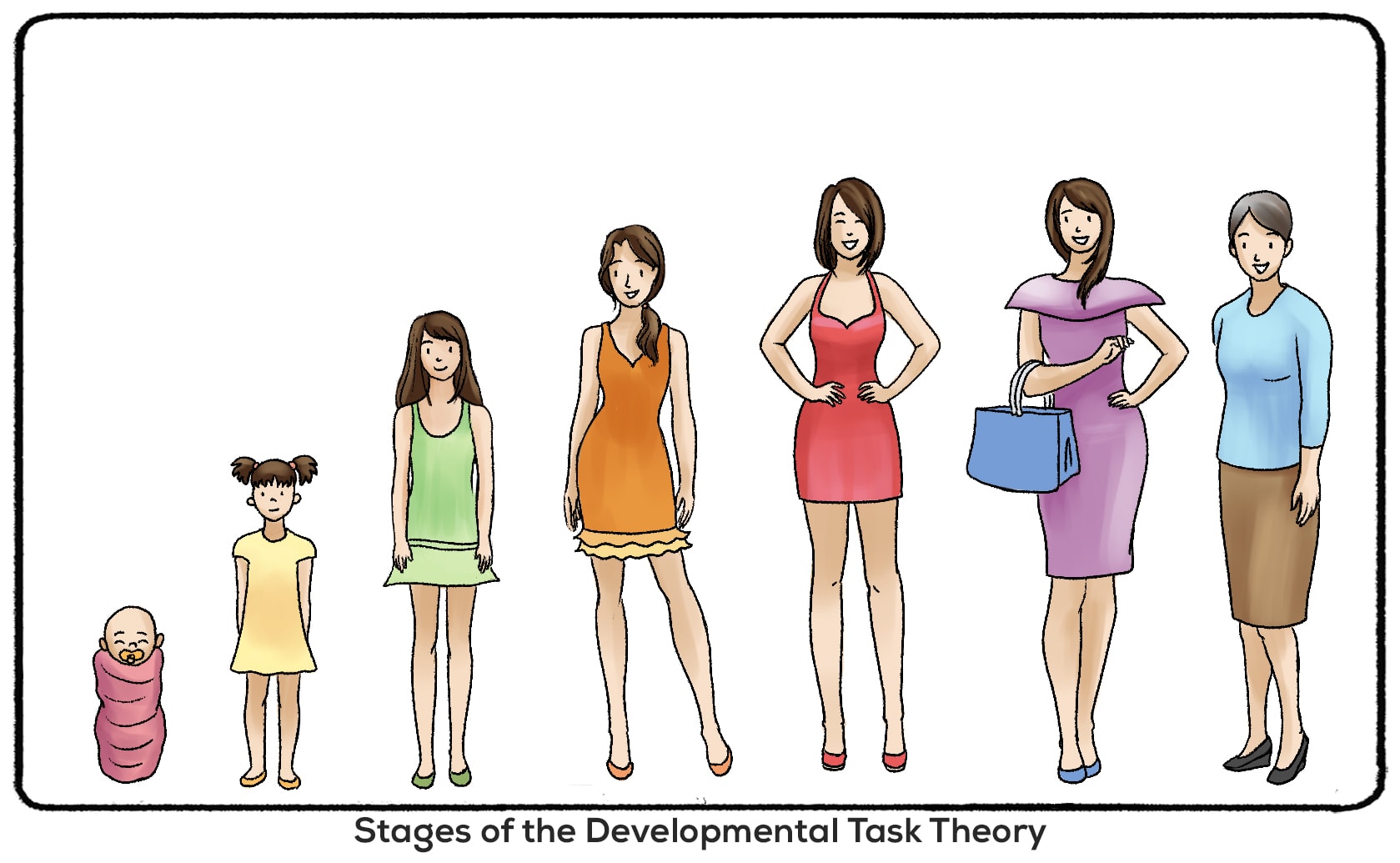
The stages in Havighurst’s Theory include:
While societal rules and customs certainly influence the tasks within each stage of development, other factors are also at play here. Havighurst also defined a list of what influences the tasks an individual strives to complete at each stage of development:
Social Influences (Pressures of Society)
These are the rules of society and othercultural ideasthat influence an individual’s developmental tasks. Havighurst lists “Achieving a masculine or feminine social role” multiple times as a developmental task. That is going to look different in every culture (and will look depending on the individual’s age.) In cultures where masculine and feminine roles are not strictly defined, it may not be considered a task at all. As time progresses and societies change their ideas of gender, these tasks may look different or become less important to complete.
Psychological Influences (Personal Values)
Biological Influences (Physical Maturation)
Biology is also at play here. Certain tasks are reserved for childhood or adulthood simply because the body can or cannot take on those tasks. On one end of a person’s life is infancy and early adulthood, where developmental tasks include “learning to walk.” On the other end is later maturity, where developmental tasks include “adjusting to decreasing physical strength and health.”
If someone is seriously injured or develops a debilitating condition later in life, their developmental tasks may change.
All of these tasks are subject to change due to biological, psychological, and social influences. But Havighurst provided an example list of tasks that go with each stage of life. I’m just going to include a handful of tasks for each stage, although Havighurst listed many more in his work.
Havighurst’s Developmental Task Theory vs. Piaget’s Stages of Cognitive Development
One of the biggest differences between Havighurst’s Developmental Task Model and Piaget’s Stages of Cognitive Development is the length at which these theories cover. Havighurst’s theory covers the life of the person and Piaget’s theory covers infancy through the age of 12.
Another difference is that Havighurst’s developmental tasks vary so widely based on societal and internal pressures. Various tasks when it comes to making friends, learning to read at the appropriate time, or feeling the pressure to adapt to society’s masculine and feminine roles may all be considered developmental tasks under Havighurst.
But Piaget’s theory is more universal. He looks at skills that largely do not include interactions with others (although the child’s grasp of abstract concepts like empathy affects their relationships.) Conservation, object permanence, and problem-solving are all important cognitive developments no matter what society or the individual dictates.
Jean Piaget’s stages of developmentfocus on cognitive development and reaching a child’s full potential of intelligence. These stages align with Havighurst’s only if society and individuals prioritize intelligence from an early age.
One of the example tasks used in Havighurst’s Middle Childhood stage (ages 6-12) is “learning to get along and play with children of the same age.” When speaking in broad terms of application, this is identical to cognitive developments achieved within Jean Piaget’s Concrete Operational Stage (ages 6-12.) But Piaget’s theory breaks down certain skills and abilities thatallowa child to get along with children of their own age. Empathy is developed during this stage. With empathy, children are more likely to include each other, anticipate the child’s needs, and create a positive environment and relationship.
Also during the Middle Childhood stage is the example task of “recognizing what society deems as masculine or feminine social roles.” Whether a child is born male or femaledoes not impact how they will developunder Piaget’s theory. Later research based on his theory also fails to see a difference in the development of skills like conservation. Recognizing what society has deemed as “masculine” and “feminine” tasks, however,does start around this age, at least in American society. This task may not be as relevant to children who grow up in a country like Sweden, where those roles are not as important.
Havighurst’s Developmental Task Theoryvs. Erikson’s Stages of Psychosocial Development
Remember, Havighurst created his developmental stages before Erikson. The two theories have a few things in common, but the “achievements” of each stage of life are different.
Erikson’s stages of developmentfocus on how people face certain crises. These crises are at the core of every person’s development: identity vs. confusion, intimacy vs. isolation, etc. Going through these crises, a person learns how to interact with themselves and the world around them.
Resolving these crises looks different than simply completing a task or checking items off their “bucket list”. Take, for example, the crisis of autonomy vs. shame. This stage takes place when a child is between the ages of 18 months and three years. During this point, the child is moving through the “Infancy and Early Childhood” stage of Havighurst’s Developmental Task Theory, which lasts from birth to six years old.
Erikson suggested that during this stage, a child aims to develop personal autonomy. They do this when they are confident in making decisions for themselves about their needs. This could look like going to the toilet on their own, a task that is outlined in Havighurst’s Developmental Task Theory. Or, it could look like choosing what they wear during the day.
Another example is Erikson’s intimacy vs. isolation, which takes place around the ages of 20 and 40. During these years, an adult is experiencing what Havighurst identifies as the Early Adulthood and Middle Age stages. The intimacy vs. isolation stage is all about the journey to finding love, intimacy, and close relationships (romantic or otherwise). Does this mean getting married? Co-habitating with a partner? Making the choice between love and career? When it comes to Havighurst’s Developmental Task Theory, the answer all depends on the pressures of societyandpersonal values. To Erikson, this stage is simply about finding intimacy and avoiding isolation. Whether this is resolved successfully also depends on whether the person feels comfortable in their own identity.
Havighurst’s Developmental Task Theoryvs. Freud’s Stages of Psychosexual Development
Similar to Havighurst vs. Piaget,Freud’s stages of psychosexual developmentprimarily focus on childhood, although the “genital stage” in Freud’s theory lasts from puberty until death. Like Piaget, the challenges and resolutions in Freud’s theory are universal…although there are fundamental differences that male and female children face.
Like Havighurst (and arguably, Erikson), toilet training is a fundamental achievement in Freud’s theory. Freud’s anal stage takes place between the years of 1 and 3. What matters in Freud’s theory is not so much that toilet training is achieved, but how the relationship between parents and child changes during this stage. Traumatic memories during the toilet training process may lead some children to having an anal-retentive personality that lasts into adulthood.
All of these theories of child development look are slightly different, but still have similarities and suggest similar methods for helping a child grow. Which theories had you heard of before reading this blog post? Which stand out to you? Let us know!
Related posts:Piaget’s Theory of Moral Development (4 Stages + Examples)Concrete Operational Stage (3rd Cognitive Development)Developmental PsychologyThe Psychology of Long Distance RelationshipsBeck’s Depression Inventory (BDI Test)
Related posts:
Reference this article:Practical Psychology. (2020, April).Havighurst’s Developmental Task Theory.Retrieved from https://practicalpie.com/havighursts-developmental-task-theory/.Practical Psychology. (2020, April). Havighurst’s Developmental Task Theory. Retrieved from https://practicalpie.com/havighursts-developmental-task-theory/.Copy
Reference this article:
Practical Psychology. (2020, April).Havighurst’s Developmental Task Theory.Retrieved from https://practicalpie.com/havighursts-developmental-task-theory/.Practical Psychology. (2020, April). Havighurst’s Developmental Task Theory. Retrieved from https://practicalpie.com/havighursts-developmental-task-theory/.Copy
Copy
