George Kelly’s work did much to advance the cognitive movement in psychology and his theory has found application in a diverse range of disciplines. He was also instrumental in the early development of the field of clinical psychology.

Who Is George Kelly?George Kelly’s Early LifeEducational Background and CareerPersonal Construct TheoryEleven Corollaries of Personal Construct TheoryApplications of Personal Construct TheoryCriticisms of Personal Construct TheoryGeorge Kelly’s Contributions to Psychology: Books, Awards, and AccomplishmentsPersonal Life
Who Is George Kelly?
George Kelly’s Early Life
Educational Background and Career
Personal Construct Theory
Eleven Corollaries of Personal Construct Theory
Applications of Personal Construct Theory
Criticisms of Personal Construct Theory
George Kelly’s Contributions to Psychology: Books, Awards, and Accomplishments
Personal Life
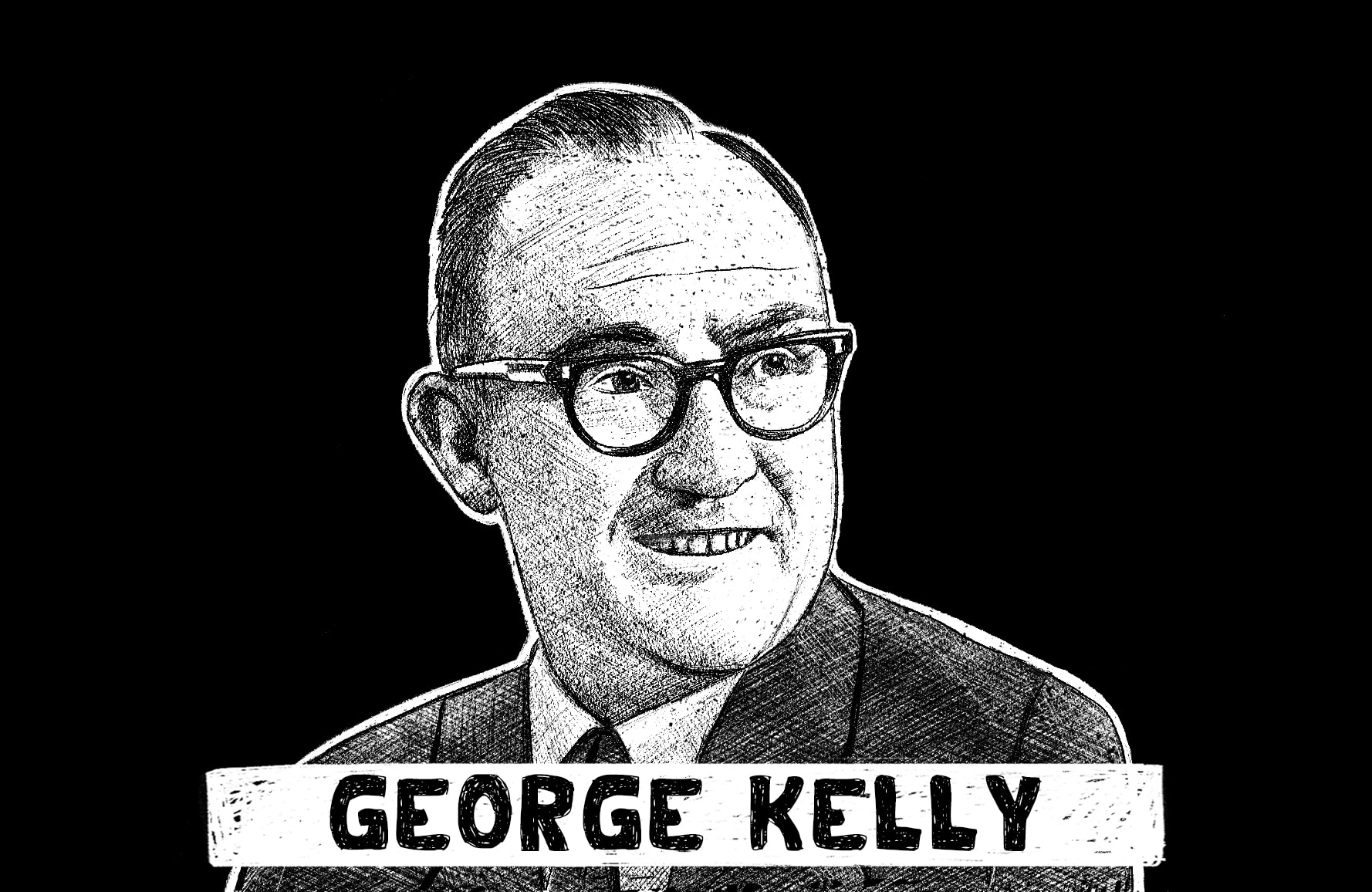
George Kelly was an American cognitive psychologist, educator, and theorist. He is best known for developing personal construct theory, an approach to personality that focuses on the unique ways in which people make sense of their world. This theory is still used in clinical psychology today.
Kelly’s early school life was quite varied. In addition to being homeschooled, he attended classes at a one-room country school in Perth. After several weeks of commuting to a local high school, Kelly was sent to the city of Wichita to continue his education when he was just thirteen years old. He attended four different high schools while he was there.
Kelly had an interest in mechanical engineering and after spending three years at Friends University and a final year at Park College, he graduated with a B.A. degree in physics and mathematics in 1926. He worked several jobs in the fields of engineering and education, but a growing interest in social problems led him to pursue a masters degree in educational sociology at the University of Kansas. After completing that program, he taught several courses at a junior college in Iowa.
In 1929, Kelly was awarded a fellowship at the University of Edinburgh in Scotland, where he earned a bachelor’s degree in education within a year. He returned to the United States with an interest in psychology and graduated with a PhD in that field from the University of Iowa in 1931.
After completing his PhD, Kelly accepted a teaching position at Fort Hays Kansas State College. In addition to teaching, he opened a psychology clinic that offered services to college students, children, and adolescents free of cost. In time, he developed a system of traveling clinics and was able to diagnose and treat psychological issues that affected students in the state’s public school system.
Time in the Military
Kelly travelled extensively and gave lectures at many respected institutions around the world. These institutions include Stanford University, the University of Chicago, the University of Southern California, and Northwestern University. In 1965, he accepted an invitation from Abraham Maslow to serve as the Riklis Chair of Behavioral Science at Brandeis University in Massachusetts. This was a prestigious appointment which would have allowed Kelly greater freedom to carry out his research but sadly, after just two short years, he died.
In our attempt to make sense of the world, Kelly theorized that we develop “personal constructs.” These mental representations serve as hypotheses that help us to interpret and make predictions about events in our lives. Whenever we experience an event, we apply our personal constructs to that event and try to anticipate what will happen next.
Example of Personal Construct Theory
Imagine that you are driving along a dark, lonely road in the middle of the night and you see a man ahead signaling you to stop. If his appearance influences you to classify him as being “distressed” (i.e., you apply your personal construct for “distressed”) you will likely predict that he will ask you for help if you stop the car. On the other hand, if you classify the man as having a “threatening” appearance, you will likely predict that he will harm you.
Constructive Alternativism
Our experiences help us determine whether our predictions and underlying constructs are correct or not. When our constructs align with our subjective experience, they are reinforced and we tend to hold on to them. On the other hand, if we recognize that our constructs are misleading, we attempt to alter them so as to make better predictions in the future. For example, we may form certain constructs or ideas about people from a particular country based on second hand information or limited research. Upon visiting that country, we may realize that our constructs, and thus our expectations, were incorrect, and so we adjust them in light of newly acquired information.
The eleven corollaries that extend Kelly’s basic assertion are as follows:
People interpret events in different ways based on their own constructs.
People organize their constructs in a hierarchy wherein some constructs are considered more important than others. This construct system is not static but is constantly evolving and changing.
All our constructs are bipolar in nature (e.g., friendly-unfriendly or sweet-sour). When we interpret an event, not only are we saying that a certain quality is characteristic of it, we are also saying that the opposite quality is not. For example, if we say that a person is generous, we are also saying that he is not stingy. However, the opposite pole may not be the same for everyone. ‘Good’ may be contrasted with ‘bad’ in one person’s construct system, but with ‘evil’ in another. The construct ‘good-bad’ carries a different meaning from the construct ‘good-evil.’
People are constantly choosing between the two poles of their constructs. According to Kelly, they may choose alternatives that ‘define’ their construct system (ie., verify their interpretations of the world) or those that ‘elaborate’ it (ie., broaden their interpretations of the world and allow for personal growth). Kelly believed people generally choose the elaborative alternative, even when it includes a measure of risk. For example, if a person is trying to decide between the two poles of the construct “pursue a college degree-drop out of school,” he will choose the option that he believes will increase his understanding of the world, even if that means dropping out of school.
Each construct has a limited range, meaning that it does not apply to every person or event we encounter. For example, the construct ‘educated-uneducated’ can be applied appropriately to adults but not to babies.
Constructs function as working hypotheses and are modified based on experience. If the predictions we derive from our constructs are ineffective or inaccurate, we amend those constructs in ways that increase their predictive accuracy.
Some constructs are more resistant to modification than others. Kelly referred to a construct’s openness to change as its level of ‘permeability.’ Constructs that are impermeable limit the extent to which the construct system can be revised based on experience.
To account for inconsistencies in behavior, Kelly suggested that people sometimes use contradictory subsystems of constructs on successive occasions. For example, a man may speak glowingly of his wife one day but harshly criticize her cooking the next. This may occur because his construct ‘wife’ includes both the subconstruct ‘love’ as well as the subconstruct ‘terrible cook.’
Despite their individuality, people may construe events similarly. According to Kelly, people who anticipate events and behaviors in similar ways form a cultural group.
Effective social interaction requires that people understand each other’s construct system and are able to anticipate their behavior, though they themselves may not have identical constructs.
Over the years, PCT has been classified in different ways. Some view it as a“humanistic” theorygiven its focus on thepersonalways in which people interpret their world, as well as Kelly’s position that humans are not passive beings but active agents. Others align the theory with the “constructivist” movement due to its emphasis on how peopleconstructtheir own realities. The most common view, however, is that this is a “cognitive” theory, despite the fact that Kelly himself rejected such a classification and hoped that his theory would be viewed independently.
Role Construct Repertory Test (RCRT)
The next phase of the test involves comparing and contrasting the people listed. Test-takers are asked to consider three individuals at a time and to state a way in which two of them are alike but different from the third. For example: “my mother and my sister are both sociable but my father is reserved.” The construct identified in this case is ‘sociable-reserved.’ The same process is repeated several times with different groups of three. By analyzing the person’s responses, Kelly suggested that one can identify the major constructs they use to make sense of the world.
The REP test is quite flexible and many variations are possible. Instead of examining constructs that involve people, the test can be used to assess personal constructs in relation to a particular area of life such as school, work, or marriage. In this case, comparisons would be made between different aspects of that area of life. For example, a personal construct in relation to “school” may involve different aspects such as homework, teachers, and classmates.
PCT has been applied to several areas, including:
Psychological disturbances are thought to arise when individuals rigidly cling to personal constructs that have been shown to be misleading or inaccurate. The result is that they have difficulty anticipating events and do not benefit from new experiences. Instead of developing better constructs, they develop symptoms. The goal of therapy is to help the individual adjust his construct system so that he can make more accurate predictions and be more in tune with the world around him.
Kelly believed that interpersonal difficulties can be resolved if people consider alternative constructions or possibilities. By viewing the same issue through different lenses, individuals may discover more creative ways of addressing the problem.
PCT and the REP test have also been applied to other areas where “personal perspectives” are important, such as vocational decision-making, organizational behavior, marketing, criminology, anthropology, architecture, and urban planning.
Scholars have often criticized Kelly’s theory for being too “mentalistic.” They argue that PCT focuses only on a person’s thinking and fails to address issues of emotion and motivation. A second criticism is that the theory is too “individualistic,” and focuses primarily on the individual and on theirpersonalconstructions, instead of on their interactions with others. Kelly has also been criticized for failing to provide adequate details about how constructs develop and about the processes involved in selecting one construct (or one pole of a construct) as the best predictor in a given situation.
Despite its wide-ranging utility, the REP test also has limitations, one of which is that it can only assess those constructs of which the individual is consciously aware. Kelly himself acknowledged that people sometimes make use of constructs which they are unable to express verbally, but he did not devise a method for assessing these. Another limitation of the test is that its interpretation is subjective, time-consuming, and highly dependent on the skill and training of the person administering the test. There is also the potential for people to provide socially desirable answers instead of responding honestly.
Compared to other prominent psychologists, Kelly did not publish much, and chose instead to focus on clinical work and training graduate students. His most popular theoretical work is his 1955 book,The Psychology of Personal Constructs, published in two volumes - Volume 1: A Theory of Personality, and Volume 2: Clinical Diagnosis and Psychotherapy.
Kelly was elected president of both the Clinical and Consulting divisions of the American Psychological Association (APA) in the 1950s. He also served as president of the American Board of Examiners in Professional Psychology from 1951 to 1953 and as chairman of the education and training board in the APA from 1952 to 1955.
On June 3, 1931, Kelly married Gladys Thompson, a high school English and drama teacher. The couple had two children—a daughter, Jacqueline and a son, Joseph. Kelly and his wife moved several times during their marriage: first to Hayes, Kansas, then to Washington DC., later to Worthington, Ohio, and finally to Framingham, Massachusetts. The moves followed Kelly’s professional appointments and his enlistment in the navy.
Kelly was a committed husband and father. He was also an excellent actor who tried his hand at drawing cartoons and writing poetry. He was known for his great kindness and his exceptional creative intellect.
How Did George Kelly Die?
Kelly died unexpectedly on March 6, 1967, from complications following a gall bladder surgery. He was 61 years old at the time of his death.
Engler, B. (2014).Personality theories: An introduction(9th ed.). Belmont, CA: Wadsworth.
Eysenck, M. W. (1994).Individual differences: Normal and abnormal. UK: LAwrence Erlbaum Associates.
Fransella, F. (1995).George Kelly. Thousand Oaks, CA: Sage Publications.
Gladys T. Kelly. (n.d.). Retrieved fromhttp://www.worthingtonmemory.org/cemeteries/walnut-grove-cemetery/kelly-gladys
Lester, D. (1995).Theories of personality: A systems approach. Washington, DC: Taylor and Francis.
Neimeyer, R. A. (n.d.).George Kelly (1905-1967). Retrieved fromhttps://www.kellysociety.org/kelly.html
The psychology of personal constructs. (n.d.). Retrieved fromhttps://www.kellysociety.org/about-pcp.html
Zuber-Skerritt, O. (2012).Professional development in higher education: A theoretical framework for action research. New York: Routledge.
Related posts:37+ Social Construct Examples (Definition + Game)Social Construct (Psychology Definition + Purpose)40+ Famous Psychologists (Images + Biographies)The Thomas TheoremDaniel Kahneman Biography - Contributions To Psychology
Related posts:
Reference this article:Practical Psychology. (2021, March).George Kelly Biography - Contributions To Psychology.Retrieved from https://practicalpie.com/george-kelly/.Practical Psychology. (2021, March). George Kelly Biography - Contributions To Psychology. Retrieved from https://practicalpie.com/george-kelly/.Copy
Reference this article:
Practical Psychology. (2021, March).George Kelly Biography - Contributions To Psychology.Retrieved from https://practicalpie.com/george-kelly/.Practical Psychology. (2021, March). George Kelly Biography - Contributions To Psychology. Retrieved from https://practicalpie.com/george-kelly/.Copy
Copy
