In the world of psychology, there is no one more famous - and more controversial - than Sigmund Freud. We see his influence in psychology and even popular culture today, over 100 years after his first books were published. Talk therapy, “Freudian slips,” and dream interpretation would not exist as they do today if it weren’t for Sigmund Freud.
Although many ideas within this theory have been criticized harshly, it is still one of the more well-known theories within developmental psychology. It heavily influenced the work of Jean Piaget, who is known as the Father of Developmental Psychology. Throughout this video, we will also make comparisons to Freud’s theory and Erikson’s Stages of Psychosocial Development.
History of Freud and Stages of Psychosexual DevelopmentWhat Happens During the Five Stages of Psychosexual Development?Stage 1: Oral (0-18 Months)Stage 2: Anal (18-36 Months)Stage 3: Phallic (3-6 Years)Stage 4: Latent (6-puberty)Stage 5: Genital Stage (Puberty-Death)Criticisms of the Stages of Psychosexual DevelopmentLegacy of Freud’s Psychosexual Stages of Development
History of Freud and Stages of Psychosexual Development
What Happens During the Five Stages of Psychosexual Development?
Stage 1: Oral (0-18 Months)
Stage 2: Anal (18-36 Months)
Stage 3: Phallic (3-6 Years)
Stage 4: Latent (6-puberty)
Stage 5: Genital Stage (Puberty-Death)
Criticisms of the Stages of Psychosexual Development
Legacy of Freud’s Psychosexual Stages of Development
But let’s begin with talking about Sigmund Freud. Freud was an Austrian neurologist who worked with troubled adults to develop psychoanalysis. In psychoanalysis, Freud would attempt to dive into a patient’s unconscious mind to reveal desires, frustrations, and trauma that was influencing their habits or behavior.
Freud believed that the unconscious mind is filled with memories, thoughts, and needs that have been suppressed. For example, if you experienced rejection as a child, you might bury those negative feelings in your unconscious so you don’t have to “deal with” them. These repressed feelings, however, still drive you toward different behaviors and influence your personality.
Many of the feelings that we repress begin in childhood. They could be memories that we are not aware that we had. The memories could be based on experiences from the first two years of our life.
Through his work with adults, Freud created the Stages of Psychosexual Development. He believed that much of our personality formation occurred within the first five years of life. If a patient was facing troubling habits or neurosis of any sort, Freud could trace it back to experiences and desires of early childhood.
 Stages of Psychosexual Development

What Happens If the Child Does Not Develop Appropriately?
If the child expends sexual energy appropriately and moves through each phase successfully, they will progress onto the next stage. That doesn’t always happen. The child may experience inappropriate parenting or their needs may not be fulfilled. When this happens, the child will become frustrated. Frustration, according to Freud, turns into fixations or anxiety. These fixations may become unhealthy habits, like smoking or biting your nails. The anxiety may develop into neurosis. Either way, the person’s development is stunted. Only through psychoanalysis and talk therapy will they be able to uncover what “went wrong” in their childhood and rid themselves of their bad behavior or fixations.
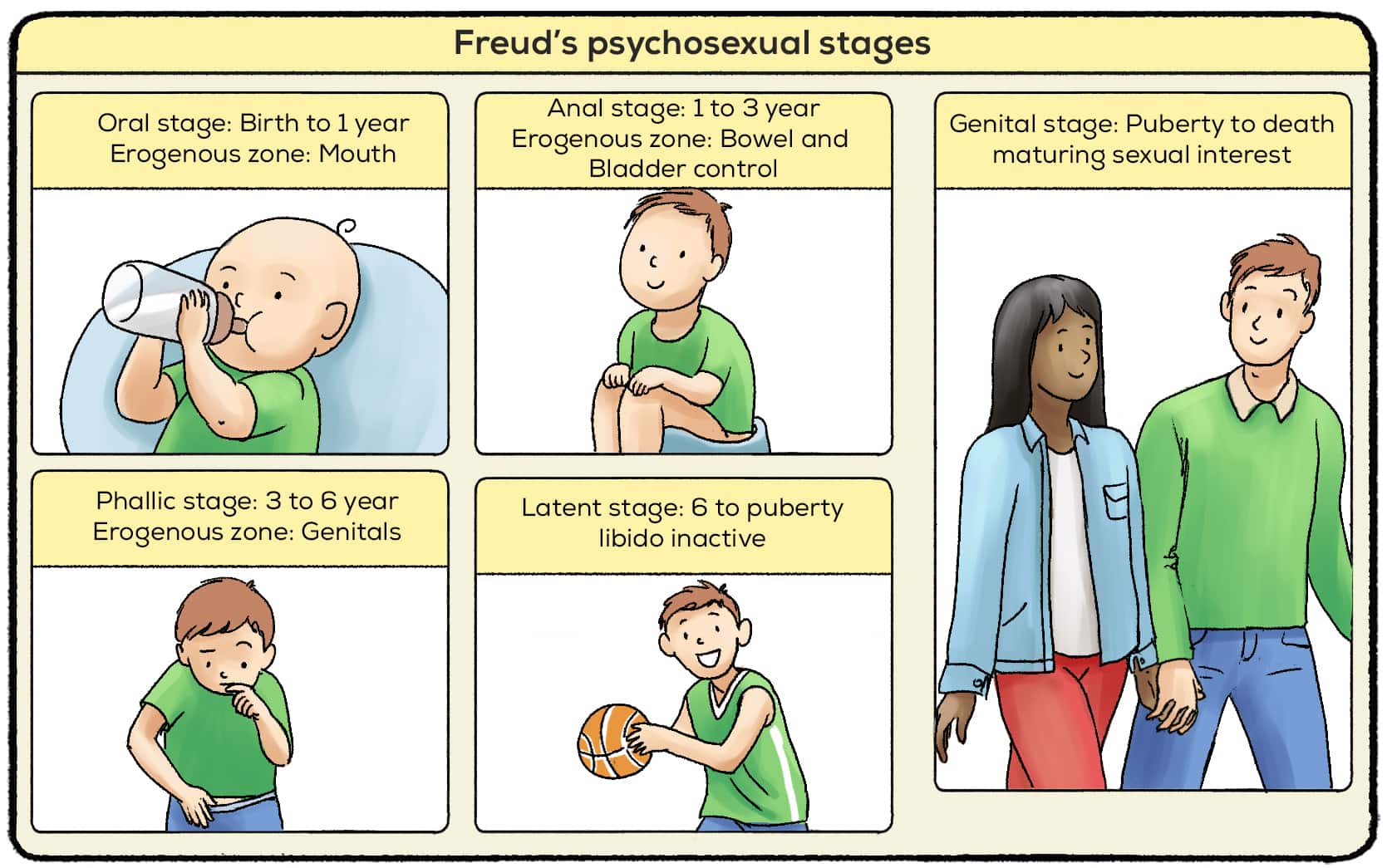
Let’s go through the stages of psychosexual development to understand where these erogenous zones are and how they influence personality and behavior later in life.
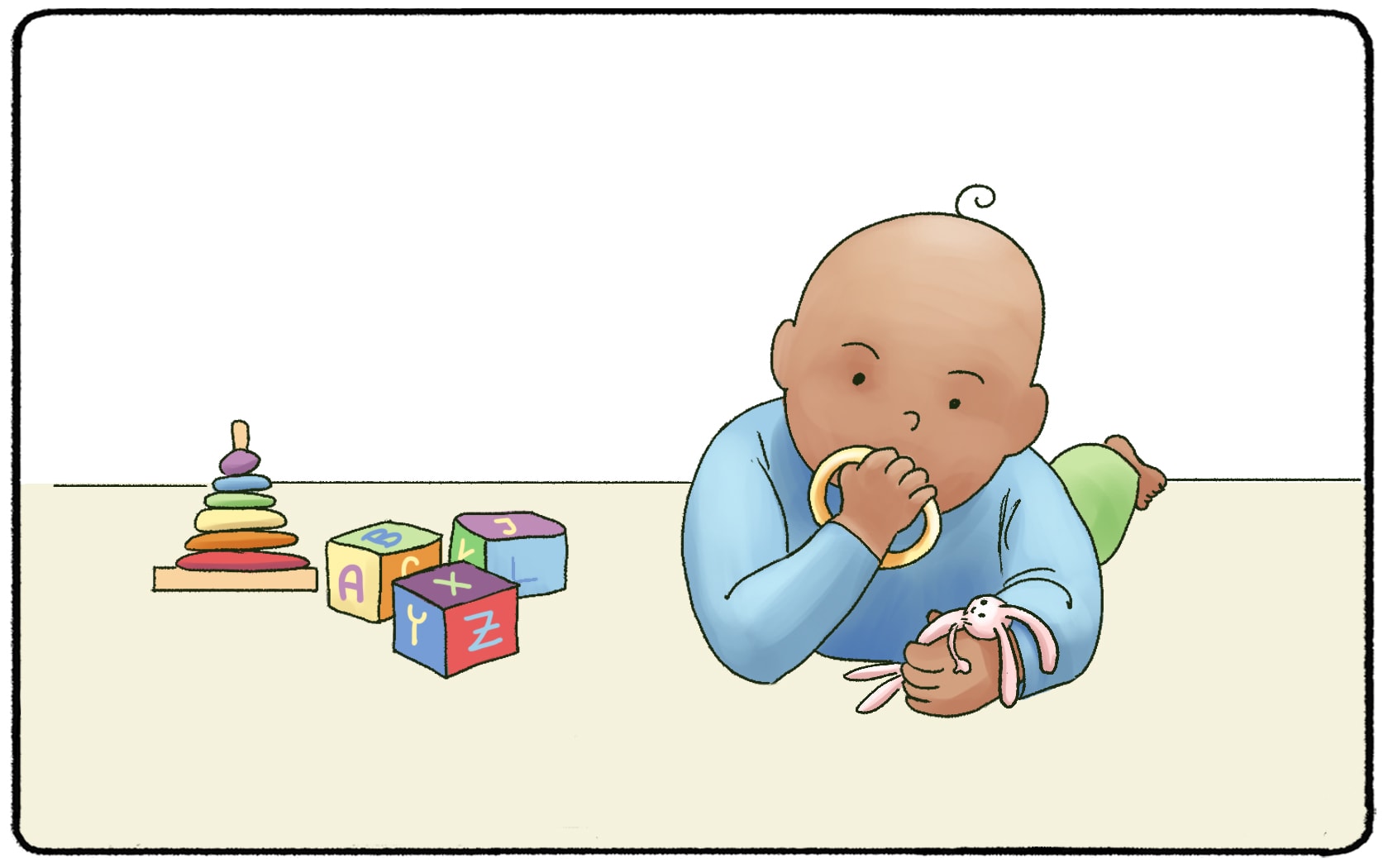
But what happens if there is struggle in this stage? What if the child is not satisfied, not fully weaned, or does not develop trust with the mother? Frued believed that failing to complete this stage could result in oral fixations later in life.
Oral fixations involve the mouth, and may include:
When a child enters into the second stage of development, the libido’s focus moves from the mouth to the anus and bowels area. They derive great pleasure from defecation.
During this time, the parents may introduce toilet training. This is considered the main conflict of the anal stage. Toilet training can be a frustrating time for parents, but their approach to this process has a serious impact on their child.
Freud believed that toilet training was so significant because it is the child’s first encounter with authority. The parents must tell the child where or when they can defecate. If there are struggles in this relationship, the child may not successfully complete this stage. Unlike the oral stage, “anal fixations” don’t have to do with the body part in question.
Personality Issues From Anal Stage
What happens if parents do not potty train their child appropriately? Freud believed that the child could develop one of two personalities.
What about the other side of the spectrum? Freud believed that if parents were too lenient during the toilet training process, the child could develop an anal-expulsive personality. The child may become messy or destructive, much like what would happen if they were allowed to defecate where they pleased. People with anal-expulsive personalities also tend to be disorganized, rebel against authority, or share too much.
Of course, if no problems arise, the child will complete the anal stage and move on without any fixations or issues. The child will find themselves capable of working with authority and making decisions about their body. Productivity, creativity, and autonomy appear if this stage is completed successfully.
Development of the Ego
The ego is the center that mediates between the two. It seeks pleasure within reality. Freud believes that the ego operates in all levels of the conscious mind (the id only operates in the unconscious mind.)
The struggle between the id, superego, and ego appears throughout a person’s life, but it starts with toilet training and the anal phase.
After the anal phase, the child enters the phallic phase. During this time, the erogenous zone moves to the genitals. The child gains pleasure from masturbation.
The conflicts within the phallic stage are some of Freud’s most controversial theories, and not just because it involves the idea of a young child masturbating. The main conflict in this stage develops as the child begins to recognize erotic attraction and the biological differences between men and women. The child also develops fear and jealousy, key emotions creating the Oedipus Complex or Electra Complex.
How does a boy at this age deal with his feelings? Freud believes that to successfully move through this stage, the boy represses his feelings for his mother and instead begins to mimic his father. This results in the boy developing “manly” characteristics. As they go through life, the boy eventually seeks out a romantic partner that can satisfy the needs he developed during this stage. The idea that a boy wants to marry a girl like his mother aligns with Freud’s ideas of the phallic stage.
But what happens for girls? Freud believes that they develop an Electra Complex. The process starts in a similar way - the woman desires her father. Rather than developing castration anxiety, the girl develops penis envy. She becomes upset that she does not have a penis, and becomes angry with her mother for not giving her a penis.
How does the girl deal with her feelings? She represses her feelings for her father and transforms her penis envy into womb envy. The girl starts to desire having a child. Throughout this process, the girl mimics her mother and begins to take on “feminine” characteristics. Later in life, she aims to find a man like her father and have children.
Freud also believed that penis envy is never truly resolved in women. The effects of this stage appear to last throughout the person’s life, influencing who they seek in a romantic partner. Again, this is one of Freud’s most controversial and outright rejected ideas. It also raises a lot of questions about homosexuality, gender identity, and the “differences” between men and women. Freud wasn’t always clear on his views on homosexuality (whether it was due to natural or empirical causes,) but he did not believe that it was any sort of negative effect stemming from the phallic or any other stage of psychosexual development. But we’ll talk more about the criticisms of this theory later in the video.
Once the child reaches the age of six, sexual development becomes dormant. Remember, Freud believed that most of the child’s personality and psychosexual development happened before they even hit grade school.
The superego and the ego continue to develop during this stage, and the child begins to navigate how to balance the desires of the id with reality and society’s rules. The child’s energy is not focused on their erogenous zones, but rather on outside activities. Hobbies, platonic relationships, and learning are the most important activities during this stage. Children spend most of their time in this stage forming bonds with friends of the same sex.
This doesn’t mean that development stops, or that there is no process for the child to go through during this stage. A child must still develop these outside skills, confidence, and the ability to control the id and ego’s constant struggle. Freud believed that a person can get “stuck” in this stage and fail to mature. This will prevent them from forming romantic relationships or satisfying the needs that are still lingering from the phallic stage.
The libido wakes up from its slumber during puberty. The erogenous zone is once again in the genitals, but pleasure comes more from others than from masturbation. Another difference between this stage and the phallic stage is the development of the superego and ego. Without these two centers, a young child is mainly focused on their own needs. Now, they turn their focus to the needs of others.
Freud believed that if all of the previous stages were completed successfully, a person will be set up to form a loving, stable relationship with a person of the opposite sex.
Criticisms of Freud’s Methods
Let’s start with talking about how Freud developed his theory of psychosexual development. Remember, he primarily worked with adults. He didn’t typically observe children as he was creating this theory about child development. His daughter, Anna Freud, is actually considered the founder of child psychoanalysis.
One child that Freud did observe, “Little Hans,” had a fear of horses. Freud connected this fear to the child’s Oedipus complex. But the child didn’t exactly express his desires to have sex with his mother and replace his father. Even in his writing, Freud noted that he would have to put thoughts, memories, and desires into the child’s head before they could be revealed. Leading a young child to admit these desires don’t make them true.
Freud’s theories were also based purely on observation and self-analysis rather than experimentation. He didn’t conduct controlled experiments to prove his theory. There is no data to prove that a child becomes anal-retentive or anal-expulsive based on their parents’ form of toilet training. Basing a theory off of observation doesn’t fly in the world of psychology today.
Criticism of Freud’s Ideas
But it’s not just the method in which Freud created his theory that remains controversial. The ideas themselves are controversial. Sexuality at the center of a child’s development doesn’t sit well with some. Others believe that the theory is problematic because it is so heavily focused on the development of cisgender, heterosexual males. Female development is not discussed to the lengths that male development is discussed. The idea of penis envy certainly does not sit well with many. And how does this theory of development apply to children who are raised with single parents, two mothers, or two fathers?
Going back to the method of testing, there is no way to prove that Freud’s theory is right or wrong. How can you measure penis envy? How can you measure libido?
Nowadays, Freud’s theory is outdated. But at the time, it was revolutionary. It allowed psychologists to explore child development in ways that had never been explored before.
Similar theories of child development that followed Freud’s theory include:
These theories, and many more that have come after, may not have been formed if it weren’t for Sigmund Freud. And now that you’ve learned about Freud’s theory of development, it’s time to explore the ideas of Piaget, Erikson, and more.
Related posts:Sigmund Freud (Psychologist Biography)Psychoanalytic Theory of PersonalityErikson’s Stages of Psychosocial DevelopmentAutonomy vs. Shame: Psychosocial Stage 2Oedipal Complex (Definition + How To Resolve)
Related posts:
Reference this article:Practical Psychology. (2020, May).Freud’s Psychosexual Stages of Development (Definition and Examples).Retrieved from https://practicalpie.com/psychosexual-stages-of-development/.Practical Psychology. (2020, May). Freud’s Psychosexual Stages of Development (Definition and Examples). Retrieved from https://practicalpie.com/psychosexual-stages-of-development/.Copy
Reference this article:
Practical Psychology. (2020, May).Freud’s Psychosexual Stages of Development (Definition and Examples).Retrieved from https://practicalpie.com/psychosexual-stages-of-development/.Practical Psychology. (2020, May). Freud’s Psychosexual Stages of Development (Definition and Examples). Retrieved from https://practicalpie.com/psychosexual-stages-of-development/.Copy
Copy
