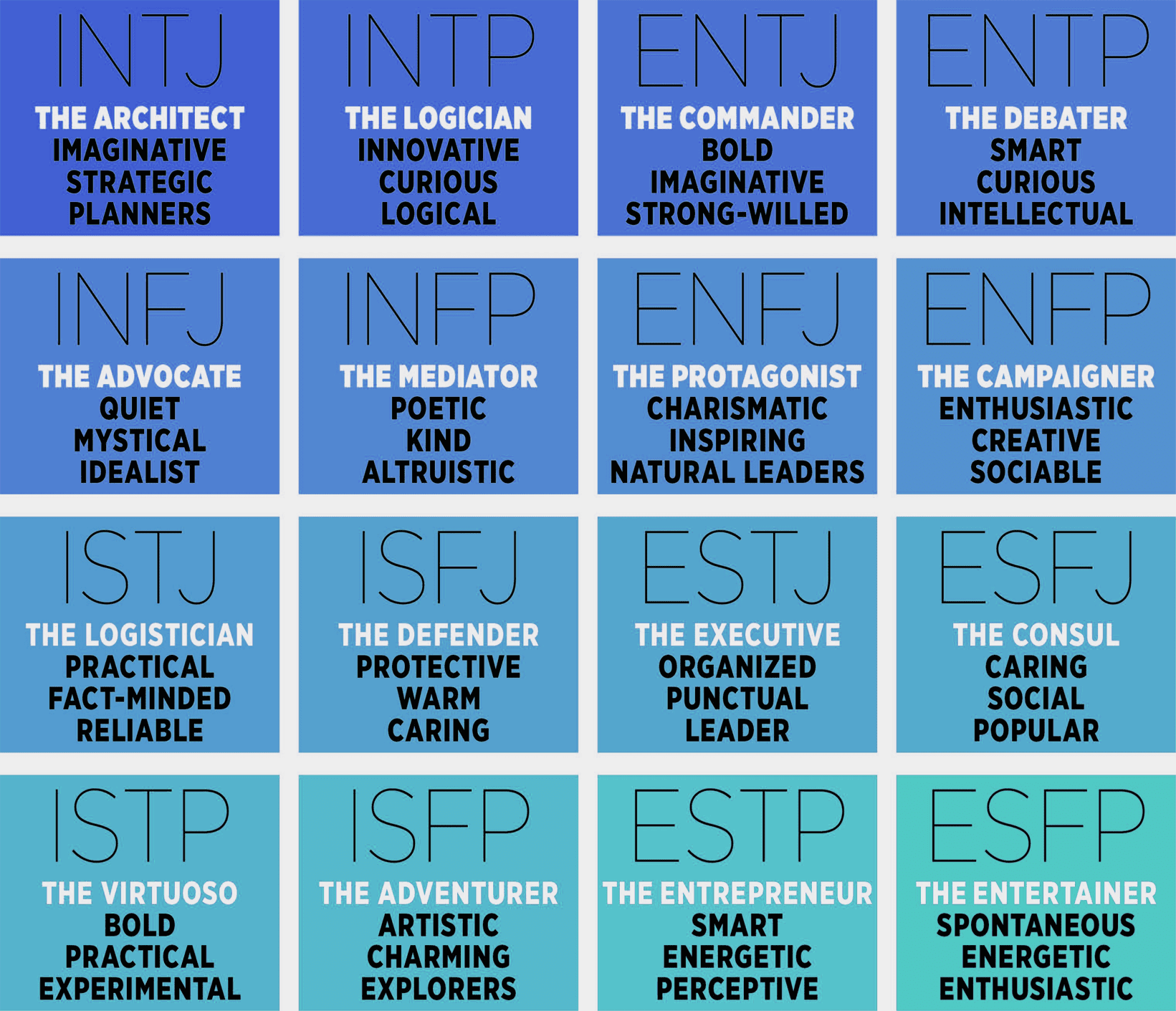
Life can be stressful. In times when it seems like everything is going wrong, entertainment can give us an escape. Entertainers are good people to have around when things get tough. They use their talents, whether they are in art, music, or comedy, to lift the spirits of people around them and give them a reason to smile and connect with others. Your favorite entertainers, both in your personal life and on the big screen, might just be an Entertainer in the eyes of personality psychologists. Out of the 16 personality types, one takes the crown for being “The Entertainer”: ESFP.
This video is going to go through the ins and outs of ESFPs, from their individual traits to basic stats about ESFPs that might surprise you. Entertainers are such an important part of our society, and this will give you some insight into how they think and see the world around them!

DescriptionFunctionReal-Life Examples of ESFPsStrengths and Weaknesses of ESFPBasic Stats of ESFPWorking and Living with ESFPsAssertive vs. Turbulent ESFPs
Description
Function
Real-Life Examples of ESFPs
Strengths and Weaknesses of ESFP
Basic Stats of ESFP
Working and Living with ESFPs
Assertive vs. Turbulent ESFPs
S is for sensing (as opposed to intuition.) This is also identified as “observant.” Rather than relying on intuition, ESFPs look at what is happening in the present moment. They look for the most obvious solutions and use straightforward, logical methods of thinking to help them get there. By being in the moment, they can interact with others with ease.
F is for feeling (as opposed to thinking.) Of course, people with both “feeling” and “thinking” in their personality type can do the other. ESFPs may rely more on how they, and more importantly others, feel. They want other people to feel good! If they have to make a decision, they are more likely to consult other people. ESFPs are great at “reading the room” for this reason.
Finally, P is for perception (as opposed to judgment.) Although “judgers” tend to enjoy structure, people with perception in their personality type are likely to keep their options open. (This trait is also known as “prospecting.”) They logically see all of the possibilities in front of them and know that there is always more to learn about a situation. Some of the world’s most well-known ESFPs are known for reaching “both sides of the aisle” and bringing people together. This requires a keen understanding of all perspectives.
All of these traits support entertainers as they connect with people and bring some joy to the world. Also known as “The Performer,” ESFPs are great on stage and great at one-on-one interaction with people.
Let’s keep diving into the mind of an ESFP. In addition to four traits, each personality type performs four different functions at varying levels.
Extroverted Sensing
Starting off with the dominant function of ESFP types is Extroverted Sensing (Se.) ESFPs enjoy focusing on the present moment instead of worrying about the future and what it holds. They are very flexible when it comes to planning and even trust themselves to problem solve spontaneously. This function also gives them a greater interest in facts rather than abstract ideas.
Introverted Feeling
Next is the auxiliary function of ESFP types: Introverted Feeling (Fi.) When decision-making, ESFPs use their introverted feeling to determine the right decision regarding their morals and values. They have a good sense of their own emotions as well as others, making them very empathetic.
Extroverted Thinking
The tertiary function of ESFP types is Extroverted Thinking (Te.) This function presents another route for ESFPs to solve problems in a way that is more grounded in logic. It causes them to naturally improve upon solutions that are already in place. However, as one of their weaker function, ESFPs will have trouble sharing their judgments or thoughts to keep situations peaceful.
Introverted Intuition
Finally, the inferior function of ESFP types is Introverted Intuition (Ni.) Introverted Intuition is ESFPs weakest function and can be very unhealthy or exhausting for them to use over their more dominant functions. This function allows them to make connections within their observations, occasionally leading to surprising insights.
Of course, ESFPs make great entertainers or musical performers. But they are also great in many careers that require them to capture the attention of others. ESFPs often become teachers, nurses, social workers, or fitness trainers. If you are an ESFP, don’t feel boxed into any one career path. Whatever job you choose to hold, you’ll likely find an opportunity to connect with others and entertain the people around you.
Not everyone can get up onstage and entertain people, but ESFPs have a set of strengths that play into this daunting activity. Of course, they are more than just singers, actors, or storytellers. Here are some of the strengths that people assign to ESFPs:
Are ESFPs perfect? Absolutely not. They also have some weaknesses that can hold them back. Entertainment isn’t everything! Here are some ways that you might describe an ESFP (but maybe not to their face!)
You probably have one ESFP in your friend group to keep things interesting. ESFPs make up 9% of the general population. They are more likely to be women! One out of 10 women are ESFPs - that’s 10%! To compare, 7% of men are ESFPs.
Know an entertainer? You’re in the right place. By understanding how an ESFP or any personality type sees the world, you can better communicate with them and meet their needs. Entertainers want to shine. Appealing to their personality traits can help you help them take center stage!
ESFP At Work
ESFPs certainly make great entertainers, but they also bring something special to every job position. They do best when they can “perform.” Teachers, nurses, and customer service positions are all great opportunities for ESFPs to shine. Helping another person is the best job in the world for an ESFP. Whether they are offering a solution to a tough problem or helping to plan the office Christmas party, ESFPs are happy to be in the center of the action.
ESFP Friendships
In their personal relationships, ESFPs like to keep things fun and enjoy making the people in their lives happy. They are more attracted to simplicity in their relationships to avoid conflict or complex situations that require hard work/effort. While they like to keep things light, they are profoundly kind-hearted and affectionate.
ESFP Compatibility and Romantic Relationships
ESFP is known to be most compatible with ISTJorISFJ, but they can make any relationship work! A user on theESFP subredditasked ESFPs what they are looking for in a partner. Here’s what they had to say!
Reddit is a great source for all things ESFP. If you have questions about this personality type, or just want to connect with other entertainers, keep the ESFP subreddit in mind!
Did you know that there aren’t just four sets of traits anymore? In recent years, personality psychologists have added another set of traits to the 16 personalities. Each of these personalities fits into the “assertive” or “turbulent” category. Here’s what these two traits mean for ESFPs.
Assertive ESFPs (ESFP-A) are more comfortable in stressful situations and overall more likely to be confident in themselves. As ESFPs, they are very in touch with their emotions and find it easy to forgive others who may hurt their feelings.
When turbulent ESFPs (ESFP-T) are faced with difficult situations, they are more likely to give in to stress. However, this trait can also give them a stronger awareness of problems they can share with others. All ESFPs are in touch with their emotions, but ESFP-Ts are better at expressing their feelings.
Related posts:The Psychology of Long Distance RelationshipsBeck’s Depression Inventory (BDI Test)Operant Conditioning (Examples + Research)Variable Interval Reinforcement Schedule (Examples)Concrete Operational Stage (3rd Cognitive Development)
Related posts:
Reference this article:Practical Psychology. (2021, April).ESFP: Entertainer (Description + Functions + Examples).Retrieved from https://practicalpie.com/esfp/.Practical Psychology. (2021, April). ESFP: Entertainer (Description + Functions + Examples). Retrieved from https://practicalpie.com/esfp/.Copy
Reference this article:
Practical Psychology. (2021, April).ESFP: Entertainer (Description + Functions + Examples).Retrieved from https://practicalpie.com/esfp/.Practical Psychology. (2021, April). ESFP: Entertainer (Description + Functions + Examples). Retrieved from https://practicalpie.com/esfp/.Copy
Copy
