This page is all about the ENTP. Not sure if you’re an ENTP? Learn more about theMyers Briggs Testto find out!
What Does ENTP Stand For?Functions of ENTP Personality TypesExamples of Real-Life ENTPsExamples of Fictional Characters Who Are ENTPsStrengths and Weaknesses of ENTPsWorking With an ENTPBasic Stats About ENTPs
What Does ENTP Stand For?
Functions of ENTP Personality Types
Examples of Real-Life ENTPs
Examples of Fictional Characters Who Are ENTPs
Strengths and Weaknesses of ENTPs
Working With an ENTP
Basic Stats About ENTPs
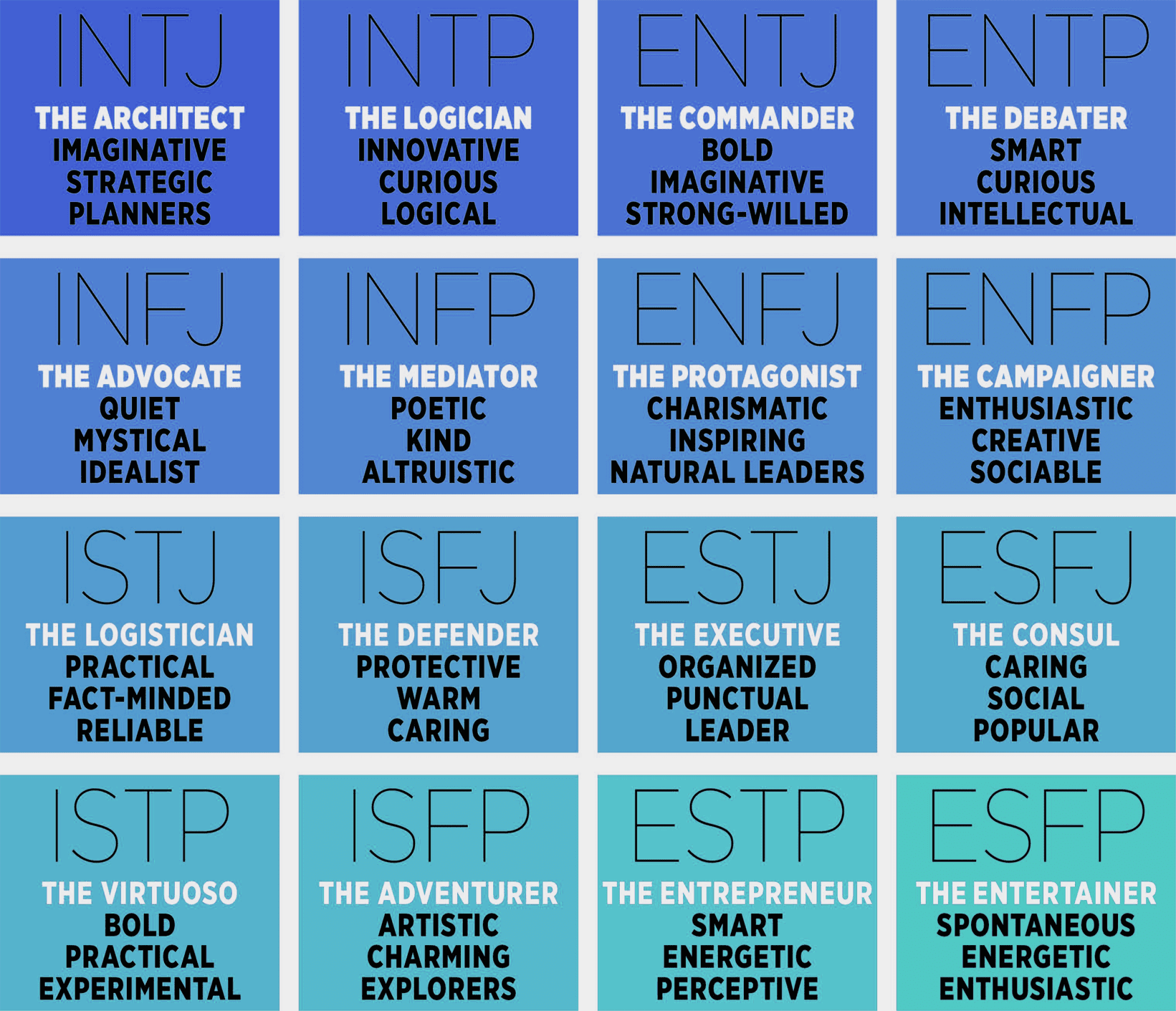
 Printable Myers Briggs Matrix
Extrovert
Intuition
N is for intuition (as opposed to sensing.) This indicates that a person makes judgments based on their intuition instead of the sensory information that is presented in front of them. They are more likely to rely on the impression they get from something than more “literal” data. Think of it as preferring the abstract to the concrete.
Thinking
T is for thinking (as opposed to feeling.) People who lean toward thinking over feeling draw conclusions from the head rather than the heart. They are more likely to make a judgment based on thoughts, perceptions, and analysis instead of where their emotions are leading them.
Perception
Finally, P is for perception (as opposed to judgment.) Although “judgers” tend to enjoy structure, people with perceptions of their personality type are likely to keep their options open. They logically see all of the possibilities in front of them and know that there is always more to learn about a situation. This is one of the reasons why an ENTP keeps an open mind, even when they have formed their own opinion. They know, logically, that another person may have a different perspective or that there is always another way to look at a problem.
Put this all together and you get a person who is great on the debate stage. ENTPs know how to craft a sound argument and they are more than willing to share that argument in a public or private setting. If they believe there is more to learn and grow from, they will look at that information and let it adjust or change their opinion accordingly. But you will always hear convincing and compelling arguments from an ENTP.
Each personality type leans toward a few different cognitive functions that shape the way they approach problems and decision-making. Not all of these functions are performed equally.
Underneath the dominant function is the auxiliary function of ENTP types – Introverted Thinking (Ti.) When ENTPs auxiliary function is engaged, their focus goes inward and they’ll use logic and reasoning to understand a situation at hand. Introverted Thinking allows them to put together a map of reason in their minds, which others may not notice. As they engage their Introverted Thinking, it helps them bring order within their inner world.
The tertiary function of ENTP types is Extraverted Feeling (Fe.) This function seeks to bring harmony to the world around them. Extraverted Feeling gives them a better understanding of other’s emotions, which helps them respond to those emotions in a way that brings happiness/harmony to others.
Finally, the inferior function of ENTP types is Introverted Sensing (Si.) Although this function is their least developed, an ENTP’s Introverted Sensing may start to act in the face of the pressure of stressful situations. It’s a rare occurrence, but when their Inferior Function is engaged, ENTPs will likely consider their other possibilities, as well as their past, and pay more attention to details they often overlook.
You can see why an ENTP is so great on the debate stage!
ENTPs are the perfect person to give a TED Talk. They have prepared at length to talk on a subject, but they are unlikely to give a boring presentation. Eloquent speakers and fierce lawyers are likely to be ENTPs. Some famous examples include:
The way ENTPs see the world allows them to best appeal to all people. They have considered everyone’s opinion, although when they make a decision, that decision remains firm. ENTPs excel in all areas of the arts, but are equally suited for careers in engineering, psychology, or consulting.
Fictional characters cannot take MBTI tests, but here are some characters that viewers believe to be Debaters:
Again, we can’t know if these personalities arereallyENTPs. But when you watch their characters, you can certainly see some characteristics of the typical ENTP!
ENTPs are the person that you want on your side in the courtroom or a party. Their approach to learning and seeing other perspectives allows them to come up with ideas that work for everyone. If you know an ENTP, you are likely to praise them as:
But singing someone’s praises only shows one side of them. ENTPs are not perfect. Their strong will and confidence can be their detriment. Some common setbacks that ENTPs face include:
Their title of “The Debater” can be misleading. ENTPs aren’t always ready to fight at work or in romantic relationships. Before they hold a position, they consider all points of view and commit to learning all of the time.
In all of their relationships, ENTPs put forth a strong effort to continuously grow and evolve. They highly value their relationships, both romantic and personal– and tend to make excellent romantic partners.
As for friendships, ENTPs can make friends easily and enjoy connecting with others. They don’t look for support or emotional feedback from their friends, and they value a friend who can hold their ground in arbitrary debates with arguments they see as valid.
Compatibility
One little letter makes a big difference in compatibility. ENTP’s top match is anINFJ, while one of their worst matches is anISFJ. But that doesn’t mean that these are the only types that ENTPs have strong reactions to.
ENTPs make great friends with INFPs. ThisReddit commenton the ENTP subreddit breaks down the compatibility between ENTPs and other personality types really well!
The user commented: “ENTPs can be extremely funny. I find them very easy to have conversations with as well, since they generally tend to lead, and our Ne-Ne interaction can spur very interesting dialogue. This can compensate for the trouble we often have maintaining conversations due to our introverted nature.
The precaution I would emphasize with ENTP friendships is that you have to give them clear boundaries. If the ENTP really enjoys talking to you, they will want to explore almost the entirety of your mind - they like playing around with your ideas and how you think. This will often include playful challenging of your thoughts and axioms. They generally believe that every idea must stand up to scrutiny to be valid. INFPs, though, will have certain things connected to our soul that are just non-negotiable topics, and that’s not really something we can change (despite how much we may be in denial about that). So we need to inform them directly about this and draw a clear line defining what constitutes “too far.”
A healthy ENTP with good Fe will respect these boundaries IF you are up-front and proactive about this. Waiting to draw a boundary until they have already stepped past it WILL result in a confused ENTP who feels tricked and/or betrayed.
An unhealthy ENTP may invalidate these boundaries and try to dismantle your non-negotiables anyway. This usually leads to conflict that will leave both sides upset (you will feel stepped on, and they will feel persecuted). If they do not respect your boundaries, steer clear.”
Check out this post about thedifference between ENTP and INTP. There are big differences in how these two groups share emotion, form logic, and handle conflict.
You’re not likely to meet more than a handful of ENTPs at a party. ENTPs make up just over 3% of the general population! Men are twice as likely to be ENTPs as women.
ENTP-A vs. ENTP-T
I just told you a lot about ENTPs, but before we wrap things up, did you know that ENTPs can be in one of two groups? In recent years, another letter was added to each of the 16 personality types, further defining the types of people we work with, live with, and love. Let’s break down how assertive and turbulent types contribute to ENTPs.
Assertive ENTPs, or ENTP-A, are hard to provoke or bother, as they rarely examine themselves critically. Like most assertive types, they are able to maintain their confidence and navigate stressful situations.
Turbulent ENTPs, or ENTP-T, are more likely to notice certain flaws in their character or actions. In the face of even slightly stressful situations, they have trouble navigating themselves through the stress. They often seek social approval, therefore criticism from others has more control over their thoughts and self-view.
Related posts:Beck’s Depression Inventory (BDI Test)The Psychology of Long Distance RelationshipsOperant Conditioning (Examples + Research)Variable Interval Reinforcement Schedule (Examples)Concrete Operational Stage (3rd Cognitive Development)
Related posts:
Reference this article:Practical Psychology. (2021, April).ENTP – Debater (Description + Functions + Examples).Retrieved from https://practicalpie.com/entp/.Practical Psychology. (2021, April). ENTP – Debater (Description + Functions + Examples). Retrieved from https://practicalpie.com/entp/.Copy
Reference this article:
Practical Psychology. (2021, April).ENTP – Debater (Description + Functions + Examples).Retrieved from https://practicalpie.com/entp/.Practical Psychology. (2021, April). ENTP – Debater (Description + Functions + Examples). Retrieved from https://practicalpie.com/entp/.Copy
Copy
