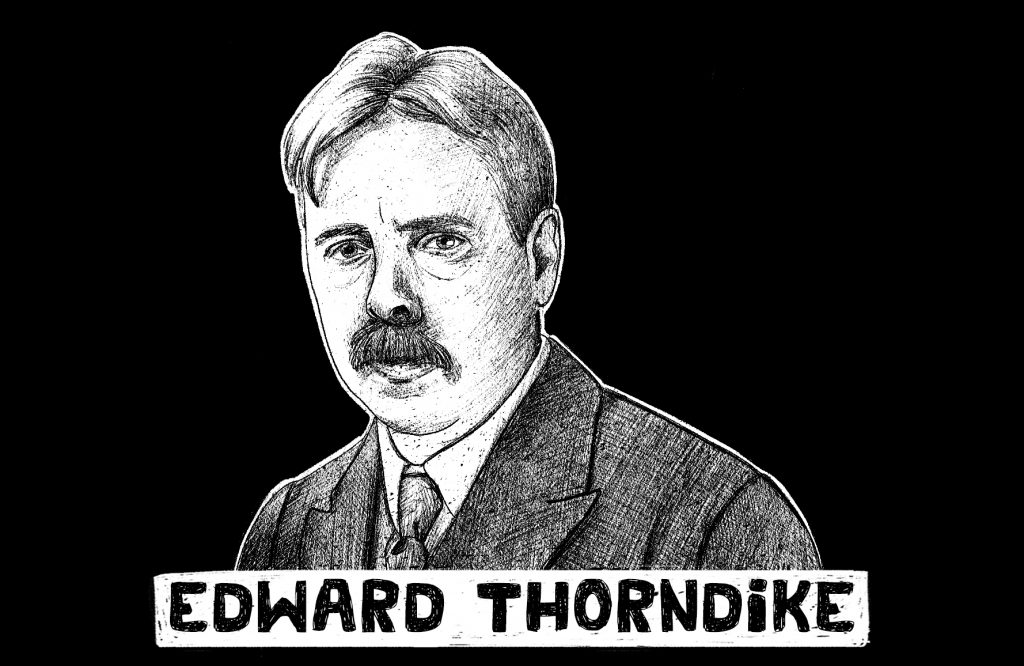
In 2002, theReview of General Psychologyranked Edward Thorndike as the ninth most eminent psychologist of the 20th century.

Who Is Edward Thorndike?Edward Thorndike’s Early LifeEdward Thorndike BackgroundThorndike’s Theory of LearningWho Did Thorndike Influence?Criticisms of Thorndike’s TheoryEdward Thorndike’s Books, Awards, and AccomplishmentsPersonal Life
Who Is Edward Thorndike?
Edward Thorndike’s Early Life
Edward Thorndike Background
Thorndike’s Theory of Learning
Who Did Thorndike Influence?
Criticisms of Thorndike’s Theory
Edward Thorndike’s Books, Awards, and Accomplishments
Personal Life
Edward Thorndike was an American psychologist, researcher, and author. He is best known for his theory of learning and developing theLaw of Effect. Thorndike was a pioneer in the use of animal subjects in experiments and his work had a major impact on the fields of psychology and education.
Edward Lee Thorndike was born on August 31, 1874 in Williamsburg, Massachusetts. He was the second son of Edward Robert Thorndike and Abigail Brewster Ladd. Thorndike’s parents would later have two other children, a son named Lynn and a daughter named Mildred. Thorndike’s older brother was named Ashley.
Thorndike’s father, Edward Robert, practiced law in Maine before becoming a Methodist clergyman and preacher in Massachusetts. He has been described as a good-looking, generous, and impulsive man with an active mind. Thorndike’s mother, Abigail, was noted for her extraordinary intelligence, artistic ability, gentleness, and deeply religious nature. Although she has been described as shy, she is also said to have possessed “a will of steel.”
Thorndike’s parents put much emphasis on academic achievement. They taught Edward how to read when he was very young and started sending him to school after he was five years old. At the age of twelve, Thorndike attended a series of high schools in Lowell, Boston, and Providence. He graduated from the Roxbury Latin School in 1891.
Although Edward Lee Thorndike would eventually find success as a psychologist, it is important to note that his siblings were also highly gifted. In the end, all four Thorndike children made an impact on the academic world—Edward in psychology, Lynn in medieval history, and Ashley and Mildred in English literature.
Thorndike was interested in studying learning in children, but as no subjects were made available to him he decided to focus on animals. In his second year at Harvard, he conducted a research study on the “instinctive and intelligent behavior of young chicks.” At the time, Thorndike did not have any major long-term plan for this experiment. He just thought he could give the animals better care than they were currently receiving.
As Harvard did not allow animals in the laboratory, Thorndike conducted the experiment in his own room. Later he was offered a space to continue the study in William James’ cellar. Thorndike’s approach proved fruitful and he eventually earned a second bachelor’s degree in 1896 and a master’s degree in 1897.
The following year, Thorndike attended Columbia University as a Fellow. He received much guidance and encouragement from psychologist James McKeen Cattell to continue his research on animals. Thorndike completed his PhD in 1898. His dissertation,Animal Intelligence: An Experimental Study of the Associative Processes in Animalsis considered a landmark study that introduced the concept of studying animal learning in the lab and proved that the observation of animal behavior could help solve general problems in psychology.
In 1898, Thorndike accepted his first teaching position at College for Women of Western Reserve University in Cleveland. He actually had two job offers after receiving his PhD, but he chose the lower paying option in Cleveland because it offered him higher academic status. In 1899, Thorndike joined the faculty of Teachers College, Columbia University. He spent the rest of his career at the institution and continued his work on human learning, intelligence testing, and education.
Thorndike’s approach to learning is known as connectionism. The basic idea behind this philosophy is that learning occurs when relationships (or connections) are formed between a stimulus and a response. This connection is called the stimulus-response (S-R) bond. A stimulus is anything that causes a reaction; a response is simply the reaction to the stimulus.
On the first few trials, the cats engaged in many irrelevant behaviors, such as meowing, pacing, pouncing on the wall, and pushing their paws through the wooden slats. Eventually, they would manage to hit the pedal or get their paw caught in the loop of string, and thus escape. Although they eventually solved the problem, they did so very slowly at first. On subsequent trials, however, the cats took less time to solve the puzzle.
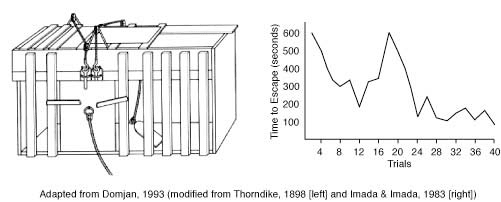
Based on his observations, Thorndike argued that when the cats engaged in irrelevant responses the results were dissatisfying—they remained trapped inside the box. The connection between being inside the puzzle box and making those responses was therefore weakened. On the other hand, when the cats performed the correct behavior, the results were pleasing—they were able to escape and eat—so that response was strengthened. Thorndike referred to this form of learning asinstrumental conditioning, since it involves the strengthening of responses that are instrumental in producing rewards.
Thorndike’s Contribution to Education: Trial and Error
Example of Thorndike’s Theory in Everyday Life
Any time we discuss “trial and error,” we can thank Edward Thorndike. This happens in learning, building skills, and even dating. Just read what Reddit user shenaniganry had to say aboutThorndike’s theory and dating:
“Thorndike concluded that the cats learned the puzzle cage’s solution through trial and error. Generally, behaviors that lead to a satisfying state of affairs are repeated, while behaviors that maintain an unsatisfying state of affairs are not.
This process, this operant conditioning, is the only way to learn a skill, and pickup, like golf or art or skydiving, is a skill. You can learn the theory from the internet and from The Game and The Mystery Method but you you cannot learn the skill unless you apply it.
And the application is going to mean trial and error.”
Changes to Thorndike’s Theory of Learning
Thorndike later modified some aspects of his theory, including his law of effect. He eventually came to the conclusion that while pleasant consequences (or rewards) for appropriate behavior always produce significant strengthening of S-R bonds, unpleasant consequences (or punishment) for inappropriate behavior was not very effective in weakening connections. In addition, Thorndike eventually abandoned the law of exercise after observing that repetition alone did not seem to strengthen S-R connections.
Thorndike’s connectionism has been credited as the first comprehensive theory of learning in American psychology. It played a key role in the behaviorist movement and laid the foundation on whichB.F. Skinnerlater developed his theory of operant conditioning. Thorndike’s pioneering work on learning in animals was also influential in developing the field of comparative psychology.
Thorndike’s Theory of Intelligence
Thorndike’s view of intellectual ability is another of his major contributions to the field of psychology. At the time when Thorndike began his work, intelligence was largely viewed as a general mental factor—as one basic ability rather than a collection of abilities—and each individual was thought to possess only a certain amount of it. This general intelligence factor was thought to influence all intellectual activities.
Thorndike disagreed with the notion of ageneral intelligence factorand proposed instead a multifactor theory of intelligence. According to this theory, intelligence is a composite of several different abilities that are independent of one another. Any mental task involves several of these abilities working together. Thorndike also argued that any intercorrelations seen among different subtests of an intelligence test are not due to a common underlying factor but occur because some abilities are common to different intellectual tasks.
Thorndike further suggested that three main categories of intellectual ability can be distinguished:
Thorndike developed an intelligence test known as the Intellect CAVD, with CAVD being an acronym for the four subtests of completion, arithmetic reasoning, vocabulary and directions. The four subtests were designed to measure different abilities involved in abstract intelligence.
Thorndike applied the principles uncovered in his animal studies to human learning and the practice of education. The law of effect, which highlights the importance of reinforcement, became one of the most important principles of education and is still being relied upon today.
Thorndike challenged the doctrine of “formal (or mental) discipline” that was popular in education in the early 20th century. According to this view, the study of difficult subjects such as Latin, Greek, and geometry was important because it trained the mind and improved one’s overall mental functioning. The mind was viewed somewhat like a muscle and harder subjects were assumed to strengthen mental faculties in much the same way that heavier weights would build stronger muscles. It was assumed that training in these difficult subjects would transfer to other areas, enhancing learning in those areas as well.
Thorndike’s research challenged these claims of general transfer and led him to propose instead a theory of transfer based on common elements. According to Thorndike, learning one type of task will only improve performance in another task to the extent that both tasks contain common elements. The idea was that transfer was specific rather than general. Based on this view, Thorndike suggested that decisions about which subjects to include in a curriculum should be based on their intrinsic, practical value and not based on assumptions of transfer value.
Thorndike’s Influence on Educational Psychology
Thorndike also emphasized the importance of measurement and testing in education. He strongly believed that “if anything exists, it exists in some amount” and can therefore be measured. Although standardized tests of achievement were already being used in schools, Thorndike developed several of his own, including tests of reading skill, English usage, and spelling, as well as college entrance tests. He also encouraged the consideration of individual differences when teaching.
Thorndike was one of the first researchers to apply psychological principles and empirical investigations to the field of education. Due to his significant early influence, he has sometimes been referred to as the founder of modern educational psychology. He wrote the first book on educational psychology and developed the first university course in educational measurement.
Applications of Thorndike’s Theory
The law of readiness alerts teachers to the importance of working with the learner’s level of readiness and motivation when introducing new concepts. If the student is not “ready” for a particular learning experience (i.e., does not have the requisite knowledge and skills), it could end up frustrating him or her. If that occurs, the teacher’s efforts may be rendered futile and the student may lose interest in learning.
Multifactor Theory of Intelligence
Thorndike’s theory of intelligence, though not the most popular today, still has practical value in its suggestion that people possess different forms of intellectual ability. Schools have traditionally emphasized the type of skills involved in what Thorndike called abstract intelligence (e.g., reading and math skills). However, his multifactor theory suggests that teachers and parents should take a much broader view of intelligence since students who do not excel in these areas might perform exceptionally well in others, such as art, dance, music, sports, and social skills.It also suggests the importance of using a variety of teaching strategies to cater to the varying intellectual strengths of learners.
One way teachers can identify their students’ intellectual strengths and weaknesses is through standardized testing, which Thorndike strongly recommended. Such testing may also prove beneficial in work settings, allowing employers to select and assign employees to the jobs that best match their pattern of intellectual abilities.
Below are some of the major criticisms leveled against Thorndike’s theory:
Thorndike’s behaviorist theory of learning focuses primarily on observable stimulus-response bonds, dismissing the cognitive events (e.g. thoughts, plans, and intentions) that influence these connections. His approach to learning has therefore been termed mechanical.
Much of Thorndike’s research involved the use of animals. This raises doubts about the generalizability of his results to humans, whose intellectual processes differ in many ways from that of lower animals.
Thorndike proposed a theory of transfer based on identical elements but did not clearly define what constitutes an “identical element.” Later researchers also found evidence to suggest that a measure of general transfer does occur under some conditions.
Thorndike authored a number of books throughout his career. Some of his works include:
Thorndike received honorary degrees from the University of Iowa (1923), the University of Chicago (1932), the University of Edinburgh (1936), and the University of Athens (1937). Some of this other awards and accomplishments include:
Edward Thordike married Elizabeth Mouton on August 29, 1900. At the time, he was 26 years old. The couple had four children together. The names of their children were Elizabeth, Edward, Robert, and Alan.
Thorndike was very involved in teaching his children from an early age and supervising their homework. So it was no surprise that Thorndike’s children continued his family tradition of scholastic brilliance. All four children eventually earned doctoral degrees—Elizabeth in mathematics, Robert in psychology, and Edward and Alan in physics. Elizabeth, the eldest, taught mathematics at Vassar College, Edward became a physics professor at Queens College, Robert became an educational psychologist and psychometrician at Teachers College, Columbia University, and Alan taught physics at the University of Washington.
Thorndike’s life was centered around his work and his family. His son, Robert, described him as “a gentle, retiring person who avoided contention and conflict and who felt that controversy was unproductive.” Edward Thorndike passed away on August 9, 1949—a few days shy of his 75th birthday One of his granddaughters, who was nine years old at the time, remembers him spending “most of his time in his study with his feet up on the desk and a cigarette in his mouth, but who was always ready to blow smoke rings for her entertainment or make her a hat or paper boats out of newspaper.”
American Psychological Association. (2002). Eminent psychologists of the 20th century.Monitor on Psychology,33(7) 29. Retrieved from https://www.apa.org/monitor/julaug02/eminent
Bustos, A. S., & Espiritu, S. C. (1996).Psychological, anthropological, and sociological foundations of education(Rev. ed. II). Quezon City: Katha Publishing Company.
Clifford, G.J. (n.d.).Edward L. Thorndike. Retrieved from
https://education.stateuniversity.com/pages/2509/Thorndike-Edward-L-1874-1949.html
Encyclopedia Britannica. (n.d.). Edward L. Thorndike. InEncyclopedia Britannica. Retrieved from https://www.britannica.com/biography/Edward-L-Thorndike
Mayer, R. E. (2003). E. L. Thorndike’s enduring contributions to educational psychology. In B. J. Zimmerman & D. H. Schunk (Eds.),Educational psychology: A century of contributions(pp.113-154). Mahwah, NJ: Lawrence Erlbaum Associates.
Teachers College. (2003).Thinking outside of the box: 100 years of educational psychology at TC. Retrieved fromhttps://www.tc.columbia.edu/articles/2003/september/thinking-outside-of-the-box-100-years-of-educational-psycho/
Woodworth, R. S. (1952). Edward Lee Thorndike, 1874-1949.National Academy of Sciences, 209-237. Retrieved from http://www.nasonline.org/publications/biographical-memoirs/memoir-pdfs/thorndike-edward-1.pdf
Related posts:40+ Famous Psychologists (Images + Biographies)Skinner’s Box Experiment (Behaviorism Study)Stimulus Response Theory (Thorndike’s Research + Examples)What is Intelligence? (9 Types Controversy + Examples)Free Online IQ Test (No Email + 5 Mins + Instant Results)
Related posts:
Reference this article:Practical Psychology. (2020, April).Edward Thorndike (Psychologist Biography).Retrieved from https://practicalpie.com/edward-thorndike/.Practical Psychology. (2020, April). Edward Thorndike (Psychologist Biography). Retrieved from https://practicalpie.com/edward-thorndike/.Copy
Reference this article:
Practical Psychology. (2020, April).Edward Thorndike (Psychologist Biography).Retrieved from https://practicalpie.com/edward-thorndike/.Practical Psychology. (2020, April). Edward Thorndike (Psychologist Biography). Retrieved from https://practicalpie.com/edward-thorndike/.Copy
Copy
