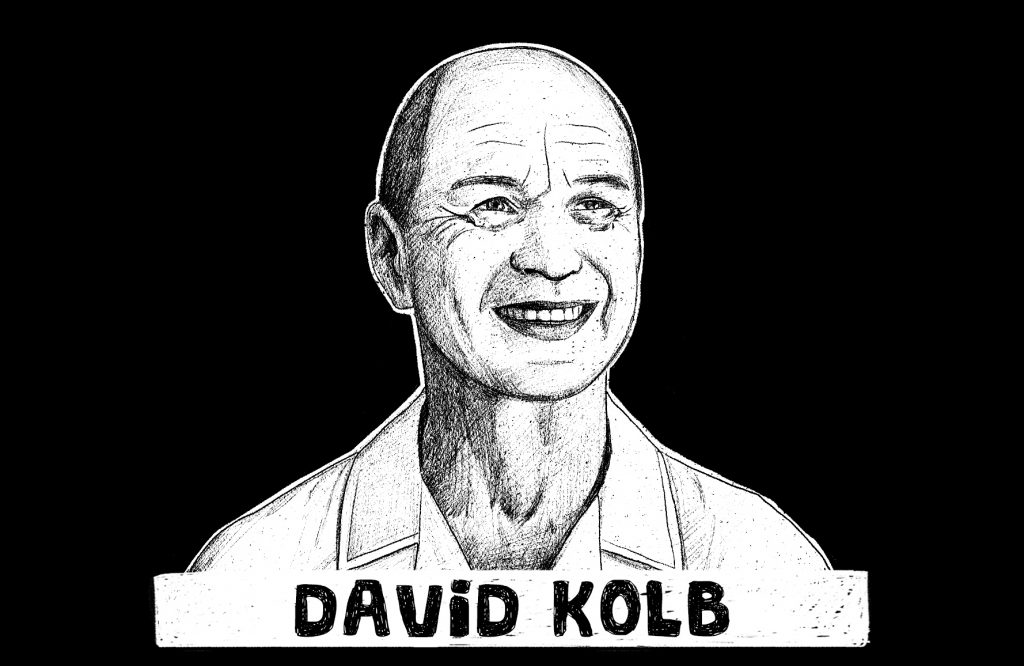
David Kolb is an American psychologist, professor, and educational theorist. He is renowned for his work on experiential learning and individual learning styles. His Learning Style Inventory was one of the first tools developed for assessing learning preferences and is still widely used today. Kolb’s unique perspective on learning has had a major influence on the educational sector as it has awakened educators to the importance of discovery and experience in the teaching-learning process.

David Kolb’s ChildhoodEducational BackgroundKolb’s Experiential Learning CycleKolb’s Learning StylesDavid Kolb’s Books, Awards, and AccomplishmentsIs David Kolb Still Alive?
David Kolb’s Childhood
Educational Background
Kolb’s Experiential Learning Cycle
Kolb’s Learning Styles
David Kolb’s Books, Awards, and Accomplishments
Is David Kolb Still Alive?
Kolb had his first encounter with experiential learning in the 6th grade. His teacher at the time asked the class to sit in a circle and gave each student the task of picking a country, learning about it, and acting as its representative in a United Nations forum. That experience is fresh in Kolb’s mind despite the fact that it occurred roughly 70 years ago.
In time, the department hired a new professor from Harvard—apersonality theorist—who had a significant impact on Kolb. Kolb finally felt as if he was being taught what he had expected to learn in a psychology program—theories about people, individual differences, and human nature. It was this professor who encouraged Kolb to pursue graduate studies at Harvard. Kolb earned his MA from Harvard in 1964 and his PhD in social psychology, also from Harvard, in 1967.
In 1965, Kolb began working as an Assistant Professor of Organizational Psychology and Management at Massachusetts Institute of Technology (MIT) Sloan School of Management. He was promoted to Associate Professor in 1970. During his time at MIT, Kolb developed an interest in finding the “best fit” for individual learners, which eventually blossomed into his theory of experiential learning.
In 1971, Kolb served as a Visiting Professor at the London Graduate School of Business Studies. In 1976, he joined the faculty at Case Western Reserve University (Cleveland, Ohio) as a Professor of Organizational Behavior in the Weatherhead School of Management. He is presently Emeritus Professor of that post.
In Kolb’s model, learning is presented as a four-stage cycle of grasping and transforming experience. Of the four stages shown in the diagram below, concrete experience and abstract conceptualization are the two modes of grasping experience; reflective observation and active experimentation are the two modes of transforming experience. Each stage lays the foundation for the one to follow.
A brief description of each stage in the learning cycle is presented below:
Let’s now consider an example of how the learning cycle might play out in real life. Imagine you have just attempted to cook rice for the first time. After removing the pot from the stove, you find that the rice is undercooked and the grains at the bottom of the pot are burnt (concrete experience). You then proceed to review in your mind the steps you had taken when cooking and check them against the recipe to see if you had followed the instructions carefully (reflective observation).
Based on your reflection, you determine that the flame had been too high and you needed to add a bit more water for the type of rice you were cooking (abstract conceptualization). You decide to throw out the first pot of rice and start again from scratch, adjusting the flame and amount of water (active experimentation). The outcome of this second attempt will result in a new concrete experience…so the cycle of learning continues.
Ideally, a learner goes through all four stages of experiencing, reflecting, thinking and acting. Kolb believes each stage is essential, with no one stage being effective on its own. Although a learner can enter the cycle at any stage, Kolb contends that effective learning will only occur if all four stages are completed.
Emerging out of Kolb’s learning cycle is his classification of individual learning styles. Kolb suggests that each learner has a preferred mode of grasping and transforming information and that this preference determines their learning style. He proposed four distinct styles of learning, each of which involves an emphasis on two phases of the learning cycle.
To better understand how Kolb arrived at his learning styles, take a look at the diagram below:
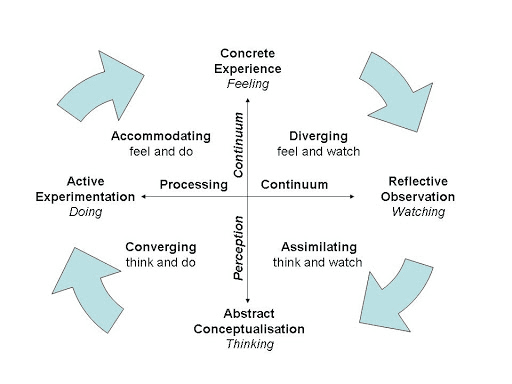
Kolb represents each stage of the learning cycle along two intersecting axes. The vertical axis is known as the “Perception Continuum” and relates to how people approach a given task. On this continuum, we choose a manner in which tograspinformation, whether through feeling (concrete experience) or thinking (abstract conceptualization) . The horizontal axis is known as the “Processing Continuum” and deals with how we make information meaningful. Here, we choose a way totransformor process our experience, whether through doing (active experimentation) or watching (reflective observation).
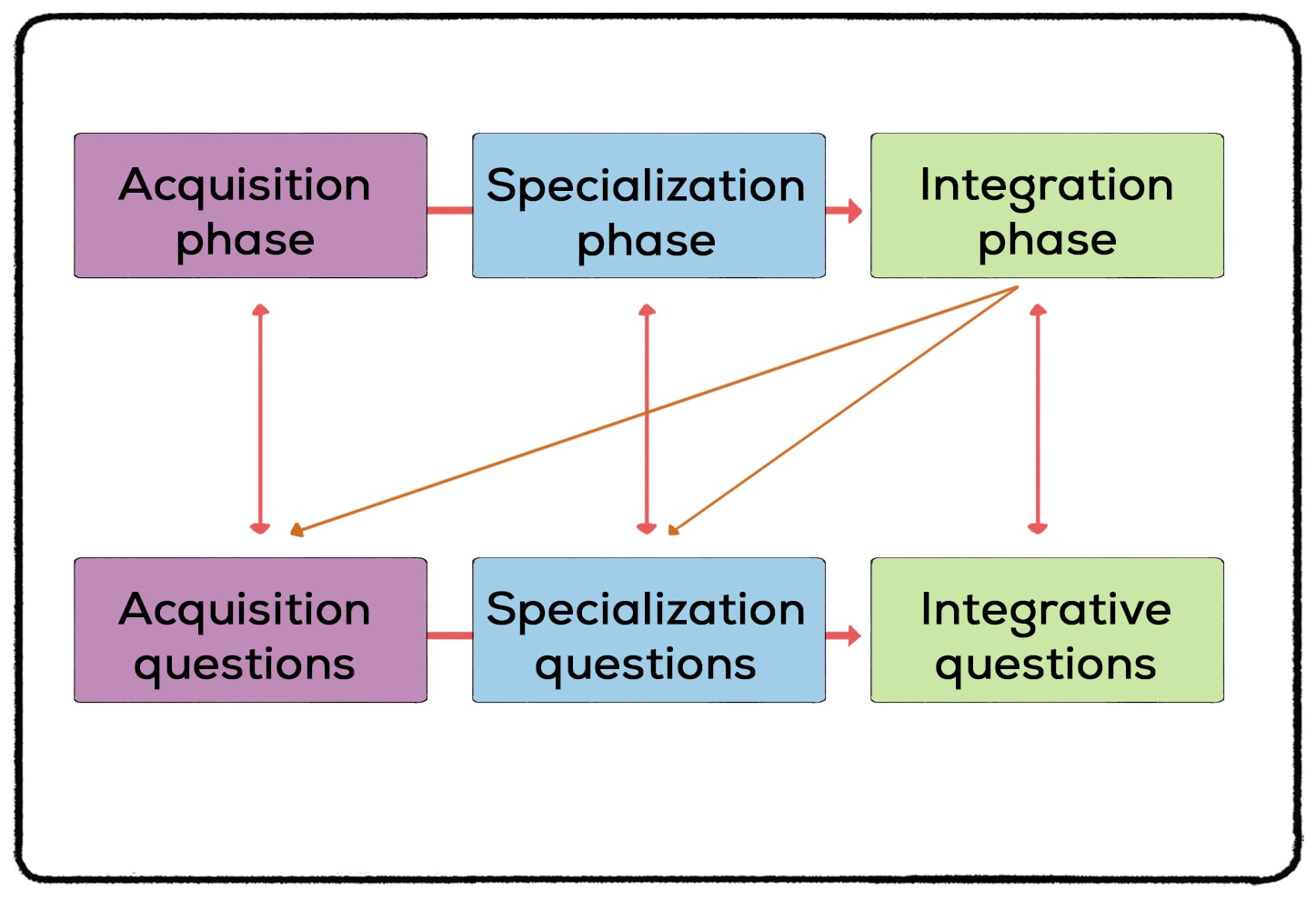
According to Kolb, each individual naturally favors a particular learning style. This preference depends on several factors, including social influences and educational experiences. Kolb believes the learner’s developmental stage also affects his or her learning preferences. Kolb specified three stages of development and suggests that people gradually learn to integrate conflicting modes of learning as they progress through the stages. In other words, as individuals grow, they gradually move away from an over-reliance on one learning style and progress toward learning in a more holistic way.
The three developmental stages Kolb identified are briefly described below:
Kolb’s Learning Style Inventory
The LSI consists of 12 statements describing different ways of responding to everyday situations. For each statement, the respondent has a choice of four endings, each corresponding to one of the four stages in the learning cycle. The individual ranks each statement from 1 to 4 according to his or her preferences. The results are then used to assign the individual to one of the four learning styles in Kolb’s classification system. (The newest version of the LSI expands Kolb’s typology from four to nine different learning styles).
Applications of Kolb’s Theory
Kolb’s theory of experiential learning has been applied to several contexts, including:
Of course, in typical educational settings, teachers are faced with a diverse array of learners. All four learning styles may be represented in a single classroom. In such situations, a variety of techniques reflecting all four components of the learning cycle would be ideal. There are two primary benefits of this approach: (1) it supports each student’s learning preference, increasing the likelihood that they will engage with the content, and (2) it challenges them to develop non-dominant learning modes so they can approach future learning situations with greater flexibility.
Academic advising and career counseling- By assessing students’ learning styles and providing them with feedback, academic advisors and counselors can help students to identify their preferences and strengths. This information also helps students to identify modes of learning that they may need to strengthen if they want to be successful in their chosen fields.
Business- In the sales and marketing industry, workers benefit from knowing the learning styles of prospective customers because it helps them to design more effective marketing strategies. In real-world settings, however, this is not always possible. As a result, it is wise for sales and marketing representatives to make use of various types of demonstrations, explanations and presentations so that people of different learning styles are able to understand exactly what the company is promoting or selling.
While there is much value in Kolb’s explanation of how we learn from experience, critics have noted several issues with his model:
For example, if after reflecting on an experience we are unable to arrive at satisfactory conclusions (abstract conceptualization), we may need to go back to the concrete experience stage in order to gather more observations. We may need to pay closer attention to what we see, hear, feel, smell, and/or taste. We may need to ask additional questions and perhaps, find out other people’s perception of the experience. Only then might we be able to reach a hypothesis we deem worthy of testing.
Doubts have also been raised about the validity and reliability of Kolb’s Learning Style Inventory. As a self-report measure, the results are based solely on how learners rate themselves and are therefore questionable. Another limitation of the inventory is that it only indicates relative strengths within the individual; it does not indicate the individual’s strengths in relation to other people.
Kolb has written numerous book chapters, monographs, and journal articles. He has also authored and co-authored several books, including:
His other awards include:
Kolb has been a member of several professional organizations, including the American Psychological Association, the Society for Intercultural Education, Training and Research (SIETAR), the International Association of Applied Social Scientists, and the National Center on Adult Learning (NCAL). He has also served on the editorial review board of several journals, including theAcademy of Management Review, theJournal of Management Development, Human Relations, andAcademy of Management Learning and Education.
Kolb is also the Chairman of Experience Based Learning Systems Inc. (EBLS), an organization which he founded in 1981 with the goal of advancing research and practice in experiential learning.
The couple enjoys going for early morning walks on the beach where they spend time reflecting and meditating. On weekends, Kolb can be found working actively in his garden. He has become a fan of Hawaiian music, which he describes as “very spiritual and connected with nature.”
David Allen Kolb. (n.d.). Retrieved fromhttps://prabook.com/web/david_allen.kolb/1698547
David Kolb. (n.d.). Retrieved fromhttps://weatherhead.case.edu/executive-education/instructors/david-kolb
Davies, L. (2008).Informal learning: A new model for making sense of experience. England: Gower Publishing Limited.
Evans, N. J., Forney, D. S., Guido, F. M., Patton, L.D., & Renn, K. A. (2010).Student development in college: Theory, research and practice(2nd ed.). San Francisco, CA: Jossey-Bass.
Kolb, D. (2020).David A. Kolb curriculum vitae. Retrieved from
https://learningfromexperience.com/about/David-Kolb-2020-curriculum-vitae.pdf
Krause, M. D. (2013).Smart prospecting that works every time!: Win more clients with fewer cold calls. New York: McGraw Hill Education.
Smith, M. K. (2013). David A. Kolb on experiential learning. Retrieved from The Encyclopedia of Pedagogy and Informal Education.https://infed.org/mobi/david-a-kolb-on-experiential-learning/
Related posts:40+ Famous Psychologists (Images + Biographies)Experiential Learning (Definition + Examples)David Berkowitz (Serial Killer Biography)David McClelland Biography - Contributions To PsychologyDavid Buss (Psychologist Biography)
Related posts:
Reference this article:Practical Psychology. (2020, April).David Kolb (Psychologist Biography).Retrieved from https://practicalpie.com/david-kolb/.Practical Psychology. (2020, April). David Kolb (Psychologist Biography). Retrieved from https://practicalpie.com/david-kolb/.Copy
Reference this article:
Practical Psychology. (2020, April).David Kolb (Psychologist Biography).Retrieved from https://practicalpie.com/david-kolb/.Practical Psychology. (2020, April). David Kolb (Psychologist Biography). Retrieved from https://practicalpie.com/david-kolb/.Copy
Copy
