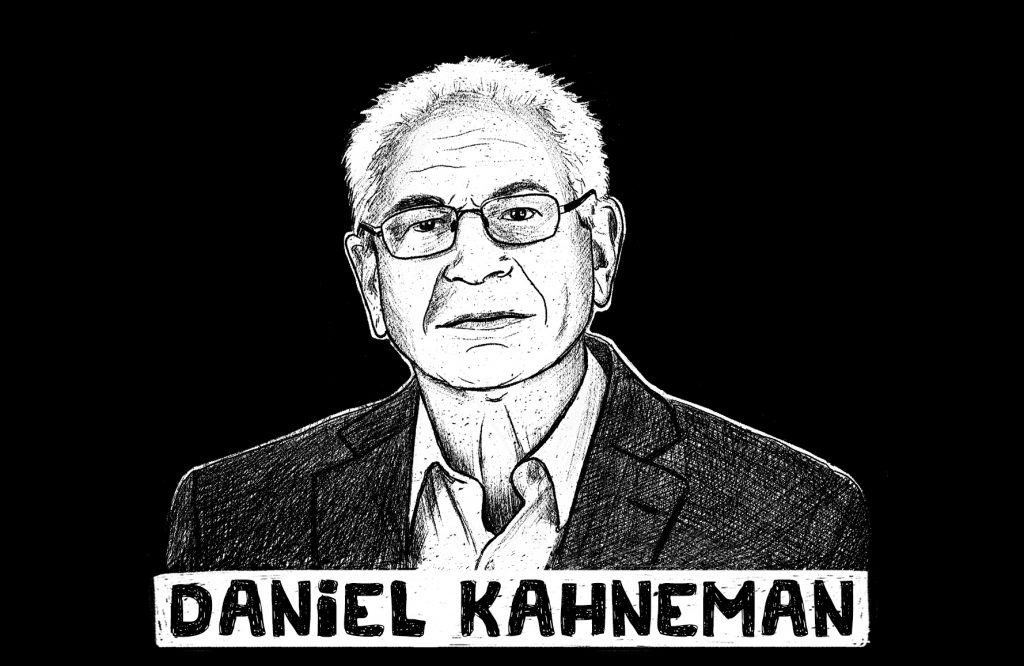
He is widely regarded as one of the founding fathers of behavioral economics and was also instrumental in developing the field of hedonic psychology.

Who Is Daniel Kahneman?Daniel Kahneman’s ChildhoodEducational BackgroundProspect TheoryHedonic PsychologyApplications of Prospect TheoryDaniel Kahneman’s Books, Awards and AccomplishmentsPersonal Life
Who Is Daniel Kahneman?
Daniel Kahneman’s Childhood
Educational Background
Prospect Theory
Hedonic Psychology
Applications of Prospect Theory
Daniel Kahneman’s Books, Awards and Accomplishments
Personal Life
Daniel Kahneman is an American-Israeli psychologist, economist, professor, award-winning author, and Nobel Laureate. He is most famous for his pioneering work on human judgment and decision-making which he applied to economic theory. His book,Thinking Fast and Slow,is a bestseller.Daniel Kahneman is considered the “father of prospect theory.”
Early Interest in Psychology
From an early age, Kahneman developed a fascination for the complexity of human behavior. In his own words, he displayed “some aptitude for psychology” while still quite young. As a child, he compiled a notebook of essays detailing his reflections on various aspects of life, the first of which he wrote before age 11 on the subject of faith. Kahneman described his childhood self as “intellectually precocious,” though “physically inept.”
During his teenage years, Khaneman’s interest in what made people think and act in certain ways intensified. By age seventeen, he was determined to study psychology, although economics also emerged as a recommendation during vocational guidance.
Military Experience
In 1954, after completing his B.A. in psychology, Kahneman was drafted into the Israeli Defence Force as a second lieutenant. After one year, he was transferred to the Psychology branch of the army where he was involved in assessing the character of candidates for officer training. He was later tasked with developing an interview method for combat-unit recruits to assist with selection of recruits and assignment of duties.
University of California at Berkeley
He commenced his studies in January 1958 at the University of California at Berkeley. Kahneman described himself as an eclectic graduate student who dabbled in a diverse range of subject areas, including subliminal perception, vision, personality testing, philosophy, andpsychoanalysis.
Kahneman wrote his dissertation in the spring of 1961 on the relations between adjectives in the semantic differential. He spent the summer of that year conducting research in the ophthalmology department of the university before returning to Jerusalem. There, he began teaching in the psychology department at the Hebrew University, rising to the rank of professor in 1970.
Teaching Experience
Kahneman taught at Hebrew University from 1961 to 1978 and at the University of British Columbia from 1978 to 1986. From there, he moved to UC Berkeley where he served as a professor until 1994. In 1993, he became the Eugene Higgins Professor of Psychology at Princeton University and Professor of Psychology and Public Affairs at Princeton’s Woodrow Wilson School of Public and International Affairs. Since 2007, he has served as Professor Emeritus of both posts. He is also a fellow of the Center for Rationality at the Hebrew University in Jerusalem.
Kahneman developed prospect theory in 1979 together with his cherished colleague and friend, Amos Tversky. The theory describes how people make decisions when their choices involve uncertainty, probability, and risk. According to prospect theory, most people prefer to hold onto the wealth they have, rather than risk their wealth to attain more. It also claims that because people do not like to experience losses, they would rather take a risk to avoid a loss than take a similar risk to make a gain.
Kahneman claims that the decision-making process has two phases. These are:
1) The Editing Phase
To get a better understanding of the framing effect, it may be helpful to consider two consent forms for surgery. On one version of the form, patients are told the surgery has an 80% chance of success. On another version of the form, patients are told the surgery has a 20% chance of failure. Although the statistical probabilities are identical, more patients are likely to sign the first consent form because the information was presented in a positive light.
2) The Evaluation Phase
After the options are framed and edited, the decision-making process moves to the evaluation phase. In this phase, the decision-maker computes the possible outcomes of each option as well as their likelihood. The decision-maker then chooses the option that results in higher value or utility.
The evaluation phase uses statistical analysis to measure and compare the outcomes of each prospect. It has two statistical aggregates that measure change: thevalue functionand theweighting function. A diagram of the value function is shown below.
Source: https://www.economicshelp.org/blog/glossary/prospect-theory/
Prospect theory has several key features:
Certainty- People usually prefer options with certainty. Consider the following scenario:
Option A: You have a 100% chance of winning £100
Option B: You have a 50% chance of winning £200
Which option would you choose?
In both cases, the expected value is the same.
Option A → 1.0 x £100 = An expected value of £100
Option B → (0.5 x £200) + (0.5 x £0) = £100 + £0 = An expected value of £100
Loss Aversion- The value function shown in the diagram above is steeper for losses than gains. This is because a loss is assigned greater value than a gain. For most people, losing £100 makes them feel worse than winning £100 makes them feel good. In other words, a loss creates a bigger psychological and emotional impact on people than a gain does.
Consider Person A who wins £200 but instantly loses £100 and Person B who wins £100 and loses nothing. Prospect theory suggests that Person A may feel worse than Person B because he experienced a loss along the way, even though in the end he has the same amount of money as Person B.
As mentioned before, people dislike losses so much that they may take greater risks than normal to avoid losing.
For example, which option below would you prefer?
Option A: 100% chance of losing £100
Option B: 50% chance of losing £200 or nothing
Option A → 1.0 x -£100 = An expected value of -£100
Option B → (0.5 x -£200) + (0.5 x £0) = -£100 + £0 = An expected value of -£100
Small vs High Probabilities- Prospect theory suggests that people usually give excessiveweightto events with low probability and insufficient weight to events with high probability. For example, people may treat an event with a probability of 99% as if it had a 90% chance of happening. And they may treat an unlikely event with a probability of 1% as if it had a 10% chance of happening.
Reference Dependence- According to prospect theory, people usually focus less on their overall net worth and more on their relative gains and losses from a reference point. To get a better idea of what this means, consider a person who is very concerned about how his salary stacks up against that of his workmates. If everyone in his company gets a 50% raise, he would be happy, but his relative position compared to everyone else is unchanged. He would likely be more interested in getting a 25% raise if everyone else in his company received nothing. He is more focused on earning more than his workmates than his overall net worth.
Prospect theory claims that the reference point when evaluating gains and losses matters. If your net worth is £1,000,000 and you lost £5 this morning, you may conclude that the loss is insignificant. But what if you had a different reference point? For example, if all the money you had in your pocket this morning was £5 for your morning coffee and you lost it, you may become very upset despite the fact that you are a millionaire.
During the 1990’s, Kahneman’s focus shifted to what he and his colleagues termed “hedonic psychology.” According to Kahneman, hedonic psychology is the study of what makes our lives and experiences pleasant and unpleasant. It is closely related to the field of positive psychology and deals with topics such as happiness, sadness, pain, pleasure, satisfaction and dissatisfaction.
One of Kahneman’s main contributions to this subfield was his suggestion that well-being is not a unitary concept but is comprised of two distinct components: experienced well-being and evaluative well-being.Experienced well-beinghas to do with how people feel about their experiences in the moment, as they are occurring.Evaluative well-beingrefers to how they feel about their experiences after they have passed. As Kahneman pointed out, the distinction is important because people’s feelings about the same experience may differ depending on whether they are presently going through that experience, or recalling it.
Kahneman and Schkade demonstrated the focusing illusion in a study involving two groups of participants: students attending Midwestern universities and students attending California universities. Participants were asked to rate their own life satisfaction and to predict how a hypothetical person would rate their life satisfaction if they lived in California versus the Midwest.
Although there was no significant difference in self ratings of life satisfaction between the two groups, both Midwest and California students predicted that the hypothetical person would be happier living in California. Kahneman and Schkade suggested that this was due to participants’ tendency to focus on the most salient differences between the two locations (namely, the beaches, natural beauty and good weather typically associated with California), while neglecting other important factors (such as job opportunities, cost of living, and the social environment) that also have a bearing on life satisfaction.
As prospect theory involves decision-making, its principles have been applied to many fields and industries. Some of the most common applications involve:
Criticisms of Prospect Theory
One of the main criticisms of prospect theory is that it provides little explanation for the processes it describes. For example, the theory mentionsthe framing effect, but why decision-makers create the frames they use is not explored. Also, limited attention is given to other important factors that influence decision making such as human emotion, cognition, and the impact of time.
Prospect theory also claims that people perceive losses and gains differently. While this may be true for most people who are experiencing a loss in a specific situation for the first time, people who are exposed to similar situations on a regular basis may eventually demonstrate changes in their decision making as they learn from past experiences. This means the theory may be more accurate in describing decision making in strange situations than familiar situations.
Some of the main features of prospect theory may be applicable in some scenarios but not in others. For example, loss aversion may be strongly felt when a person is risking his or her own money. However, bankers and money managers may react differently when working with money that is not their own. Critics have emphasized that Kahneman never intended to apply the principles of prospect theory to fields outside of economics.
Kahneman published over 150 scholarly articles, as well as two books: the award-winningThinking, Fast and Slowin 2011, andAttention and Effortin 1973. He was also co-editor for four other books:
During the course of his illustrious career, Kahneman received numerous awards, most notably the2002 Nobel Prize in Economics, which he received for his work with Amos Tversky on prospect theory. His other accomplishments include:
Kahneman is a fellow of the American Psychological Association, the American Psychological Society, the Society of Experimental Psychologists, and the Econometric Society. He also holds honorary doctorates from several universities, including Harvard, Yale, and Cambridge.
Daniel Kahneman married Irah Kahneman, an educational psychologist, in the 1950’s and their marriage produced two children. In 1978, he married a second time to Anne Treisman, a cognitive psychologist, and the pair moved to the University of British Columbia together. In 1986, they moved again, this time to UC Berkeley, and later to Princeton in 1993. Kahneman and Anne remained together until Anne’s death in 2018.
Is Daniel Kahneman Still Alive?
In a recent interview, Kahneman weighed in on AI, saying, “Clearly AI is going to win. How people are going to adjust is a fascinating problem.” Weigh in on the debate, and learn more about this psychologist,on Reddit!
Arora, R., Harter, J., & Muller, G. D. (2009). Global well-being. In S. J. Lopez,The Encyclopedia of Positive Psychology(Vol.1). Malden, MA: Wiley-Blackwell.
Cynkar, A. (2007).A towering figure. Retrieved fromhttps://www.apa.org/monitor/apr07/towering
Daniel Kahneman. (2020). InEncyclopedia Britannica. Retrieved fromhttps://www.britannica.com/biography/Daniel-Kahneman
Goldstein, E. B. (2008).Cognitive psychology: Connecting mind, research, and everyday experience(2nd. ed.). Belmont, CA: Thomson Wadsworth.
Kahneman, D. (2002).Daniel Kahneman biographical.Retrieved fromhttps://www.nobelprize.org/prizes/economic-sciences/2002/kahneman/biographical/
Kahneman, D. & Tversky, A. (1979). Prospect theory: An analysis of decision under risk.Econometrica,47(2), 263-292. Retrieved from https://www.its.caltech.edu/~camerer/Ec101/ProspectTheory.pdf
Prof. Dr. Daniel Kahneman. (n.d.). Retrieved fromhttps://www.mediatheque.lindau-nobel.org/laureates/kahneman
Prospect theory. (n.d.). InEncyclopedia Britannica. Retrieved from https://www.britannica.com/topic/prospect-theory Publications. (n.d.). Retrieved fromhttps://scholar.princeton.edu/kahneman/publications-0
Related posts:40+ Famous Psychologists (Images + Biographies)Free Memory Test (5 Mins + Instant Results)19+ Unhelpful Thinking Styles (Examples + Tools)The Framing Effect (Definition + Examples)Kurt Lewin Biography - Contributions To Psychology
Related posts:
Reference this article:Practical Psychology. (2020, March).Daniel Kahneman Biography - Contributions To Psychology.Retrieved from https://practicalpie.com/daniel-kahneman/.Practical Psychology. (2020, March). Daniel Kahneman Biography - Contributions To Psychology. Retrieved from https://practicalpie.com/daniel-kahneman/.Copy
Reference this article:
Practical Psychology. (2020, March).Daniel Kahneman Biography - Contributions To Psychology.Retrieved from https://practicalpie.com/daniel-kahneman/.Practical Psychology. (2020, March). Daniel Kahneman Biography - Contributions To Psychology. Retrieved from https://practicalpie.com/daniel-kahneman/.Copy
Copy
