If you’re here, you’re probably a psychology student or want to know what a cognitive psychologist does. Lucky you, I’ve compiled a huge list of different fields and topics in cognitive psychology and turned this page into a giant resource just for you.
What is Cognitive Psychology?Distinguishing Cognitive Psychology: A Comparative Overview with Psychoanalysis and BehaviorismBasic AssumptionsPerceptionMemoryLearningAttentionMetacognitionCognitive DevelopmentCognition in Cognitive PsychologyFamous Studies and Experiments
What is Cognitive Psychology?
Distinguishing Cognitive Psychology: A Comparative Overview with Psychoanalysis and Behaviorism
Basic Assumptions
Perception
Memory
Learning
Attention
Metacognition
Cognitive Development
Cognition in Cognitive Psychology
Famous Studies and Experiments
There are eight main parts of cognitive psychology, refer below for a quick table of contents on this page, and click on the headings to be directed to a more in-depth page:
 memory



MetaCognition

Decision Making

Jobs in Cognitive Psychology
‘Thinking’ occurs between stimulus and response
Behavior should be studied objectively in a controlled environment using scientific methods
Humans are information processors with inputs and outputs
When it comes to your brain, Cognitive Psychologists like to think of it as a computer with inputs and outputs.
Perception deals with how our brain receives the “inputs” through our sensory organs and tries to make sense of the world. We have5 main senses, although many more aren’t discussed as much.
Memory is the brain’s function for encoding, storing, and retrieving information. Without memory, we couldn’t hold information for further applications.
There are many types of memory. However, the main model (Atkinson-Shiffrin Model) consists of 3 main parts:
Another memory model (The Levels of Processing Theory) theorizes that the more we encode information, the longer we can remember it. Encoding information is the process of “making use” of it. For example, you might remember a new friend’s name because she looks like a character from a movie you saw.
The Serial Position Effect was also another breakthrough in understanding how memory works. Hermann Ebbinghaus discovered that when shown a list of 10 to 40 words, people would be much more likely to remember the last few words and the first few words.
The Primacy Effect and Recency Effect break up the Serial Position Effect into two parts. The Primacy Effect is the tendency to remember the beginning of a list, such as the first person you meet at a conference. The Recency Effect is the tendency to remember the last of a list, such as the last side effects of a medication. Both of these can be used during studying to improve student retention.
If you’d like to test your memory, I have a3-in-1 memory testyou can take online for free. It’s the first of its kind, and I’ll even show you where you compare to the population that took it!
One last thing to note on memory is Mnemonic Devices. Mnemonic Devices are mental tools that can be used to extend the duration or capacity of long-term memory without much work. There are many mnemonics. However, I will explain two below:
Acronym: Instead of trying to remember an entire sentence or phrase, you can keep the first letter of each word. For example, “POTUS” and “ROY G. BIV” are both acronyms commonly taught to students.
Chunking: Most people can remember 5-7 items in short-term memory at a time. When they chunk information into pieces of 3-4 items, they can hold up to 4 ‘chunks’, which increases the number to 12-16 items in short-term memory.
What is learning in psychology, you ask?
The first big breakthrough in learning was Classical Conditioning, attributed to Ivan Pavlov and his famous dog experiment. Not long after, John B. Watson tested classical conditioning on children in his infamous Little Albert study.
This theory strongly supported the behavioralism theory.
Remember: reinforcement means to increase the likelihood of a behavior, and punishment means to decrease the likelihood of a behavior.
Another important thing to note on operant conditioning is that Skinner realized the importance of schedules. In other words, how often did the conditioning happen, and how often was it rewarded/punished? Was the ratio of rewards fixed? Or was each reward given out at a specific interval?
The Bobo doll experiment was conducted to see if children would react to a toy the same way they observed others to act towards it. In short, they did. There are 4 main parts of observational learning: attention, memory, reproduction, and motivation.
Attention in psychology is defined as the selective concentration of our consciousness on certain sensory inputs or processes. Within the realm of cognitive psychology, various theories seek to explain attention. Two prominent theories among these are Broadbent’s filter model and Treisman’s attenuation model.

In 1953, a psychologist named Cherry found the “cocktail party effect,” where participants could pick out words from a bunch of noise they heard. This was interesting because this means we canfilterthe information we hear after we hear it.
5 years later, in 1958, Donald Broadbent used this effect to help support his theory of how attention works. In his dichotic listening experiments, participants listened to two sounds in each ear and were asked to focus on one. When focusing on both, they couldn’t understand either, however, when they focused on one, they could clearly understand what was being said.
Broadbent said that sensory information enters the brain, and we filter out what is unnecessary or unwanted and store the rest in working memory so we can use it. A bottleneck is commonly used to help explain this model - we can only let so much information into our working memory at a time. We have to choose what is important.
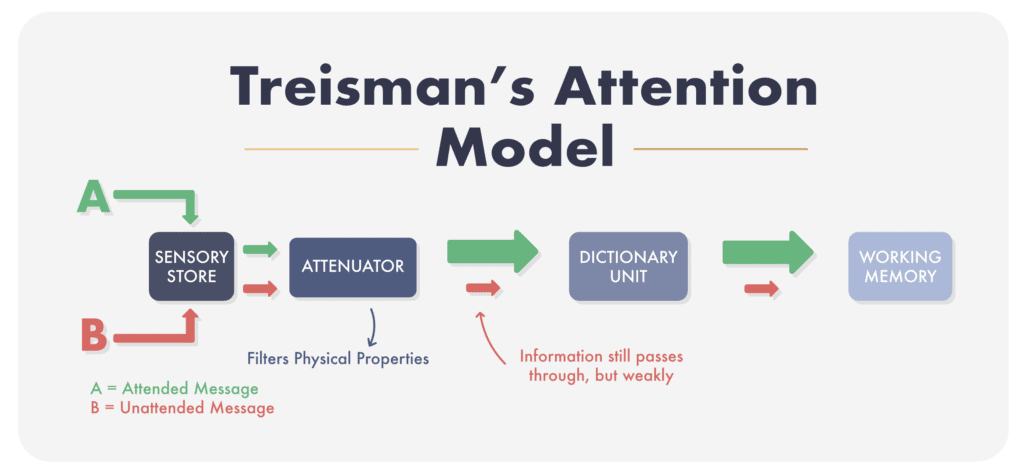
Anne Treisman was one of Broadbent’s students. She continued his model and filled the problems with her attenuation model. Attenuation is turning up or down the intensity of information, similar to adjusting a volume knob. That is exactly how her model works, too: we can turn our attention to something and lower our attention to other things.
TheInvisible Gorilla experimentsupports Treisman’s attenuation model. In this experiment, participants are asked to watch a video of people throwing a basketball around. The goal is for them to count how often the basketball is passed. However, halfway through the video, a man in a gorilla outfit walks between the basketball players. Most viewers don’t even notice the gorilla. They turned down the gorilla and continued to focus on the basketball.
To put it simply, metacognition is the process of thinking about thinking. Metacognition is important because it seems to be very unique to humans.
According to the psychologists who coined the term, the Self-Fulfilling Prophecy is “A false definition of the situation evoking a new behavior which makes the originally false conception come true.”
Another very important aspect of metacognition is meditation. Mindfulness Meditation is a mental exercise in which you try to not think about anything. Doing so seems to increase the grey matter in the brain, along with other positive benefits, such as:
One of the most famous and tested theories of development in cognitive psychology is the work of Jean Piaget. He proposed that we go through 4 main stages of cognitive development:
From ages 2 to 7, we start to use language to communicate and think. However, children in this stage are still egocentric, meaning they struggle to see things from the views of others. Another notable feature is pretend play and the introduction of creativity.
During the Concrete Operational stage, Piaget stated that children ages 7 to 11 started thinking more logically about specific events. They also develop and understand a concept called Conservation. Their thinking is much more organized yet still concrete and basic. Egocentricity fades away, and we can think how others feel.
After around age 11, children develop complex cognitive skills like advanced reasoning and thinking in abstractions. Questions of moral, ethical, and political ideas start to arise, and children solidify their identity.
Piaget’s theory of a child’s development has been a standard in cognitive psychology for a long time, and that’s because his theories are hard to ignore.
Cognition refers to the mental processes and activities of acquiring, processing, storing, and applying information. It encompasses a broad range of functions, including perception, attention, memory, language, problem-solving, and decision-making. Understanding cognition is central to the field of cognitive psychology.
Cognitive psychologists aim to study and understand these intricate mental processes. To achieve this understanding, they take several actions:
By delving deep into the intricacies of the mind and its functions, cognitive psychologists provide insights that have profound implications, not just in understanding human behavior but also in enhancing our quality of life.
We are still adding information to this section, but here is a list:
Loftus and Palmer
Peterson and Peterson, 1959
Cocktail party Effect
Invisible Gorilla
The Spacing Effect
Related posts:The Psychology of Long Distance RelationshipsOperant Conditioning (Examples + Research)Beck’s Depression Inventory (BDI Test)Variable Interval Reinforcement Schedule (Examples)Abandonment Issues (Examples, Causes, and Treatment)
Related posts:
Reference this article:Practical Psychology. (2019, August).Cognitive Psychology.Retrieved from https://practicalpie.com/cognitive-psychology/.Practical Psychology. (2019, August). Cognitive Psychology. Retrieved from https://practicalpie.com/cognitive-psychology/.Copy
Reference this article:
Practical Psychology. (2019, August).Cognitive Psychology.Retrieved from https://practicalpie.com/cognitive-psychology/.Practical Psychology. (2019, August). Cognitive Psychology. Retrieved from https://practicalpie.com/cognitive-psychology/.Copy
Copy
