You may hear the phrase “cognitive dissonance” used frequently, but what does it actually mean? I’ll tell you!
What is Cognitive Dissonance?
Who Coined the Term “Cognitive Dissonance”?
Is Cognitive Dissonance a Bias?
Examples of Cognitive Dissonance
Is Cognitive Dissonance Bad?
Rationalization Techniques
Sticking to Your Beliefs
Fighting Cognitive Dissonance
Read More About Cognitive Dissonance on Reddit!
References
Cognitive dissonance is the state of mind that occurs when you are simultaneously entertaining two or more opposite ideas. This situation is stressful for your brain, so it wants to quickly pick an option to resolve the conflict. Your brain then tries to rationalize the option you chose so you can feel like you made a good decision.
Cognitive dissonance can be more generally defined as a situation where you must choose an option and rationalize it to make yourself feel better.
Read Leon Festinger’s psychologist biography here!
Cognitive dissonance is often discussed alongsideconfirmation bias,but the two are slightly different. Confirmation bias occurs when additional information confirms what you already believe - you favor and accept that information as a result of a bias. Cognitive dissonance occurs when information challenges your beliefs, and you choose to ignore it or even consider it.

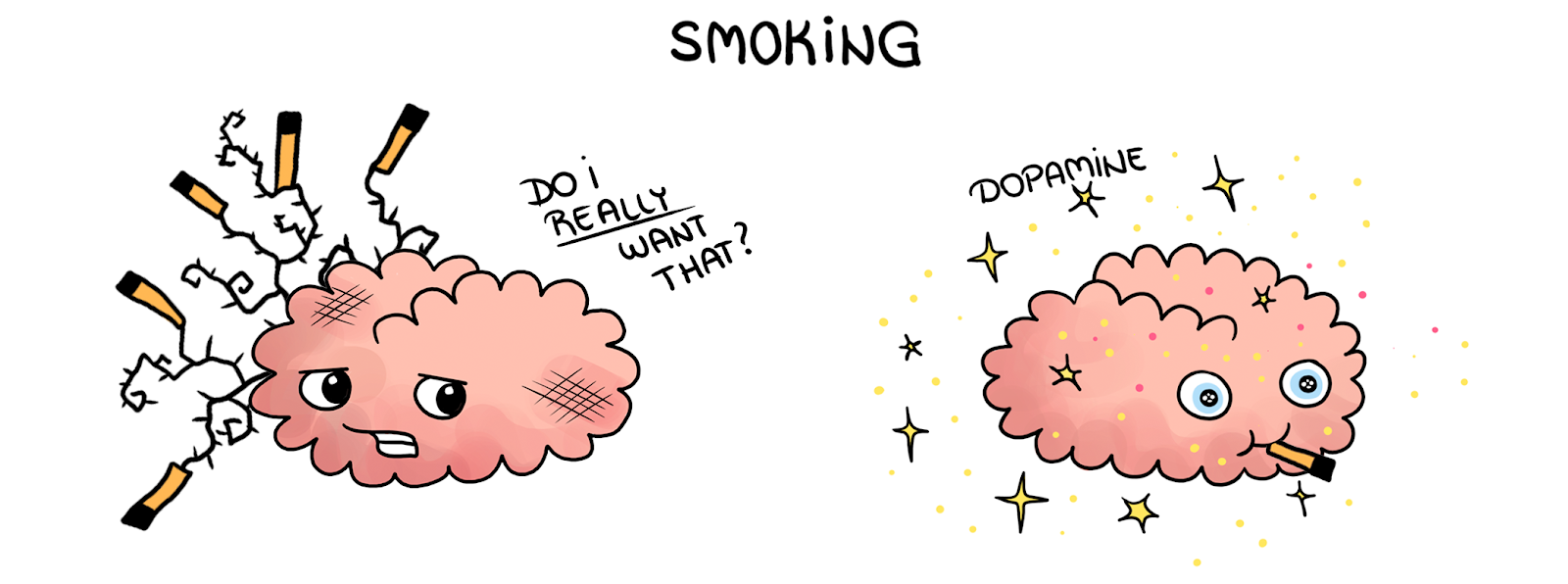
One classic example of cognitive dissonance is smoking. When people smoke, they are simultaneously entertaining two opposing ideas:
Another example would be an employer telling you to misrepresent a product to a customer:
Cognitive dissonance can also be described as a situation where you change your beliefs to rationalize your previous beliefs. The whole goal of this rationalizing is so that you can say you were technically never wrong.
For example, a cult leader in 1954 predicted the end of the world. When the world didn’t end, the cult’s followers had to choose between wanting to believe in their leader and acknowledging that the world, in fact, did not end. The cult’s followers ended up changing their beliefs and saying that their devotion to the cult was thereasonthe world did not end. This allowed them to continue believing in and trusting their cult leader while accepting the fact that the world had not ended.
Another more recent example of cognitive dissonance involves a group of “flat-earthers,” or people who believe that the Earth is flat. This group demonstrated cognitive dissonance when they reacted to the result of one of their own experiments. They wanted to prove that the Earth was not rotating, so they came up with a cleverexperiment. They said that, if the Earth was really round and spinning 360 degrees every 24 hours (or 15 degrees/hour), then a gyroscope mounted anywhere on Earth would drift 15 degrees per hour. They then invested $20,000 in an extremely accurate laser gyroscope and performed their test.
To their dismay, the expensive and accurate gyroscopedidshow a drift of exactly 15 degrees/hour. The flat-earthers then retried the experiment in many different ways, until eventually dropping the whole experiment altogether and disregarding their results.
These people were in a state of cognitive dissonance because:
To resolve the cognitive dissonance, they disregarded the new evidence and stuck with their previous belief.
It’s not fun to suspect your partner of cheating on you. In fact, it can feel downright uncomfortable. Many people get away with sneaking around for years because their partner “refuses to see the signs.” Really, they are failing to let in ideas that oppose what they currently think about their partner. The first signs of betrayal may conjure up the idea of the partner cheating, but it’s too uncomfortable to think that their partner could love them and could also be unfaithful. So the person decides to push away thoughts of infidelity until it’s impossible to deny the partner’s betrayal.
Not all schools teach their students the same curriculum. Material may vary depending on the type of school that the student attends, the teacher at the head of the classroom, and whether or not the school faces any restrictions from state laws. A private, religious school may teach a very different approach to science or sex ed than a public school.
Stepping outside of that school system and “unlearning” can be a scary and uncomfortable process. If you spent your entire childhood learning that evolution was simplyonetheory of how we came to earth, it might be a shock to your system to go to college and discover that many teachers don’t teach anything besides evolution.
It’s normal to feel uncomfortable when you have to “unlearn” this information or open your mind to allow different theories to enter. It’s not unusual to feel that one or more of your teachers may be wrong or maybe even turn some of the blame on yourself. People often resist or fight back if they are being taught new information that goes against what they already know or believe. This is cognitive dissonance, and the only way to have a successful education experience is to face these feelings head-on and keep learning.
We all know that smoking is bad for us. It’s hard to argue that a cigarette can do anything good for one’s health. And yet, over 30 million adults in the United States smoke.
It’s common for people who smoke to feel guilt when they go out for a cigarette. If they think too hard about the health risks associated with smoking, they might get downright uncomfortable. They are stuck trying to juggle two opposing thoughts: theywantto smoke because it will satisfy their craving, and yet theydon’t wantto smoke and cause damage to their lungs. Unfortunately, addiction is powerful and can overcome a lot of the discomfort that comes from cognitive dissonance.
Many of us form limiting beliefs throughout our lives. It can be easy and comfortable to hold onto ideas that we “can’t” do something great or that we aren’t good enough. Unfortunately, these limiting beliefs get in the way if we want to form a productive habit, set a lofty goal, or change the direction of our lives.
If you want to change your life, you will have to change your beliefs. More than that, you will have to replace old, limiting beliefs with new, positive ones. This can be a hard process for many people because they encounter a lot of cognitive dissonance. When you spend your whole life telling yourself that you’re no good, you’re going to feel mighty uncomfortable using affirmations to tell yourself that you’re worthy of achievements or that you can reach your goals.
This is the important thing to remember about cognitive dissonance. You can get through it! By recognizing that the discomfort is just a cognitive process, and not a sign that your new beliefs are wrong.
At this point, you may have noticed a concerning trend in that people often don’t make the best decisions when in a state of cognitive dissonance. People often choose to smoke and harm their bodies. Employees often put their morals aside and follow questionable orders from their employer. Conspiracy theorists often disregard solid science that disproves their beliefs.
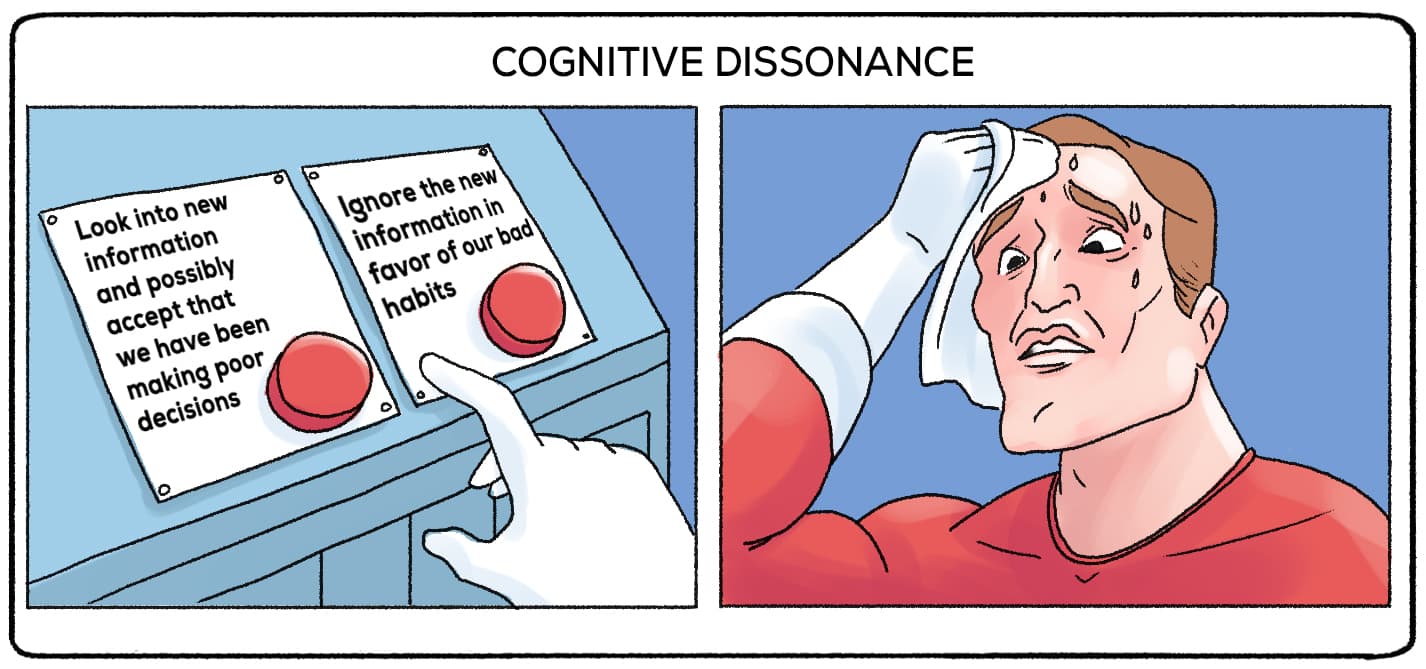
This happens because cognitive dissonance often puts us in a state where we are inclined to ignore our morals. This happens because of two things:
When we are not aware of this process, cognitive dissonance can lead us to make poor decisions, even when the rest of the world is pleading with us to choose something else.
We want to see ourselves as good people, so our brains try to rationalize our decisions - especially when cognitive dissonance has forced us to ignore our morals. Some common rationalization techniques include:
Ethics Unwrapped[1] has come up with this list to describe why people don’t listen to evidence disproving their beliefs:
We all want to be a good person, so how do we prevent ourselves from choosing the immoral option and sticking to it when in a state of cognitive dissonance? Here are three strategies that you can use right now to combat this psychological dilemma:
“Just to add to this, the dissonance (uncomfortable feeling) can also occur whenever there’s a mismatch beliefs/behaviors. For example, if you told yourself you need to study tonight for a test tomorrow (your belief) but you’re currently on reddit or binge-watching Netflix (your behavior), that mismatch would create dissonance. So we like to resolve that dissonance before it becomes too uncomfortable (oftentimes without even being aware of it). That means either changing our behavior (getting back to studying), or changing our belief (the test won’t be that hard, I’ll do fine if I cram in the morning). There’s lots of other interesting examples of how our behaviors cause us to change our feelings/beliefs, and one of the reasons people in cults like them so much.”
“Cognitive Dissonance - Ethics Unwrapped - The University of Texas at ….“https://ethicsunwrapped.utexas.edu/video/cognitive-dissonance. Accessed 10 Apr. 2019.
“Explaining Attitudes from Behavior: A Cognitive Dissonance … - Harvard.” 28 May. 2015,https://projects.iq.harvard.edu/files/pegroup/files/acharyaetal2015.pdf. Accessed 10 Apr. 2019.
“The Origins of Cognitive Dissonance - Mind and Development Lab.“https://minddevlab.yale.edu/sites/default/files/files/The%20origins%20of%20cognitive%20dissonance.pdf. Accessed 10 Apr. 2019.
Related posts:Leon Festinger (Psychologist Biography)Beck’s Depression Inventory (BDI Test)The Psychology of Long Distance RelationshipsOperant Conditioning (Examples + Research)Abandonment Issues (Examples, Causes, and Treatment)
Related posts:
Reference this article:Practical Psychology. (2019, April).Cognitive Dissonance (Definition + Examples).Retrieved from https://practicalpie.com/cognitive-dissonance/.Practical Psychology. (2019, April). Cognitive Dissonance (Definition + Examples). Retrieved from https://practicalpie.com/cognitive-dissonance/.Copy
Reference this article:
Practical Psychology. (2019, April).Cognitive Dissonance (Definition + Examples).Retrieved from https://practicalpie.com/cognitive-dissonance/.Practical Psychology. (2019, April). Cognitive Dissonance (Definition + Examples). Retrieved from https://practicalpie.com/cognitive-dissonance/.Copy
Copy
