The American Psychological Association ranks Rogers as the 6th most eminent psychologist of the 20th century. Why is this psychologist so influential? Let’s find out.

Who Is Carl Rogers?Carl Rogers Family BackgroundCarl Rogers Early LifeCarl Rogers’ Educational BackgroundHumanistic PsychologyWhat Are The 6 Core Conditions?The Fully Functioning PersonApplications of Rogers’ TheoryIs Person-Centered Therapy Still Used Today?Criticisms of Rogers Theory
Who Is Carl Rogers?
Carl Rogers Family Background
Carl Rogers Early Life
Carl Rogers’ Educational Background
Humanistic Psychology
What Are The 6 Core Conditions?
The Fully Functioning Person
Applications of Rogers’ Theory
Is Person-Centered Therapy Still Used Today?
Criticisms of Rogers Theory
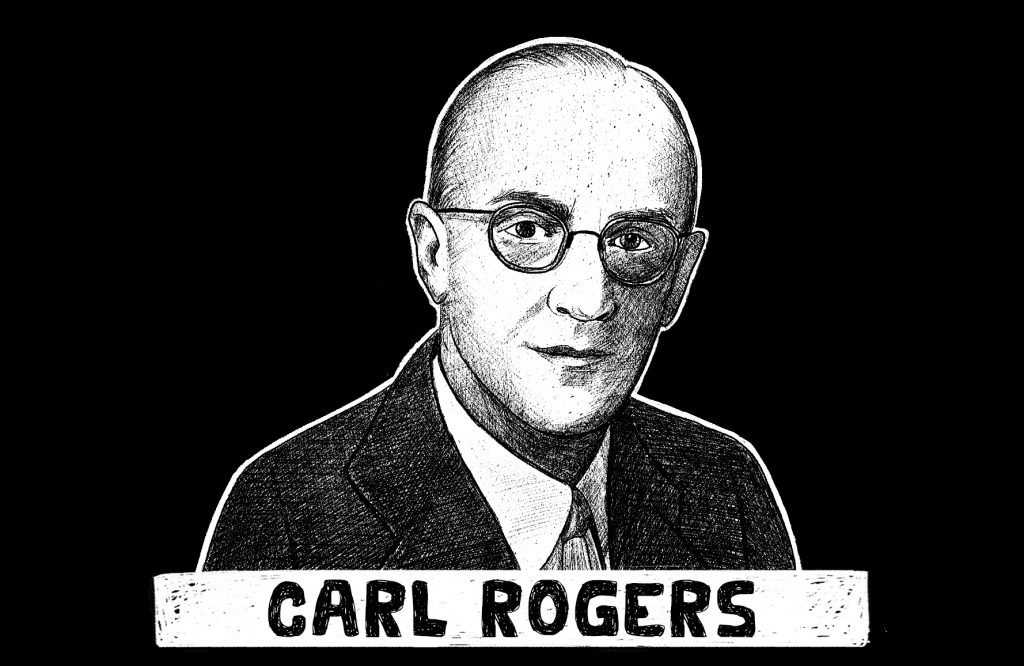
Carl Rogers was an American psychologist, researcher, and author. He is widely considered to be one of the founding fathers of humanistic psychology. Rogers also developed person-centered therapy—a form of talk therapy that emphasizes a personal, supportive relationship between therapist and client.
Carl Ransom Rogers was born on January 8, 1902 in Oak Park, Illinois. His parents were Walter Rogers and Julia Cushing. Rogers was the fourth of six children. His father worked as a civil engineer and his mother was a homemaker.
Rogers was raised in an educated, conservative, middle-class, Protestant family. His parents had strict views on proper behavior. According to Rogers, his parents did not “dance, play cards, attend movies, smoke, drink, or show any sexual interest.” Walter and Julia Rogers expected their children to maintain high moral standards, work hard, and limit expressions of emotion.
Despite having five siblings, Rogers often felt lonely. One reason for his loneliness was his belief that his parents had greater love for one of his older brothers. This led to considerable competition between Rogers and his brother. When he was an adult, Rogers recalled several bad childhood memories in which he was the butt of his brother’s jokes.
A second reason for Rogers’ childhood loneliness was that he had little social life outside his family. He described himself as “shy, solitary, dreamy, and often lost in fantasy.” Rogers was able to read well before he was five years old and his loneliness led him to read all the books he could, including a dictionary and an encyclopedia. Over time, his solitude helped him to develop discipline, independence, resilience and his own way of thinking.
When Rogers was twelve years old, his family moved from the suburbs to live on a farm in the country. They raised sheep, pigs, and cows. Rogers read through all the books on agricultural science that his father brought home. This knowledge and his ability to work independently on the farm sparked his love for science.
Rogers was an excellent student. Over the course of several months, he observed, captured, and bred a specific type of moth that he discovered in the woods. As his father used modern scientific methods to farm, Rogers learned how to study individual variables, use control groups, and collect and analyze data. These experiences contributed much to his future work as a psychologist.
Rogers enrolled at the University of Wisconsin-Madison after leaving high school. This was the same college that his older brothers and sister had attended. His goal was to study agriculture. However, these plans would change during his junior year at the university.
In 1922, a 20 year old Rogers was invited to attend an international Christian student conference in China. During his 6 months of travel, he wrote to his parents that his religious views had changed from fundamentalist to liberal. After going to a seminar entitledWhy am I entering the Ministry?Rogers decided to quit agriculture. His new goal was to study theology and become a minister.
Rogers’ parents were upset when he informed them of his new views on religion. However, Rogers felt emotionally and intellectually free after letting go of his parents' beliefs. He remarked that he could now think his own thoughts, draw his own conclusions and stand up for what he believed in. Rogers graduated from the University of Wisconsin-Madison in 1924 with a bachelor’s degree in history and immediately enrolled at Union Theological Seminary in New York City.
Rogers earned his master’s degree in psychology in 1928 and his PhD in psychology in 1931. He then joined the staff of the Society for the Prevention of Cruelty to Children in Rochester, New York. At the center, Rogers diagnosed and treated delinquent and underprivileged children. He also helped to develop a highly successful child study department.
Rogers lectured at the University of Rochester from 1935 to 1940. He then accepted an offer to become professor of psychology at Ohio State University. During his time in Ohio, Rogers formulated and shared his views on treating people with mental health issues. He also worked to bring awareness to clinical psychology.
In 1947, Rogers accepted the position as professor of psychology and executive secretary of the counseling center at the University of Chicago. However, when he was unable to help a client with a serious mental illness, he experienced a nervous breakdown. He left Chicago and remained secluded in a cabin for six months. When he returned to the university, he entered therapy himself and regained his composure, drive, and confidence.
From 1957 to 1963, Rogers taught at the University of Wisconsin. He published several articles and books that brought his theories and client-centered therapy to the attention of the general public. During the last few years of his life, Rogers focused on bringing conflicting groups together. He worked on reducing tension between Catholics and Protestants in Northern Ireland, and Arabs and Jews in the Middle East.
Rogers rejected these perspectives and promoted a more optimistic view of humans’ ability to shape their own behavior and enhance themselves in positive ways. His approach was central to thehumanistic movement in psychology.Some of the main concepts from Roger’s theory are explained below.
Carl Rogers and Self-Actualization
Rogers believed all organisms are born with one basic motive - a tendency toward development, maintenance, enhancement, and fulfillment. This actualizing tendency, as he termed it, moves organisms to satisfy their biological needs and promotes physical maturation.
In humans, the actualizing tendency also motivates individuals to develop psychologically, for example, to increase autonomy, self-regulation and personal growth. Rogers referred to this unique, psychological aspect of the actualizing tendency asself-actualizationsince it involves development of the self. Self-actualization is a striving to achieve one’s highest potential. It is the primary drive behind personality development. (You may recognize this term fromMaslow’s Hierarchy of Needs.)
The Self, Congruence, and Incongruence
According to Rogers, theself(or self-concept) consists of those conscious perceptions and sensations that we associate with “me” or “I.” It is an organized, yet fluid, set of characteristics that develop through our interactions with the environment, particularly our interactions with significant others. Development of the self-concept begins in infancy.
Some of the characteristics we incorporate into our self-concept are based on our own organismic valuing process; others are based on values which we take over (or introject) from others. Because the self-concept is derived in part from others, the possibility exists that our experiences may sometimes be at odds with the view we have formed of ourselves.
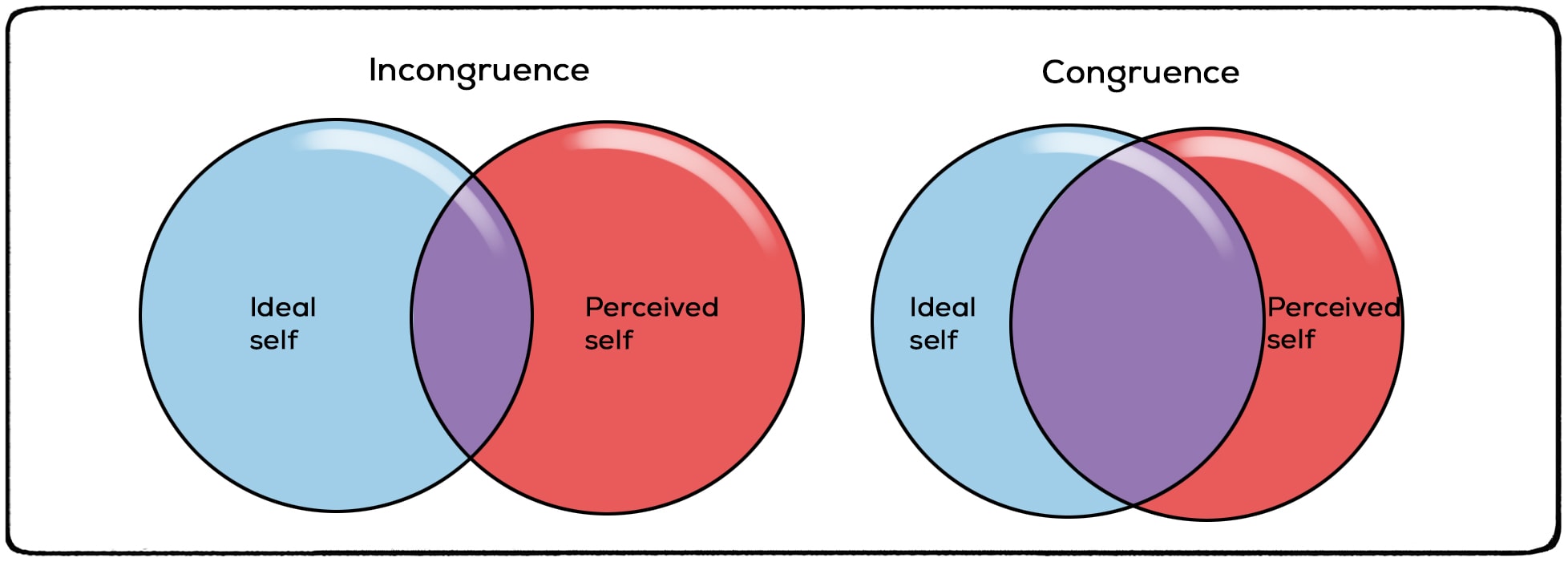
Such an individual is experiencing what Rogers calledincongruence- a clear discrepancy between one’s perception of the self and one’s actual experiences. Incongruence invariably results in tension, which is often experienced as anxiety. In order to reduce this anxiety and protect the self-concept, the individual may employ defenses such as denial or distortion of their experiences. For example, the young man in the example may choose to block out those occasions when he became genuinely angry, or he might attribute his physiological reactions to dealing with a stressful project at work.
According to Rogers, healthy individuals do not need to rely on defenses to protect their self-concept. They are able to assimilate and incorporate most, if not all, of their experiences, including those that are inconsistent with their existing self-structure. Rather than clinging to a rigid view of the self, they allow room for their self-concept to adapt and grow. They learn to accept themselves and embrace all their experiences.
Healthy individuals exist in a state ofcongruence,where their experiences closely match their internal representation of the self. It is important to note though, that people rarely experience a state oftotalcongruence, where all their experiences are consistent with their self-image. All of us experience some degree of incongruence. The greater our level of incongruence, the greater our level of psychological distress.
Roger’s view of congruence and incongruence can also be understood in relation to what he called the real self and the ideal self. Thereal selfrefers to the way individuals actually see themselves; theideal selfrefers to the type of person they believe they should be. Incongruence occurs when there is a gap between the real and ideal selves. The greater this gap, the greater the tension and anxiety experienced.
Conditional vs Unconditional Positive Regard
As children grow and develop an awareness of self, they experience a need for positive regard, that is, a need for love and acceptance. Children who are raised in an atmosphere ofconditional positive regardreceive love and acceptance only under certain conditions or when they engage in certain behaviors. In an environment ofunconditional positive regard, love and acceptance are provided independent of the child’s behavior, with no strings attached.
Conditional positive regard and conditions of worth set the stage for incongruence. Consider a young girl who enjoys playing soccer and has dreams of playing professionally. Her mother disapproves of her soccer playing but constantly tells her how proud she would be of her if she became a teacher like her sisters. These conditions of worth soon become incorporated into her self-concept. She starts to believe she should excel at teaching because this would result in greater approval from her mother.
The result is conflict or incongruence between what the young girl naturally experiences as satisfying (playing soccer) and what her self-concept now demands from her (abandoning soccer in favor of teaching). Of course, the result in this situation would be psychological tension and discomfort, along with the associated defenses.
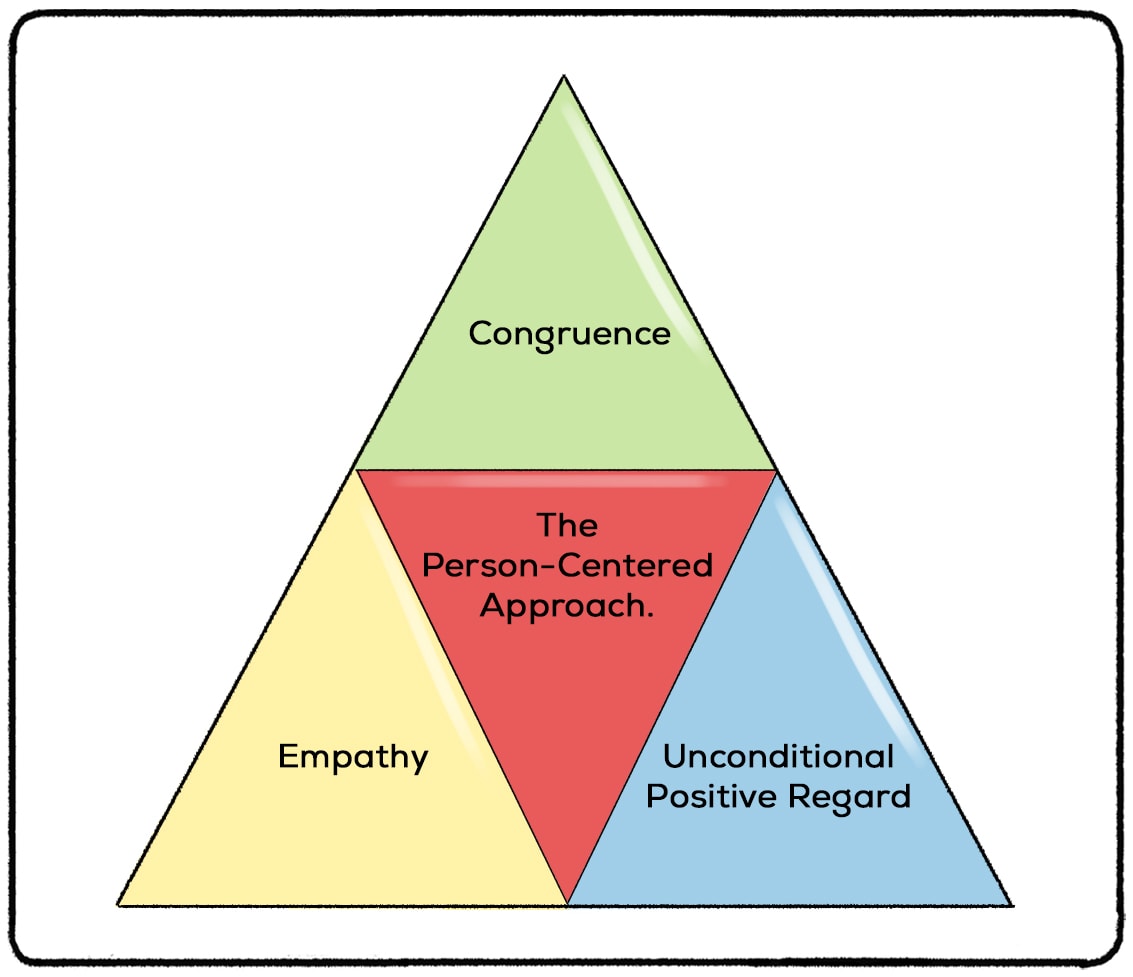
In order for the tension to dissipate and change to occur, Carl Rogers believedsix core conditionsmust exist:
Rogers specified five characteristics of a fully functioning person:
In Rogers’ view, being fully functioning is not a state one achieves but a continual process of growth. The fully functioning person lives what Rogers called the good life - a life that is rewarding, enriching, challenging and meaningful. He or she also shows genuine concern for others and feels obliged to help them become fully functioning as well.
The three pillars of person-centered therapy include the six conditions, seven stages of process, and 19 propositions.
What Are Carl Rogers' 19 Propositions?
Together, the 19 propositions put together Carl Rogers' larger theory of personality. They include hypotheses like:
You can read the full list of 19 propositionshere.
Roger’s person-centered approach has also been applied to a wide variety of areas outside of psychotherapy. For example, in the field of education, Rogers advocated student-centered teaching where the goal of the instructor is to facilitate full expression of each student’s potential. Person-centered nursing is also practiced, with an emphasis on developing a trusting relationship with the patient.
Other areas where the person-centered approach has been applied include child-rearing, conflict resolution, management training, group leadership, employee relations, and international politics.
Although Rogers showed a willingness to test his theory empirically, he has been criticized for his overemphasis on self-report instruments due to their subjective nature and the potential for deception. Some of Rogers concepts, such as congruence and unconditional positive regard, have also proven difficult to measure and study scientifically.
Roger’s considered the healthy personality to be one that is self-actualizing, differentiated from others, and focused on achievement. This aspect of his theory may not be very applicable to non-Western cultures, where family and community are emphasized over individual strivings, and where the self is largely defined in relation to others.
Carl Roger’s Books, Awards, and Accomplishments
Rogers authored a number of influential scholarly papers and books throughout his career. They include:
Rogers also received several prestigious awards and held influential positions in a number of organizations. Some of his accomplishments include:
Carl Rogers’ Personal Life
Carl Rogers married Helen Elliot in 1924. She was his childhood friend. The couple had two children named David and Natalie. They also had six grandchildren and one great-grandchild.
Rogers had the pleasure of seeing both his children find academic success and achieve their career goals. David became a medical doctor and eventually served as the dean for Johns Hopkins University. Natalie became a respected psychotherapist in her own right and conducted a number psychology workshops with her father.
In 1987, Rogers broke his pelvis after a bad fall. Although his operation was successful, his pancreas failed the following day. He died from a heart attack several days later on
February 4, 1987. A few months after he passed away, Rogers was nominated for the Nobel Peace Prize.
American Psychological Association. (2002). Eminent psychologists of the 20th century.Monitor on Psychology,33(7) 29. Retrieved from https://www.apa.org/monitor/julaug02/eminent
Carducci, B. J. (2009).The psychology of personality: Viewpoints, research, and applications(2nd ed.). Malden, MA: Wiley-Blackwell.
Ellis, A., Abrams, M., & Abrams, L. D. (2009).Personality theories: Critical perspectives. Thousand Oaks, CA: Sage Publications
Encyclopedia Britannica. (n.d.). Carl Rogers. InEncyclopedia Britannica. Retrieved from https://www.britannica.com/biography/Carl-Rogers
Engler, B. (2014).Personality theories(9th ed.). Belmont, CA: Wadsworth.
Freeth, R. (2007).Humanising psychiatry and mental health care: The challenge of the person-centered approach. Oxford: Radcliffe Publishing.
Related posts:40+ Famous Psychologists (Images + Biographies)Client Centered Therapy (Benefits + Explanation)Humanistic Perspective of PersonalityCarl Jung BiographyDaniel Kahneman Biography - Contributions To Psychology
Related posts:
Reference this article:Practical Psychology. (2020, March).Carl Rogers Biography - Contributions To Psychology.Retrieved from https://practicalpie.com/carl-rogers/.Practical Psychology. (2020, March). Carl Rogers Biography - Contributions To Psychology. Retrieved from https://practicalpie.com/carl-rogers/.Copy
Reference this article:
Practical Psychology. (2020, March).Carl Rogers Biography - Contributions To Psychology.Retrieved from https://practicalpie.com/carl-rogers/.Practical Psychology. (2020, March). Carl Rogers Biography - Contributions To Psychology. Retrieved from https://practicalpie.com/carl-rogers/.Copy
Copy
