The American Psychological Association ranks Jung as the 23rd most eminent psychologist of the 20th century.

Who Is Carl Jung?Carl Jung’s ChildhoodCarl Jung’s Educational BackgroundWho Was Carl Jung to Freud?Jung’s Theory of the Human PsycheApplications of Jung’s TheoryCarl Jung’s Books, Awards, and AccomplishmentsWant to Discuss Jung and His Theories?
Who Is Carl Jung?
Carl Jung’s Childhood
Carl Jung’s Educational Background
Who Was Carl Jung to Freud?
Jung’s Theory of the Human Psyche
Applications of Jung’s Theory
Carl Jung’s Books, Awards, and Accomplishments
Want to Discuss Jung and His Theories?
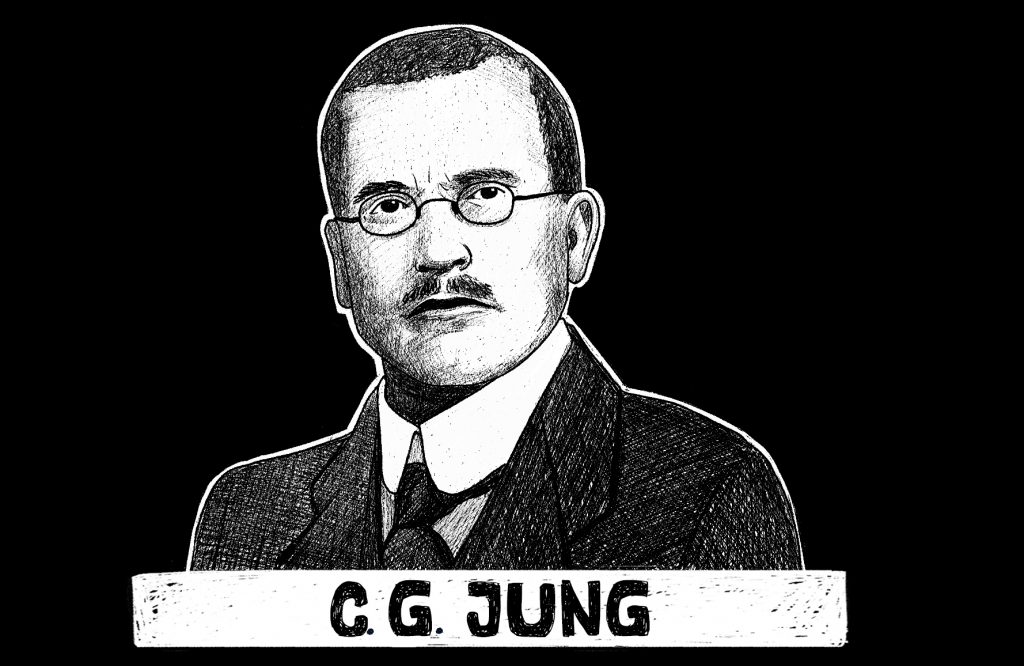
Carl Jung was a Swiss psychologist and psychiatrist. He is the founder of analytical psychology. Jung’s work impacted the fields of psychology, art, literature, philosophy, and religion. He is also well known for developing several psychological concepts such as the collective unconscious, archetypes, the psychological complex, and introversion and extraversion.
Jung was raised in a religious, lower class household. His father, Paul, was a Protestant minister and philologist. Jung considered his father to be a kind and tolerant man. His mother, Emilie, was eccentric and spent most of her time in her bedroom as she had serious mental and emotional issues.
Carl Jung’s Mother
Most of Jung’s early years were spent as an only child. He was a quiet and observant boy who preferred to play alone and carefully watch the adults around him. It did not take long for him to notice that his mother was normal during the daytime, but seemed like a completely different person at night. She later spoke to him about the “spirits” that visited her bedroom after hours.
When Jung was three years old, his mother had to be placed in a psychiatric hospital for several months. This was to become a recurring theme as his mother was frequently in the hospital throughout his childhood. Although Jung loved his mother, her absences and depression ultimately resulted in him not getting as close to her as he could have. Over time, he began to associate his mother, and women in general, with unreliability.
Carl Jung’s Father
Jung was closer to his father than his mother. However, Jung observed his father’s failing belief in religion as he got older. He thought his father’s approach to religion was too academic and that his father lacked real faith in the living god. Although Jung viewed his father as a reliable parent who was there when he needed him, he also saw his father as a powerless person who could not fix the issues in his family.
Like his mother, Jung was interested in the supernatural. Just as she seemed to become a different person at night, he too believed he had two personalities. Person 1 was a typical hard working schoolboy from the 19th century and person 2 was a distinguished older gentleman from the 18th century. As a child, Jung unknowingly performed rituals with religious themes and had visions of ghosts and heaven.
Early Schooling
Jung attended the village school in Klein-Huningen. When he was four years old, his father began to teach him Latin. At age 12, he attended the Humanistisches Gymnasium in Basel. After recognizing his family’s poverty, Jung made the commitment to well in school.
Many of Jung’s family members expected him to become a minister when he finished school. Besides his father, many of Jung’s other male relatives were also members of the clergy. However, Jung started to read philosophy and became very interested in science during his teenage years. He decided to study nature and science after he had a dream about digging up the bones of prehistoric animals.
Many of Jung’s childhood experiences would inspire his future research. His younger sister Johanna would later serve as his secretary.
Jung enrolled at the University of Basel in 1895. He delved into a number of fields such as paleontology, archeology, biology, and religion, before focusing on medicine. In 1896, Jung’s father passed away and left the family almost penniless. However, Jung was able to complete his studies after receiving financial help from relatives.
In 1900, Jung graduated from the University of Basel. He then relocated to Zurich to work under the supervision of Eugen Blueler at the Burghölzli psychiatric hospital. While treating people with mental illness at the hospital, Blueler encouraged Jung to study the patients’ unconscious issues. Jung earned his medical degree from the University of Zurich in 1902.
Jung and the older Freud became good friends and collaborated closely from 1907 to 1912. The pair enjoyed long conversations when they were together and exchanged hundreds of letters about their research. Freud came to view Jung as the heir he needed to continue his work on psychoanalysis. With Freud’s support, Jung became editor of theYearbook for Psychoanalytical and Psychopathological Researchin 1908 and president of the International Psychoanalytical Association in 1910.
Why did Jung and Freud Split?
The friendship between Jung and Freud came to a sudden end in 1912. Jung had always been a free thinker, and while he agreed with some of Freud’s ideas on the unconscious, there were some concepts that he disagreed with. Jung believed Freud put too much emphasis on sexuality as the explanation for mental health issues. In 1912, Jung published a book titledPsychology of the Unconsciousin which he challenged several of Freud’s theories.
Jung was soon closed off from Freud’s inner circle. Both men had volatile tempers and they seemed to make a concerted effort to slight each other. Jung was deeply affected after losing Freud’s friendship. Nevertheless, he resigned from the International Psychoanalytic Society in 1914 and pressed forward with his own ideas on analytical psychology.
Jung traveled the world and learned about new cultures to expand his understanding of the unconscious. He spent time in the United States, Kenya, Uganda, Egypt, and India. Jung accepted a teaching position at the University of Basel in 1943. However, he left the post one year later after he had a heart attack.
Jung believed that thehuman psycheconsists of three separate but interconnected parts - the ego, personal unconscious, and collective unconscious. Theegois the conscious part of the psyche and consists of all the thoughts, feelings and memories of which a person is aware. It is the ego that provides us with a sense of identity and stability.
Thepersonal unconsciousconsists of material which we have forgotten or set aside for the moment (since not everything can be held in consciousness). This material can later be retrieved, such as when we recall an event from our childhood. The personal unconscious also includes thoughts, memories, desires and impulses which have been repressed because they were considered painful or upsetting. Such repressed material is much less accessible to consciousness.
In Jung’s view, the collective unconscious accounts for striking similarities in beliefs, symbols, experiences and behaviors across diverse cultural groups. For example, across all societies, we take on similar roles in the family, experience similar emotions, share similar myths and dreams, and have experiences to which we can all relate (eg., falling in love).
Jungian Archetypes (Jung’s Theory of Personality)
The contents of the collective unconscious are organized into patterns which Jung called archetypes. Archetypes are inherited models or prototypes that are universally understood and that influence how we perceive and respond to the world. Jung likened archetypes to instincts because of their natural ability to produce similar behaviors and thought patterns across different cultures and time periods. Archetypes are never fully consciously known but they emerge as symbols in dreams and in various aspects of culture, such as art, film, mythology and religion.
Jung identified several different archetypes, the principal ones being the persona, the shadow, the anima/animus, and the self.
The persona- This refers to the public face we present to others and includes the social roles we choose to take on or to which we are assigned. The persona is not our true identity but is like a mask we wear in order to comply with the demands of society. It represents a compromise between our true identity and the dictates of society. The development of the persona is essential for adapting to our social environment.
The shadow- The shadow is the flip side of the persona. It consists of those characteristics (including thoughts, feelings, desires and behaviors) that do not fit in with our view of the ideal personality and that run counter to the standards of society. The shadow has often been compared to the devil within us. Despite this negative undertone, Jung believed the shadow archetype is necessary and that it adds greater depth to our personality. He also suggested that the shadow is the source of creativity, spontaneity and vitality.
The anima/animus- Jung was of the view that no one is purely male or female. Instead, he suggested that we all possess characteristics of the opposite sex. He referred to the feminine side of the male psyche as anima, and the masculine side of the female psyche as animus. The anima and animus represent the collective experiences of our female and male ancestors respectively, and help us to relate to people of the opposite gender. Jung believed we should express the characteristics of our anima/animus or risk developing a one-sided personality. At the same time, he warned against embracing the qualities of the opposite sex so much so that one’s inherent masculinity or femininity is lost.
Psychological types
Jung described eight different personality types resulting from various combinations of what he called attitudes and functions. The two basicattitudesare extraversion and introversion.Extraversionis an outward orientation, where the individual directs most of his or her energy toward people and objects in the external world.Introversioninvolves an inward orientation; the individual feels more at ease with his or her own inner world of thoughts and ideas.
Although we all possess elements of both attitudes, individuals may be described as either extraverts or introverts depending on which attitude is more dominant. Extraverts tend to be more open and sociable, whereas introverts are more withdrawn.
As with the two attitudes, we have the capacity to display aspects of all four functions. However, one function tends to be dominant.
The interactions between the two attitudes and four functions yield eight different psychological types. There are strengths and limitations associated with each type and none is considered superior to the others. A brief description of each type is provided in Table 1 below:
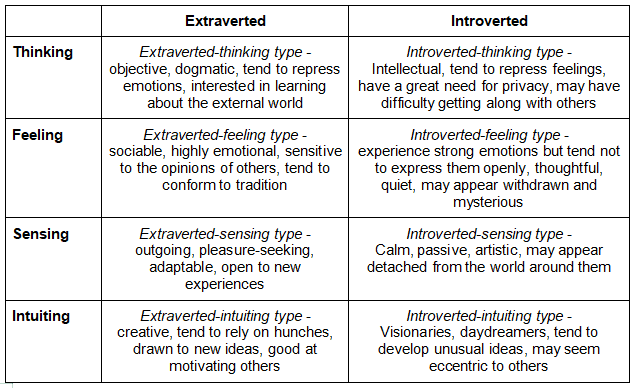
Table 1. Characteristics associated with Jung’s psychological types.
Jung’s classification of psychological types is arguably his most important and lasting contribution to the field of psychology. The concepts of introversion and extraversion are still in common usage today and are included in most modern models of personality.
Jung’s theory has also greatly influenced personality assessment with the two dimensions of extraversion and introversion featuring prominently on many tests of personality. His work led to the development of the Myers-Briggs Type Indicator (MBTI), one of the most popular personality assessment tools for non-clinical populations.
Jung’s analytical psychology has also been applied to learning theory, influencing ideas regarding learning styles. The four functions and attitudes in Jung’s typology are thought to provide an indication of an individual’s learning preferences. For example, sensors are thought to prefer hands-on methods of instructions with an emphasis on details. Intuitors, on the other hand, favor theories and abstract thinking, and are more likely to focus on the bigger picture than on smaller details.
Though not very popular today, some therapists still practice a form of psychotherapy based on analytical theory. Jungian therapy has been used to treat conditions such as depression, anxiety, grief and trauma. Techniques include dream interpretation, assessment of personality type, and catharsis.
Criticisms of Jung’s Theory
Another common criticism leveled against Jung’s theory is that it is unscientific. Jung’s failure to adequately explain many of his concepts means that they are difficult to study empirically. As a result, it is impossible to either validate or disprove many aspects of his theory, including his concept of archetypes.
Jung’s interest in, and emphasis on, occultism, mysticism, mythology, and religion provided further reason for critics to label his work as unscientific. Many of his conclusions regarding archetypes and the collective unconscious were actually based on myths, dreams, art, and the occult, none of which qualify as scientific proof. Given these and other criticisms, several scholars have concluded that Jung’s work is best described as philosophical and mystical rather than scientific.
Jung was a prolific writer who wrote a number of papers and books. Most of his work was published after his death and some is still being published today. A few of his most well-known books are listed below:
He received honorary doctoral degrees from a number of respected universities, including:
Personal Life
Carl Jung married Emma Rauschenback in 1903. Emma was the daughter of Johannes Rauschenbach-Schenck—the owner of the International Watch Company. As shareholders in the company, the couple had access to all the money they would ever need. Carl and Emma had five children together.
Despite Jung’s repeated infidelities, Emma devoted herself to her husband. She showed interest in his work and even served as his assistant when he worked at the Burghölzli psychiatric hospital. They stayed together until Emma passed away in 1955.
Carl Jung died at home in Zurich on June 6, 1961.
There is still plenty of discussion on Jung today: in universities, in psychology labs, and online! Check out theJung subredditfor current thoughts on the Swiss psychologist.
American Psychological Association. (2002). Eminent psychologists of the 20th century.Monitor on Psychology,33(7) 29. Retrieved from https://www.apa.org/monitor/julaug02/eminent
Biography. (2019, June 21).Carl Jung biography.Retrieved from https://www.biography.com/scholar/carl-jung
Ellis, A., Abrams, M., & Abrams, L. D. (2009).Personality theories: Critical perspectives.Thousand Oaks, CA: SAGE.
Encyclopedia.com. (2020). Jung, Carl Gustav (1875-1961). InEncyclopedia.com.Retrieved from https://www.encyclopedia.com/humanities/encyclopedias-almanacs-transcripts-and-maps/jung-carl-gustav-1875-1961
Encyclopedia Britannica. (n.d.). Carl Jung. InEncyclopedia Britannica. Retrieved from https://www.britannica.com/biography/Carl-Jung
Engler, B. (2009).Personality theories(8th ed.). New York: Houghton Mifflin Harcourt Publishing Company.
Maraldi, E. D. O. & Fernandes, M. D. F. (2018).Carl Jung (Biography). Retrieved from https://www.researchgate.net/publication/330026069_Carl_Jung_Biography
Schultz, D. P., & Schultz, S. E. (2013).Theories of personality(10th ed.). Belmont, CA: Wadsworth.
Sharp, A. (2012) Jungian learning styles. In N. M. Seel (Ed.),Encyclopedia of the Sciences of Learning(pp.1672-1675). New York: Springer.
Thomas, J. (2020).Jungian psychology in theory and practice. Retrieved from https://www.betterhelp.com/advice/psychologists/jungian-psychology-in-theory-and-practice/
Related posts:Unconscious Mind (Definition + Purpose)40+ Famous Psychologists (Images + Biographies)Sigmund Freud (Psychologist Biography)Psychoanalytic Theory of PersonalityThe Psychodynamic Approach
Related posts:
Reference this article:Practical Psychology. (2020, March).Carl Jung Biography.Retrieved from https://practicalpie.com/carl-jung/.Practical Psychology. (2020, March). Carl Jung Biography. Retrieved from https://practicalpie.com/carl-jung/.Copy
Reference this article:
Practical Psychology. (2020, March).Carl Jung Biography.Retrieved from https://practicalpie.com/carl-jung/.Practical Psychology. (2020, March). Carl Jung Biography. Retrieved from https://practicalpie.com/carl-jung/.Copy
Copy
