As you continue reading, you’ll learn about the details, the history, and the widespread influence of Weber’s Bureaucratic Theory.
The Historical Context of Weber’s Bureaucratic TheorySix Major Principles of BureaucracyBenefits and Limitations of BureaucracyCharacteristics of an Ideal BureaucracyExamples of Bureaucratic OrganizationsComparison with Other Organizational TheoriesBureaucracy, Capitalism, and Political Ideologies: A Comparative OverviewThe Evolution of Bureaucratic Theory Over TimeModern Relevance of Weber’s IdeasConclusion
The Historical Context of Weber’s Bureaucratic Theory
Six Major Principles of Bureaucracy
Benefits and Limitations of Bureaucracy
Characteristics of an Ideal Bureaucracy
Examples of Bureaucratic Organizations
Comparison with Other Organizational Theories
Bureaucracy, Capitalism, and Political Ideologies: A Comparative Overview
The Evolution of Bureaucratic Theory Over Time
Modern Relevance of Weber’s Ideas
Conclusion
 pyramid and ladder

It’s often said that to understand something truly, you need to know where it came from. So, let’s move back to the late 19th and early 20th centuries.
Imagine cities growing at a crazy-fast pace and factories buzzing with activity. All these institutions needed a way to manage their size and complexity.
Enter Max Weber, a keen observer of his times. Born 1864 in Erfurt, Germany, Weber grew up witnessing the transformative changes sweeping through Europe.
The world around him was evolving, and traditional managing methods were proving ineffective. There was a need for a more systematic approach.
Weber’sBureaucratic Management Theorywas his response to this challenge. The term “bureaucracy” might conjure up images of red tape and slow-moving government agencies, but Weber saw it differently.
According to Max, bureaucracy was the most powerful tool fororganizing large-scale operations. Instead of seeing it as a problem, he identified it as a structure that could bring order to chaos.
According to Weber, one of the first things needed was a division of labor based on practical and technical qualifications. An organization must have a hierarchy of authority to maintain control of informal groups.
To frame it another way, imagine you’ve been given thousands of puzzle pieces, and you’re expected to assemble them quickly. Without a clear picture or guide, the task seems daunting.
Weber’s theory tried to provide a clear picture, offering a structure and a method to make sense of all these pieces. Now there are evencareers in industrial organization!
Here are the basic principles Weber outlined in his ‘manual.’ Remember that the entire organizational structure is rules-based, which are the basics that governments or business organizations must follow.
- Hierarchical Structure:Imagine a pyramid. At the top, there’s the boss or the leader of a bureaucratic organization, and as you move downwards, there are various levels with different roles and responsibilities.
In bureaucracy, this well-defined hierarchy ensures that everyone knows their place and there’s a clear chain of command.
- Division of Labor:Consider when you and your friends tackled a big project together. Each of you took on a specific task matching your skills, right?
In the same way, bureaucratic organizations divide tasks among their members based on expertise. This makes sure things are done efficiently. People with technical skills will be in a different department than someone with human resource management skills.
Formal Selection:Ever been to a job interview? That’s a formal selection process in action. Positions in bureaucratic organizations are filled based on technical qualifications and performance. They shouldn’t be based on favoritism or personal relationships. These formal rules and regulations guide both selection and promotion.
Rule-based Conduct:Established rules and procedures guide actions in bureaucratic systems, ensuring consistency and fairness.
Impersonal Relationships:Personal feelings or relationships shouldn’t interfere with work. Decisions are based on facts and rules, not emotions or personal biases.
Career Orientation:People are encouraged to grow, get promoted, and achieve higher ranks based on merit.
Weber believed these principles could provide a solid foundation for any large organization. But he was also aware that nothing was perfect. This model has both shining advantages and glaring limitations, which you’ll soon discover.
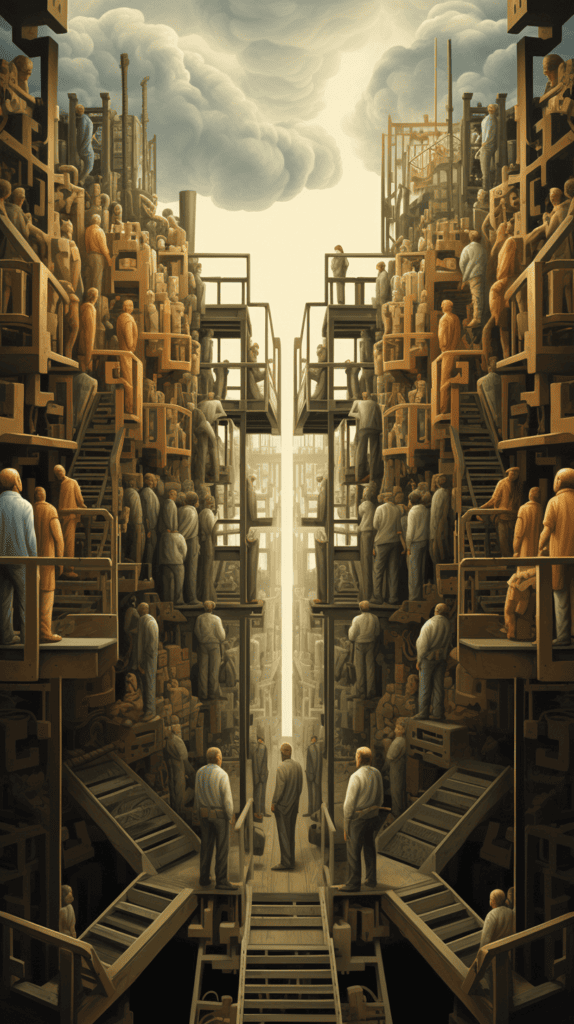
Every coin has two sides; the same goes for Weber’s Bureaucratic Theory. On one hand, this organizational structure has been applauded for bringing order and efficiency to large institutions.
Conversely, it has faced criticism for being rigid and sometimes dehumanizing. Let’s weigh the pros and cons.
Benefits of Bureaucracy
Efficiency.Think about a conveyor belt in a factory, systematically moving items from one point to another. With their clearly defined roles and procedures, bureaucracies ensure tasks are completed quickly.
Clarity.Ever felt relief when someone gives you clear instructions for a task? The clear hierarchy and rules ensure everyone knows their job and responsibilities in bureaucracies.
Predictability.Everyone, from employees to clients, knows what to expect because of the consistency in operations.
Stability.Bureaucracies offer stability because of their established structures and rules.
Limitations of Bureaucracy
Rigidity.Bureaucracies can sometimes be slow to adapt to changes because of their fixed rules and procedures.
Red Tape.The maze of procedures and paperwork in bureaucracies can sometimes hinder swift decision-making.
Dehumanization.Ever felt like just a number in a system? Bureaucracies, emphasizing impersonal relationships, can sometimes make individuals feel undervalued.
Resistance to Innovation.Bureaucracies can sometimes resist new ideas because of their commitment to established procedures.
Bureaucratic Inertia.Bureaucracies can become so self-serving that they resist changes, even if they’re for the better.
In life and organizational structures, there’s no one-size-fits-all. Bureaucracy, with its many advantages, has its fair share of challenges.
It’s essential to understand both to make informed decisions and to recognize where improvements or changes might be needed.

For a bureaucracy to work efficiently, it needs to have some rules based on certain characteristics. These are like the precise measurements and steps in a recipe.
Clearly Defined Roles.In an ideal bureaucracy, everyone knows exactly what they’re responsible for. This takes advantage of human capital, ensuring everyone has their proper place based on their abilities, skills, and experience. This also ensures central planning.
Documentation.Keep records for everything. Whenever you need to verify something, there’s always a paper trail or, in modern times, a digital record.
Consistent and Unbiased Rules.Just as traffic laws apply to everyone on the road, rules are the same for everyone in a bureaucracy and are applied consistently, without bias.
Predictability.Imagine going to your favorite restaurant and ordering your go-to dish. You expect it to taste the same every time, right? Similarly, in a bureaucracy, actions, and decisions are predictable because they follow rules and procedures.
Expertise.Just as a surgeon specializes in surgery and a chef excels in cooking, members of a bureaucratic system are trained and skilled in their specific roles. It’s all about putting the right person in the right job.
Continuity.Institutions built on bureaucratic principles are designed to outlive any one person. In other words, they want to last as long as possible.
Sometimes, the best way to understand a concept is to see it in action. Bureaucracy isn’t just a theory on paper; it’s been implemented in various forms across the globe.
Let’s explore some real-world examples of bureaucracies.
Government Agencies.When you think of bureaucracy, this is probably the first thing that comes to mind. Governments worldwide use this structure to manage tasks, from issuing licenses to maintaining public order.
Corporations.Large companies often use bureaucratic structures. Think of Apple, Toyota, or HSBC. They have departments dedicated to specific tasks, strict hierarchies, and many rules and regulations that guide every process. All this ensures they operate seamlessly across different continents.
Educational Institutions.Universities likeHarvard,Oxford, and theUniversity of Tokyomanage thousands of students, faculty, and research projects. To do this efficiently, they use a bureaucratic structure with deans, departments, and committees, each with its set role.
Hospitals.Institutions like theMayo ClinicorJohns Hopkins Hospitaldeal with life and death daily. For them, clear hierarchies, specialized departments, and rules aren’t just about efficiency; they’re about ensuring patient safety and care.
International Organizations.TheUnited Nations,World Health Organization, andInternational Monetary Fundtackle global challenges. Given their vast scope and the many countries involved, a bureaucratic structure helps them function effectively.
The world of organizational theories is vast and varied. There’s more than one way to organize and manage large groups of people.
While bureaucracy stands out as one of the most well-known, other theories have unique merits and challenges. Let’s look at a few.
Taylor believed in optimizing every job for the most productivity. Unlike bureaucracy, which emphasizes structure, scientific management focuses on the tasks themselves.
It’s a stark contrast to bureaucracy’s impersonal approach. It argues that happier employees are more productive.
3.Systems Theory.Systems theory views organizations as complex systems with interrelated parts. Instead of focusing on hierarchy or tasks, it emphasizes the relationships and interactions within the organization.
4.Contingency Theory:This theory is about adaptability. It suggests that there’s no one-size-fits-all approach.
Instead, business organizations should adapt their structures based on their environment and challenges. This makes it more fluid than the rigid structure of bureaucracy.
In the tapestry of societal organization, numerous models and ideologies weave together, creating the fabric of our communal lives. Bureaucracy, an organizational model, often intertwines itself with economic systems and political ideologies. Capitalism, as a predominant economic philosophy, has its distinct attributes. Likewise, political ideologies, such as socialism and democracy, offer different visions for governance. As we delve into the core tenets of these systems, we’ll explore their characteristics, differences, and the intricate dance of their coexistence in modern society.
Bureaucracy
Capitalism
Other Political Ideologies
For the sake of this comparison, I’ll briefly describe socialism and democracy, two common political ideologies:
Comparing the Three:
While bureaucracy, capitalism, and political ideologies like socialism and democracy intersect in various ways, they have distinct characteristics and objectives.

Much like fashion trends or technology, theories evolve. They adapt, merge, get critiqued, and sometimes even undergo significant shifts.
Weber’s Bureaucratic Theory, though groundbreaking in its time, hasn’t been immune to this evolution. Here are some of the changes that happened.
Post-Weberian Shifts
After Weber, scholars began to notice the limitations of strict bureaucratic structures, especially in the face of rapid technological and societal changes. They advocated for more flexible, adaptive systems like:
Neo-Weberianism
Neo-Weberianism tried to merge the efficiency and structure of classic bureaucracy with a greater focus on the needs and satisfaction of both employees and the public.
Influence of Technology
The digital age, with its computers, internet, and AI, has dramatically changed how organizations function.
Technology has challenged bureaucratic structures, prompting adaptations to accommodate rapid information flow and decentralized decision-making.
Globalization’s Role
In today’s interconnected world, organizations aren’t confined to national boundaries. Modern bureaucracies have had to merge practices and norms from diverse cultures, leading to more inclusive and adaptive structures.
Max Weber might have penned his Bureaucratic Theory over a century ago, but its ripples are still felt today. Here are a few ways it impacts us still.
Digital Bureaucracy.In today’s digital age, bureaucracy has taken on a new form. Governments and corporations are adopting e-governance and digital management systems, combining Weber’s structural principles with modern technology.
Corporate Management.Major corporations, like Amazon and Microsoft, still use a form of bureaucracy, albeit modernized. It’s about balancing structure for efficiency and flexibility for innovation.
Public Administration.Modern governments use these bureaucratic management principles to serve their citizens. It ensures service consistency and fairness, much like a reliable postal service delivering timely letters. There are several administrative processes to go through for any centralized decision-making.
Non-Governmental Organizations (NGOs).Groups like Doctors Without Borders or Save the Children operate globally. Bureaucratic structures help them coordinate efforts, manage resources, and drive missions.
Academic Studies:Weber’s theory isn’t just practiced; it’s studied. Universities worldwide include it in their curriculum, ensuring new generations understand its significance.
As we draw this exploration close, it’s evident that Max Weber’s Bureaucratic Theory isn’t just a relic of the past. It’s a living, breathing framework that continues influencing how we organize, work, and think.
While the world has transformed dramatically since Weber’s time, this core need for structure remains. Think about it: even in our personal lives, we create routines, lists, and schedules to manage our time and tasks.
Bureaucracy has its advantages, like ensuring consistency and fairness. But it also has challenges, like making people feel like numbers.
The theories and ideas we explore aren’t just academic—they shape our world, influence decisions, and impact our daily lives.
Related posts:The Psychology of Long Distance RelationshipsOperant Conditioning (Examples + Research)Nuclear Family (Definition + History)Beck’s Depression Inventory (BDI Test)Social Institutions (Definition + 7 Examples)
Related posts:
Reference this article:Practical Psychology. (2023, October).Bureaucratic Theory of Max Weber (Explanation + Examples).Retrieved from https://practicalpie.com/bureaucratic-theory-of-max-weber/.Practical Psychology. (2023, October). Bureaucratic Theory of Max Weber (Explanation + Examples). Retrieved from https://practicalpie.com/bureaucratic-theory-of-max-weber/.Copy
Reference this article:
Practical Psychology. (2023, October).Bureaucratic Theory of Max Weber (Explanation + Examples).Retrieved from https://practicalpie.com/bureaucratic-theory-of-max-weber/.Practical Psychology. (2023, October). Bureaucratic Theory of Max Weber (Explanation + Examples). Retrieved from https://practicalpie.com/bureaucratic-theory-of-max-weber/.Copy
Copy
