How drunk will you get after three mimosas at brunch?
Enter your weight, gender, and click on each the alcohol you’ve consumed to calculate your blood alcohol level.
[bac-calculator]
If you’re over 21, you might be able to answer that question with experience. A few mimosas may be a pleasant hair of the dog. Or it could be enough to keep you on the couch for the rest of the day.
Can you drive after three mimosas at breakfast?
That’s not an answer you should take a chance on. But, in the eyes of the law, the answer isn’t exactly clear. How strong were the mimosas? How big was each glass? When did you start drinking them, and how long has it been since you stopped?
In DUI cases, law enforcement officers will rely on the measurement of a driver’s blood alcohol content, or BAC. If you are pulled over and suspected of drunk driving, you will likely have to take a chemical test that reveals your BAC. That small number, usually never higher than .2, may determine the course of your future.
This article is all about BAC. I’m going to tell you how to figure out your BAC and what happens if you are pulled over and suspected of drunk driving. States handle these procedures differently, so it’s best to do a little research on your own to protect yourself in case you are pulled over.
BAC ChartWhat Is Blood Alcohol Level?What Influences Blood Alcohol Level?How Long Does It Take For Alcohol To Leave Your System?Laws on Blood Alcohol Level and DrivingCan Blood Alcohol Tests and Breathalyzers Be Wrong?How long can you detect alcohol in your system?What happens at each Blood Alcohol Concentration level?How long does it take to get alcohol out of your system?Your Rights When Pulled OverStay Safe and Understand Your BAC
BAC Chart
What Is Blood Alcohol Level?
What Influences Blood Alcohol Level?
How Long Does It Take For Alcohol To Leave Your System?
Laws on Blood Alcohol Level and Driving
Can Blood Alcohol Tests and Breathalyzers Be Wrong?
How long can you detect alcohol in your system?
What happens at each Blood Alcohol Concentration level?
How long does it take to get alcohol out of your system?
Your Rights When Pulled Over
Stay Safe and Understand Your BAC
 blood alcohol content table
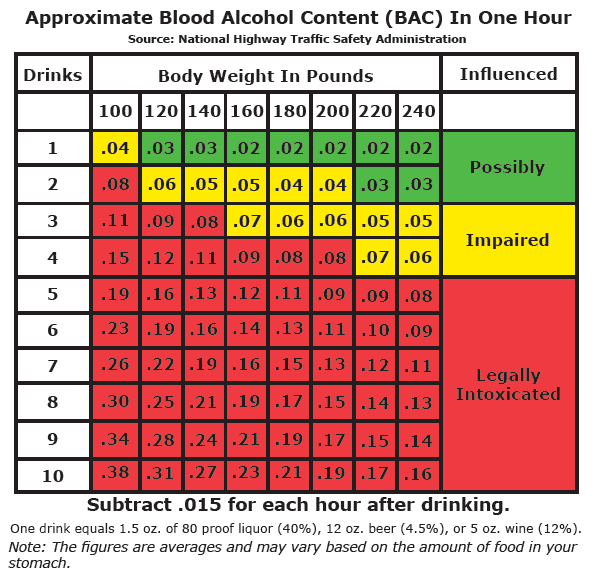
Your BAC is the measurement of how much alcohol has made it to the bloodstream. If your blood contains 1000 parts blood and one part alcohol, your BAC is .10. It’s likely that you’ll blackout from drinking at .20. If your BAC reaches .25, you will get alcohol poisoning.
In order to understand BAC, it’s important to know how alcohol travels through the body. When you take a swig of booze, it travels down to the stomach. About 20% of alcohol is absorbed here. Most of it goes to the small intestine. The alcohol in the small intestine then makes contact with blood vessels and moves through the bloodstream.
On most nights out, you shouldn’t be reaching .20. But it’s often hard to tell whether you’re at .07 or .08, the legal limit for driving while intoxicated. So let’s talk about the factors that may put you over that line (and behind bars.)
The amount of alcohol you drink will obviously influence BAC. But there are other factors that influence how much alcohol is in your blood:
If you’ve had experience drinking, you probably know all of this already. You might see friends with different body types who are able to drink more or less than you. If you start drinking in the morning without any breakfast, you might feel it “hit” harder than if you’ve had a full meal and then start drinking.
Not all of these factors can be quantified, so know that online BAC calculators are not guaranteed to provide an accurate answer. This is why so many BAC test apps areremoved from app stores!
You might also know that it takes the liver one hour to process a standard drink. If you drink a beer and wait an hour, you should be good to go. But you can’t just take four shots, wait four hours, and expect to be a-okay.
If you take on more alcohol than your liver can handle, that’s when your BAC really starts to rise. Alcohol will remain in the tissues and bloodstream until the liver can break it down. This means that it could take much longer than four hours to sober you up.
A Note About An Empty Stomach and BAC
It’s also important to note that the food in your stomach previous to drinking influences BAC. Eating a bunch of junk food after some shots isn’t going to magically make you sober and ready to drive. The only thing that will decrease your BAC is time. The body needs to process the alcohol in your blood in order to decrease BAC. It can only process a drink an hour, but it usually needs more time.
Blood alcohol level is usually brought up in stories about DUI, DWI, or OUI. That’s right. Not all states have a charge called “DUI.” Each state handles how DUIs are charged, the penalties for this crime, and even what the crime is called. In Texas, there is no such thing as a DUI charge. They do, however, have a “Driving While Intoxicated” charge, abbreviated to DWI. This charge covers other controlled substances that might be in your system while you’re behind the wheel.
There is one thing that all states have in common: the per-se BAC limit across the country is .08. If someone has a blood alcohol level of .08 or higher, they are considered legally drunk and will likely be charged for driving while under the influence of drugs or alcohol.
In Arkansas, a first-time DWI conviction results in the following penalties:
California’s penalties are a little bit different:
An IID is a device that requires you to take a blood alcohol level test before turning on your car. This ensures that you are not drinking and driving after you are out of jail. California is currently testing out a pilot program that puts more IIDs in offenders’ cars. If you are in Arkansas, you may qualify to get an IID installed in your car. With an IID, your driving will still be restricted to places like school, work, or a treatment facility.
IIDs are generally expensive, costing hundreds of dollars to install and keep in your car. Many states will suspend an offender’s license until they can get the IID installed.
Other BAC Measurements
All of these penalties are just for a first-time conviction without any injuries or aggravating factor. “Aggravating factors” are factors that make a crime more serious. For example, if you were driving drunk with children in the car, you may face extra charges or penalties. If your BAC was exceptionally high, you may also face additional penalties.
States have different laws for what “counts” as an aggravating factor and what BAC qualifies for enhanced penalties. In Georgia, a BAC of .15 will come with extra penalties. In Idaho, this number is increased to .20. In Hawaii, there is no BAC level for enhanced penalties.
States also have different “zero-tolerance” BAC laws for underage drivers. Federal law prohibits the purchase of any alcoholic beverage until you’re 21. While states uphold this law on purchasing, rules for consumption may vary. In Texas, a minor can drink only if they are in the presence of their parent or legal guardian. (And this doesn’t mean a friend over the age of 21.)
But what happens if that Texan gets behind the wheel? They might get charged with DWI. If a minor’s BAC is above .00 while they are driving, they are breaking the law. Even if they had a glass of wine with a parent at dinner and “feel fine.”
A handful of states have a zero-tolerance BAC level of .02. California’s zero-tolerance BAC level is .01. Check your state laws to understand the rules of driving while intoxicated, and the penalties you could face if convicted.
Not all drunk drivers are caught, causing many of the accidents that happen throughout the country. But there is another side to this coin. Not all people pulled over for drunk driving, or arrested for drunk driving, are actually breaking the law.
There are other factors that could influence the BAC that shows up in a Breathalyzer or chemical test:
How rare is it that you’ll get a false reading on a Breathalyzer? Not as rare as you might think. In 2019, Massachusetts and New Jersey threw out over30,000Breathalyzer results. That’s not common for other types of forensic evidence. It’s one of the largest exclusions of forensic evidence in American history.
These tests can present a number that is over 40% higher than your actual results. (They can also show results that are significantly lower than your actual BAC, but don’t rely on that chance.)
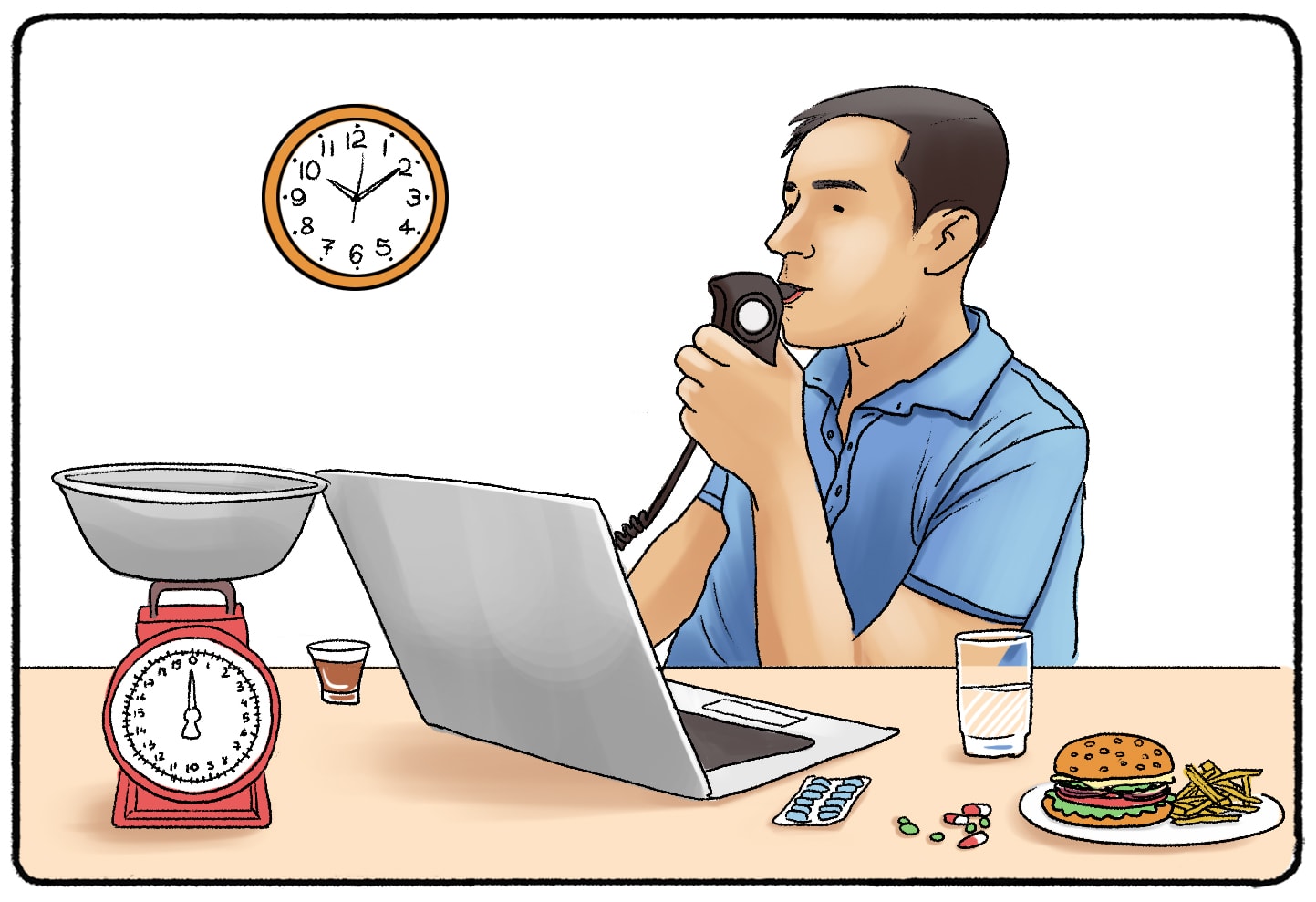
The best thing that you can do to prevent an arrest based on false results is to educate yourself on your rights and don’t drink and drive. You can’t be arrested for taking an Uber while intoxicated.
What you use to measure the alcohol level in your body makes a difference here. In most cases, alcohol can be detected for up to 24 hours after you started drinking.Here is a more detailed answer to the amount of time it takes for alcohol to leave your body:
Everyone is different and will experience the effects of alcohol differently, but we’ve put together this general guide to what you might expect at each BAC level:
Once you hit 0.40%, you’re in real trouble. You could fall into a coma and there is now a serious risk of death because you could stop breathing (respiratory failure).
The short answer is: it depends.
I know! Not helpful, right? There’s a reason for the fluffy answer though. Turns out that there’s a bunch of factors that determine how long alcohol takes to get out of your system, which include:
How you metabolize alcohol
Alcohol metabolism
If we just ignore all these extra factors and just focus on the science stuff, we know that for the average person, the body metabolizes alcohol at a rate of 20mg/dL per hour. It’s important to make the point that this isn’t related to your blood alcohol concentration (BAC) level. While it takes pretty much everyone the same amount of time to process alcohol through their system, people can have completely different BAC levels!
What about the different type of alcohol?
These are just general estimates, as another factor that play a part is the amount or proof of alcohol in each drink:
It goes without saying that the more drinks you have, the longer it will take for your body to process and eliminate the alcohol from your system (and the more side effects you’ll experience).
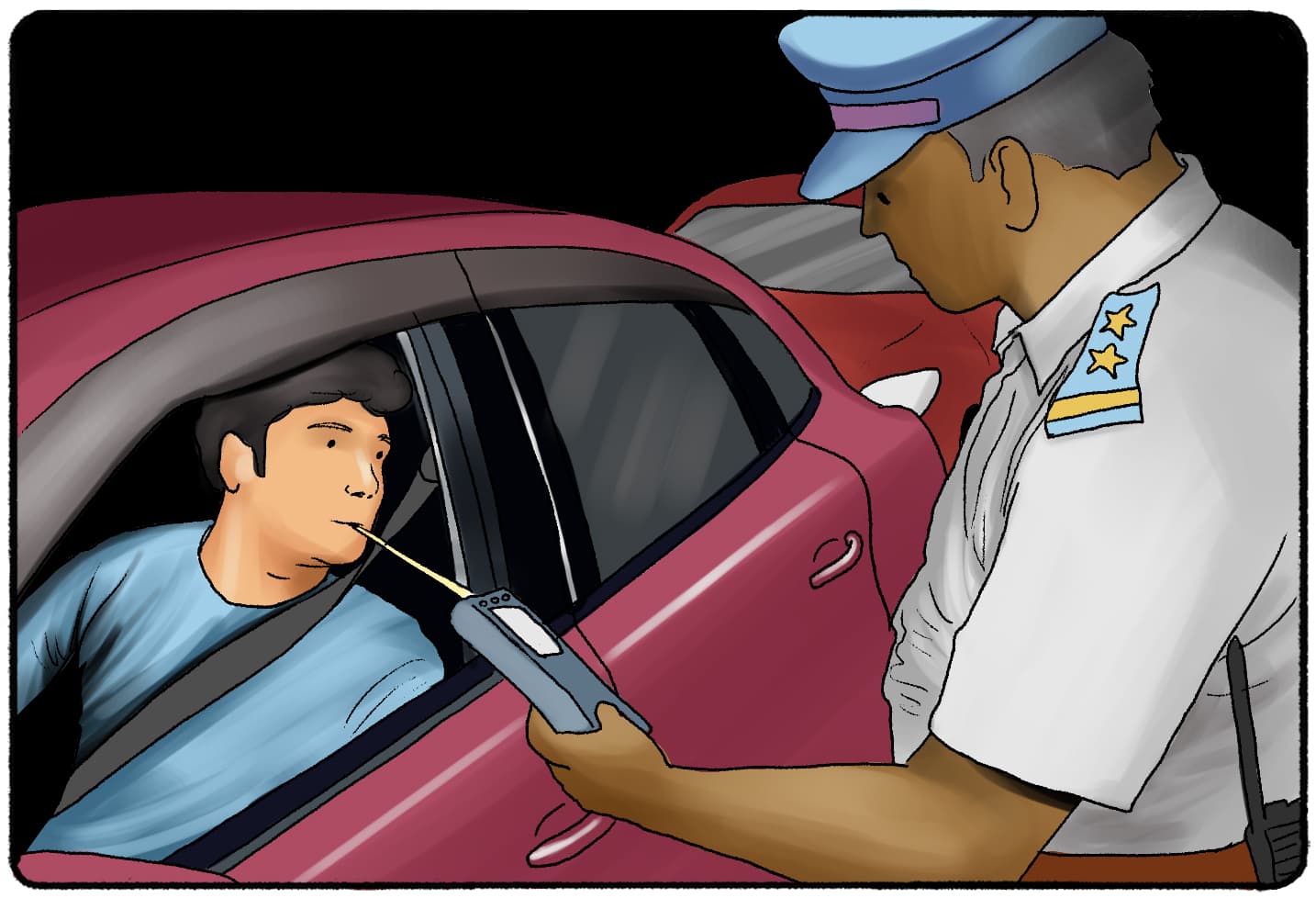
Implied Consent and Refusing a Chemical Test
Wrong…maybe.
Each state handles this process differently. If you have a driver’s license in a state with implied consent, you can’t just say no to a chemical test if you’ve been suspected for drunk driving. Well, you can, but you will have to face some penalties. In Massachusetts, for example, refusing a chemical test may result in losing your license for six months. Prosecutors will not be able to use your refusal as “evidence” that you drove while intoxicated. Other types of evidence, including witness testimony, may convict you.
In most of these cases, a police officer will need a reason to pull you over. Maybe you were swerving. Or speeding. Maybe you didn’t have your headlights on, and when rolling down your window, the officer saw an empty beer can. Whatever the reason is, it will have to raise suspicion that you were driving under the influence. Officers may be instructed to conduct field sobriety tests (walking in a straight line, etc.) before a chemical test can be administered.
Check with state laws to see whether you can refuse a chemical test without penalty, and the requirements for pulling you over in the first place.
DUI Checkpoints
It’s also useful to look at whether your state allows DUI checkpoints. These checkpoints are areas on the side of the road where every car gets stopped and every driver must take a Breathalyzer to keep driving. If this sounds absurd, your state may not have them.
There are ten states that claim that DUI checkpoints are unconstitutional:
Every other state adheres to federal law, which says that this type of stop is permissible. Again, it’s possible to refuse a chemical test at these checkpoints, but you might face penalties. Refusing a chemical test at an unlawful checkpoint may result in your case getting thrown out. To keep yourself safe, assume that all DUI checkpoints are lawful and follow the officer’s orders at the checkpoint. You can always fight a checkpoint or your test results in court.
To keep yourself safe, you should also assume that if you plan on drinking, you should plan on calling a rideshare or having a designated driver. But I know that this doesn’t always work out the way we planned. So keep this BAC calculator handy if you’re in a pinch.
Related posts:What Can Cross the Blood Brain Barrier?What is Wet Brain?53+ Deviance Examples in Sociology (Definition + Theories)200+ Truth Or Drink Questions (Deep, Dirty, and Hilarious!)209+ Personal Values A-Z (Definition + Examples)
Related posts:
Reference this article:Practical Psychology. (2020, April).Blood Alcohol Level (Free BAC Calculator).Retrieved from https://practicalpie.com/blood-alcohol-level-calculator/.Practical Psychology. (2020, April). Blood Alcohol Level (Free BAC Calculator). Retrieved from https://practicalpie.com/blood-alcohol-level-calculator/.Copy
Reference this article:
Practical Psychology. (2020, April).Blood Alcohol Level (Free BAC Calculator).Retrieved from https://practicalpie.com/blood-alcohol-level-calculator/.Practical Psychology. (2020, April). Blood Alcohol Level (Free BAC Calculator). Retrieved from https://practicalpie.com/blood-alcohol-level-calculator/.Copy
Copy
