Looking to take the free Big 5 Personality test online? Here’s one that will take less than 10 minutes and requires no email!
0%complete
I am the life of the party.DisagreeSlightly DisagreeNeutralSlightly AgreeAgree
I am the life of the party.
DisagreeSlightly DisagreeNeutralSlightly AgreeAgree
Disagree
Slightly Disagree
Neutral
Slightly Agree
Agree
I feel little concern for others.DisagreeSlightly DisagreeNeutralSlightly AgreeAgree
I feel little concern for others.
I am always prepared.DisagreeSlightly DisagreeNeutralSlightly AgreeAgree
I am always prepared.
I get stressed out easily.DisagreeSlightly DisagreeNeutralSlightly AgreeAgree
I get stressed out easily.
I have a rich vocabulary.DisagreeSlightly DisagreeNeutralSlightly AgreeAgree
I have a rich vocabulary.
I don’t talk a lot.DisagreeSlightly DisagreeNeutralSlightly AgreeAgree
I don’t talk a lot.
I am interested in people.DisagreeSlightly DisagreeNeutralSlightly AgreeAgree
I am interested in people.
I leave my belongings around.DisagreeSlightly DisagreeNeutralSlightly AgreeAgree
I leave my belongings around.
I am relaxed most of the time.DisagreeSlightly DisagreeNeutralSlightly AgreeAgree
I am relaxed most of the time.
I have difficulty understanding abstract ideas.DisagreeSlightly DisagreeNeutralSlightly AgreeAgree
I have difficulty understanding abstract ideas.
I feel comfortable around people.DisagreeSlightly DisagreeNeutralSlightly AgreeAgree
I feel comfortable around people.
I insult people.DisagreeSlightly DisagreeNeutralSlightly AgreeAgree
I insult people.
I pay attention to details.DisagreeSlightly DisagreeNeutralSlightly AgreeAgree
I pay attention to details.
I worry about things.DisagreeSlightly DisagreeNeutralSlightly AgreeAgree
I worry about things.
I have a vivid imagination.DisagreeSlightly DisagreeNeutralSlightly AgreeAgree
I have a vivid imagination.
I keep in the background.DisagreeSlightly DisagreeNeutralSlightly AgreeAgree
I keep in the background.
I sympathize with others' feelings.DisagreeSlightly DisagreeNeutralSlightly AgreeAgree
I sympathize with others' feelings.
I make a mess of things.DisagreeSlightly DisagreeNeutralSlightly AgreeAgree
I make a mess of things.
I seldom feel blue.DisagreeSlightly DisagreeNeutralSlightly AgreeAgree
I seldom feel blue.
I am not interested in abstract ideas.DisagreeSlightly DisagreeNeutralSlightly AgreeAgree
I am not interested in abstract ideas.
I start conversations.DisagreeSlightly DisagreeNeutralSlightly AgreeAgree
I start conversations.
I am not interested in other people’s problems.DisagreeSlightly DisagreeNeutralSlightly AgreeAgree
I am not interested in other people’s problems.
I get chores done right away.DisagreeSlightly DisagreeNeutralSlightly AgreeAgree
I get chores done right away.
I am easily disturbed.DisagreeSlightly DisagreeNeutralSlightly AgreeAgree
I am easily disturbed.
I have excellent ideas.DisagreeSlightly DisagreeNeutralSlightly AgreeAgree
I have excellent ideas.
I have little to say.DisagreeSlightly DisagreeNeutralSlightly AgreeAgree
I have little to say.
I have a soft heart.DisagreeSlightly DisagreeNeutralSlightly AgreeAgree
I have a soft heart.
I often forget to put things back in their proper place.DisagreeSlightly DisagreeNeutralSlightly AgreeAgree
I often forget to put things back in their proper place.
I get upset easily.DisagreeSlightly DisagreeNeutralSlightly AgreeAgree
I get upset easily.
I do not have a good imagination.DisagreeSlightly DisagreeNeutralSlightly AgreeAgree
I do not have a good imagination.
I talk to a lot of different people at parties.DisagreeSlightly DisagreeNeutralSlightly AgreeAgree
I talk to a lot of different people at parties.
I am not really interested in others.DisagreeSlightly DisagreeNeutralSlightly AgreeAgree
I am not really interested in others.
I like order.DisagreeSlightly DisagreeNeutralSlightly AgreeAgree
I like order.
I change my mood a lot.DisagreeSlightly DisagreeNeutralSlightly AgreeAgree
I change my mood a lot.
I am quick to understand things.DisagreeSlightly DisagreeNeutralSlightly AgreeAgree
I am quick to understand things.
I don’t like to draw attention to myself.DisagreeSlightly DisagreeNeutralSlightly AgreeAgree
I don’t like to draw attention to myself.
I take time out for others.DisagreeSlightly DisagreeNeutralSlightly AgreeAgree
I take time out for others.
I shirk my duties.DisagreeSlightly DisagreeNeutralSlightly AgreeAgree
I shirk my duties.
I have frequent mood swings.DisagreeSlightly DisagreeNeutralSlightly AgreeAgree
I have frequent mood swings.
I use difficult words.DisagreeSlightly DisagreeNeutralSlightly AgreeAgree
I use difficult words.
I don’t mind being the center of attention.DisagreeSlightly DisagreeNeutralSlightly AgreeAgree
I don’t mind being the center of attention.
I feel others' emotions.DisagreeSlightly DisagreeNeutralSlightly AgreeAgree
I feel others' emotions.
I follow a schedule.DisagreeSlightly DisagreeNeutralSlightly AgreeAgree
I follow a schedule.
I get irritated easily.DisagreeSlightly DisagreeNeutralSlightly AgreeAgree
I get irritated easily.
I spend time reflecting on things.DisagreeSlightly DisagreeNeutralSlightly AgreeAgree
I spend time reflecting on things.
I am quiet around strangers.DisagreeSlightly DisagreeNeutralSlightly AgreeAgree
I am quiet around strangers.
I make people feel at ease.DisagreeSlightly DisagreeNeutralSlightly AgreeAgree
I make people feel at ease.
I am exacting in my work.DisagreeSlightly DisagreeNeutralSlightly AgreeAgree
I am exacting in my work.
I often feel blue.DisagreeSlightly DisagreeNeutralSlightly AgreeAgree
I often feel blue.
I am full of ideas.DisagreeSlightly DisagreeNeutralSlightly AgreeAgree
I am full of ideas.
It’s true that I can be mean to others.DisagreeSlightly DisagreeNeutralSlightly AgreeAgree
It’s true that I can be mean to others.
Avoid direct conflict with others because they may be useful in the future.DisagreeSlightly DisagreeNeutralSlightly AgreeAgree
Avoid direct conflict with others because they may be useful in the future.
Make sure your plans benefit you, not others.DisagreeSlightly DisagreeNeutralSlightly AgreeAgree
Make sure your plans benefit you, not others.
People who mess with me always regret it.DisagreeSlightly DisagreeNeutralSlightly AgreeAgree
People who mess with me always regret it.
I feel embarrassed if someone compliments me.DisagreeSlightly DisagreeNeutralSlightly AgreeAgree
I feel embarrassed if someone compliments me.
I am an average person.DisagreeSlightly DisagreeNeutralSlightly AgreeAgree
I am an average person.
Whatever it takes, you must get the important people on your side.DisagreeSlightly DisagreeNeutralSlightly AgreeAgree
Whatever it takes, you must get the important people on your side.
Most people can be manipulated.DisagreeSlightly DisagreeNeutralSlightly AgreeAgree
Most people can be manipulated.
Many group activities tend to be dull without me.DisagreeSlightly DisagreeNeutralSlightly AgreeAgree
Many group activities tend to be dull without me.
I know that I am special because everyone keeps telling me so.DisagreeSlightly DisagreeNeutralSlightly AgreeAgree
I know that I am special because everyone keeps telling me so.
Generally speaking, people won’t work hard unless they have to.DisagreeSlightly DisagreeNeutralSlightly AgreeAgree
Generally speaking, people won’t work hard unless they have to.
I insist on getting the respect I deserve.DisagreeSlightly DisagreeNeutralSlightly AgreeAgree
I insist on getting the respect I deserve.
People often say I’m out of control.DisagreeSlightly DisagreeNeutralSlightly AgreeAgree
People often say I’m out of control.
I like to get revenge on authorities.DisagreeSlightly DisagreeNeutralSlightly AgreeAgree
I like to get revenge on authorities.
There are things you should hide from other people because they don’t need to know.DisagreeSlightly DisagreeNeutralSlightly AgreeAgree
There are things you should hide from other people because they don’t need to know.
Payback needs to be quick and nasty.DisagreeSlightly DisagreeNeutralSlightly AgreeAgree
Payback needs to be quick and nasty.
I hate being the center of attention.DisagreeSlightly DisagreeNeutralSlightly AgreeAgree
I hate being the center of attention.
I like to get acquainted with important people.DisagreeSlightly DisagreeNeutralSlightly AgreeAgree
I like to get acquainted with important people.
I have been compared to famous people.DisagreeSlightly DisagreeNeutralSlightly AgreeAgree
I have been compared to famous people.
I like to pick on losers.DisagreeSlightly DisagreeNeutralSlightly AgreeAgree
I like to pick on losers.
I’ll say anything to get what I want.DisagreeSlightly DisagreeNeutralSlightly AgreeAgree
I’ll say anything to get what I want.
It’s wise to keep track of information that you can use against people later.DisagreeSlightly DisagreeNeutralSlightly AgreeAgree
It’s wise to keep track of information that you can use against people later.
I have never gotten into trouble with the law.DisagreeSlightly DisagreeNeutralSlightly AgreeAgree
I have never gotten into trouble with the law.
You should wait for the right time to get back at people.DisagreeSlightly DisagreeNeutralSlightly AgreeAgree
You should wait for the right time to get back at people.
People see me as a natural leader.DisagreeSlightly DisagreeNeutralSlightly AgreeAgree
People see me as a natural leader.
I avoid dangerous situations.DisagreeSlightly DisagreeNeutralSlightly AgreeAgree
I avoid dangerous situations.
It’s not wise to tell your secrets.DisagreeSlightly DisagreeNeutralSlightly AgreeAgree
It’s not wise to tell your secrets.
I prefer to do work “whenever”.DisagreeSlightly DisagreeNeutralSlightly AgreeAgree
I prefer to do work “whenever”.
I am very punctual.DisagreeSlightly DisagreeNeutralSlightly AgreeAgree
I am very punctual.
I like to leave my options open and undecided.DisagreeSlightly DisagreeNeutralSlightly AgreeAgree
I like to leave my options open and undecided.
It’s more admirable to be organized than to adapt quickly.DisagreeSlightly DisagreeNeutralSlightly AgreeAgree
It’s more admirable to be organized than to adapt quickly.
I work in bursts of energy.DisagreeSlightly DisagreeNeutralSlightly AgreeAgree
I work in bursts of energy.
Common sense is often questionable.DisagreeSlightly DisagreeNeutralSlightly AgreeAgree
Common sense is often questionable.
I’d rather trust my hunch than past experience.DisagreeSlightly DisagreeNeutralSlightly AgreeAgree
I’d rather trust my hunch than past experience.
In writing, I prefer more literal stories than metaphors.DisagreeSlightly DisagreeNeutralSlightly AgreeAgree
In writing, I prefer more literal stories than metaphors.
I start with facts, then form a big picture.DisagreeSlightly DisagreeNeutralSlightly AgreeAgree
I start with facts, then form a big picture.
I trust my experiences more than words.DisagreeSlightly DisagreeNeutralSlightly AgreeAgree
I trust my experiences more than words.
I like doing things that are new and different.DisagreeSlightly DisagreeNeutralSlightly AgreeAgree
I like doing things that are new and different.
Sometimes I think so much about new possibilities that I never look at how to make them a reality.DisagreeSlightly DisagreeNeutralSlightly AgreeAgree
Sometimes I think so much about new possibilities that I never look at how to make them a reality.
I’m more interested in what is actual, than what is possible.DisagreeSlightly DisagreeNeutralSlightly AgreeAgree
I’m more interested in what is actual, than what is possible.
It’s harder for me to utilize others than to identify with them.DisagreeSlightly DisagreeNeutralSlightly AgreeAgree
It’s harder for me to utilize others than to identify with them.
I often daydream about what is possible.DisagreeSlightly DisagreeNeutralSlightly AgreeAgree
I often daydream about what is possible.
I learn best when I see how to use what I’m learning.DisagreeSlightly DisagreeNeutralSlightly AgreeAgree
I learn best when I see how to use what I’m learning.
What Are The Big Five Traits?Who Developed the Five Factor Model of Personality?Are the Big Five Traits Universal?Can You Change Your Big Five Score?What Is The Difference Between HEXACO and Big Five?Where to Find HEXACO and Big Five TestsHow to Use The Big Five Test (Examples)
What Are The Big Five Traits?
Who Developed the Five Factor Model of Personality?
Are the Big Five Traits Universal?
Can You Change Your Big Five Score?
What Is The Difference Between HEXACO and Big Five?
Where to Find HEXACO and Big Five Tests
How to Use The Big Five Test (Examples)
Personality psychologists created the Big Five traits to identify and categorize what brings us all as humans and separates us as individuals with individual personalities. The original Big Five traits are also known as the OCEAN Model. OCEAN stands for Openness, Conscientiousness, Extraversion, Agreeableness, and Neuroticism.
Let’s look at eachtraitindividually.
Openness to Experience
Most of these traits are self-explanatory. The Openness to Experience trait describes people who are curious about the world and comfortable trying new things. They enjoy creative activities and are more inclined to explore different or alternative ideas. People who score low on this scale rarely break out of their comfort zone. Different activities, routines, or ideas may make them feel uncomfortable.
Conscientiousness
More conscientious people tend to pay more attention to detail and put effort into organizing their everyday activities. They are more likely to plan every detail of a vacation itinerary or reread their work a handful of times before turning it in. People who score lower in terms of conscientiousness are more likely to let things happen without planning or organizing.
This is a good time to reiterate that a high score on these traits does not make you a “better” or a “worse” person. You may view conscientiousness as a positive or negative trait depending on your values and culture. It’s important to remember that personality tests will not tell you if you are a “good” person, just your traits and how they influence your decisions. Conscientiousness is the only Big 5 trait that predicts job performance across most jobs.
Extraversion
Extraverts are more likely to respond positively to stimuli in the outside world. They feel more comfortable around lots of people and things happening around them. Introverts, on the other hand, prefer to eliminate outside stimuli and focus inward.
People can also find these traits in the Myers-Briggs Type Indicator.
Agreeableness
More agreeable people are more willing to take action in order to make peace with others. Agreeable people are also more likely to be patient with others. They might sacrifice what they want for the sake of others or let go of anger. Researchers have put anger on the other side of the scale here. This trait still causes some debate in personality psychology; no one wants to be called a “disagreeable” person.
Neuroticism
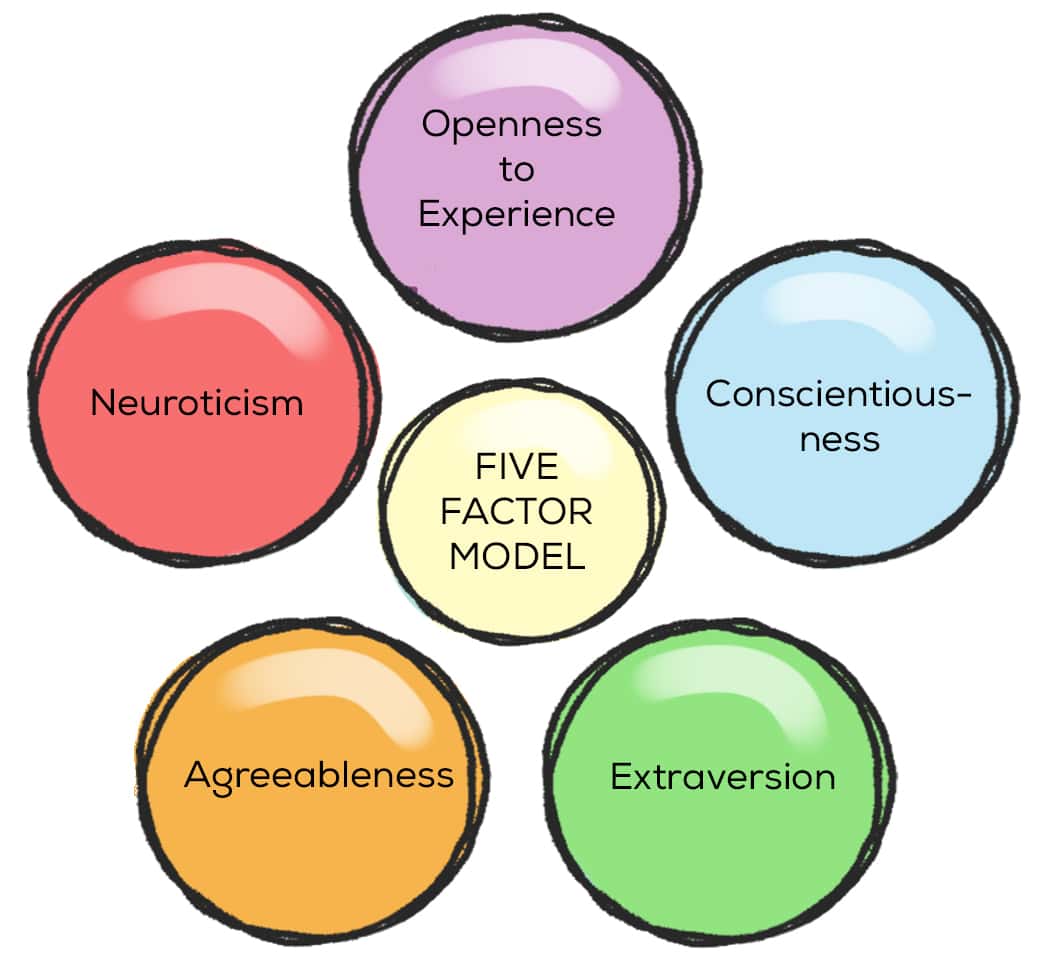 Big Five Factor Model
Many personality psychologists (Lewis Goldberg, Costa, McCrae, etc.) have had a hand in developing the Five Factor Model and the “Big Five.” This research has taken place over decades, starting in the 1940s. It didn’t really catch on until the 1980s.
In almost all research, the Five-Factor Model of Personality has been universally credited throughout all cultures. This makes it one of the best personality tests to perform further research and create accurate behavior predictions. However, the “Big Five” has recently evolved.
Many factors play into your personality and Big Five scores: age, life experience, culture, etc. Personality traits are rarely set in stone. Evidence shows that your Big Five may change throughout your life, whether you intend it or not!
Examples of Changes in Big Five Scores
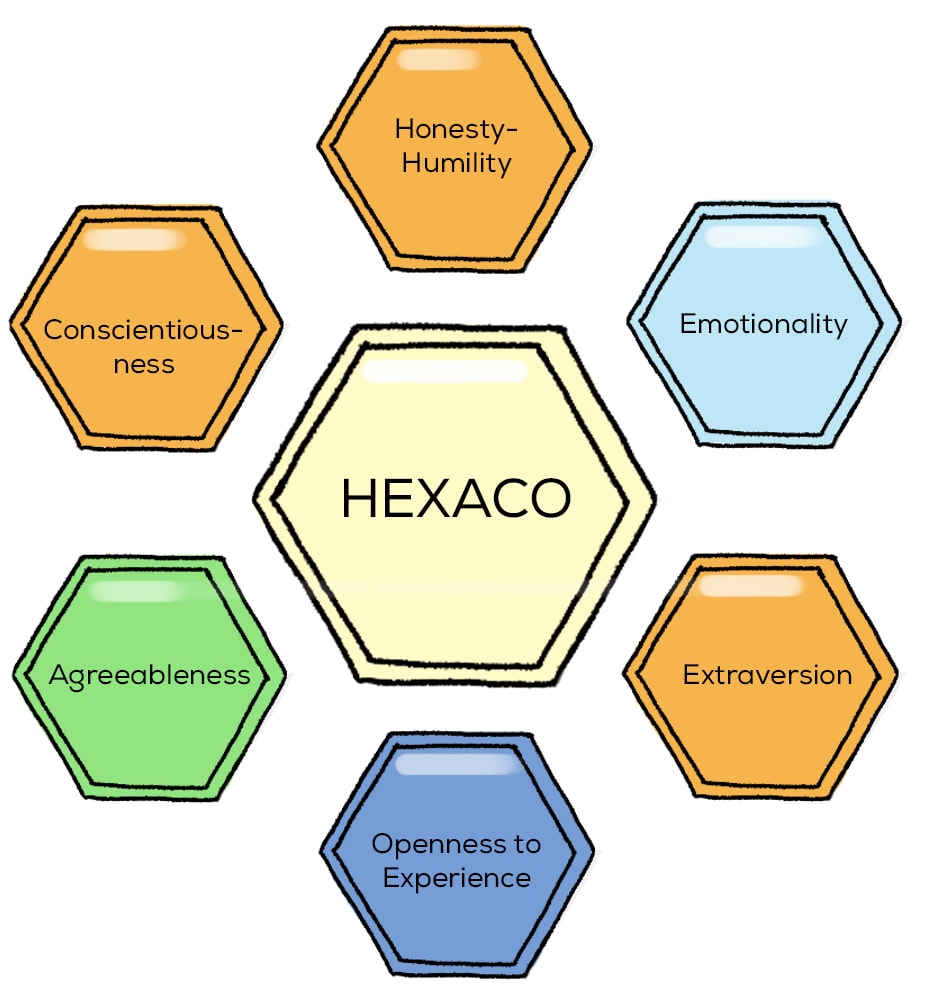 HEXACO model of personality
Personality psychology is always changing. Researchers have added a sixth trait to the Big Five model: honesty-humility. This addition has called for tweaks to the acronym. Researchers have added H, started to represent extraversion with an X, and changed Neuroticism to Emotionality. These six traits form theHEXACO model of personality.
Honesty-humility was added as the Big Five started to expand beyond American studies. Researchers began to assess whether or not the Big Five were present in languages other than English. As this research continued, they realized that all of the Big Five traits were present, and honesty and humility kept appearing as additional traits.
Ashton and Lee, the psychologists behind HEXACO, have a test on hexaco.org where you can see where you rank for each HEXACO trait (and see median scores from participants.) If you want to assess a friend’s HEXACO inventory, you can choose this option before you start the test. Psychologists are still collecting data related to the HEXACO inventory, so your results will be recorded and used in further studies. When you get your results, you can see a broken-down ranking of each element (and see your score for anxiety, patience, creativity, etc.) Many other tests also measure how you relate to each of the Big Five terms online.
The Big Five and other personality tests based on theory are not just for contemplation.These tests have real-world applications. Consider using this test to get to know yourself, people in your life, and people worldwide!
Get To Know Yourself
The easiest way to learnthe Big Five model is to take a test! See the results for yourself. You may find that the results are right on the money or reveal a truth about yourself that your friends have been trying to tell you for years! Did you think your agreeableor neuroticism score would be as high or low as it is? You don’t have to take the test too seriously. Don’t let the results change the course of your life. But enjoy getting to know what the answers reveal about your personality and behavior through the lens of the Five Factor model.
The Big Five test is one of many frameworks psychologists have developed to categorize and identify different personalities. If this is the first test you’ve taken, consider learning more about the Myers-Briggs or Type A vs. Type B tests. Compare your answers! What do these different approaches say about who you are, how you see the world, and how you interact with others?
Get To Know Your Team
Personality tests are a common team-building tool. Tests with extensive results, like the Big Five, work best when discussed among smaller teams. If you work with a group of 2-5 others, try taking this test and comparing your results.
Big Five test results reveal your personality traits andhow you approach certain situations at work. For example, a high conscientious person (particularly orderliness and cautiousness) may take extra time to review their work and ensurea project will be presented up to their standards. Someone who is not high in those areas of conscientiousness but high in areas of agreeableness may present a rougher draft, expecting their coworkers to provide feedback so the final results are the best they can be. Unless these intentions are communicated, the two team members may clash.
The answers may surprise you, and that’s a good thing!
Consider The Experience of Others
We so often see the world from our viewpoint that we can fail to consider the viewpoints of others. But not everyone thinks and behaves the same way. Whether nature or nurture shapes us, there is no denying that every person is unique.
Look at your results and what they say about your personality. Then, think about what it might be like to take the test and get a completely different set of results. How might someone who is not as open to experiences see the world? When a very conscientious person starts their day, how might it look different than someone who is not conscientious? How would a more or less neurotic person like to be treated or treat others?
This is a fun exercise, but it can also help you be aware of why someone may behave in a certain way. Thinking about the varying levels of openness, conscientiousness, etc.,may also help you avoid misunderstandings with people different from you. At the end of the day, most people just want to be treated with respect and kindness. And they probably deserve it, no matter what the results of their personality test say. Understanding another person’s perspective can help you meet them where they are and treat them the way they wantto be treated.
 missing piece of personality
Related posts:17+ Cardinal Traits (Definition + Examples)Conscientiousness (Meaning + Examples)Free 3-in-1 Personality Test (5 Mins Quiz)Free Online IQ Test (No Email + 5 Mins + Instant Results)The Dark Triad Personality Test (Free 5-Min Quiz)
Related posts:
Reference this article:Practical Psychology. (2019, February).Big 5 Factor Model of Personality (Free Test + OCEAN).Retrieved from https://practicalpie.com/the-big-5-personality/.Practical Psychology. (2019, February). Big 5 Factor Model of Personality (Free Test + OCEAN). Retrieved from https://practicalpie.com/the-big-5-personality/.Copy
Reference this article:
Practical Psychology. (2019, February).Big 5 Factor Model of Personality (Free Test + OCEAN).Retrieved from https://practicalpie.com/the-big-5-personality/.Practical Psychology. (2019, February). Big 5 Factor Model of Personality (Free Test + OCEAN). Retrieved from https://practicalpie.com/the-big-5-personality/.Copy
Copy
