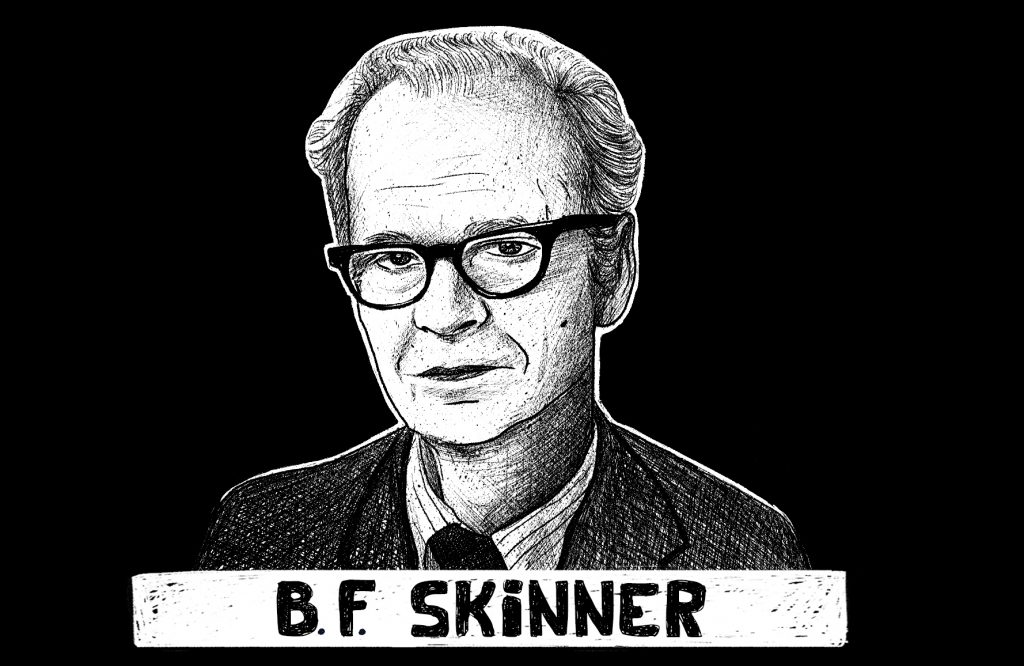
B. F. Skinner was an American psychologist, researcher, philosopher, inventor, and author. He is best known for his scientific approach to studying human behavior and his contributions to behaviorism. Skinner believed all human behavior is acquired via conditioning and that free will is an illusion. The American Psychological Association ranks Skinner as the most eminent psychologist of the 20th century.
 B F Skinner
B. F. Skinner’s ChildhoodEducational BackgroundSkinner’s Accomplishments in Radical BehaviorismWhat Is Operant Conditioning?How is Skinner’s Theory Used Today?B. F. Skinner’s Books, Awards, and Accomplishments
B. F. Skinner’s Childhood
Educational Background
Skinner’s Accomplishments in Radical Behaviorism
What Is Operant Conditioning?
How is Skinner’s Theory Used Today?
B. F. Skinner’s Books, Awards, and Accomplishments
Burrhus Frederic Skinner was born on March 20, 1904, in Susquehanna, Pennsylvania. Susquehanna was a small coal and railroad town located in the hills. Skinner’s parents were Grace and William Skinner. His brother Edward was two and a half years younger than him.
Much of Skinner’s childhood was spent outdoors roaming the hills of Susquehanna. He was an active, energetic young boy who loved to build things. He once built a cart, but accidentally put in the steering backwards. He also tried and failed to build a perpetual motion machine. However, he was successful in building a host of other devices such as rafts, sleds, slides, roller-skate scooters, merry-go-rounds, slingshots, bows and arrows, water pistols, blow guns, and a cabin in the woods.
Skinner attended the same high school as his mother and father. He played the saxophone and piano at home and played in a jazz band at school. Perhaps his most influential teacher was Miss Mary Graves, who taught him English and art. Her guidance likely played a role in Skinner enjoying his time in high school and majoring in English Literature in college. He later dedicated his bookThe Technology of Teachingto her.
Although the Skinner household was generally happy, Skinner and his parents experienced a devastating loss during his adolescence. Skinner’s younger brother Edward had a cerebral hemorrhage and died at the age of sixteen. Edward was closer to his parents than Skinner was, and Edward’s death caused his parents to focus more on Skinner. Even though Skinner loved his parents, he was not always comfortable with the extra attention.
After graduating from high school, Skinner went to Hamilton College in New York. His goal was to major in English Literature. However, Skinner did not fit in well with college life at Hamilton. He thought it was absurd to take courses such as anatomy, embryology, mathematics, and biology because they did not relate to his major. He did not enjoy college football and parties. And as an atheist, he disliked the mandatory daily chapel attendance.
Skinner graduated from Hamilton College in 1926 with a bachelor’s degree in English Literature. Shortly before leaving school, he made the decision to return home and become a writer. After failing to write a captivating novel, he chose to focus on short stories. However, Skinner only managed to write a few short newspaper articles over the course of the next year. He believed he had “nothing important to say” because he lacked the perspective and life experiences necessary to become a good writer.
Skinner received his master’s degree in psychology in 1930. One year later, he earned his PhD in psychology. Skinner was awarded several fellowships that allowed him to continue his research at Harvard until 1936.
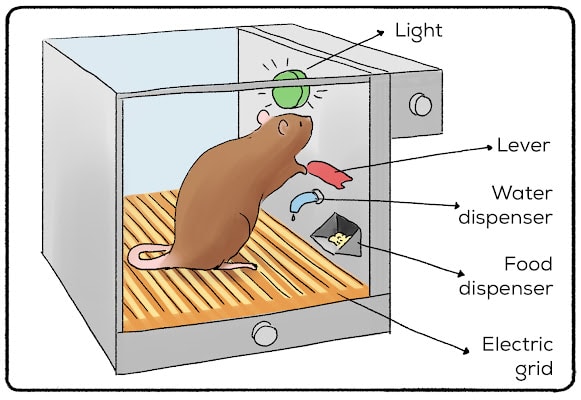
Ivan Pavlov was one of Skinner’s biggest influences. Skinner adopted Pavlov’s belief that if you can control the environment, you can see the order in behavior. The majority of Skinner’s research involved animal studies with rats or pigeons. He invented a number of devices for his experiments, the most popular of which was the “Skinner box.” Over time, Skinner developed his own version of behaviorism called radical behaviorism.
In 1936, Skinner accepted a teaching position at the University of Minnesota at Minneapolis. During this time, much of the research he had started at Harvard was put on hold. When World War II erupted, Skinner was very eager to contribute to the war effort and attempted to train pigeons to help guide missiles to enemy ships. Eventually the project was discontinued with the rise of radar.
Skinner moved to Indiana University in 1945 and served as the chair of the psychology department. However, Skinner rejoined the Harvard faculty as a tenured professor in 1948. He spent the rest of his professional career at Harvard.
While Skinner agreed that observable behaviors should be the primary focus of psychology, he did not reject the role of internal events. He believed private events could also be included in a scientific study of behavior. However, such events should not be regarded asexplanationsfor behavior, but rather, as behaviors that need explanation themselves. He pointed to the environment as the ultimate determinant of behavior, both internal and external. Skinner’s approach to the study of behavior became known as radical behaviorism.
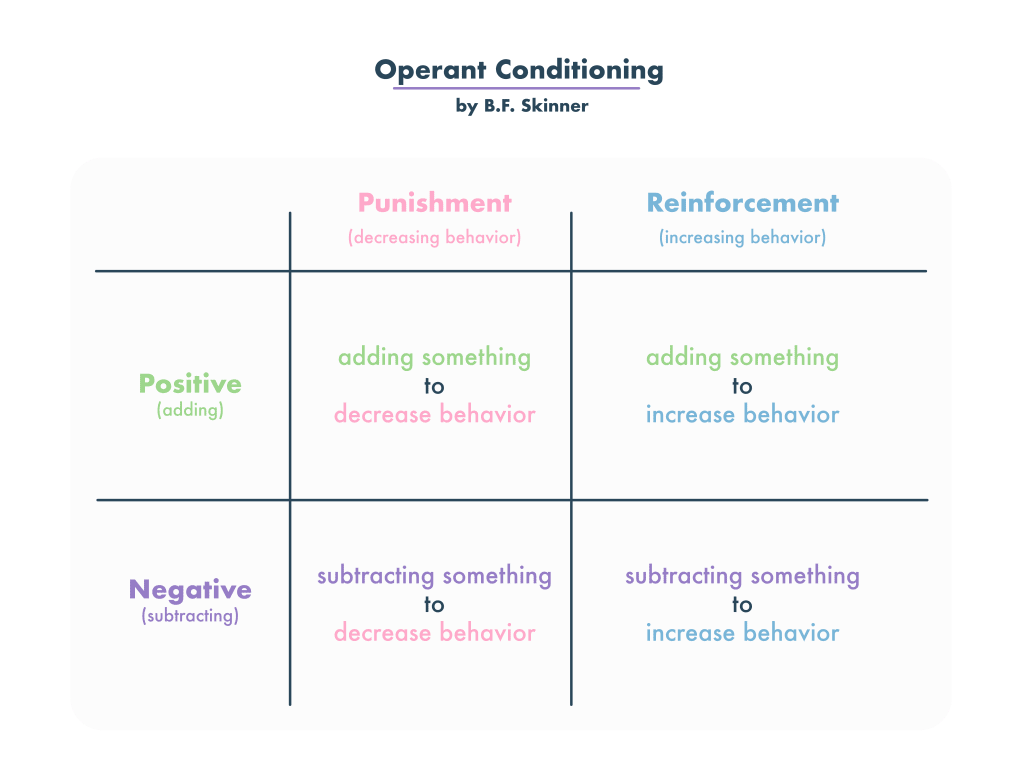
Operant conditioning is a form of learning in which the consequences of a behavior influence the likelihood of that behavior being repeated in the future. Skinner outlined two types of consequences - reinforcement and punishment. Reinforcement refers to any consequence that increases the likelihood of a behavior recurring; punishment is any consequence that decreases it.
Skinner further broke down each type of consequence into positive and negative forms. Here, ‘positive’ simply refers to the addition of a stimulus following the behavior, while ‘negative’ refers to the removal of a stimulus. Reinforcement (whether positive or negative) always strengthens behavior; punishment (whether positive or negative) always weakens it.
Principles of Operant Conditioning
Operant conditioning of complex behaviors often involves a process known asshaping. This involves reinforcing successive behaviors that gradually come closer to the behavior you ultimately wish to reinforce. For example, if you wish to train your dog to roll over on command, you could wait until he performs this behavior spontaneously and then reward him for it. You would then have to wait for the dog to repeat this behavior several times since a single instance of reinforcement would not be enough for him to learn the behavior. No doubt, that would require a great deal of patience.
Once a behavior has been conditioned (i.e., learned) in the presence of a given stimulus, there is a tendency for the organism to produce that behavior in the presence of similar stimuli.This is known asstimulus generalization. For example, if a rat learns to press a lever for food when it sees a green light come on, he might also press the lever when a red light is switched on.
The opposite of stimulus generalization isstimulus discrimination. This is the tendency for a conditioned response to occur in the presence of certain stimuli but not in the presence of others. The organism learns to distinguish between stimuli that signal a reward and those that do not. If a rat receives a shock for pressing a lever when a red light is on, but receives food for performing the same behavior when a green light is on, it will quickly learn to press the lever only in the presence of a green light.
In continuous reinforcement, every instance of a desired response is reinforced. For example, a child might get a bonus on his allowance every time he aces a math test. In partial reinforcement, some, but not all, instances of the desired behavior are reinforced. The occasional payout received from playing a slot machine is an example of partial reinforcement. Behaviors that are partially reinforced tend to be more resistant to extinction than those that are continuously reinforced.
What Was B.F. Skinner’s Position on Free Will?
By showing how behaviors could be learned through outside consequences and rewards, his theories lean to the “determinism” side of the argument. (Users discuss this further in thisReddit postabout Skinner’s positions.) It is important to note that while his theories are applied today, not everyone who cites or studies him sees the free will vs. determinism argument in black and white measures.
Many real-world applications of operant conditioning theory exist. These include:
Behavior modification programs- these programs are designed to increase desirable behaviors and minimize or eliminate undesirable ones. Many of the techniques used in behavior modification are based on the principles of operant conditioning. In one of these techniques, known as a token economy, participants are awarded tokens for appropriate behavior. The tokens (eg., points, coins, or gold stars) can then be exchanged for items or privileges that are reinforcing for the individual. Token economies can be implemented at home, or in institutions such as schools, prisons and psychiatric hospitals.
Animal training- animal trainers typically employ the technique of shaping in order to teach complex tricks. By successively rewarding responses that inch closer and closer to the target behavior, trainers have managed to teach animals complex maneuvers and stunts that might otherwise have been impossible.
Biofeedback training- Biofeedback has been used to treat conditions such as anxiety and chronic pain. Individuals are taught techniques such as deep breathing and muscle relaxation, which help to alter involuntary bodily responses such as heart rate, blood pressure and muscle tension. As they engage in these behaviors, recording devices measure bodily changes and transmit the information to them. Positive changes (eg. a lowered blood pressure reading) reinforce the behaviors that preceded them.
Superstitions- many superstitions result from accidental reinforcement. Take for example a gambler who happens to blow on his dice just before a big win. Even though his success has absolutely nothing to do with the act of blowing on the dice, he will likely keep engaging in that behavior because it has been reinforced.
Criticisms of Skinner’s Theory
Skinner conducted numerous studies to support his view of human nature. However, most of these studies were conducted in laboratories using small animals such as rats and pigeons. Critics argue that generalizations about human behavior cannot be made on the basis of these studies since humans are much more complex. Humanistic psychologists, in particular, claim that Skinner’s approach is overly simplistic since it does not take into account uniquely human characteristics such as free will.
Skinner has also been criticized for ignoring the role of cognitive and emotional factors in learning. Some have argued that Skinner’s approach promotes a mechanical view of human nature in which humans are seen as slaves to the consequences of their actions. Contrary to what Skinner believed, studies have shown that reinforcement and punishment are not necessary for learning to take place. Behaviors can also be learned through observation and insight.
B. F. Skinner was a prolific writer who published 180 scholarly papers and 21 books. His literary works include:
Skinner received honorary degrees from several universities, including:
Skinner also received a multitude of prestigious awards throughout his career. Some of these awards are listed below:
Personal Life
Skinner married Yvonne Blue in 1936. They had two daughters named Julie and Deborah. Skinner died from leukemia on August 18, 1990. Ten days before he died, he accepted the lifetime achievement award from the American Psychological Association and gave a talk based on the article he was currently working on. He completed his final article the same day he passed away.
American Psychological Association. (2002). Eminent psychologists of the 2th century.Monitor on Psychology,33(7) 29. Retrieved from https://www.apa.org/monitor/julaug02/eminent
Aubrey, K., & Riley, A. (2019).Understanding and using educational theories(2nd ed.). Thousand Oaks, CA: SAGE Publications.
B. F. Skinner Foundation. (n.d.).Biographical information.Retrieved from https://www.bfskinner.org/archives/biographical-information/
Jarvis, M., & Okami, P. (2020).Principles of psychology: Contemporary perspectives. Oxford, England: Oxford University Press.
Kelland, M. D. (2019).B. F. Skinner and the behavioral analysis of personality development. Retrieved from
Milan, M. A. (1990). Applied behavior analysis. In A. S. Bellak, M. Hersen & A. E. Kazdin (Eds.),International handbook of behavior modification and therapy(2nd ed.) (pp. 67-84). New York: Plenum Press.
Powell, R. A., Symbaluk, D. G., & Honey, P. L. (2009). Introduction to learning and behavior (3rd ed.). Belmont, CA: Wadsworth.
Schultz, D. P., & Schultz, S. E. (2005).Theories of personality(8th ed.). Belmont, CA: Thomson Wadsworth.
Related posts:Operant Conditioning (Examples + Research)Skinner’s Box Experiment (Behaviorism Study)Schedules of Reinforcement (Examples)Fixed Ratio Reinforcement Schedule (Examples)Variable Interval Reinforcement Schedule (Examples)
Related posts:
Reference this article:Practical Psychology. (2020, March).B.F. Skinner (Psychologist Biography).Retrieved from https://practicalpie.com/bf-skinner/.Practical Psychology. (2020, March). B.F. Skinner (Psychologist Biography). Retrieved from https://practicalpie.com/bf-skinner/.Copy
Reference this article:
Practical Psychology. (2020, March).B.F. Skinner (Psychologist Biography).Retrieved from https://practicalpie.com/bf-skinner/.Practical Psychology. (2020, March). B.F. Skinner (Psychologist Biography). Retrieved from https://practicalpie.com/bf-skinner/.Copy
Copy
