How attached are you to your romantic partner? Do you think these attachment styles have anything to do with how you were raised?
Log In
0%complete
That may seem like a weird question, but psychologists have found a strong connection between our relationship with our parents and how we approach romantic relationships as an adult. Adults display one of four different attachment styles. Your attachment style could make a big difference in how you view yourself in a relationship, treat your partner, or handle a breakup, so take the time to learn about them and make your dating life easier!
What Are Attachment Styles?Who Discovered Attachment Styles?Why Attachment Theory Is ImportantCan Attachment Styles Change Over Time?
What Are Attachment Styles?
Who Discovered Attachment Styles?
Why Attachment Theory Is Important
Can Attachment Styles Change Over Time?
Attachment styles refer to how people approach their relationships. While some people are more secure in their relationships, others are more disorganized, ambivalent, or anxious. Studies on attachment styles go back to the 1950s and have evolved to include observations on how adults become attached to their romantic partners.
Some people feel safe and confident in relationships, some worry a lot about being left or not being loved enough, some prefer to keep a distance, and some are a mix of being scared but also wanting closeness.
What Are the Four Attachment Styles?
Everyone falls under one of four attachment styles:
 attachment styles Chart
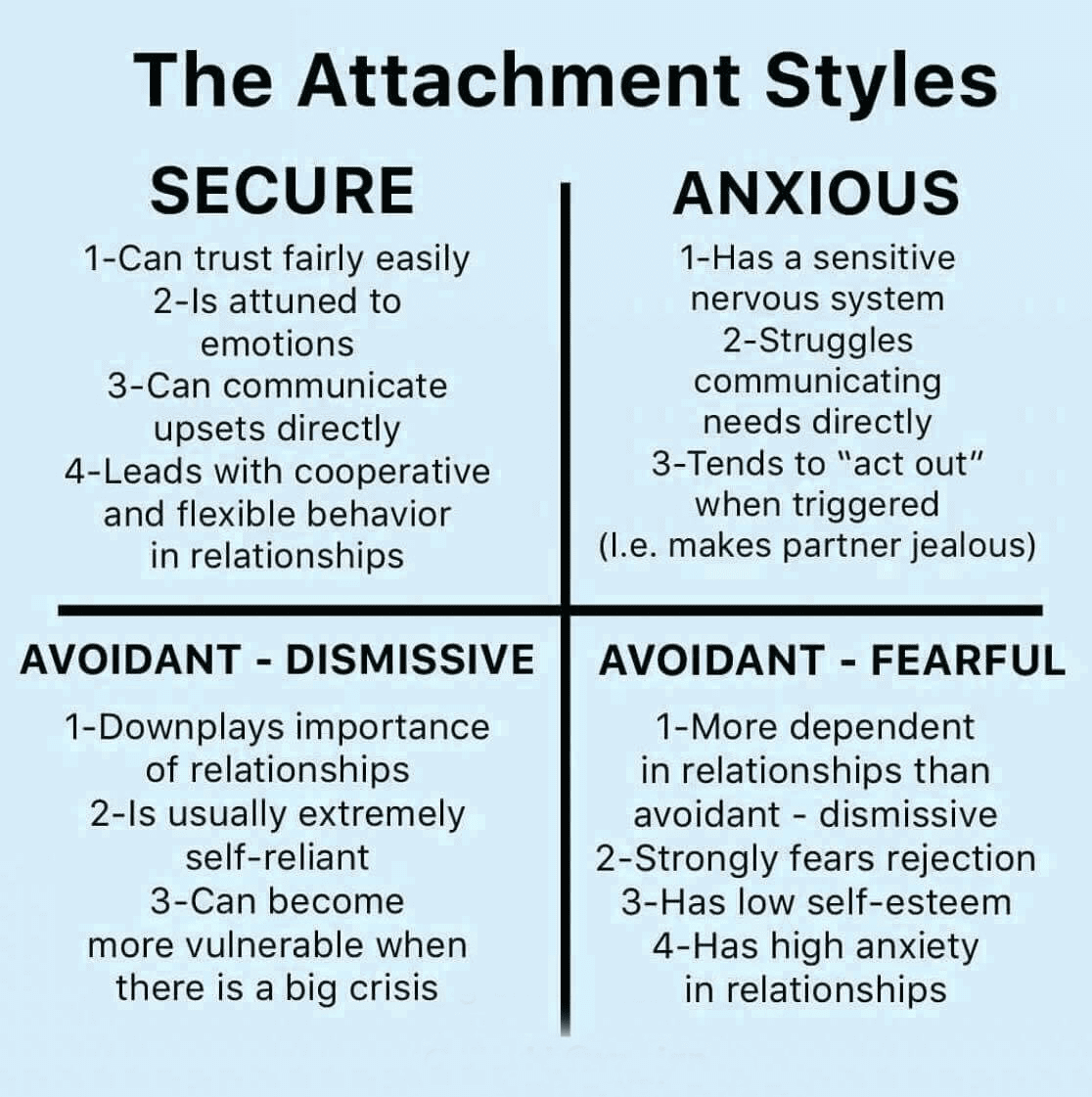
Attachment Behaviors
When a child feels secure, they are likely to display more exploratory behaviors. These behaviors include exploring the environment with ease, being sociable with others, and enjoying intimacy without anxiety.
On the other hand, if the child does not feel secure, they are likely to displayattachment behaviors.These attachment behaviors include:
From our first waking moments, our parents provide us with basic needs. They feed us, put a roof over our heads, and protect us. These needs form the base of Maslow’s hierarchy of needs - we seek these needs before we seek anything else.
Children who display these attachment behaviors seek to fulfill these needs. Attachment behaviors aim to bring the attachment figure closer. When the person is close enough to the attachment figure, they are more likely to feel that their needs will be met and that they will be safe and secure. Safety and security may be physical, emotional, or even financial.
At an early age, these attachment figures are the parents. The attachment figure may be a lover or partner as the person grows into an adult.
Multiple people are most credited with discovering and identifying attachment styles:

When do these attachment styles start to form? This is the question that psychologists Schaffer and Emerson tried to answer in their experiments in the 1960s. They found that infants had different attachment stages to primary or secondary caregivers. By eleven months, the infants preferred one caregiver over another. But they also start to form bonds with grandparents, aunts, uncles, or other caregivers. Once the infant has formed an attachment to one primary caregiver, they may display behaviors related to separation anxiety or stranger anxiety.
During the SSC, Ainsworth observed infants between 12 and 18 months through a one-way mirror. The children interacted with both their mother and a stranger in different scenarios. The scenarios lasted about three minutes each:
How did the infants react to all of these scenarios? Did they search for the attachment figure (mother), or were they content exploring the room and playing with toys?
Ainsworth recorded the infant’s behavior and how intensely the behavior was displayed.
She noticed that the infants generally fell under one of three categories. 70% of the infants felt secure when the mother was around. During these moments of security, the infant felt comfortable exploring their environment even when the stranger was around. They were distressed when the mother left but happy when the mother returned. These babies were categorized as having asecure attachment style.
In the second group of infants, only 15% of the infants observed were more distressed than the first. They resisted the stranger and even resisted the mother when she returned to the room. These infants were highly unlikely to explore the area around them. Ainsworth classified these infants as having aresistant attachment style,also known as theanxious attachment style.
The last group of infants, the final 15%, did not appear to be that attached to the mother. They weren’t distressed when the mother left and weren’t overly thrilled when the mother came back. Infants in this group seemed as comfortable with the stranger as they did with their mother. Ainsworth classified these children as having anavoidant attachment style.
Attachment Styles in Modern Relationships
These attachment behaviors are not rigid. A child’s explorative actions when feeling secure or their search for an attachment figure when distressed are emblematic of their attachment style. In adult scenarios, this might manifest as seeking comfort from a partner or maintaining distance due to past traumas.
Importantly, understanding one’s attachment style can be transformative. Contemporary perspectives, such as those shared on platforms like Reddit, indicate that recognizing one’s attachment tendencies can aid in navigating relationships, preventing heartbreaks, and fostering deeper connections. Moreover, individuals can transition towards a more secure attachment style with mindfulness, therapy, and a commitment to nurturing positive relationships.
Until the 1980s, these three different attachment styles were the most accepted. The disorganized-insecure attachment was added in 1986. Ainsworth did observe attachment behaviors that described children in this category, but they were not classified as their own group until Main and Soloman’s observations. These behaviors include:
Main and Soloman observed that these children typically experienced maltreatment, and their trauma went unresolved. Due to the lack of closure on this treatment, the children were unsure how to act, and this frustration sometimes led to aggression.
When we read about different attachment styles, we are more likely to relate them to our adult relationships. You might take a quiz to seeyourattachment style or contemplate how this affects your relationship with your partner. But until 1987, psychologists only talked about attachment styles as they related to children.
In 1987, Hazan and Shaver observed adults in romantic relationships and noticed the parallels between them and the relationships between children and their parents. Both sets of people engage in bodily contact. Both feel more safe and secure when the other person is around. Hazan and Shaver argued that a romantic partner may act as an attachment figure from these observations.
Cultural Perspectives on Attachment
While attachment theory has been foundational in understanding human development and interpersonal relationships, it’s essential to consider its cultural dimensions. The way attachment manifests can differ significantlyacross diverse cultural contexts, affecting the prevalence of various attachment styles.
Recent research has expanded to include diverse cultural groups, and some findings suggest that the distribution of attachment styles can vary across cultures. For instance, secure attachment, while predominant in many Western samples, might not be as prevalent in other cultural groups.
For psychologists, therapists, and educators, it’s essential to approach attachment theory with a culturally sensitive lens. Recognizing that attachment behaviors might have different meanings in different cultural contexts can lead to more accurate and empathetic understandings of individuals from diverse backgrounds.
Reddit user nenindis shared her thoughts on attachment theory in theFemaleDatingStrategy subreddit:
You don’t have to be a female to benefit from learning about attachment styles! If you want to form a deep connection with someone, it is worth understanding your attachment style and how that affects your compatibility with others.
You are not doomed to one attachment style forever. Attachment styles can change as a person grows up. Not everyone with an absent parent is ambivalent or avoidant in nature. People with secure childhoods may also develop mistrust later in life!
If you are looking to change your attachment style, you are taking the right first steps. Awareness, mindfulness, and an open mind are key to acknowledging the attachment issues you have had in the past and trusting people more.
Consider taking the next steps on your journey to more secure relationships:
What Is Your Attachment Style?
Related posts:
Reference this article:Practical Psychology. (2023, July).Attachment Styles Theory (Free Test).Retrieved from https://practicalpie.com/attachment-styles-theory/.Practical Psychology. (2023, July). Attachment Styles Theory (Free Test). Retrieved from https://practicalpie.com/attachment-styles-theory/.Copy
Reference this article:
Practical Psychology. (2023, July).Attachment Styles Theory (Free Test).Retrieved from https://practicalpie.com/attachment-styles-theory/.Practical Psychology. (2023, July). Attachment Styles Theory (Free Test). Retrieved from https://practicalpie.com/attachment-styles-theory/.Copy
Copy
