An empirical study in 2002 listed Adler as the 67th most eminent psychologist of the 20th century.

Who Is Alfred Adler?Alfred Adler’s ParentsEducational Background and CareerAdler’s Theory of Individual PsychologyAdler’s View on Styles of Life, Birth Order, and Parent EducationApplications of Adlerian TheoryPersonal Life
Who Is Alfred Adler?
Alfred Adler’s Parents
Educational Background and Career
Adler’s Theory of Individual Psychology
Adler’s View on Styles of Life, Birth Order, and Parent Education
Applications of Adlerian Theory
Personal Life
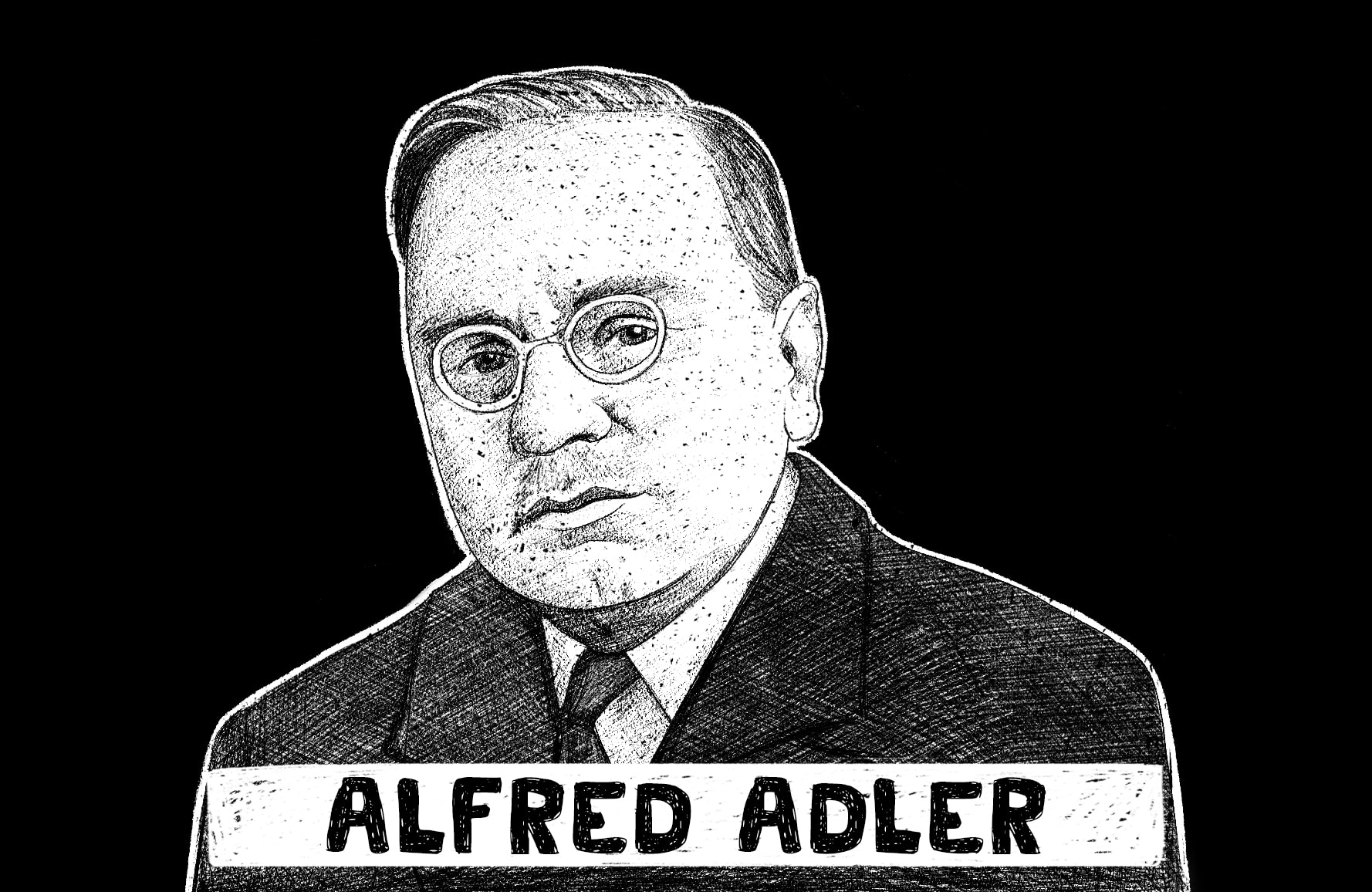
Alfred Adler was an Austrian physician and psychiatrist. He is highly esteemed for his contributions to psychoanalysis and for founding the school of thought known as individual psychology. Adler emphasized how social factors and inborn feelings of inferiority may impact personality development.
Alfred Adler was born on February 7, 1870, in a small village named Rudolfsheim on the outskirts of Vienna, Austria. He was the second of seven children born to middle-class Jewish parents, Pauline and Leopold Adler. His mother was a homemaker and his father worked as a grain merchant.
Childhood Illnesses
As a child, Adler was very sickly. He developed rickets at a very young age, which prevented him from walking until about age four. One of his earliest memories was sitting on a bench bandaged up because of his rickets, while his healthy, athletic older brother sat across from him. His brother Sigmund could run about and play effortlessly but for Adler, any form of movement was a strain. Adler was intensely jealous of Sigmund and the rivalry between the two lasted well into Adler’s adolescent years.
In addition to rickets, Adler experienced spasms of the glottis which caused breathlessness and placed him at risk of suffocation if he cried. When he was five years old, he almost died from a severe bout of pneumonia and even overheard the doctor telling his father: “Your boy is lost.” Adler later identified this as the point in his life when he resolved to become a physician.
Other Traumatic Events
During his youth, Adler also struggled with feelings of inferiority and viewed himself as frail and unattractive. Despite this, he worked hard to excel at physical activities and developed a lively, friendly personality that attracted others. He loved music as a boy and was known for his singing voice. He also loved spending time outdoors.
Adler began secondary school at age nine but performed quite poorly at first—so poorly, in fact, that his math teacher encouraged him to leave school and learn a trade. In the eyes of this teacher, Adler was not suited for much more than becoming a shoemaker’s apprentice. Adler’s father objected and in time, with determination and perseverance, Adler rose from the bottom to the top of his class.
After completing his medical degree, Adler specialized at first in ophthalmology before switching to general practice. His interest in social reform and socialism continued and his first professional publication was a moving social-medicine paper on the effect of working conditions on the health of tailors.
Freud’s Influence
Individual Psychology
After severing ties with Freud, Adler went on to establish his own theory and approach to therapy, which he termedindividual psychology. In 1914, he along with Carl Furtmuller started the Journal for Individual Psychology. In 1919, Adler established the first of several child guidance clinics in Vienna after serving for three years as a physician in the Austrian army during World War I. Around that time, he also began lecturing at the Pedagogical Institute.
From 1926 onwards, Adler spent an increasing amount of time in the United States and became a visiting professor at Columbia University in 1927. He was appointed as chair of medical psychology at the Long Island College of Medicine in 1932.
Adler strongly disagreed with Freud’s claim that psychosexual conflicts during childhood were the primary forces behind personality development. He believed that a psychologist must consider other internal forces as well as external forces if he or she wants to understand a person completely. Adler referred to his school of thought as individual psychology—a reference to the Latin wordindividuuswhich means indivisibility. Rather than studying human nature one piece at a time, Adler believed that the individual should be studied as a whole (an approach now known as holism).
In some cases though, children may have very intense feelings of inferiority. These feelings may cause them to work very hard to compensate for their shortcomings, however, compensation is no longer enough for them. Eventually, they reach a state ofovercompensationwhere their fictive goal (or final goal) is extreme, exaggerated, or even pathological. For example, a person who desperately wants to lose weight may begin to eat too little, exercise too much, and develop an unhealthy view of his own body as he strives to be “perfectly thin.”
Inferiority Complex
Adler made the distinction between primary and secondary feelings of inferiority. He described primary inferiority as the “normal” feelings of inferiority that an infant is born with. These feelings are healthy as they encourage the child to grow and develop. Secondary inferiority occurs when the child has extreme feelings of inferiority. These feelings have a negative impact and contribute to the development of an inferiority complex later on in life.
While many people are familiar with the term “inferiority complex,” far fewer are aware of the existence of asuperiority complex. A person with a superiority complex has a drive to show others that he is better than he really is. Individuals with a superiority complex tend to be viewed as arrogant, impatient, rude, egocentric, aggressive, or power-hungry. Adler believed people develop a superiority complex as a way to escape from their strong feelings of inferiority.
Adler did not define strict personality types because he felt that approach reduced human nature to a specific set of rules and ignored the fact that each person is unique. Nevertheless, he did note that there are certain behavioral patterns that may start in childhood and develop throughout a person’s life. Adler referred to these patterns as “styles of life” and he distinguished them based on the different levels of energy he believed they manifested. They include:
Adler recognized that if an individual fits into a particular pattern, a therapist can use that information to help him or her to address maladaptive issues. He also believed that a person’s style of life could be used to predict his or her future behavior.
Theories on Birth Order
One factor that Adler believed has a significant impact on a person’s style of life and psychological make up is his or herbirth order. Birth order refers to the position of siblings in the family. While a typical researcher may argue that a family with three children is able to raise all the siblings in the same environment, Adler disagreed. He believed that each sibling is raised in a different environment as the eldest child has two younger siblings, the middle child has an older and a younger sibling, and the youngest child has two older siblings.
Adler suggested the following theories on birth order:
Adler viewed childhood as a key period in the development of personality. As a result, he believed one of the best ways to prevent psychopathology is to train a child to think of himself as an equal and valued member of the family. Adler emphasized the need for teachers, social workers, and nurses to be trained inparent educationso that they could work along with families in positive child development. He argued that this approach would lower the odds that children are pampered or neglected, making the development of inferiority or superiority complexes less likely.
According to Adler, people have one basic desire: to belong and feel significant. He believed that people will cooperate with each other if they feel capable, encouraged, respected, and appreciated. When people are discouraged, Adler claimed they are more likely to withdraw, compete, or give up.
Adler applied many of his personality theories to the mental health field. In his opinion, a person with good mental health feels connected to other people, is motivated to reach his full potential, and is eager to help other individuals in need. Adler’s approach has been particularly effective in promoting the growth and development of children. Adlerian psychotherapists view a child with behavior issues as a discouraged child. They believe the best strategy to help such a child is to make him feel competent and valued.
Adlerian psychotherapy seeks to reduce the inferiority complex, reduce the superiority complex, and increase feelings of community and equality. After forming a trusting therapeutic relationship, the therapist tries to assess several factors such as the client’s radius of activity, feelings of inferiority, position in the family constellation, fictive goal, and sense of community. The client is then encouraged to overcome his feelings of inferiority, develop stronger feelings of human connectedness, and redirect his energy to improving society rather than seeking significance for himself. As the client attempts to adjust his beliefs, attitudes, and behaviors about himself and the world, his increasing confidence, pride, and satisfaction motivate him to continue cooperating with the treatment process. The therapist helps the client to reduce exaggerated desires for self-protection, self-indulgence, or self-enhancement and increase his motivation to make social contributions.
Criticisms of Adler’s Theories
Perhaps the biggest criticism of Adler’s theories is that they lack empirical support. The fact that many of his concepts are not able to be observed and measured has led some critics to label his approach as unscientific. Adlerian psychotherapy has been criticized for its ineffectiveness in treating issues that are not related to birth order or other Adlerian concepts. The approach is also ineffective if a client is experiencing severe mental health issues such as schizophrenia, dementia, or bipolar disorder.
Adler’s Contributions to Psychology: Books, Awards, and Accomplishments
Adler was a prolific writer over the course of his career. Some of his most important works include:
While studying at the University of Vienna, Adler met Raissa Epstein, an independent Russian student and feminist who shared his interest in socialism. The couple married in 1897 and had four children—Valentine (b. 1898), Alexandra (b. 1901), Kurt (b. 1905), and Cornelia (b. 1909). Adler enjoyed music and would often sing and play the piano with his children. He also appreciated good food, had an excellent sense of humor, and loved spending time with others.
Adler did not identify much with his Jewish heritage and as an adult, converted to Christianity.
Nevertheless, in the 1930’s, the Nazis closed down Adler’s clinics on account of his Jewish background. To secure the future of individual psychology, Adler and his wife moved to the United States in 1932 and settled in New York City.
How Did Alfred Adler Die?
Adler died from a heart attack while on a speaking tour in Aberdeen, Scotland on May 28, 1937. He was 67 years of age at the time. His body was cremated at Warriston Crematorium in Edinburgh but his family never claimed his ashes. They were rediscovered 74 years later in 2011 and returned to Vienna for burial. Two of Adler’s children, Kurt and Alexandra, carried on his legacy as practicing psychotherapists.
References
Alfred Adler’s personality theory and personality types.(n.d.). Journal Psyche. Retrieved from http://journalpsyche.org/alfred-adler-personality-theory/
Adler Graduate School (n.d.). Alfred Adler: Theory and application.Retrieved from https://alfredadler.edu/about/alfred-adler-theory-application
Schultz, D. P., & Schultz, S. E. (2016).A history of modern psychology(11th ed.). Boston, MA: Cengage Learning.
Sharf, R. S. (2016).Theories of psychotherapy and counseling: Concepts and cases. Boston, MA: Cengage Learning.
Stein, H. (Ed.) (2005).The collected clinical works of Alfred Adler (Vol. 7): Journal articles: 1931-1937. Bellingham, WA: The Classical Adlerian Translation Project.
Related posts:40+ Famous Psychologists (Images + Biographies)Psychoanalytic Theory of PersonalitySigmund Freud (Psychologist Biography)Industry vs Inferiority (Psychosocial Stage 4)Freud’s Psychosexual Stages of Development (Definition and Examples)
Related posts:
Reference this article:Practical Psychology. (2021, March).Alfred Adler Biography - Contributions To Psychology.Retrieved from https://practicalpie.com/alfred-adler/.Practical Psychology. (2021, March). Alfred Adler Biography - Contributions To Psychology. Retrieved from https://practicalpie.com/alfred-adler/.Copy
Reference this article:
Practical Psychology. (2021, March).Alfred Adler Biography - Contributions To Psychology.Retrieved from https://practicalpie.com/alfred-adler/.Practical Psychology. (2021, March). Alfred Adler Biography - Contributions To Psychology. Retrieved from https://practicalpie.com/alfred-adler/.Copy
Copy
