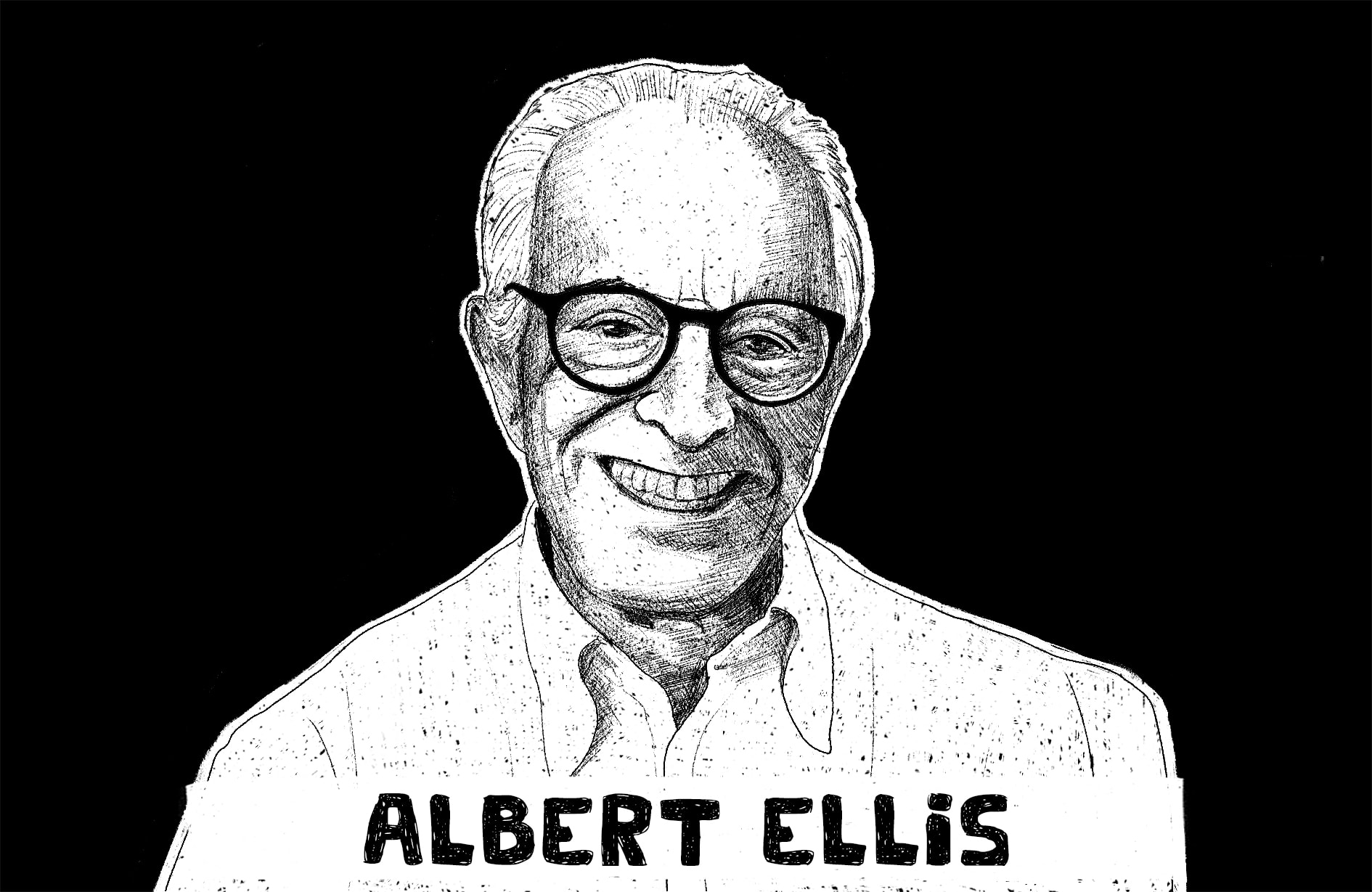
Albert Ellis’ pioneering work laid the groundwork for what is now known as cognitive behavioral therapy. He is widely recognized as one of the most influential figures in modern psychology.

Who Is Albert Ellis?Albert Ellis’s Early LifeEducational Background and CareerRational Emotive Behavior Therapy (REBT)Work on Human SexualityApplications of REBTREBT CriticismsAlbert Ellis’s Books, Awards, and AccomplishmentsPersonal Life
Who Is Albert Ellis?
Albert Ellis’s Early Life
Educational Background and Career
Rational Emotive Behavior Therapy (REBT)
Work on Human Sexuality
Applications of REBT
REBT Criticisms
Albert Ellis’s Books, Awards, and Accomplishments
Personal Life
Albert Ellis was an eminent American psychologist and theorist best known for developing Rational Emotive Behavior Therapy (REBT). His work revolutionized the practice of psychotherapy, shifting the focus away from psychoanalysis, with its emphasis on unconscious processes, toward a more pragmatic approach centered on conscious thoughts.
Albert Ellis was born in Pittsburgh to Jewish parents, Henry Oscar and Hettie Ellis, on September 27, 1913. He was raised in the Bronx borough of New York City and was the eldest of three children; he had a brother, Paul, who was two years younger and a sister, Janet, who was four years his junior. During his childhood years, Ellis had limited contact with his father, who worked as a traveling salesman and was often away from home.
Ellis’ mother was an amateur actress who he described as self-absorbed, melodramatic, and a “bustling chatterbox who never listened.” She was emotionally distant from her children and showed very little interest in domestic life. In his autobiography, Ellis recalled that she was often asleep when he left for school and was typically absent when he returned.
The young Ellis tried to make the best of his circumstances. He said, “I took my father’s absence and my mother’s neglect in stride, and even felt good about being given so much autonomy and independence.” He also assumed responsibility for his younger siblings, waking up early to get them dressed and ready for the day.
Health Problems
In addition to having parents who were often physically and emotionally unavailable, Ellis had to deal with a series of health problems in his youth. At the age of five, he developed a serious kidney disorder that required repeated hospitalizations for extended periods of time. According to Ellis, between the ages of five and seven, he was hospitalized on eight different occasions, one of which lasted almost a year. Even during those challenging times, Ellis reported receiving very little support from his parents. They divorced when he was 12 years old.
As a child, Ellis had an interest in sports but his physical frailty caused him to turn his attention to books instead. He excelled in school, skipped grades, and won several writing contests. By the time he reached junior high, his heart was set on becoming a novelist. His plan was to study business in college and earn enough money so that he could retire at 30 and devote all his time to writing.
Ellis earned a degree in business administration from the City University of New York (CUNY) in 1934 and was eager to start his business career. However, the Great Depression meant that he had to seek innovative means of earning cash. His first venture involved locating used pants and jackets of similar colors at garment auctions, and then selling them as suits. A few years later, he became personnel manager for a novelty gift company.
In his spare time, Ellis managed to write several poems, plays, essays, short stories, and novels. After failing to find a publisher for his novels, he decided to focus exclusively on writing nonfiction books. He had an interest in human sexuality and began reading and writing extensively on this subject. As there were few experts at the time in this area, many people began seeking his advice. Ellis found that he enjoyed counseling others and decided to pursue a career in clinical psychology.
Ellis enrolled in the clinical psychology program at Columbia University in 1942, and earned his masters degree in 1943. Soon after, he set up a part-time private practice that offered family and sex counseling while he worked on completing his doctorate. He was trained in psychoanalysis and awarded his PhD in 1947.
After completing his doctorate, Ellis pursued further training inpsychoanalysiswith Richard Hulbeck at the Karen Horney Institute. He obtained teaching positions at Rutgers University and New York University, and became the senior clinical psychologist at the Northern New Jersey Mental Hygiene Clinic. He also served as chief psychologist at the New Jersey Diagnostic Center and later, at the New Jersey Department of Institutions and Agencies. In the early 1950’s, he quit working with the state and decided to work full-time at his private practice.
Ellis went on to publish several books on the subject of human sexuality, and developed a reputation as a sexologist. He also defended homosexuals and alleged sex offenders in court. Not everyone embraced his liberal views on sexuality and he was banned from making presentations at several universities, including his alma maters.
Rational Emotive Therapy
Ellis was of the view that it is our way of thinking about events, and not the events themselves, that lead to unhealthy emotions and behaviors. He asserted that all humans are born with a talent for illogical or “crooked” thinking, which impedes their efforts to achieve satisfaction in life. Nevertheless, he held an optimistic view of human nature and stressed that individuals have the capacity to change. As such, the goal of REBT is to help people modify their irrational thought patterns in order to overcome the psychological issues they face.
ABC Model
To explain how our interpretation of events contributes to mental distress, Ellis developed what he called the ABC Model:
A - Activating Event: Something happens in our environment
B - Beliefs: We form a belief about that event
C - Consequence: We develop an emotional and/or behavioral response to our belief
Irrational Beliefs
Ellis identified three major categories of irrational demands that are at the core of psychological dysfunction. People who hold themselves to these unrealistic ideals are likely to experience emotional problems:
Ellis also referred to four irrational thought processes in which clients often engage:
Example of Irrational Thoughts
As an example, an individual who habitually engages in these thought processes might think: “I must get a date to the prom (demandingness). If I don’t, it will be absolutely horrible (awfulizing) and I won’t be able to stand it (low frustration tolerance). It would mean I’m a total loser!” (generalized negative rating). A person who thinks this way will likely experience frustration, depression, anxiety and anger.
Once the irrational beliefs underlying an individual’s emotional distress are identified, the next step in therapy is to challenge these beliefs, and lastly, to replace them with more realistic ones. For example, the person mentioned above might be helped to reason along these lines: “I would love to get a date to the prom but if I don’t, it’s not the end of the world. Though it would not be pleasant to go without a date, I can stand it and I can still have a good time with my friends.”
The methods used in REBT to modify irrational beliefs are known as cognitive restructuring techniques. One such technique is “disputing.” As the name suggests, the emphasis is on helping clients dispute or question their self-limiting beliefs through the use of logic. For example, clients might be encouraged to ask themselves, “What proof do I have that this belief is true? Are my judgments based on feelings rather than facts? Am I thinking in all-or-nothing terms?”
Other techniques involve the use of imagery, humor, relaxation, journaling, role-playing, and meditation. Quite often, clients are given homework assignments (which may involve behavioral experiments) to help them practice the skills learnt during therapy. Ellis’ approach formed the foundation of what is now known as cognitive behavior therapy and is one of the most popular forms of psychotherapy practiced today.
Ellis displayed an interest in human sexuality very early in his career and was among the first sex therapists in the United States. In 1951, he became the American editor of the International Journal of Sexology, and throughout the 1950’s, he published several books and articles expressing his opinions on the topic. He wrote extensively about sexual dysfunction and was the first to publish specific therapeutic methods for addressing sexual problems. He worked with noted sex researcher Alfred Kinsey and in 1957, was instrumental in founding the first national organization devoted to the study of sexuality.
Ellis advocated a very liberal attitude toward sex and was widely regarded as one of the prime instigators of the 1960’s American sexual revolution. Though he initially conceived of homosexuality as a psychological disorder, he claimed that he was “one of the most prominent proponents of gay liberation in the 1950s and 1960s.” In the 1970’s, after the American Psychiatric Association declared that homosexuality was no longer considered a mental disorder, Ellis likewise reversed his position.
REBT has been applied successfully to individuals, couples, families, and groups, and has been shown to be effective in treating a diverse range of psychological conditions. These include:
REBT has also been applied extensively to non-clinical populations. It has helped individuals with concerns related to relationships, social skills, career and lifestyle changes, stress management, grief, aging, illness, money, and procrastination, among other concerns. It has also had an impact on a wide range of fields, including sexology, healthcare, education, business, and sports.
REBT emphasizes quick results, which makes it appropriate in situations where time is limited. A large number of self-help materials have also been developed based on REBT principles, which allows people to independently apply its basic tenets to the challenges of daily living.
Like all other forms of psychotherapy, REBT has been subjected to several criticisms. Some scholars argue that there is not enough empirical evidence to support some of its concepts, especially when compared to behavioral and client-centered forms of therapy. Ellis himself conducted very few studies and many of those which he cites in support of REBT were not done exclusively on this form of therapy. Instead, they fall under the broader frameworks of cognitive behavior therapy, cognitive therapy, and cognitive restructuring.
Ellis drew much criticism because of the confrontational style with which he challenged illogical beliefs. His manner of responding to clients has invariably been described as blunt, harsh, rough, and laden with obscenities. Some of his critics argue that it sometimes sounded as if he was telling people with severe emotional disorders to simply “pull their socks up” and get on with life. It must be noted, however, that this criticism has more to do with Ellis’ personality than with REBT itself. Most other REBT practitioners adopt a less abrasive manner.
Ellis was a very prolific writer who authored or co-authored over 80 books and more than 1200 articles on the topics of sex, marriage, and REBT. Several of his books became bestsellers. Some of his most influential books include:
Ellis was a member of several professional organizations and held distinguished positions in most of them. He was a fellow of 12 Divisions of the APA and served as President of the Division of Consulting Psychology, as well as a member of the APA’s Council of Representatives. He was also a fellow and President of the Society for the Scientific Study of Sex. Other organizations in which he served include the American Association of Marriage and Family Therapists, the American Association for the Advancement of Science, the American Academy of Psychotherapists, and the National Council of Family Relations. He also served as consulting or associate editor for several journals.
Awards
Throughout his prestigious career, Ellis was the recipient of various honors and awards, including:
Ellis’ work had such a great impact that in a 1982 survey of clinical and counseling psychologists, he was ranked as the second most influential figure in the field, ahead of Sigmund Freud who was ranked third. Based on an analysis of major psychology journals published in the United States, he was listed as the most cited author between 1957 and 1982.
Ellis has also been dubbed “the most prolific psychotherapist in history,” having seen more than 20,000 clients and having performed over 350,000 therapy sessions. In 2013, he was posthumously honored with the APA’s award for Outstanding Lifetime Contributions to Psychology.
Ellis was involved in a number of romantic relationships over the course of his life, most of which were short-lived. His longest companion was Janet Wolf, who started out as an intern at the Albert Ellis Institute, eventually rising to the position of Executive Director. They lived together in an open relationship for almost four decades, from 1965 to 2002.
Albert Ellis Wife
Ellis formalized three of his relationships with marriage. He married Karyl Corper, an actress, in 1938 but the marriage was later annulled. In 1956, he married Rhoda Winter, a dancer, but they divorced in 1958. His third marriage was to Debbie Joffee, an Australian psychologist and his former assistant. The marriage took place in 2004 and lasted until his death.
How Did Albert Ellis Die?
About Albert Ellis. (n.d.). Retrieved fromhttp://albertellis.org/about-albert-ellis-phd/
Abrams, M. (2019).REBT and sexual problems. Retrieved from
Albert Ellis papers. (n.d.). Retrieved from http://www.columbia.edu/cu/lweb/archival/collections/ldpd_8683406/
Burkeman, O. (2007). Albert Ellis.The Guardian. Retrieved from
https://www.theguardian.com/news/2007/aug/11/guardianobituaries.usa
Ellis, A. (1990). Rumors about my anti-homosexual views: A reply to Kristin Gay Esterberg.The Journal of Sex Research, 27(4), 645-646.
Ellis, A., Abrams, M., & Abrams, L. (2012).A brief biography of Dr. Albert Ellis 1913-2007.Retrieved fromhttp://www.rebt.ws/albertellisbiography.html
Kaufman, M. T. (2007).Albert Ellis, 93, influential psychotherapist, dies. Retrieved fromhttps://www.nytimes.com/2007/07/25/nyregion/25ellis.html
Morris, G. B. (n.d.).The rational-emotive approach: A critique. Retrieved from
https://citeseerx.ist.psu.edu/viewdoc/download?doi=10.1.1.883.7905&rep=rep1&type=pdf
O’Kelly, M. E., & Collard, J. J. (2016). Rational emotive behavior therapy. In C. M. Nezu & A. M. Nezu (Eds.),The Oxford handbook of cognitive and behavioral therapies(pp. 142-159). New York: Oxford University Press.
Thorburn, R. W. (2013).Exclusive news: Dr Albert Ellis recognized with posthumous American Psychological Association award for outstanding lifetime contributions to psychology. Retrieved from
Exclusive News: Dr Albert Ellis Recognised with Posthumous American Psychological Association Award for Outstanding Lifetime Contributions to Psychology
Related posts:40+ Famous Psychologists (Images + Biographies)The Little Albert Experiment19+ Unhelpful Thinking Styles (Examples + Tools)Skinner’s Box Experiment (Behaviorism Study)Albert Fish (Serial Killer Biography)
Related posts:
Reference this article:Practical Psychology. (2021, March).Albert Ellis Biography - Contributions To Psychology.Retrieved from https://practicalpie.com/albert-ellis/.Practical Psychology. (2021, March). Albert Ellis Biography - Contributions To Psychology. Retrieved from https://practicalpie.com/albert-ellis/.Copy
Reference this article:
Practical Psychology. (2021, March).Albert Ellis Biography - Contributions To Psychology.Retrieved from https://practicalpie.com/albert-ellis/.Practical Psychology. (2021, March). Albert Ellis Biography - Contributions To Psychology. Retrieved from https://practicalpie.com/albert-ellis/.Copy
Copy
