
Who Is Abraham Maslow?Abraham Maslow’s Early LifeEducational BackgroundAbraham Maslow Achievements in Humanistic PsychologyMaslow’s Hierarchy of NeedsWhat is Self-Actualization?Applications of Maslow’s TheoriesAbraham Maslow’s Books, Awards, and AccomplishmentsPersonal Life
Who Is Abraham Maslow?
Abraham Maslow’s Early Life
Educational Background
Abraham Maslow Achievements in Humanistic Psychology
Maslow’s Hierarchy of Needs
What is Self-Actualization?
Applications of Maslow’s Theories
Abraham Maslow’s Books, Awards, and Accomplishments
Personal Life
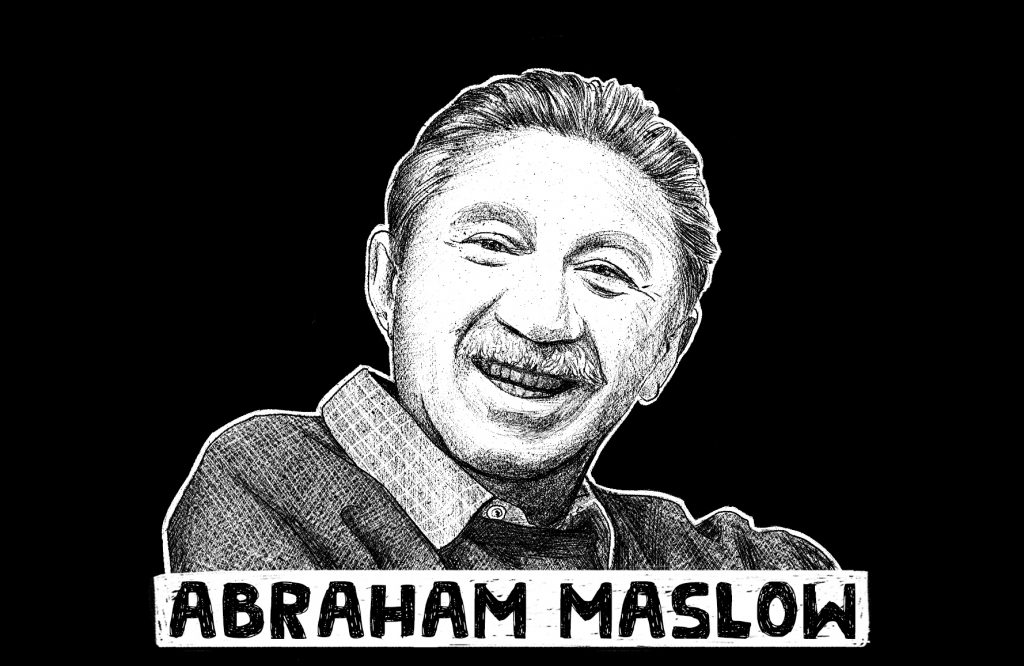
Abraham Maslow was an American psychologist who is widely considered to be one of the founding fathers of humanistic psychology. He is best known for his theory of motivation based on a hierarchy of needs. In addition, Maslow helped to lay the groundwork for positive psychology and transpersonal psychology.
Abraham Maslow’s Parents
On one occasion, young Maslow brought home two stray kittens and tried to hide them away in the basement. When his mother found out, Maslow watched in horror as she smashed the head of each kitten against the brick wall of the basement until it was dead. Little wonder then, that Maslow developed a deep-seated hatred for his mother. In later years, he described his family as “a miserable family” and his mother as “a horrible creature.” He never forgave her for the way she treated him as a child. He saw very little of her after leaving home and upon her death, refused to attend her funeral.
Maslow’s relationship with his father was somewhat better, but he also harbored feelings of hostility toward him. His father was distant and known as a heavy drinker, fighter, and womanizer. He frequently abandoned the family for long periods of time. Maslow had very few friends and spent much of his time visiting libraries and reading books. Reflecting on his childhood, Maslow once told an interviewer, “It’s a wonder I’m not psychotic.”
Abraham Maslow and Anti-Semitism
Maslow also had to deal with anti-Semitic sentiments from youth gangs in his community and from teachers at school. He was also bullied because of his religion. In order to defend himself, he once tried to join a Jewish gang but could not bring himself to carry out the acts that were required of gang members.
After completing high school, Maslow knew he wanted to pursue further studies but took a while to settle into a degree program. He enrolled for classes at the City College of New York in 1925 with the intention of studying law. He made this decision primarily to please his father, whose wish was for him to become a lawyer. However, Maslow quickly got bored and unhappy with this course of study. His lack of interest in becoming a lawyer was reflected in his poor grades, and he quit during his second semester.
Was Abraham Maslow a Behaviorist? How Behaviorism Influenced His Studies
Maslow found the atmosphere in the psychology department at Wisconsin stimulating and exciting. He flourished in that environment and completed his bachelor’s degree in two years. He earned his B.A. in 1930, his master’s degree in 1931, and his PhD in 1934, all from the University of Wisconsin.
Social Psychology Influences
Around the time he was getting ready to work on his doctoral dissertation, Maslow met Harry Harlow, who later became known for his studies of attachment in monkeys. Maslow began working as Harlow’s research assistant and developed an interest in primate behavior. He decided to study the relationship between social dominance and sexual behavior in monkeys as the subject of his dissertation.
Upon completion of his doctoral degree, Maslow taught at the University of Wisconsin for a short time before taking up a temporary position at Columbia University in 1935. There, he became a research assistant to learning theorist, Edward Thorndike. A year and a half later, Maslow was offered a permanent position at the newly formed Brooklyn College in 1937. He began as a tutor and eventually rose to the rank of associate professor. During that time, Maslow began to extend his earlier research on dominance in monkeys to the study of dominance in humans.
Who Did Abraham Maslow Study?
Throughout his fourteen years at Brooklyn College, Maslow had the opportunity to meet several prominent psychologists and anthropologists, including Karen Horney, Max Wertheimer, Alfred Adler, Erich Fromm, Margaret Mead, and Ruth Benedict. Their work had a major influence on him and helped to spur his transition from a stimulus-response view of behavior to a more holistic, humanistic approach.
In 1951, Maslow moved to Brandeis University where he served as chairman of the psychology department for many years. He remained at Brandeis until 1969 when failing health prompted his early retirement. He was subsequently appointed resident fellow of the W. P. Laughlin Foundation in Menlo Park, California.
Humanistic psychology quickly became a force in academia for its recognition of and appreciation for the human experience. Maslow believed that human beings were more than just the sum of their parts, and that a true understanding of what it means to be human involved more than simply studying each part of a person. However, Maslow also recognized that “the fundamental desires of human beings are similar.” From these beliefs, he developed a theory of motivation that included concepts such as a hierarchy of needs, self actualization, and peak experiences.
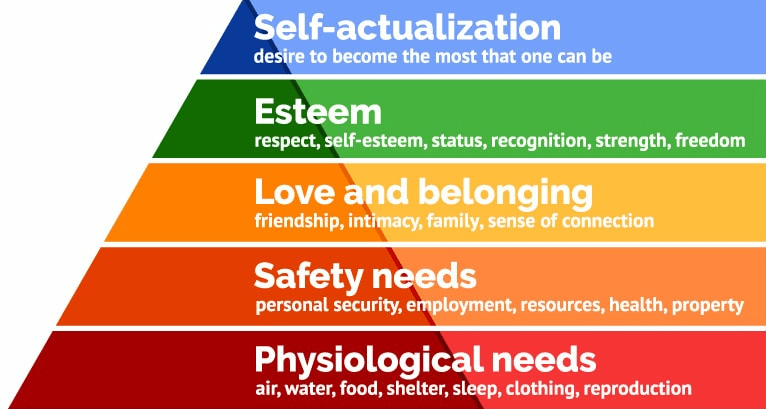
Maslow believed physiological needs such as eating and sleeping are most important because they contribute directly to a person’s survival. Unless these needs are taken care of first, they will continue to dominate the individual’s thoughts and behaviors. Once a person’s physiological needs are met, Maslow claimed it is easier to move up the pyramid and focus on higher level needs. All five tiers of needs are outlined below:
While Maslow’s hierarchy of needs is often seen as a fixed sequence of progression, Maslow recognized that human needs are flexible and several needs may be present in a person at the same time. In the latter part of his life, Maslow suggested that people do not reach self-actualization automatically even if they address all their other needs in the pyramid.
Maslow defined self-actualization as “the full use and exploitation of talents, capacities, potentialities, etc.” He believed that people are always trying to reach their full potential in terms of creativity, well-being, and fulfilment. However, Maslow did not view self-actualization as a fixed end point. Rather, he believed self-actualizing people continue to strive for new heights.
Rather than researching mental illness, Maslow focused on studying self-actualizing individuals with excellent mental health. He believed these individuals share a number of important traits such as independence, self-acceptance, spontaneity, wholeness, richness, and the ability to have peak experiences.
What are Peak Experiences?
Maslow believed self-actualizing individuals are more likely to have peak experiences as they indicated the highest level of personality development. His early research on self-actualizing people suggested that common triggers for a peak experience included music, work, advanced knowledge of science, nature, sex, art, and the ability to examine one’s own emotional and cognitive processes. Maslow suggested that self-actualizing people may have several peak experiences in a single day. His later research described “plateau experiences” as more serene, calm, and voluntary events that generally lasted longer than peak experiences.
Transpersonal Psychology
Maslow was familiar with the euphoric, mystical, or spiritual state associated with peak experiences. He believed these types of experiences transcended the ordinary or the average and referred to the empirical study of these experiences as transpersonal psychology. Maslow claimed that human beings need to feel connected to something that is bigger than themselves. He founded the school of transpersonal psychology in the 1960s along with Victor Frankl, Stanislav Grof, and other colleagues.
Positive Psychology
In addition to mental health counseling, principles from Maslow’s hierarchy of needs have been applied to:
Criticisms of Maslow’s Theories
The major criticism of Maslow’s theories is the lack of supporting empirical evidence. For example, Maslow based the majority of his research on the writings of people he thought had reached self-actualization. Maslow’s list of subjects included psychologist Max Wertheimer, anthropologist Ruth Benedict, and physicist Albert Einstein. However, this approach is highly subjective and extremely vulnerable to the personal bias of the researcher.
A second criticism is that therapy grounded in humanistic principles may not be effective when treating serious mental health issues. This means people with chronic conditions such as schizophrenia, bipolar issues, or posttraumatic stress disorder may have to seek other therapeutic approaches to manage their symptoms. As humanistic psychology focuses on events that go right, some critics question how suitable it is for solving real world problems.
A third criticism of Maslow’s theories is that they are not universally applicable because they mainly reflect Western values. Interestingly though, a five year study on Maslow’s concepts that was published in 2011 found that people in 123 countries have the same basic needs despite their cultural differences. Other critics have claimed that Maslow’s hierarchy does not necessarily follow a strict order. However, Maslow himself agreed with that viewpoint and stated that people’s needs were fluid on several occasions.
Maslow wrote several books throughout his career and some of his writings were published posthumously. His most well-known books are listed below:
A few of Maslow’s other awards and accomplishments include:
Against his parents’ wishes and the advice of his friends and professors, Maslow married his first cousin Bertha Goodman on December 31, 1928, at the age of 20. In his later years, Maslow described his marriage to Bertha as one of the best decisions and one of the greatest joys in his life. The two loved each other dearly and eventually had two daughters, Ann, who was born in 1938, and Ellen, born in 1940.
Despite his successes as an adult, Maslow suffered from anxiety and intense stage fright. After a public presentation, he sometimes had to go on bed rest for several days. His fear of public speaking caused him to resign as president of the APA after only one year.
Maslow had a history of chronic heart disease and experienced a major heart attack in 1967. Three years later, on June 8, 1970, he suffered another massive heart attack which proved to be fatal. He was 62 years of age at the time of his death.
Allen, B. P. (2016).Personality theories: Development, growth, and diversity(5th ed.). New York: Routledge.
American Psychological Association. (2002). Eminent psychologists of the 20th century.Monitor on Psychology, 33(7). Retrieved fromhttps://www.apa.org/monitor/julaug02/eminent
Encyclopedia Britannica. (2020). Abraham Maslow. InEncyclopedia Britannica. Retrieved fromhttps://www.britannica.com/biography/Abraham-H-Maslow
Krapp, K. (Ed.). (2015).A study guide for psychologists and their theories for students: Abraham Maslow.Farmington Hills, MI: Gale.
Lawson, R. B., Graham, J. E., & Baker, K. M. (2016).A history of psychology: Globalization, ideas, and applications. New York: Routledge.
Martin, B. S. (n.d.). Managing police personnel using Scott’s pillars of organizations.Police Chief Magazine. Retrieved fromhttps://www.policechiefmagazine.org/managing-police-personnel-using-scotts-pillars/
Reevy, G. M., Ozer, Y. M., & Ito, Y. (2010).Encyclopedia of emotion, Volume 1. Santa Barbara, CA: Greenwood.
Schultz, D. P., & Schultz, S. E. (2016).A history of modern psychology(11th ed.). Boston, MA: Cengage Learning.
Selva, J. (2019).Abraham Maslow, his theory and contribution to psychology.Retrieved fromhttps://positivepsychology.com/abraham-maslow/
Zalenski, R. J., & Raspa, R. (2006). Maslow’s hierarchy of needs: A framework for achieving human potential in hospice.Journal of Palliative Medicine, 9(5), 1120-1127.
Related posts:Humanistic Perspective of PersonalityThe Psychology of Long Distance RelationshipsBeck’s Depression Inventory (BDI Test)40+ Famous Psychologists (Images + Biographies)Maslow’s Hierarchy of Needs
Related posts:
Reference this article:Practical Psychology. (2020, May).Abraham Maslow (Biography + Accomplishments).Retrieved from https://practicalpie.com/abraham-maslow/.Practical Psychology. (2020, May). Abraham Maslow (Biography + Accomplishments). Retrieved from https://practicalpie.com/abraham-maslow/.Copy
Reference this article:
Practical Psychology. (2020, May).Abraham Maslow (Biography + Accomplishments).Retrieved from https://practicalpie.com/abraham-maslow/.Practical Psychology. (2020, May). Abraham Maslow (Biography + Accomplishments). Retrieved from https://practicalpie.com/abraham-maslow/.Copy
Copy
