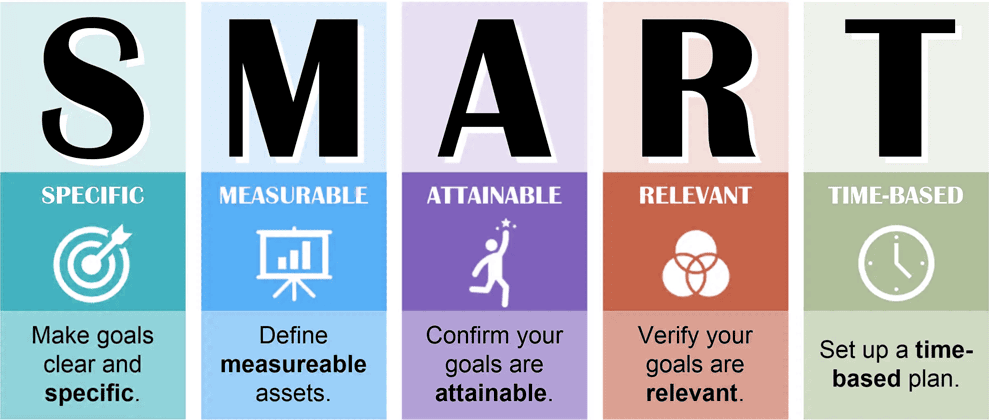
SMART Goals are a powerful tool in the world of goal setting, providing a clear and effective framework to help individuals and organizations achieve their objectives.The acronym SMART stands for Specific, Measurable, Achievable, Relevant, and Time-bound. This strategic approach utilizes your own psychology to ensure your goals are crystal clear and can be realistically attained within a specified timeframe.
 smart goals explained
The act of setting goals is a fundamental component of personal development and success. It gives individuals a sense of direction, serving as a roadmap guiding their actions and decisions. Without well-defined goals, it’s easy to drift aimlessly, lacking purpose and motivation. Goal-setting also provides a mechanism for self-reflection, enabling us to recognize our strengths and weaknesses, and ultimately promoting self-improvement.
Whether you’re aiming to develop a new skill, save for a big purchase, or enhance your professional career, goal setting is the first step towards reaching these ambitions. However, merely outlining a goal often isn’t enough. This is where SMART goals come in.
SMART Acronym ExplainedWhy Use SMART Goals?The Psychology Behind Smart GoalsOther Goal-Setting TechniquesDetailed SMART Goals Breakdown
SMART Acronym Explained
Why Use SMART Goals?
The Psychology Behind Smart Goals
Other Goal-Setting Techniques
Detailed SMART Goals Breakdown
Specific
The first principle of SMART goal setting is specificity. A specific goal precisely defines what you want to achieve, leaving no room for ambiguity. Rather than setting a goal to “get fit,” a specific goal would be “to run a 5K race.” By being specific, you clarify where to focus your efforts and establish a clear direction to follow.
This makes it easier to stay motivated and committed throughout your journey towards goal achievement. It also makes it easier to make decisions that revolves around your goal.
Measurable
Measurable goals have tangible evidence that you’ve accomplished the goal. This usually means a number is involved in the goal setting process. Numbers allow you to track progress and determine when the goal has been met. For example, if your goal is to save money, a measurable goal might be “to save $5000 in a year.”
By setting a precise figure, you can gauge your progress and make necessary adjustments to your saving strategy. Measurable goals provide motivation and foster a sense of achievement when they are reached.
“What gets measured, gets managed.” - Peter Drucker
Achievable
While it’s important to set goals that challenge you, they should also be achievable. Goals that are too lofty can lead to disappointment and a feeling of failure.
A SMART goal considers your available resources, skills, and abilities. It should inspire you to stretch your abilities, but not so far that it’s out of reach. An achievable goal for someone who has never run before might be “to run a mile without stopping within two months,” rather than “to run a marathon in one month.”
Relevant
Relevant goals align with your broader objectives and values. They’re meaningful to you and play a part in your overarching plan for life or business. For instance, if you value physical health and well-being, a relevant goal might be “to incorporate a half-hour exercise routine into your daily schedule.” Relevance in goal setting ensures that you’re moving in the direction that is most important to you.
Time-bound
Lastly, SMART goals are time-bound, meaning they have a clear start and end date. This creates a sense of urgency and prompts action.
By setting a deadline on your goal, you can also clearly know if you accomplish your goal or not.

SMART goals offer a practical system for setting and achieving goals that go beyond the generic ambitions many of us are familiar with. By requiring specificity, measurability, attainability, relevance, and a time frame, SMART goals compel us to think through our desires carefully, plan strategically, and align our efforts efficiently. These criteria help to eliminate vagueness and indecision, paving the way for meaningful action towards goal fulfillment.
From personal fitness to financial planning, academic achievements to career progression, SMART goals can be employed in virtually any area of life. They provide a proven framework for success, encouraging individuals to take ownership of their goals, monitor their progress, and celebrate their accomplishments.
Through the remainder of this article, we will dive deeper into the SMART goal-setting process, discuss its benefits, and provide numerous examples across diverse scenarios.
SMART goals leverage the psychological principles of self-efficacy and self-regulation, boosting motivation and achievement.
Relevance ensures the goal is personally meaningful, which increases intrinsic motivation, and being time-bound creates a sense of urgency, promoting immediate action.
The SMART methodology brings several key advantages over traditional goal setting. First, it removes ambiguity, ensuring you know precisely what you’re working towards.
Second, the structure of SMART goals facilitates regular tracking and adjustment, promoting agility in the face of change.
Lastly, SMART goals tend to create a deeper sense of commitment and ownership, leading to higher levels of engagement and effort.

While there are other goal-setting techniques such as CLEAR (Collaborative, Limited, Emotional, Appreciable, Refinable) or HARD (Heartfelt, Animated, Required, Difficult), SMART goals offer a unique blend of criteria that ensure goals are precise and actionable.
CLEAR Goals:
HARD Goals:
Other techniques might focus more on emotional connection, collaboration, or continual refinement. However, these methodologies often overlap in many aspects with SMART goals, emphasizing specificity, measurability, and having time constraints.
SMART Goals for Weight Loss:

SMART Goals for Students:

SMART Goals for Saving Money:

Now that we’ve diagnosed what it takes to come up with a SMART goal, let’s get onto a larger list of one-liners that satisfy all the requirements!
70+ SMART Goal Examples

Related posts:10 Habits of Happy PeopleTranstheoretical Model and Stages of Change (Examples)7 Psychological Money-Saving Tricks - How to Save More Money Each Month!250+ Flirty Bet Ideas (For Couples + Consequences)Emotional Intelligence
Related posts:
Reference this article:Practical Psychology. (2023, June).70+ SMART Goal Examples (For Students, Losing Weight, Saving Money…).Retrieved from https://practicalpie.com/smart-goal-examples/.Practical Psychology. (2023, June). 70+ SMART Goal Examples (For Students, Losing Weight, Saving Money…). Retrieved from https://practicalpie.com/smart-goal-examples/.Copy
Reference this article:
Practical Psychology. (2023, June).70+ SMART Goal Examples (For Students, Losing Weight, Saving Money…).Retrieved from https://practicalpie.com/smart-goal-examples/.Practical Psychology. (2023, June). 70+ SMART Goal Examples (For Students, Losing Weight, Saving Money…). Retrieved from https://practicalpie.com/smart-goal-examples/.Copy
Copy
