From not remembering where we left our keys to forgetting the name of a person we’ve just met, memory failures are a daily occurrence. But why do they happen? Not everyone has the same answer. Psychologists and neuroscientists have developed five theories of forgetting that attempt to explain why our memories get foggy or slip away from us entirely.
What Are the Five Theories of Forgetting?Theory #1: Displacement Theory of ForgettingTheory #2: Trace Decay Theory of ForgettingTheory #3: Interference Theory of ForgettingProactive interference (Example)Retroactive interference (Example)Theory #4: Retrieval Failure Theory of ForgettingRetrieval cuesTheory #5: Consolidation Theory of ForgettingOther Theories of Forgetting
What Are the Five Theories of Forgetting?
Theory #1: Displacement Theory of Forgetting
Theory #2: Trace Decay Theory of Forgetting
Theory #3: Interference Theory of Forgetting
Proactive interference (Example)
Retroactive interference (Example)
Theory #4: Retrieval Failure Theory of Forgetting
Retrieval cues
Theory #5: Consolidation Theory of Forgetting
Other Theories of Forgetting
Throughout the years, psychologists have created five theories of forgetting in an attempt to explain how and why memories slip from our minds. Not all of these theories are still accepted. Some were even created in response to theories that came before them! Some can easily be true alongside other theories of forgetting. All these theories will make you think about the mysterious nature of forgetting information.
The five theories of forgetting include:
The displacement theory describes how forgetting works in short-term memory. Short-term memory has a limited capacity and can only hold a small amount of information—up to about seven items—at one time. Once the memory is full, new information will replace the old one.
There seems to be no one figurehead of this theory, but many psychologists have contributed to experiments and studies that support it. Free recall method studies often support the idea of the displacement theory of forgetting. This theory is pretty solid and has stood the test of time.
Displacement theory plays neatly into theMulti-Store Model of Memory. This model shows that while some information reaches long-term memory, other pieces of information in short-term memory storage are simply forgotten. What pieces of information are displaced? Keep on reading.
Serial Position Effect
In studies based on the free-recall method, participants are asked to listen to a list of words and then try to remember them. The free recall method, unlike the serial recall method, allows participants to remember words in no particular order. Through these studies, psychologists have discovered that the first and the last items on a list are the easiest ones to remember. They named this phenomenon the Serial Position Effect. Two other effects, the primacy and recency effects, explain why the first and last items are so crucial in memory.
The primacy effect suggests that recalling the first item on the list is simple. At the time they are presented, these initial words don’t yet compete with the subsequent ones for a place in the short-term memory.
Examples of the Displacement Theory of Forgetting
Suppose you have just learned a seven-digit phone number when you are given another number to memorize. Your short-term memory doesn’t have the capacity to store both information. In order to recall the new phone number, you’ll have to forget the first one. This isn’t always a conscious process, but it can be. The moment you begin to focus on the new set of numbers, the first one seems to “go away” or get confused with the new numbers you are learning.
Another example of the displacement theory of forgetting involves grocery lists. As you walk out the door to the grocery store, your partner tells you that you need to buy “milk, eggs, cheese, flour, and sugar.” You try to memorize the whole list, but a lot of it goes away while you are driving to the store. When you arrive, all you can remember is “milk” and “sugar.”
 ebbinghaus forgetting curve
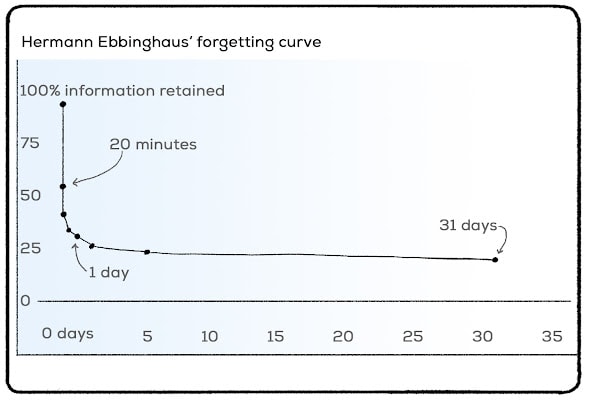
When we learn something new, the brain undergoes neurochemical changes called memory traces. Memory retrieval requires us to revisit those traces that the brain formed when encoding the memory. The trace decay theory implies that the length of time between the memory and recalling determines whether we will retain or forget a piece of information. The shorter the time interval, the more we will remember, and vice versa.
In 1965,Waugh and Normanput both displacement theory and trace decay theories to the test. They put participants through a “serial probe task.” Each participant listened to a long list of letters. Later, the researchers would yell out one of the letters from the list, and the participants would have to name the letter listedafter. What they found showed that displacement theory could explain some instances of forgetting, but not all of them.
The interesting part of the results was that when the list was read at a faster pace, participants completed the task more successfully.
Criticisms and Need for Other Theories of Forgetting
The trace decay theory, however, doesn’t explain why many people can clearly remember past events, even if they haven’t given them much thought before. Neither does it take into account the role of all the events that have taken place between the learning and the recall of the memory. Just like the serial probe task suggests that displacement theory is not “enough,” decay theory fails to cover all instances of forgetting and remembering.
The interference theory concentrates precisely on the aspects of forgetting that decay theory fails to address.
Proactive interferencestake place when old memories prevent making new ones. This often occurs when memories are created in a similar context or include near-identical items. Remembering a new code for the combination lock might be more difficult than we expect. Our memories of the old code interfere with the new details and make them harder to retain.

There are two main reasons for failure in memory retrieval. Encoding failure prevents us from remembering information because it never made it into long-term memory in the first place. Or the information may be stored in long-term memory, but we can’t access it because we lack retrieval cues.
A retrieval cue is a trigger that helps us remember something.
When we create a new memory, we also retain elements of the situation in which the event occurred. These elements will later serve as retrieval cues. Information is more likely to be retrieved from long-term memory with the help of relevant retrieval cues. Conversely, retrieval failure or cue-dependent forgetting may occur when we can’t access memory cues.
Semantic cues
Semantic cues are associations with other memories. For example, we might have forgotten everything about a trip we took years ago until we remember visiting a friend in that place. This cue will allow recollecting further details about the trip.
State-dependent cues
State-dependent cues are related to our psychological state at the time of the experience, like being very anxious or extremely happy. Finding ourselves in a similar state of mind may help us retrieve some old memories.
Context-dependent cues
Context-dependent cues are environmental factors such as sounds, sight, and smell. For instance, witnesses are often taken back to the crime scene that contains environmental cues from when the memory was formed. These cues can help recollect the details of the crime.
While the above theories of forgetting concentrate principally on psychological evidence, the consolidation theory is based on the physiological aspects of forgetting. Memory consolidation is the critical process of stabilizing a memory and making it less susceptible to disruptions. Once it is consolidated, memory is moved from short term to a more permanent long-term storage, becoming much more resistant to forgetting.
These five theories are most frequently mentioned when discussing forgetting, memory, and recall. Psychologists have devised other theories that may be worth looking into. No one theory of forgetting covers all incidences of memory loss and recall, so these theories are valid, too!
Motivated Theory of Forgetting
Friedrich Nietzsche was one of the first psychologists to suggest that people intentionally forgot their memories. Typically, these memories are traumatic or shameful. This theory really took off when Freud expanded upon this theory. Freud spoke more about the idea that peopleunintentionallyforgot their memories. This process is calledrepressionand is considered a defense mechanism. Freud, however, believed he could recover repressed memories. Today, psychologists mostly discredit this idea, as the mind can “change” memories with leading questions and other methods. Still, this motivated theory of forgetting is an important idea in the history of psychology.
Gestalt Theory of Forgetting
The Gestalt Theory of Forgetting attempts to explain how memories can be forgotten through a process called distortion. This does not have to be an intentional process, either. If memory is hazy or missing pieces of information, the brain will fill in those pieces. The memory may feel accurate but is actually distorted.
Which of these theories of forgetting is correct? Maybe all of them, in their own ways!
Related posts:Ebbinghaus Forgetting Curve (Definition + Examples)Motivated Forgetting (Examples!)Memory (Types + Models + Overview)Long Term MemoryDaniel Kahneman Biography - Contributions To Psychology
Related posts:
Reference this article:Practical Psychology. (2020, April).5 Theories of Forgetting (Memory).Retrieved from https://practicalpie.com/theories-of-forgetting/.Practical Psychology. (2020, April). 5 Theories of Forgetting (Memory). Retrieved from https://practicalpie.com/theories-of-forgetting/.Copy
Reference this article:
Practical Psychology. (2020, April).5 Theories of Forgetting (Memory).Retrieved from https://practicalpie.com/theories-of-forgetting/.Practical Psychology. (2020, April). 5 Theories of Forgetting (Memory). Retrieved from https://practicalpie.com/theories-of-forgetting/.Copy
Copy
